Disclosure: Some links in this post are affiliate links. As an Amazon Associate I earn from qualifying purchases, at no extra cost to you. Learn more
Specs are compiled from manufacturer listings and verified buyer reviews and can change over time — please confirm the key details on the product page before buying.
You want a glue that keeps holding after the fabric bends, the boot flexes, or the headliner heats up. A flexible glue cures to a rubbery film that bends with the fabric or leather instead of hardening into a brittle sheet that cracks on the first flex. Below you get five picks sorted by what they actually bond, from a washable fabric glue for patches and denim to a niche silicone adhesive that repairs torn cosplay rubber.
This guide is built by comparing the manufacturers’ published specifications and the patterns across verified customer reviews, so you get each pick’s real strengths and trade-offs instead of marketing spin.
You will see which glues dry clear, which need clamping, and which simply refuse to grip certain plastics. The goal is to match the tube to your material, so these picks for the flexible glue category stop you buying a second bottle you do not need.
Top Picks


How To Choose The Best Flexible Glue
No single tube bonds cloth, hide, and silicone rubber equally well, so buying one all-purpose bottle usually means buying a second one later. Flexible glues are built around a specific material family. Fabric glue grabs cloth fibers. Leather cement bites into hide and foam. Silicone adhesive is the only thing that truly welds to silicone rubber. Start with the material list on the bottle — fabric glue for cloth, leather cement for hide and foam, silicone adhesive for silicone rubber — and the rest of the choice falls into place.
Match the glue to the material, not the other way around
A fabric glue will not hold a rubber boot sole, and a contact cement will stiffen a cotton hem into a crust. Look at the compatible-material list on the bottle before you buy. If your repair involves silicone rubber, only a dedicated silicone adhesive will bond to it — ordinary craft glue slides right off.
Separate set time from full cure time
Set time is how long you must hold or clamp the pieces together before they stop moving. Full cure time is when the bond reaches its final strength — and that number can run to 24 hours or even 48. Opening the clamp early to peek at progress is the most common way a good repair fails. Leave it alone for the whole window.
Think about the conditions the bond will live in
A denim patch goes through a washing machine. A headliner sits against a hot car roof. A costume piece gets stretched over a body. Waterproof, UV-resistant, and heat-resistant ratings tell you whether the glue keeps its grip in those conditions. If the label says nothing about water, assume a damp environment will weaken it.
Check the finish before it dries
Clear-drying formulas keep a repair invisible on light fabric and pale leather. Some silicone adhesives leave a slight shine once cured, which matters on a visible surface but is fine on a hidden seam. On a visible hem or pale leather, choose a clear-drying formula; on a hidden seam, a slight shine from a silicone adhesive is fine.
Side-by-Side Comparison
| Model | Best For | Best Material | Full Cure Time | Pack Count | Amazon |
|---|---|---|---|---|---|
| 3Pcs Fabric Glue Permanent, 60 ML★ Best Overall | Patches, denim, and clothing DIY | Fabric | 48 hours | 3 | Amazon |
| Aleene’s Super Fabric Glue 3-PackBest for Crafters | Crafters who need a flexible, washable bond | Fabric | — | 3 | Amazon |
| Duall-88 Leather Glue 4 oz | Leather, upholstery, and shoe repair | Leather | 24 hours | 1 | Amazon |
| S-18 All-Purpose Adhesive 4 oz | Headliners, upholstery, and mixed materials | Rubber, metal, glass | 24 hours | 1 | Amazon |
| Smooth-On SIL-Poxy | Silicone rubber repair and cosplay builds | Silicone, plastic, ceramic | 24 hours | 1 | Amazon |
Detailed Reviews
1. 3Pcs Fabric Glue 60 ML
Our pick — 4.5+★ from 1,000+ verified ratings; the strongest balance of quality and price.
Three bottles, spreaders and clips — a whole stitching-free repair kit that survives the wash.
If you have a torn seam, a loose patch, or a pile of rhinestones to stick down, this kit covers the full job. You get a 60 ML bottle with a three-count pack, plus the two tools most glue bottles skip: spreaders to even out the line and clips to hold the seam shut while it dries. The formula is a permanent fabric glue meant to replace the sewing machine on mending jobs.
The headline number is the 48-hour full cure time. That is the window when the glue reaches its final strength, and it is twice the 24 hours of the Duall-88 leather cement. Practically, it means you clip the seam and walk away for two days. Do not peel a clip back to check — that early peek is where a good repair goes wrong. Once cured, the glue holds through machine washing, which is the whole point of a washable fabric bond.
What wins people over is the hold. It is by far the most-praised trait on this bottle, and the proof shows up in odd places — one buyer used it to seal a long tear in a light Berber carpet and reported that “it’s holding up well when the carpet is vacuumed and steam cleaned.” Denim patches, flag afghans, and gems on jackets all come up in the same breath. The trade-off is honesty on two fronts: the glue is thick and can be stiff to squeeze out, and the wet glue carries a strong smell that fades once dry. A patch on a curved trouser seam also needs real pressure at the edges, not just the middle.
What earns its keep
- Three 60 ML bottles with spreaders and clips included — no separate clamping tools to buy
- Washable, permanent bond that holds through machine cycles
- Dries clear with a subtle fragrance, so light fabric repairs stay invisible
- Needle-tip nozzle with an anti-clog cap that keeps the bottle usable between jobs
Where it asks patience
- 48-hour full cure — the longest wait on this list
- Thick formula takes a firm squeeze, especially from a fresh bottle
- Strong odor while wet; ventilate the room you work in
- Edges of a patch on a curved seam can lift if you skip the clips
Reach for this if: you mend clothes, stick patches, or bedazzle denim and want the tools in the box.
Think twice if: your repair needs a fast turnaround — the two-day cure does not rush.
2. Aleene’s Super Fabric Glue 1.5 fl oz 3-Pack
The tube that dries like soft rubber instead of a hard crust, so trimmed fabric still moves.
Anyone who sews, crochets, or builds costumes knows the real test of fabric glue: does the seam bend with the cloth, or does it crack? Aleene’s Platinum Bond cures to a flexible rubbery film rather than a stiff plate. That single behavior is the reason it earns a spot here over the three-pack fabric glue above, which is thicker and slower to set. Each tube is 1.5 fl oz, and this listing is a three-count pack, against the single 4 oz can you get from the leather cements later on this list.
It also carries two labels that matter for anything living outdoors: UV proof and waterproof. A denim hat, a canvas tote, a garden flag — these are the jobs where sun and rain peel weaker adhesives apart. One buyer put it through Florida-style punishment on a denim hat and found it “held up very well especially in the heat and humidity.” The finish is clear and non-foaming, so it will not bubble up through a light fabric. Embellishments on jeans have survived several washes in the same reports.
Here is the catch, and it is a careful-hands one. This glue sets fast, so a stray smear on visible fabric is difficult to clean once it grabs. The tube tip is not the most precise, and too much can come out in one squeeze — squeeze onto a scrap or a spreader first, not straight onto the garment. Do your test piece before the real project and you dodge the whole problem.
Why crafters keep rebuying: a flexible, clear, UV-proof bond that moves with the fabric and survives hand washing — the three things a soft-goods project needs.
The catch to plan around: fast grab plus an imprecise tip means overshoot is easy, so slow, small doses beat one confident squeeze.
Buy it for: crochet work, denim embellishment, canvas and trim, where a bendy clear seam matters more than raw speed.
Skip it for: anyone who wants a needle-fine applicator — the flow control is the weak point.
3. Duall-88 Leather Glue 4 oz
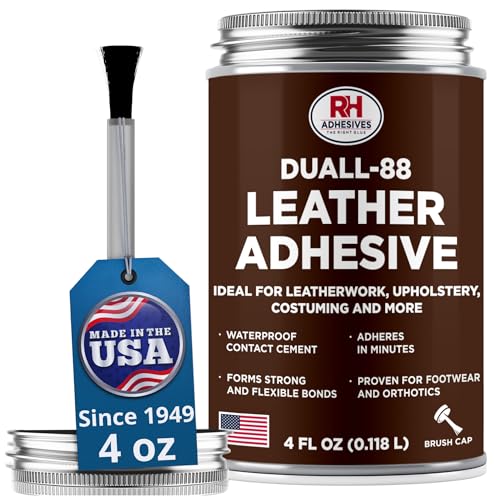
A leather cement that grabs in ten to thirty minutes and still flexes when the hide bends.
Shoes, bags, couches, and jackets all share one problem — the repair has to bend with the leather or it peels off. Duall-88 is built for exactly that. It is a neoprene-based contact cement in a 4 oz can that sets within ten to thirty minutes and reaches full cure in 24 hours. The 5.6-ounce can is lighter than the 8-ounce Aleene’s multipack, so it slots into a toolbox without weighing it down.
The material list is wider than the name suggests. Beyond leather, this formula is listed for crepe rubber, EVA foam (the dense foam used in shoe soles and craft mats), fiberglass, glass, metals, neoprene, particle board, some plastics, tile, and wood. It dries amber-clear, so a repair on a brown shoe or a tan bag stays low-profile. The maker has been producing adhesives in the United States since 1949, which is why it turns up in upholstery shops as much as home repair kits.
The honest part: bonding strength is the mixed signal on this can. Some users get a permanent, leather-to-leather weld; others find pieces that pull apart once joined. The application method is usually the difference — spread a thin coat on both surfaces, let it go tacky for a couple of minutes, then press hard. Skip the two-sided coat and the bond is weaker than it should be. Expect strong fumes too, so work near an open window. A book-cover repair that came back “better than when it was new” shows how well it works when applied right.
Pick this when: the project is leather, foam, or upholstery and you can follow the two-sided contact-cement method.
Look elsewhere if: you want a forgiving squeeze-and-forget glue — this one rewards technique.
4. S-18 All-Purpose Adhesive 4 oz
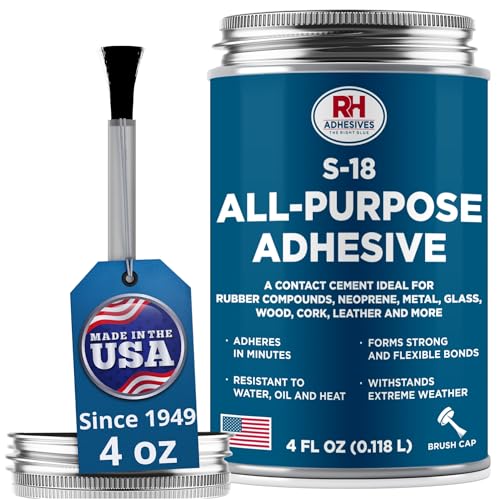
The mixed-materials workhorse that holds rubber to metal and a sagging car roof to its foam.
Some repairs do not fit neatly into one material box — a headliner sagging off its foam backing, vinyl peeling off a metal panel, a boot sole splitting from the upper. S-18 is a neoprene contact cement listed for both porous and non-porous surfaces, which is what lets it span ceramics, cork, fabric, felt, glass, metals, rubber compounds, and tile. It also carries a water-resistant solvent rating, so damp and difficult temperatures do not end the bond.
The specs that matter: it reaches full cure in 24 hours and the can weighs 5.6 ounces. Its films are built for peel strength and oil resistance, which is why it earns a slot on the upholstery shelf. A thin layer on both the foam and the fabric, a few minutes of tack time, then firm hand pressure — that is the whole method. Vehicles that bake in summer heat are a fair test, and one driver fixed a sagging Honda headliner with a thin coat that held on a hot-weather drive. Another used it to reattach a blown-out boot sole, and a third fixed a drooping vinyl sample board minutes before a client meeting.
The repeated gripe is surface-specific, not universal. Adhesion is the mixed note here — it grips vinyl and metal fast, yet some users report it will not stick to certain rubber surfaces. Read your material against the compatible list before committing, and test a small hidden spot if you are unsure. The smell is strong enough to require a window and a fan while you work. Those two caveats aside, this is the pick when your repair crosses material lines and you cannot buy a different bottle for every surface.
The standout spec: a water-resistant neoprene contact cement rated for both porous and non-porous materials — a rare combination in one 4 oz can.
Who should look elsewhere: if your target is an unlisted rubber, test first; this formula is not universal on every rubber compound.
Best fit for: headliners, upholstery, boot soles, and any repair where two different materials meet.
Hold off if: you cannot ventilate the workspace — the solvent fumes are real.
5. Smooth-On SIL-Poxy Rubber Silicone Adhesive, 3 oz Tube
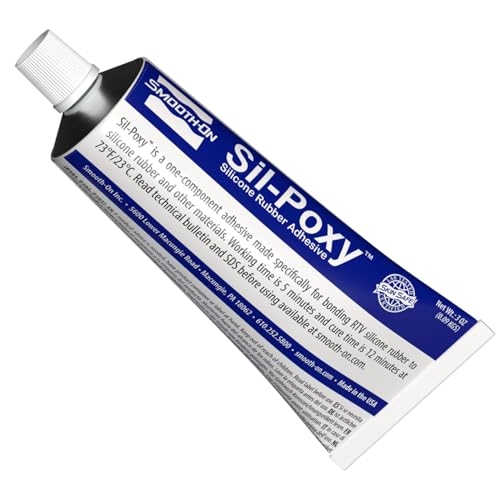
The one bottle that actually welds torn silicone back together instead of sliding off it.
Silicone is the surface that breaks ordinary glue. It has a slick, low-energy skin that almost nothing will grip. SIL-Poxy is formulated to bond silicone to silicone, plus plastics, ceramics, plaster, and fabric, which is why it exists at all. It comes as a 3 oz gel tube weighing 3.52 ounces and reaches full cure in 24 hours. For a torn silicone mask, a split bodysuit seam, or a mold that needs sealing, nothing else on this list is the right tool.
The cured bond is the selling point: high-elongation, meaning it can stretch a long way before it fails. It stays flexible without cracking, so a stress-prone part keeps working. It also handles weather, moisture, and UV exposure after curing, which covers outdoor props and hot workshop conditions. Cosplay builders are the core audience — a repaired silicone breast plate came back feeling “like a silicone weld,” and a zipper attached to a full silicone bodysuit held fast. It suits both tin-cure and platinum-cure RTV moldmaking silicones, so it will not conflict with the mold material you already own.
Two honest notes before you buy. The smell is potent — it can fill a room for a day — so ventilate hard. And the cured surface takes on a slight shine, which is fine on a hidden seam but visible on a face piece. This is also the priciest tube here, and it is a specialist: spend it only if silicone is your material. For cotton, denim, or leather, the fabric and leather picks above do the job for far less.
Choose it for: silicone rubber repair, mold sealing, and FX or animatronics work where no other adhesive will bond.
Not the one if: your project is fabric or leather — this tube is wasted there.
Know the Specs
Full Cure Time (and Why It Is Not Set Time)
Full cure time is when the glue reaches maximum strength — often 24 hours, and up to 48 on some fabric formulas. Set time is much shorter; a contact cement can grab in ten to thirty minutes while still needing the full window to finish. Keep the clamps on for the full cure time — 24 hours on most contact cements, up to 48 on some fabric glues — not just the shorter set time.
Flexibility and Elongation
A flexible glue cures to a rubbery film rather than a hard crust. High-elongation adhesives can stretch noticeably before failing, which is what you want on shoe soles, bodysuit seams, and anything that moves. A rigid glue such as superglue has no give, so it cracks where a rubbery adhesive would stretch with the sole or seam.
Water, UV, and Heat Resistance
These ratings tell you whether a bonded repair survives washing, rain, sunlight, or a hot car roof. A waterproof, UV-resistant formula holds where a plain craft glue weakens. A glue with no water-resistance rating will weaken in the wash or in rain, so keep that repair dry.
Compatible Materials and Finish
The material list is the first thing to check — fabric glue for cloth, leather cement for hide and foam, silicone adhesive for silicone rubber. The finish matters too: clear-drying keeps repairs invisible on light fabric, while some silicone adhesives leave a slight shine.
Common Questions
Will a flexible glue hold a patch on jeans through the washing machine?
Can I glue leather without a sewing machine or stitching?
Why won’t ordinary glue stick to silicone rubber?
How long should I clamp a fabric repair before checking it?
Is a contact cement different from a fabric glue?
Can these glues be used outdoors?
How do I fix a sagging car headliner without a shop?
Do these flexible glues dry clear?
How strong is a flexible bond compared with rigid superglue?
The Bottom Line
For most people mending clothes and sticking patches, the flexible glue winner is the 3Pcs Fabric Glue kit, because it ships with the spreaders and clips that make a clean seam and survives the wash. If you want a flexible, clear, UV-proof bond for crochet and denim, grab Aleene’s Platinum Bond 3-Pack. And when the repair is leather, foam, or a sagging headliner, the S-18 All-Purpose Adhesive is the one to reach for. For silicone rubber, only SIL-Poxy will do the job — buy it once for that purpose and it earns its place.
How we choose
We do not accept paid placement. Every pick is matched to a real buyer and a real use-case; we do not hands-on test units.
Sources
Specifications: manufacturer listings and product documentation. Review insights: verified customer reviews, as of October 2026. Pricing: not shown on this page (it changes often); check the current price via the retailer link.
As an Amazon Associate, Aappliancez earns from qualifying purchases. This does not affect which products we feature.