Disclosure: Some links in this post are affiliate links. As an Amazon Associate I earn from qualifying purchases, at no extra cost to you. Learn more
Specs are compiled from manufacturer listings and verified buyer reviews and can change over time — please confirm the key details on the product page before buying.
A road rash burn hurts most in the two places you never expect: under the shower, and under the bandage you peel off the next morning. The right pick keeps the raw surface moist, keeps grit out, and lifts away without tearing the new skin forming underneath. Every pick below does that job a different way.
This guide is built by comparing the manufacturers’ published specifications and the patterns across verified customer reviews, so you get each pick’s real strengths and trade-offs instead of marketing spin.
You will see a protectant you can smear over a whole forearm, a medicated salve for angry itchy edges, and a non-stick gauze layer that sits between the wound and the pad. The short answer: match the product to your scrape’s stage — barrier for a fresh raw abrasion, medicated salve for itchy edges, non-stick layer under the pad. Here is how to pick the right cure for road rash.
Top Picks

How To Choose The Best Cure for Road Rash
A gravel scrape is a wet wound with grit in it, and it heals best when it stays moist and covered. The product you reach for depends on whether you are coating the whole abrasion, treating the itchy red border, or laying a barrier between the raw skin and the pad.
Barrier first, medicine second
A petrolatum-based ointment (a thick petroleum jelly base) seals the surface so it does not dry into a tight, cracking scab. That is the single most useful thing you can do in the first days. Look at the petrolatum percentage if the label lists one — a higher share means a heavier, longer-staying seal.
Why the dressing matters as much as the cream
If you cover the scrape with ordinary gauze, fibers knit into the forming skin and the removal hurts more than the fall. A non-adherent dressing (one treated so it does not stick to the wound bed) lifts away cleanly. That is the difference between a two-second change and a wince.
Medicated versus plain
Plain protectants just seal and moisturize. A medicated salve adds an active ingredient, such as 2% resorcinol, aimed at itch and irritation. If your road rash is angry and itchy around the edges, a medicated option earns its place; for a clean raw scrape, a plain barrier is often enough.
Side-by-Side Comparison
| Model | Best For | Type | Size | Key Ingredient | Amazon |
|---|---|---|---|---|---|
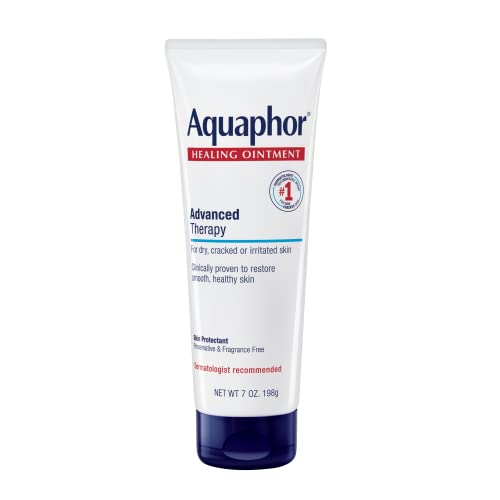
| Aquaphor Advanced Therapy Healing Ointment★ Best Overall | Whole-limb scrapes and daily barrier | Water-free ointment | 7 oz tube | Petrolatum base | Amazon |
| Resinol Medicated OintmentBest for Itchy Edges | Itchy, irritated rash edges | Medicated ointment | 1.75 oz tube | 2% resorcinol, 55% petrolatum | Amazon |
| Carbou Xeroform Petrolatum Dressing | Covering the raw abrasion | Non-stick gauze | 4″ x 4″, 25 pack | Petrolatum, 3% Bismuth Tribromophenate | Amazon |
| Rawleigh Antiseptic Salve | Home and travel first aid tin | Antiseptic salve | 4.5 oz tin | Turpentine, liquefied phenol in petrolatum | Amazon |
| SilvrSTAT First Aid Kit Gel | Weeping, stubborn scrapes | Silver wound gel | 1 oz | 32 PPM silver, SilverSol Ag₄O₄ | Amazon |
Detailed Reviews
1. Aquaphor Healing Ointment 7 OZ
Our pick — 4.5+★ from 58,000+ verified ratings; the strongest balance of quality and price.
The thick, water-free tube that coats a whole road rash in one pass.
If you only buy one thing for a road rash, buy this. It is a water-free ointment, which means it does not evaporate off the skin the way a body lotion does. Instead it lays down a protective barrier that lets oxygen through while keeping the surface moist — exactly the environment a raw abrasion needs to knit back together.
The 7 oz tube means you can be generous on a big scrape across a knee and forearm without rationing. And because it is fragrance-free and thick, it does not sting when it meets open skin. As owners put it: “I really like Aquaphor. It keeps my skin moisturized and works especially well on dry areas.” The crowd favorite here holds 4.5+ stars across 58,000+ owners, and what wins people over is simply how effective it is on compromised skin and how much a little covers.
The catch is texture. Greasiness is the one mixed note in the feedback — some find it non-greasy, others call it rather greasy. On a road rash you actually want that cling, but it does mean you sleep on a towel the first night. skip it if you want a fast-absorbing gel.
What it does well
- Water-free formula seals an abrasion instead of drying into a cracking scab
- Fragrance-free and thick, so it does not sting on raw skin
- 7 oz tube gives you room to coat a large scrape generously
- A small amount lasts hours, so one tube goes far
Where to plan around it
- Greasiness is the one mixed note — it clings and feels heavy
- Thick texture needs a wipe before you handle anything
Reach for this if: you have a broad, raw scrape and want one product to seal it, keep it moist, and speed a clean heal.
Bear in mind: the cling is real — plan to cover the area so it does not transfer.
2. Resinol Medicated Ointment 1.75 oz Tube
The medicated salve for when the red border itches more than the scrape hurts.
A road rash does two things: it weeps at the center and it itches around the edges. This tube goes after the second part. It pairs 2% resorcinol (an active ingredient aimed at irritation) with 55% petrolatum (the thick petroleum-jelly base that seals out wetness and dirt). So it both calms and covers in one swipe.
It is steroid-free, free of hydrocortisone, parabens, and fragrance, and small enough to drop in a first aid kit. For chafed, itchy, or friction-red skin, that is a useful tool.
Here is the honest part: the tube is 1.75 oz, and the resorcinol edge means you would not want to coat a whole leg with it anyway — it is a spot treatment, not a main barrier. Pair it with the Aquaphor for the center of the wound and reach for this around the itchy rim.
Where it fits: spot-treating the itchy, irritated border of a healing rash, chafing from kit straps, and friction-red patches that keep flaring up.
The sizing catch: at 1.75 oz it is a targeted tube — think edges and small patches, not whole-limb coverage.
Your move if: itch and irritation are the problem you want a medicated salve for.
Not your pick if: you need broad coverage — it is a spot tube.
3. Carbou Xeroform Petrolatum Dressing 25 Pack
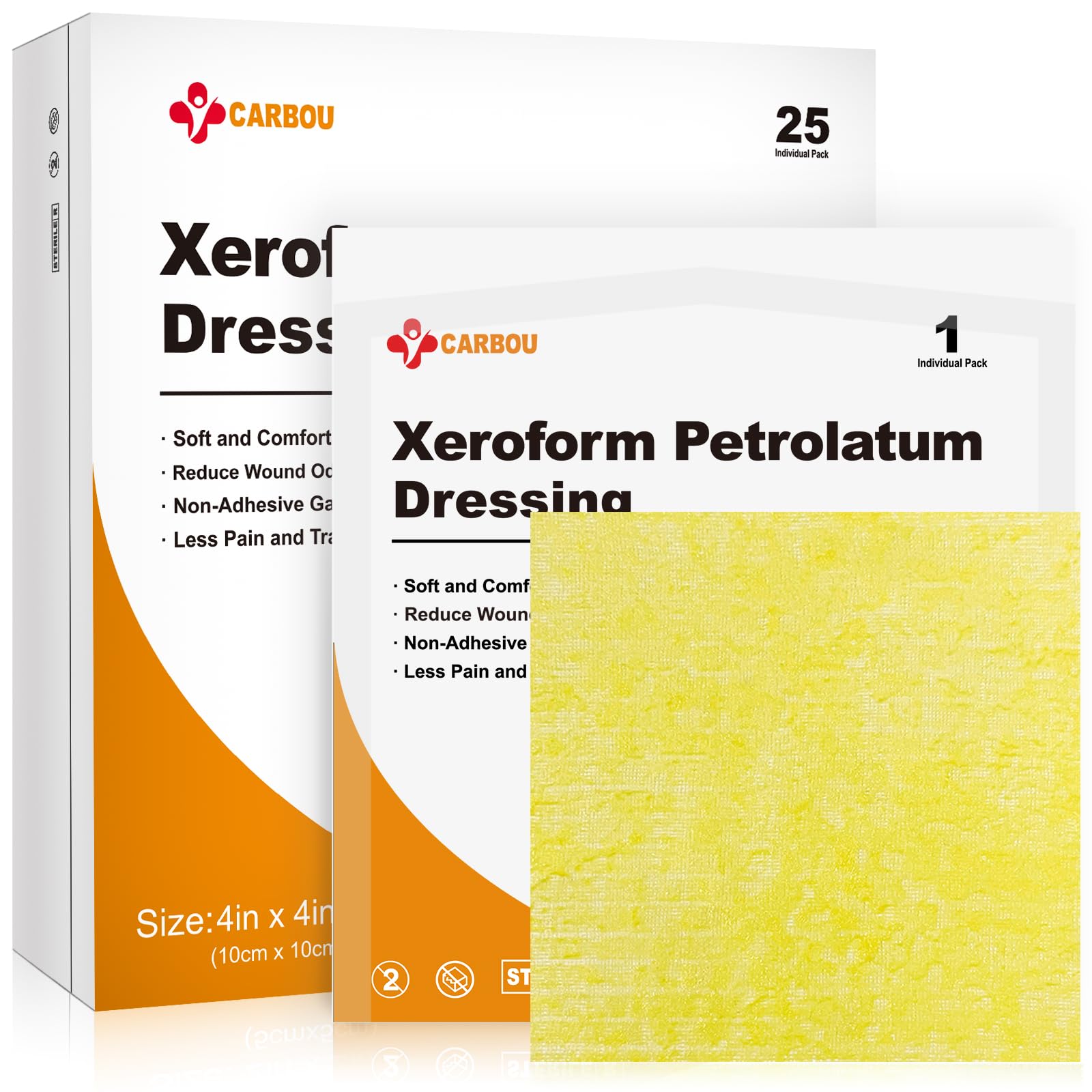
The layer that sits between the raw scrape and the bandage so nothing rips.
The morning after a fall, the pad has fused to the scab and peeling it off restarts the whole thing. This dressing fixes that. It is a fine, soft mesh loaded with petrolatum and 3% Bismuth Tribromophenate, designed to be the primary contact layer — the bottom sheet right against the wound, with your bandage on top.
Because it is non-adherent, it lifts away without pulling the healing skin, and you can cut it to the exact shape and size of the abrasion. Each of the 25 dressings comes individually wrapped and sterile, which keeps the ones you have not opened clean for the next ride. One owner used them across three months of ICU burn care and now keeps them in a first-aid kit; because they are not folded, they lay flatter than the hospital version.
The trade-off is thinness — it is a very thin mesh, so it wants a second bandage over the top to stay put on a curved knee. On a scrape that needs constant covering, though, this is the piece that makes dressing changes tolerable.
The barrier logic: a petrolatum-coated mesh that keeps the pad off the wound bed, so removal stays gentle instead of re-opening the scab.
What to expect: thin and cuttable — it needs a wrap or tape on top to hold its place on a moving joint.
Suits you if: you are covering a large abrasion and dreading every dressing change.
Skip the shortcut if: you want a one-piece cover — this is a contact layer, so add a wrap.
4. Rawleigh Antiseptic Salve Iconic Yellow Big Tin: 4.5 oz
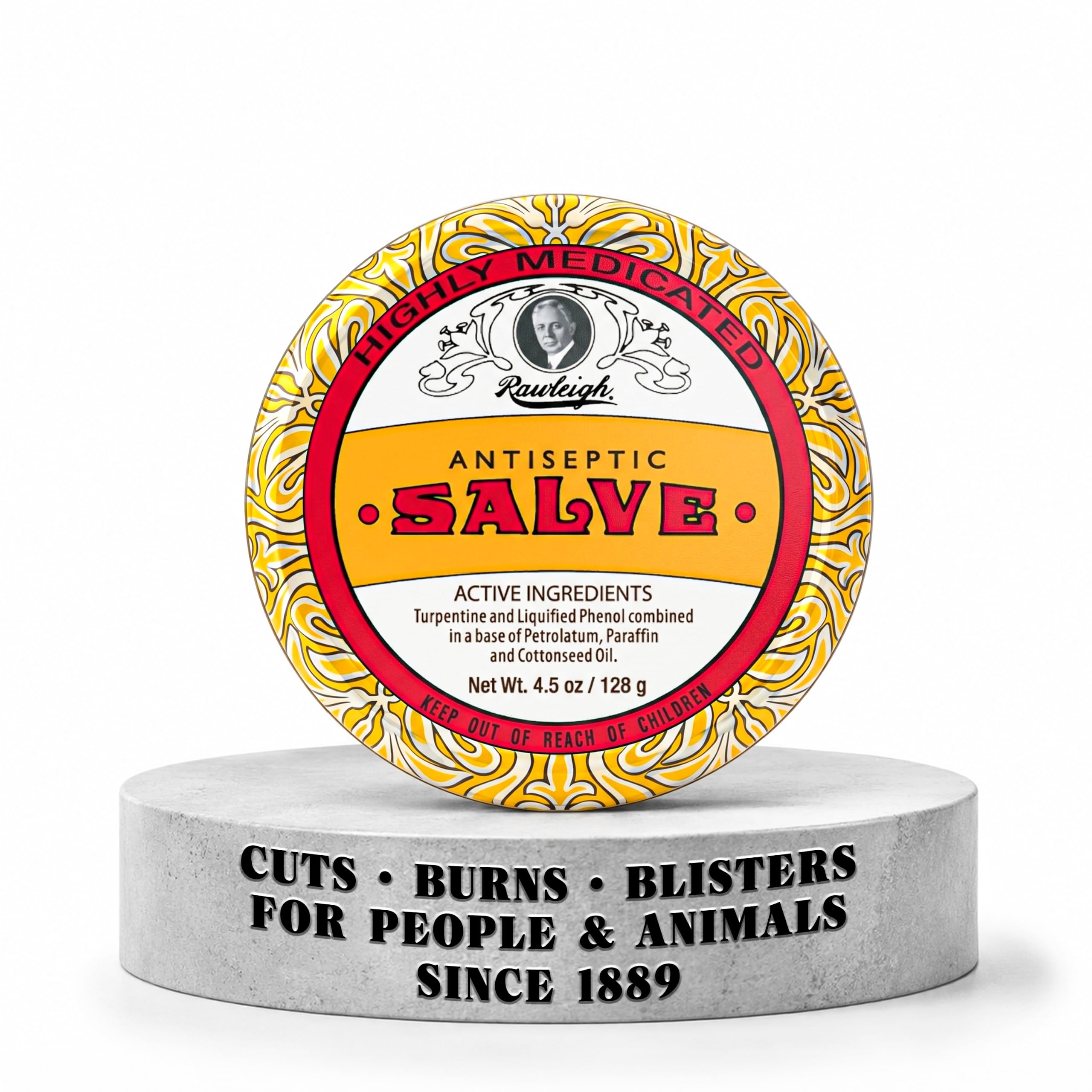
A farm-cabinet classic in a 4.5 oz tin for scrapes, blisters, and saddle chafe.
Some products live in one drawer; this one lives in three. The turpentine and liquefied phenol sit in a base of petrolatum, paraffin, and cottonseed oil — the same formula, by the brand’s account, that has gone unchanged since 1889. It seals the scrape against germs and lets skin heal underneath.
The 4.5 oz tin is the family size, and a little goes a long way, which is why families keep one in the medicine cabinet and one in the truck. What the salve does best is coat a scrape without washing away, so it stays put through a day of work. Longtime users describe it as the salve their grandparents swore by — and one buyer’s dog, its skin covered in sores, healed fast on it.
Two honest notes. It has a strong herbal smell, which is part of its character but not for everyone. And the tin lid is stiff — several buyers describe wrestling with it, so keep a coin or spoon handy for the first open.
Why it earns a drawer
- 4.5 oz family tin lasts months and covers cuts, scrapes, blisters, and chapped skin
- Thick petrolatum base stays on through sweat and work, not washed off easily
- Longstanding formula, unchanged by the brand’s account since 1889
Worth knowing first
- Strong herbal smell from the turpentine and phenol
- The tin lid can be stiff and hard to open
The pick for you if: you want one tin that handles a scrape, a blister, a chapped heel, and the horse too.
One snag: the lid takes some muscle on the first open.
5. SilvrSTAT First Aid Kit Gel 1 oz

A non-greasy silver gel for a scrape that keeps weeping or refusing to close.
When a road rash stays angry and slow, a plain ointment may not be enough. This gel carries 32 PPM of silver (parts per million — the strength of the silver in the formula) built on SilverSol Ag₄O₄ particles, made for topical management of minor cuts, lacerations, abrasions, and first and second degree burns.
Unlike the greasy barriers above, it is a gel that absorbs well, so you can use it where you do not want a heavy film. It is odorless and the 1 oz tube goes a long way — a little dab covers the area you are treating, and you reapply daily or at each bandage change. Its real strength shows on stubborn wounds: buyers report healthier tissue within a week and a wound bed ready to close within a month on a stubborn diabetic toe wound.
What everyone notices is that silver makes it effective — that is the whole point of the price jump over a plain protectant. The honest limit is its size. One ounce goes far for spot treatment but runs out faster if you are covering a broad scrape daily, so it suits the stubborn spot, not the whole-leg coat.
The standout: a non-greasy, odorless silver gel that absorbs and works on the wounds that refuse to close.
The practical limit: 1 oz is a spot-treatment tube — great for a stubborn patch, thinner on supply for a large abrasion.
Go here if: a scrape has stalled and you want a targeted, non-greasy silver gel.
Think twice if: you need to cover a large area daily — one ounce is a small tube.
Know the Specs
Petrolatum Percentage
Petrolatum (petroleum jelly) is the thick base that seals a scrape and keeps it moist. It does not evaporate, so it stays on the surface as a barrier. When a label lists a percentage, such as the 55% in Resinol, that tells you how heavy the seal is; a higher share means a longer-lasting, thicker coat.
Non-Adherent Gauze
A non-adherent dressing is treated so it does not knit into the forming skin. On a road rash, that means lifting it off without pulling the scab. The Carbou dressing does this with a petrolatum-coated mesh layer that sits right against the wound — a contact layer, with your normal bandage placed over it to hold it down.
Water-Free Ointments
A water-free ointment contains no water, so it does not dry off the way a lotion does. Instead of soaking in and evaporating, it stays on top and keeps the surface moist while letting oxygen reach the skin. That is why an ointment like Aquaphor is a barrier rather than a moisturizer that disappears.
Silver and PPM
PPM stands for parts per million — the concentration of silver in a formula. SilvrSTAT lists 32 PPM. Silver has been used in wound care across many cultures, and this gel uses SilverSol Ag₄O₄ particles for topical management of minor wounds. Think of it as a gel for a stubborn spot, applied daily or at each bandage change.
Common Questions
Should I use an ointment or a gel on road rash?
Why does my bandage stick to the road rash in the morning?
What does non-adherent mean on a wound dressing?
Is a medicated ointment better than a plain protectant for itching?
Can I use the same salve on my dog or horse?
How often should I reapply a silver gel on a scrape?
How long does one tube or tin last?
Is a petrolatum dressing safe to leave on for a day?
Do these products sting when they touch an open scrape?
Which product should I keep in a travel first aid kit?
The Bottom Line
For most people, the cure for road rash winner is the Aquaphor Advanced Therapy Healing Ointment because its water-free barrier seals a raw scrape, keeps it moist, and does not sting — the single most useful thing you can do in the first days. If the itch and irritation around the edges are what bother you, grab the Resinol Medicated Ointment. And to stop the bandage ripping your scab each morning, the Carbou Xeroform Dressing is the layer to reach for.
How we choose
We do not accept paid placement. Every pick is matched to a real buyer and a real use-case; we do not hands-on test units.
Sources
Specifications: manufacturer listings and product documentation. Review insights: verified customer reviews, as of October 2026. Pricing: not shown on this page (it changes often); check the current price via the retailer link.
As an Amazon Associate, Aappliancez earns from qualifying purchases. This does not affect which products we feature.