Disclosure: Some links in this post are affiliate links. As an Amazon Associate I earn from qualifying purchases, at no extra cost to you. Learn more
Specs are compiled from manufacturer listings and verified buyer reviews and can change over time — please confirm the key details on the product page before buying.
You want a big glass of iced tea at 4 p.m. without lying awake at midnight. That is the narrow problem this shortlist solves. Decaf iced tea comes in two very different forms — powder sticks you stir into a glass, and real tea bags you steep — and picking the wrong one is the usual reason a pitcher ends up poured down the sink. Below you get five picks split across both styles, each one matched to the way you actually drink tea.
This guide is built by comparing the manufacturers’ published specifications and the patterns across verified customer reviews, so you get each pick’s real strengths and trade-offs instead of marketing spin.
The quick version: powder wins on speed and shelf life, bags win on real tea flavor, and cold-brew bags split the difference by steeping in cold water with no kettle. Everything below has been sorted by how you brew, so you can settle on the Best Decaf Iced Tea for your own kitchen and get straight to pouring.
Top Picks
How To Choose The Best Decaf Iced Tea
The single decision that matters most is powder versus bag. A powder stick gives you a glass in about ten seconds and never spoils on the shelf. A real tea bag gives you an actual brewed cup, which tastes rounder but needs water, time, and a pitcher you can keep in the fridge. Decide between powder and bags before you compare flavors, because the format determines how much effort each glass takes.
Powder Sticks: Speed Over Depth
A powdered drink mix is a measured scoop of flavor, sweetener, and color that dissolves into water. You get a consistent glass every time and a canister that sits in the cupboard for months. The trade-off is that the tea flavor tends to be lighter than a brewed bag, and dissolvability becomes a real issue — some powders clump if you stir lazily.
Sugar content is where these live or die. Plenty of decaf tea powders are sugar-free and sweetened with stevia, a plant-derived sweetener that carries a slightly different finish than sugar. If you are watching sugar intake, read that line before you read anything else on the label.
Tea Bags: Real Brew, More Fuss
Buying actual tea bags gets you a brewed drink with body, aroma, and color that powder cannot match. The catch is strength. Decaf tea is often milder than its caffeinated counterpart, so a bag that makes a strong cup for one person can taste thin to another — some people simply use more than one bag per glass.
Bag material matters more than most buyers expect. Unbleached, plant-based bags avoid the plastic mesh question entirely, and bags without strings or tags cut down on packaging. A flimsier bag can also split in hot water, so the construction of the pouch itself is worth a look.
How the Caffeine Actually Comes Out
Decaf tea is not caffeine-free by magic. The CO2 decaffeination process uses carbon dioxide to draw the caffeine out gently, and it is described on several of these labels as a chemical-free method that retains flavor. If a chemical decaffeination process concerns you, look for the CO2 wording on the box.
Cold brew is a separate axis worth knowing. A bag formulated for cold brewing is built to release flavor in cold water over hours in the fridge, which produces a smoother glass than brewing hot and then chilling it. It also means no kettle, no boiling water, and no waiting for a pitcher to cool down.
Side-by-Side Comparison
| Model | Best For | Format | Servings | Caffeine | Amazon |
|---|---|---|---|---|---|
| Crystal Light Decaf Iced Tea, Lemon★ Best Overall | Glass-by-glass speed | Powder canister | 3 canisters, 6 packets each | 99.9% caffeine free | Amazon |
| Klass Peach & Lime Stick PacketsBest for Travel | Flavor variety on the go | Powder sticks | 44 sticks | Decaf black tea base | Amazon |
| TeeLux Decaf Green Tea Bags | Grocery-style green tea | Plant-based bags | 100 count | CO2 decaffeinated | Amazon |
| Clipper Organic Decaf Black Tea | Full-bodied black brew | Plant-based bags | 80 count | CO2 decaffeinated | Amazon |
| Lipton Decaf Cold Brew, Family Size | No-boil pitcher brewing | Family-size bags | 22 count | Decaf (cold brew) | Amazon |
Detailed Reviews
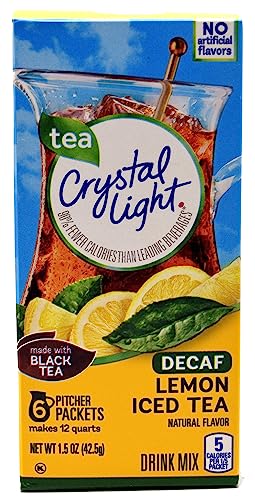
1. Crystal Light Decaf Iced Tea 12-Quart Canister Pack of 3
Our pick — 4.5+★ from 700+ verified ratings; the strongest balance of quality and price.
A lemon iced tea that skips the kettle, the pitcher, and the caffeine — one scoop and you are drinking.
You make it by the glass, whenever you want it, and it is 99.9% caffeine free — so a tall pour at dinner does not follow you to bed. Each box holds 6 packets that each make 2 quarts, and this three-canister pack means you are stocked for a long stretch of summer rather than a single week. For a household that drinks iced tea daily, that is the whole appeal: no brewing, no cooling, no pitcher taking up fridge space.
What wins people over is how little effort it takes. Owners consistently describe it as refreshing and easy — a spouse who cannot have caffeine keeps it as the summer default, and the lemon base gets stretched with lemonade or a splash of sugar-free syrup for variety. The flavor is described as rich for a powder, which is high praise in a category where thin and watery is the norm. It is also gluten free and kosher, and a 12-ounce serving carries 5 calories.
The honest catch is the canister itself. The lemon flavor is a specific taste, and people who expect a deep brewed-tea backbone find powder lemon tea a little flat next to a real bag. There is also a strain of buyer disagreement about value — the canisters are the sort of thing you should price per packet before committing to a multi-pack. Try a single canister first if lemon is not already your go-to.
What earns it top spot
- 99.9% caffeine free, so it works as an evening drink
- Each packet makes 2 quarts — a full pitcher from one sachet
- Sugar free, gluten free, kosher, and 5 calories per 12-ounce serving
- Lemon base takes lemonade or sugar-free syrup well for variety
Where it asks a little of you
- Powder lemon flavor reads lighter than a brewed tea bag
- Value per canister draws mixed feelings, so check the packet math
- Strictly a lemon profile — no peach, no lime option here
Go for it if: you want a caffeine-free glass in under a minute and like a bright lemon tea.
Think twice if: you want real brewed-tea depth — a bag pick further down suits you better.
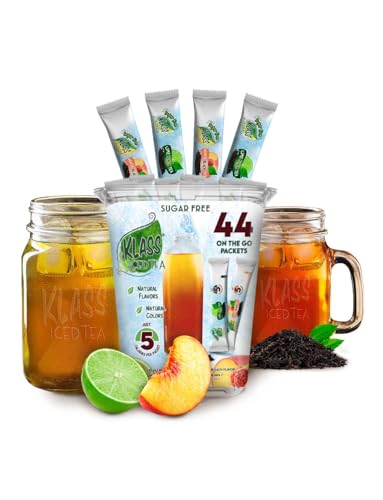
2. Klass Iced Tea Peach & Lime Zero Sugar Drink Mix Packets 44 Sticks
Single-serve sticks that live in a bag, a desk drawer, or a car console and turn a bottle of water into peach or lime tea.
One stick goes into 16 ounces of water, you shake, and you are done — no measuring, no canister, no scoop. The pack holds 44 sticks split evenly at 22 peach and 22 lime, and each one carries 5 calories and 2 grams of carbohydrates. At 3.1 ounces for the whole box, it is the kind of thing that disappears into a backpack. For scale, the Crystal Light above weighs 8.15 ounces — this pack comes in at 3.1 ounces.
Flavor is the reason this one has a following. Taste is the runaway favorite here, and the black tea base reads full without leaning sickly sweet — a prediabetic buyer specifically liked that it is sweetened with stevia (a plant-based sweetener) rather than sugar, and that the sweetness stays in check compared with the same brand’s fruitier mixes. The brand also states no artificial colors and flavors from natural sources, which matters if you are dodging dye.
Here is the part you should plan for: these powders need help dissolving. Some sticks turn clumpy and take several minutes of shaking to break down, and using a small whisk or a shaker bottle is the practical fix rather than stirring with a spoon. The flavor split is also uneven in practice — buyers report “Tasty but the flavor packets were 70% the Lime flavor, very few Peach in the box!!!!” — so treat the “22 of each” listing as a target rather than a guarantee.
Why the flavor carries it
- Black tea base with real peach and lime character, sweetened with stevia
- 44 sticks at 5 calories and 2 grams of carbs each
- No artificial colors; flavored from natural sources
- Fits a 16-ounce bottle of water with no measuring tools
The mixing caveat
- Clumps unless you shake hard or use a whisk
- Pack ratios can skew toward lime
- Powder texture is not the same as a brewed glass
Reach for this if: you drink tea away from home and want a stick in your bag instead of a canister in your cupboard.
Look elsewhere if: you brew at a kitchen counter and dislike shaking a bottle to dissolve powder.
3. TeeLux Decaf Green Tea Bags 100 Count

A hundred bags of grassy steamed green tea, decaffeinated with CO2 and built to go straight over ice.
If you want green tea in the fridge rather than the kettle, this is the box to keep on the shelf. One hundred bags is a serious amount of tea, and the leaves are steamed rather than pan-fired, which is what gives that slightly vegetal, grassy note the label describes. It is decaffeinated with the CO2 process, which the brand says retains maximum flavor, and the bags are unbleached non-GMO plant fiber with no strings or tags.
The taste is the thing that sells it. Buyers describe a mellow, smooth cup that is not bitter — the kind of green tea you can drink plain and still enjoy, hot or poured over ice with lemon and honey. Caffeine content is the second most-discussed point, and it is a clean fit for anyone who is caffeine-sensitive. Heads up on strength: a fair number of people find it light and use more than one bag to build a bolder pitcher.
The bag construction is where it needs care. These pouches are minimalist by design, and a thin bag can split — one reviewer noted a bag bursting in roughly one in five cases, though that reads like an isolated batch rather than a universal flaw. Brew them gently, avoid aggressive stirring, and the trade-off is mostly cosmetic. As owners sum it up on the flavor question: “it takes up to three bags to get the required taste” — so buy with a heavier hand than you would for a standard caffeinated bag.
The green tea verdict: the smoothest way to keep a caffeine-free green tea habit without a kettle ritual, and 100 bags means you are not rebuying every few weeks.
The fair warning: light strength and thin bags mean you should plan on extra bags per pitcher and handle them gently.
Built for: the iced green tea drinker who wants a big box of mild, chemical-free decaf at a sensible price.
Not the pick for: anyone who wants a bold, dark brew from a single bag.
4. Clipper Organic Decaf Fairtrade Black Tea, 80 Tea Bags

A full-bodied decaf black tea for people who refuse to accept that decaf has to taste watery.
Steep it 2 to 4 minutes in freshly boiled water, then let it cool and pour it over ice — that is the whole method, and it produces a dark, rich glass rather than a pale one. The leaves are decaffeinated with CO2 rather than a chemical solvent, and the brand describes it as one of the best-tasting organic decafs on the market. Eighty bags per box, plant-based and unbleached, from a certified B-Corp.
Flavor is what this one is known for, and the reason is straightforward: decaf black tea usually loses body, and this one keeps it. Buyers call it smooth with a nice taste and note it brews strong quickly — good hot, and just as good iced. The organic angle lands hard with people who had given up on tea altogether; one describes commercial teas causing digestive trouble and this spray-free organic decaf causing none, with “great flavor, color, smooth and clean.” If other decafs have tasted flat or papery to you, this CO2-decaffeinated black tea keeps enough body to avoid that finish.
Two things to know before you commit. Strength is genuinely debated — some find it sturdy, others want more punch from a single bag, so make your first pitcher with two bags and dial back. And the price draws split opinions, which is fair for an organic, Fairtrade product versus a plain supermarket box. What you are paying for is the sourcing and the clean decaf process, not a bargain per bag.
Where it wins: real black tea body from a decaf bag, which is rarer than it should be, plus organic leaves and a chemical-free CO2 process.
What to expect: a strong first steep that some find too mild at one bag, and a higher price per bag than entry-level decaf.
The one to choose if: you want an honest, full-flavored black iced tea and care where the leaves come from.
Less ideal if: you brew by the gallon weekly and need the lowest cost per bag.
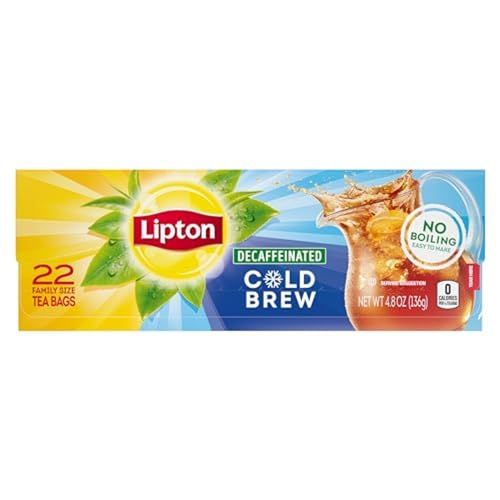
5. Lipton Decaf Cold Brew Iced Tea Bags, Family Size, 22 Count
The pitcher-in-the-fridge answer: family-size bags built to release flavor in cold water, no kettle required.
These bags are formulated specifically for cold brewing, which means the flavor comes out in cold water instead of needing a boil first. You drop a family-size bag in, add water, and let it sit. The result is a smoother glass than hot-brewed-then-chilled tea, because cold extraction pulls less of the tannic bite. The box holds 22 family-size bags of unsweetened black tea with orange pekoe and pekoe cut leaves, and it is caffeine-free.
What people keep coming back for is the lack of fuss. Owners describe it as quick, easy, and genuinely good iced tea, with the bags holding the leaves together so nothing leaks into the pitcher. It is also the decaf cold brew that is hard to find on a local shelf, which is why so many people order it in bulk. If you have been brewing hot and waiting for a pitcher to chill, this cuts that step out entirely.
The thing to keep in mind is that cold brew is a patient method. It works on its own schedule in the fridge, so you are planning a pitcher ahead rather than making a glass on demand — the opposite of reaching for a powder stick. Strength also leans mild, as decaf black tea tends to, so if you like a punchy glass use a second bag. The 22-count box is also smaller than the 80- and 100-count boxes above, so heavy pitchers will burn through it faster.
Where the design pays off
- Formulated to brew in cold water, so no boiling and no cooling wait
- Family-size bags make a full pitcher per bag
- Bags hold their leaves without leaking into the tea
- Smoother extraction than hot brewing, with less tannic edge
The patient-brewer reality
- Needs fridge time — not a glass-on-demand product
- Mild decaf strength means some will want two bags
- 22 bags runs out faster than the bigger-count boxes
Made for you if: you want a pitcher of decaf black tea waiting in the fridge with zero boiling.
Skip the swap if: you need a glass the moment the craving hits — go powder for that.
Know the Specs
Servings and Packaging Format
The count on the box tells you how long the product lasts, but the formats are not comparable. A powder canister lists packets, and each Crystal Light packet makes 2 quarts — a whole pitcher from one sachet. A stick pack like Klass is one glass per stick at 16 ounces of water. A bag box lists individual bags at 80, 100, or 22 to a box. Compare within a format, not across it.
Decaffeination Process
CO2 decaffeination uses carbon dioxide to draw caffeine out, and brands describe it as a chemical-free method that keeps flavor intact. It appears on the TeeLux green tea and the Clipper black tea. Powder products state their caffeine position directly on the label instead — Crystal Light lists 99.9% caffeine free. Either way, “decaf” is a process claim, so read how it was done if that matters to you.
Cold Brew Versus Standard Bags
A standard tea bag releases flavor in hot water, so making iced tea means brewing hot and cooling it down. A cold brew bag is formulated to extract in cold water over hours in the fridge. Lipton’s cold brew bags sit in that second camp, and the payoff is a smoother glass with less tannic bite. The cost is time — you plan a pitcher rather than making a glass.
Sugar, Calories, and Sweeteners
Sugar-free does not mean flavor-free, and the sweetener choice changes the finish. Klass uses naturally extracted stevia, which carries a different taste from sugar. Crystal Light is sugar free, gluten free, and kosher, with 5 calories in a 12-ounce serving. Bagged teas like TeeLux and Clipper are unsweetened by nature, so you control what goes in — lemon, honey, or nothing at all.
Common Questions
Is decaf iced tea really caffeine free?
Which is better for iced tea, powder or tea bags?
How long does it take to cold brew decaf tea?
Do I need to boil water for Lipton cold brew bags?
Why does my decaf iced tea taste weaker than regular tea?
Is CO2 decaffeination different from chemical decaffeination?
Are the tea bags plant based?
Can kids drink decaf iced tea?
How do I stop powder drink mix from clumping?
Does decaf iced tea need to be kept in the fridge?
The Bottom Line
If you want the simplest path to a caffeine-free glass, the Crystal Light Decaf Iced Tea is the pick — one packet per 2-quart pitcher, 99.9% caffeine free, and no brewing at all. For a bagged glass with real body, the Clipper Organic Decaf Black Tea delivers the deepest brew, while the TeeLux Decaf Green Tea covers the lighter, grassy green tea crowd. If you would rather never touch a kettle, the Lipton Decaf Cold Brew bags are built to steep in the fridge from the start. Choose powder for a glass in seconds, bags for real brewed flavor, or cold-brew bags for a pitcher that steeps in the fridge overnight.
How we choose
We do not accept paid placement. Every pick is matched to a real buyer and a real use-case; we do not hands-on test units.
Sources
Specifications: manufacturer listings and product documentation. Review insights: verified customer reviews, as of October 2026. Pricing: not shown on this page (it changes often); check the current price via the retailer link.
As an Amazon Associate, Aappliancez earns from qualifying purchases. This does not affect which products we feature.