Disclosure: Some links in this post are affiliate links. As an Amazon Associate I earn from qualifying purchases, at no extra cost to you. Learn more
Specs are compiled from manufacturer listings and verified buyer reviews and can change over time — please confirm the key details on the product page before buying.
Your first decision is simple: are you sealing a flat, horizontal joint (like a driveway expansion joint) or patching a vertical crack in a wall? For flat joints, the SIKA Sikaflex Self-Leveling Concrete Joint Sealant is the one to beat. Its self-leveling formula (it flows and flattens itself) pours right into a gap and finds its own level, so you don’t have to tool it smooth by hand.
This guide is built by comparing the manufacturers’ published specifications and the patterns across verified customer reviews, so you get each pick’s real strengths and trade-offs instead of marketing spin.
The tube is the easy part — cleaning the joint and knowing whether it’s horizontal or vertical does the real work. Here is the straight story on the best caulk for concrete joints.
Top Picks
How To Choose The Best Caulk for Concrete Joints
The first thing you need to nail down is the direction of your joint. A flat, horizontal gap — an expansion joint across a driveway, a crack in a garage floor — needs a self-leveling product that flows out like syrup. A vertical crack in a wall, a cinder block, or above a garage door needs a thick, textured paste that stays put instead of running down the face.
Horizontal versus vertical joints
Self-leveling sealants only work on flat surfaces: tip the tube onto a slope and you watch your product drain away from the gap. Textured mortar filler, by contrast, is a thick paste you press into a wall crack. A self-leveling sealant on a wall crack runs out of the gap, and a thick paste on a flat joint never levels.
Cure time and the weather
Read the label in two stages. Set time (skin-over) is when the surface stops being tacky. Full cure is much longer, and it is the number that matters before rain or heavy traffic hits a fresh repair. DAP’s textured mortar is water-ready in 24 hours; DAP’s concrete patch reaches full cure after 48 hours for a 1/4″ depth repair.
Backer rod and gap depth
Deep gaps swallow an enormous amount of sealant if you fill them solid. Pushing in foam backer rod (a compressible foam rod that fills the bottom of the joint) gives the sealer a base and lets it flex instead of sticking to a rigid floor. That backer rod step saves sealant and gives the cured bead room to flex.
Side-by-Side Comparison
| Model | Best For | Type | Joint Direction | Capacity | Amazon |
|---|---|---|---|---|---|
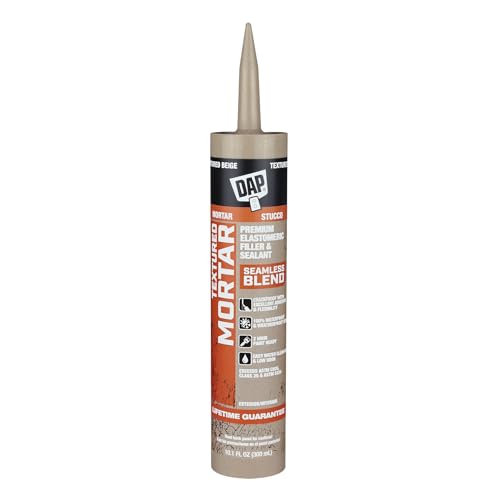
| DAP Textured Mortar Filler & Sealant★ Best Overall | Wall and brick cracks | Textured elastomeric latex paste | Vertical / overhead | 10.1 Oz | Amazon |
| DAP Concrete and Mortar Repair | Patching holes and dents | Ready-to-use concrete patch | Horizontal or vertical | 32 oz | Amazon |
| SIKA Sikaflex Self-Leveling Sealant | Driveway and garage floor joints | Self-leveling polyurethane | Horizontal only | 29 fl oz | Amazon |
| Autosel Concrete Crack Filler (2 PCS) | Wide surface coverage | Self-leveling silane resin gel | Horizontal | 2 pack, 1 kg total | Amazon |
Detailed Reviews
1. DAP Textured Mortar
Our pick — 4.5+★ from 450+ verified ratings; the strongest balance of quality and price.
The beige paste that disappears into brick and mortar instead of leaving a shiny scar.
If your concrete joint is vertical — a cracked wall, a gap above a garage door, a settlement crack in cinder block — this is the pick. It’s a textured elastomeric latex filler (a rubbery latex paste with grit in it that stretches rather than cracking) and it comes in a light beige that lands close to most tan mortar. That color match is the whole reason people reach for it: the repair blends in rather than announcing itself.
The practical side is strong too. It’s 100% waterproof and weatherproof, ready for water and rain in 24 hours, and paintable after 2 hours if you want a closer custom match. It meets ASTM C920, Class 25 and ASTM C835 (published sealant standards for joint movement and adhesion). The tube is small — 10.1 Oz — and slim at 2 x 2 x 11.25 inches, so it tucks into a toolbox and handles small settlement gaps rather than acre-wide slabs. For scale, that’s a far more compact tube than the 16 x 2.5 x 16 inch SIKA cartridge in this lineup.
What you notice first is that it works and looks right. It’s thick enough to press a bead into a crack and hold its shape without running down the wall, textured enough to read as mortar, and it sets up fast. The catch is volume and thickness: pile it deeper than about 1/4″ and it takes a long time to firm up. As buyers report, “Only issue I found was if you put it on m1/4″ or more it takes a long time to dry and even long to get firm.” Spread thin layers instead of one fat bead, and one tube goes much further than the size suggests.
What lands the repair
- Beige tone blends into tan mortar and brick so repairs nearly vanish
- Rain-ready in 24 hours and paintable after 2 hours
- Meets ASTM C920 and ASTM C835 standards
- Holds its shape on vertical cracks without sagging
What to watch on the bead
- Deep beads over about 1/4″ dry slowly — build up in thin layers
- 10.1 Oz goes fast on larger cracks
- A few note the dispensing cap can give out under pressure
Reach for this if: you’re sealing a vertical crack in brick, block, or stucco and want the fix to blend in.
Look elsewhere if: you need to fill a wide flat floor joint — the self-leveling pick below is the right tool.
2. DAP Concrete and Mortar Repair, Gray, 32 oz

Not a flexible sealant at all — a spreadable gray patch that rebuilds missing concrete.
Here’s the distinction that trips up a lot of buyers: this is a concrete patch, not a caulk. It won’t stretch with a moving joint, but it will fill a hole, a dent, a chipped step, a spot where the surface has broken away. Thick, spreadable, and ready to use straight from the 32 oz pail, it tools flat and finishes hard. That makes it the right answer for spot leveling and rebuilding defects on both interior and exterior concrete.
The weight tells you it’s a substantive product — 3.8 pounds against the SIKA sealant’s 2 pounds — and it carries real capacity at 32 oz versus the 10.1 Oz textured mortar above. The cure schedule is the number to plan around: full cure after 48 hours for a 1/4″ depth repair, and you add 48 hours for each additional 1/4″ of depth. It sets in 3-5 hours, and you can paint it with latex paint in 2 to 4 hours or oil-based after 24 hours. It applies in temperatures above 40 degrees Fahrenheit.
Application is where this earns its keep. Owners mention, “I had one spot that was a couple of inches deep so I applied several thin layers and it worked perfectly.” Thin layers, not one deep fill, is the trick. The honest trade-off is durability over time — a chunk of the feedback mentions it can crack down the line, and the feel is more putty than concrete. For a cosmetic patch on a walkway or garage floor it’s ideal; for a joint that has to move, reach for a flexible sealant instead.
Depth and layering rule: build up in 1/4″ passes and give each one the full 48 hours before the next — rushing the layers is how patches fail.
Where it fits: garages, walkways, chimneys, and small defects where you want a hard, paintable surface that reads like the original concrete.
Pick this when: you’re filling a hole or chipped corner and want a product that hardens like the slab around it.
Pass if: your target is a joint that flexes with the seasons — this one sets rigid.
3. SIKA Sikaflex Self-Leveling Concrete Joint Sealant

Pour it in a flat joint and walk away — the formula levels itself into a clean gray line.
This is the specialist for horizontal expansion joints — driveways, garage floors, sidewalks, pavement. It’s a self-leveling polyurethane sealant, meaning it flows into the gap and flattens to its own level, so you don’t have to tool a smooth finish by hand. At 29 fl oz it’s the biggest single tube here, and it’s built for the worst of the weather: waterproof and immersible once cured, paintable, sandable, and stainable so you can blend it in afterward.
Speed is a selling point. You get a fast skin-over but a patient full cure you plan around — as customers note from a deep driveway apron gap, it was “not tacky next morning, full cure 3-5 days.” It measures 16 x 2.5 x 16 inches and weighs 2 pounds, so it’s a real cartridge for a caulk gun, not a squeeze tube.
What wins people over is the way it actually levels — the self-leveling behavior is the star of the show and the reason it’s the default choice for flat joints. There’s a real technique to getting it right, though: prep the joint, use a foam backer rod to limit waste in deep gaps, and fill slowly and slightly proud. It’s horizontal only — never try it on a slope or a wall, because it will run. Some feel the tube runs short on big projects, so buy accordingly.
The prep that pays off: clean the joint, sweep and blow out debris, then seat backer rod below grade before you fill. That’s what turns a messy pour into a professional line.
Make this your call: for any flat driveway, garage, or sidewalk expansion joint where you want a smooth self-leveled finish. skip it if you’re filling a vertical wall crack — the self-leveling formula will run.
Steer clear on: vertical cracks and sloped surfaces — this formula is built to flow, and flow it will.
4. Autosel Concrete Crack Filler, High Elasticity, 2 PCS
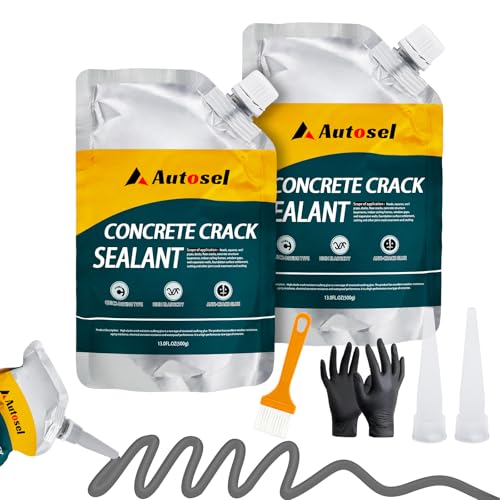
A two-tube kit that crosses over to asphalt — handy if your driveway isn’t all concrete.
This one is for the homeowner who wants to knock out cracks across mixed surfaces — concrete, cement slabs, and asphalt. It’s a silane resin gel (a resin-based filler that stays flexible) in a 2-pack, and the kit comes with nozzles, brushes, and a glove, so you’re not hunting for tools. It’s rated for driveways, walkways, patios, garages, steps, basement floors, and parking lots. The self-leveling, quick-drying formula fills and bonds, and it’s built to flex so ground movement doesn’t just crack it open again.
On the right crack it does the job, and effectiveness is what comes through clearest in the feedback. It stays flexible rather than going brittle, and it holds through heavy rain once cured. Two things to know before you buy: it’s runny, so it wants a flat surface — on a slope it will travel — and the gray can skew dark against older, sun-bleached concrete. As reviewers point out, “Very dark in color, almost black. It’s ok I’m painting over it.” That’s a cosmetic note, not a structural one, but worth knowing if a clean match matters to you.
The consistency is the real wildcard. Some tubes come well-mixed and flow right into the gap; others arrive with the product solidified or separated, which is why it pays to check the tube before you commit to a big pour. When it’s good, it’s an easy, flexible, weather-resistant repair that survives freeze-thaw cycles. My read is it’s best treated as a budget-conscious patch-and-move-on option for wide surface coverage rather than the precision choice for one critical joint.
Why it earns a spot
- 2-pack covers more cracks with nozzles, brushes, and a glove included
- Flexible formula resists cracking as the ground moves
- Works across concrete, asphalt, brick, and tile
- Stays put through rain and freeze-thaw once cured
Where it asks patience
- Runny gel travels on slopes — flat surfaces only
- Gray can read darker than aged concrete
- Tube-to-tube consistency varies, so check before pouring
Handy for: the driveway that’s part concrete and part asphalt, where a flexible, self-leveling filler saves you buying two products.
Think twice if: your joint is sloped or you want a color that vanishes into old concrete.
Know the Specs
Self-leveling vs. textured paste
A self-leveling sealant flows and flattens itself, so it’s made for horizontal joints like driveways and garage floors. A textured paste stays where you press it, so it’s the choice for vertical cracks in walls and block. Putting a self-leveling sealant on a vertical crack, or a textured paste in a flat joint, is the most common way a repair fails.
Set time vs. full cure
Set (skin-over) time is when the surface stops being tacky — often within a couple of hours. Full cure is the deeper hardening that takes much longer, up to several days or more depending on depth. Rain and traffic are safe only after the full cure, so plan your project around that number, not the skin-over.
Waterproof and weatherproof ratings
A waterproof, weatherproof sealant keeps rain and snow from infiltrating the joint, which is what protects the slab through freeze-thaw cycles. Check for labels that say water-ready or waterproof once cured, because that tells you when the repair can face the elements.
Elasticity and movement
Concrete slabs shift with ground movement and temperature, so a joint filler has to stretch instead of cracking. Elastomeric and high-elasticity formulas flex with that movement. Rigid concrete patch, by contrast, is for filling holes and rebuilding surfaces, not for joints that move.
Common Questions
Can I use the same caulk on a driveway expansion joint and a wall crack?
How long before rain can hit a fresh concrete joint sealant?
Do I need a backer rod before sealing a deep concrete joint?
Is DAP Concrete and Mortar Repair the same as a flexible caulk?
How deep should I apply DAP Concrete and Mortar Repair?
Why did my self-leveling sealant run out of the joint on a slope?
Can I paint over a concrete joint sealant once it’s cured?
What temperature can I apply concrete patch in?
Will a concrete crack filler work on asphalt too?
The Bottom Line
For most people buying the best caulk for concrete joints, the right pick depends on the joint in front of you. A vertical wall crack calls for the DAP Textured Mortar Filler & Sealant, because its beige textured paste blends into brick and mortar and stays put on a vertical surface. If your target is a flat driveway or garage expansion joint, grab the SIKA Sikaflex Self-Leveling Sealant, which pours in and levels itself into a clean gray line. And for filling a hole, a chipped step, or a dented slab surface, the DAP Concrete and Mortar Repair is the one to reach for. Match the sealant type to the joint direction, clean the surface, and seat backer rod in deep gaps — that’s what makes a seal last.
How we choose
We do not accept paid placement. Every pick is matched to a real buyer and a real use-case; we do not hands-on test units.
Sources
Specifications: manufacturer listings and product documentation. Review insights: verified customer reviews, as of October 2026. Pricing: not shown on this page (it changes often); check the current price via the retailer link.
As an Amazon Associate, Aappliancez earns from qualifying purchases. This does not affect which products we feature.