Disclosure: Some links in this post are affiliate links. As an Amazon Associate I earn from qualifying purchases, at no extra cost to you. Learn more
Specs are compiled from manufacturer listings and verified buyer reviews and can change over time — please confirm the key details on the product page before buying.
Most boots squeeze your toes because the toe box (the front section that holds your toes) is built for a narrow foot. A workday on concrete turns that pinch into throbbing pain by lunch. The fix is not a bigger size — it is a boot whose toe box is actually shaped for a wide forefoot. That room can come from a wide last (the foot-shaped mold a boot is built on), a composite toe built with extra room, or leather that gives instead of pinching. Every pick below earns its place on toe room plus what keeps a boot wearable all day: a cushioned footbed, real traction, and support that does not collapse by month six.
This guide is built by comparing the manufacturers’ published specifications and the patterns across verified customer reviews, so you get each pick’s real strengths and trade-offs instead of marketing spin.
You will see how each boot handles a wide forefoot, what its sole and support actually deliver, and where its honest limit sits. The goal is simple: find the boots with wide toe box that fit your foot the first time.
Top Picks

How To Choose The Best Boots With Wide Toe Box
The wrong assumption most buyers carry is that sizing up gets you toe room. It does not. Going up a size adds length in front of your toes, not width across the ball of your foot, so you end up with a boot that sloshes at the heel while the sides still press in. What you want is a boot whose forefoot is built wide from the start, then sized to your normal number.
Look at the toe box shape, not the size number
A wide toe box means the front of the boot has room for your toes to sit flat and spread instead of stacking on top of each other. Leather uppers soften and give over a few wears, but a safety toe cap does not — it is a rigid shell, so its internal width is fixed for the life of the boot. That is why a composite or carbon toe boot either fits your forefoot on day one or never will.
Decide if you need a safety toe at all
A composite toe (a non-metal protective cap that shields your toes from impact) or a carbon toe adds protection but eats some interior room. If your job does not require impact protection, a soft-toe boot gives your toes the most space and the most give. If it does, pick a model whose cap is shaped with extra forefoot room rather than a narrow dome.
Check what sits under your foot
Toe room is only half the story. A roomy forefoot on a thin, hard sole still wrecks a long shift. Look for a cushioned removable insole, a midsole that resists compression, and a shank (a stiff strip inside the sole that supports your arch). A removable insole matters because it lets you swap in your own orthotic or a thicker pad without buying a new boot.
Match the upper to your conditions
Waterproof membranes keep rain and puddles out but hold warmth in, so they suit wet, cold job sites. Water-resistant leather breathes better in heat. If you stand on concrete indoors all day, breathability usually matters more than a waterproof layer.
Side-by-Side Comparison
| Model | Best For | Toe Type | Upper | Weight / Build | Amazon |
|---|---|---|---|---|---|
| Timberland Redwood Falls Waterproof★ Best Overall | Everyday wear and light work | Soft moc toe | Waterproof Premium Timberland leather | Steel shank, OrthoLite footbed | Amazon |
| Orthofeet Granite Orthopedic Work BootsBest for Aching Feet | Long shifts with foot pain | Extra-depth, wide fit | Leather work boot upper | Removable insole, fitting spacers | Amazon |
| ROCKROOSTER Magnolia 6″ Side-ZipperBest for Riding | Riding and light-duty work | Soft moc toe | Thick leather, Goodyear welt | ~1.95 lbs per boot (US 10) | Amazon |
| KEEN Utility Kenton Mid Composite Toe | Sneaker-feel work days | Composite toe | Leather, wider KEEN form | 18.3 oz / 519 g per shoe | Amazon |
| 5.11 Tactical ATAC 2.0 8-Inch Side-Zip | Duty and variable terrain | Full-grain leather toe | Full-grain leather and 840D nylon | 3.9 lbs | Amazon |
| KEEN Utility Gibson Mid Composite Toe | Light industrial, flexible feel | Carbon fiber safety toe | Full-grain water-resistant leather | KEEN.ReGEN midsole | Amazon |
| Timberland PRO Boondock Ultralight 6″ | Cold, wet job sites | Composite safety toe | Waterproof Premium leather + Ever-Guard | HoverSpring foam midsole | Amazon |
| Ariat Rebar Lift 6″ Waterproof | Industrial and refinery work | Composite toe | Waterproof leather | Lightweight build | Amazon |
| Zamberlan 1996 VIOZ LUX GTX RR | Backpacking with heavy loads | Reinforced leather toe | Leather with GTX lining | Resoleable, stiff sole | Amazon |
Detailed Reviews
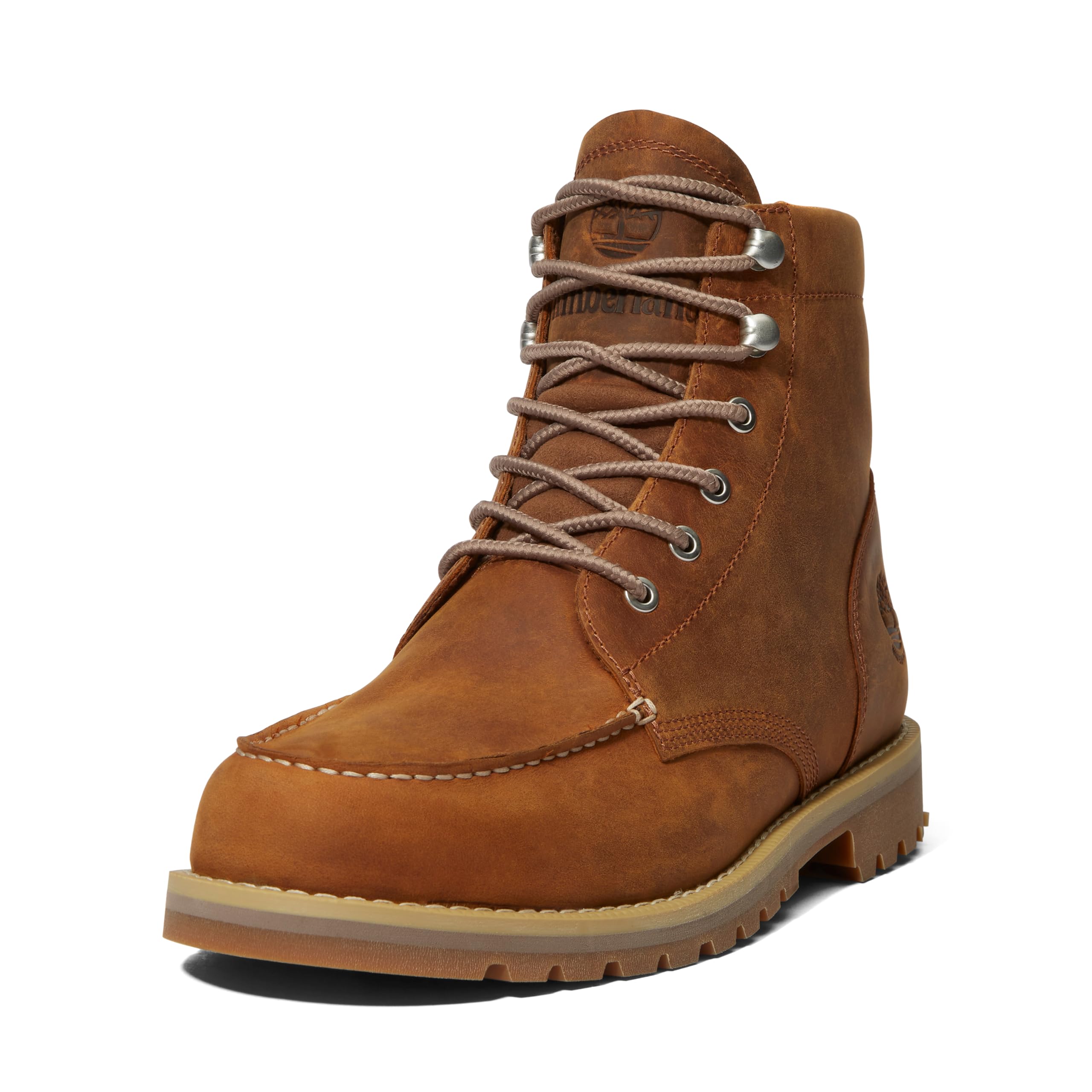
1. Timberland Redwood Falls Waterproof
Our pick — 4.5+★ from 500+ verified ratings; the strongest balance of quality and price.
A moc-toe boot that gives your toes room and your arches a steel shank to lean on.
This is the strongest all-rounder here for one reason: it pairs a genuinely roomy toe box with a waterproof layer and a supportive sole. So it works on a wet commute and a light job site without changing shoes. The upper is waterproof Premium Timberland leather, backed by a TimberDry waterproof membrane (a thin liner that stops water getting through while letting sweat vapor escape). Underfoot sits a steel shank (a stiff plate that supports your arch) and an OrthoLite footbed for cushioning. The steel shank holds your arch up through a long shift on hard floors.
Where it wins people over is the look — a clean leather moc toe that reads dressy enough for a night out and tough enough for a trail. The break-in is close to nothing. As one verified buyer put it, these are “Comfy, cushy, no break-in (5-mile hike, no rubbing).” That same buyer also confirmed the grip holds and the waterproofing does its job, and the toe area stays roomy. The rustproof speed-lace hardware matters too — laces that do not corrode mean the fit stays adjustable season after season.
The honest caveat is sizing. The fit is the mixed part of the feedback, and the reliable approach for most feet is to size down half a size if you wear thin socks, or keep your normal number if you wear thick ones. Durability is the other soft spot: leather this soft lasts, but heavy abrasive site work is not its home. Compare it with the Zamberlan below, which is built to be resoled and keep going — the Redwood Falls is the boot you reach for when comfort and looks lead the day.
What earns it the top spot
- Roomy toe box with almost no break-in — one owner logged a 5-mile hike with no rubbing.
- TimberDry waterproof membrane plus rustproof speed-lace hardware for wet weather.
- Steel shank for arch support and an OrthoLite footbed for all-day cushioning.
- ReBOTL fabric lining made with at least 50% recycled plastic.
Where to watch out
- Fit runs tricky — half-size down for thin socks, normal size for thick socks.
- Soft leather will not shrug off heavy abrasive work like a stiff industrial boot.
Take this one: if you want a roomy, good-looking leather boot for everyday wear, light work, and wet sidewalks.
Reconsider: if you need a hard safety toe or a boot that takes years of grinding site abuse.
2. Orthofeet Granite Orthopedic Men’s Work Boots
The boot built for a forefoot that has been pinched for years and wants space back.
If wide boots have always rubbed your toes, this is the pair to look at first. It is cut extra wide and extra deep, so the toe area has height as well as width — your toes sit flat instead of curling under a low ceiling. The removable insole slides out so you can drop in your own orthotic (a custom support insert). Orthofeet also includes fitting spacers and an Arch Booster so you can fine-tune how the boot hugs your foot rather than living with the factory setup.
What people rave about is the comfort under a heavy load. A highway laborer in a condensed review wore these 55+ hours a week for six months. He said they held up, kept his heel pain quiet, and stayed warm all winter — and he expects another six months out of them. Another buyer said they ended decades of toe pain caused by narrow boots. The cushioning and the wide fit are the pair this boot is known for, and both are real.
The trade-offs are honest ones. Rigid ortho-style boots do not always come cheap, and a couple of buyers found the sole loosening over months of hard use. Those who need a soft, whippy sole or a sneaker feel should look elsewhere. For anyone in the narrow-boot-pain crowd, the Granite delivers room and support that is hard to find at its price tier.
Room at the front: Extra width and extra depth give the toe box real height, which matters if your toes are tall or wide across the knuckles.
Support you can tune: The removable insole plus fitting spacers and Arch Booster let you adjust the fit to your own foot instead of guessing.
Made for you if: you are on your feet 50-plus hours a week and narrow boots have punished your toes.
Look past it if: you want a soft, flexible sole for light walking rather than firm podiatric support.
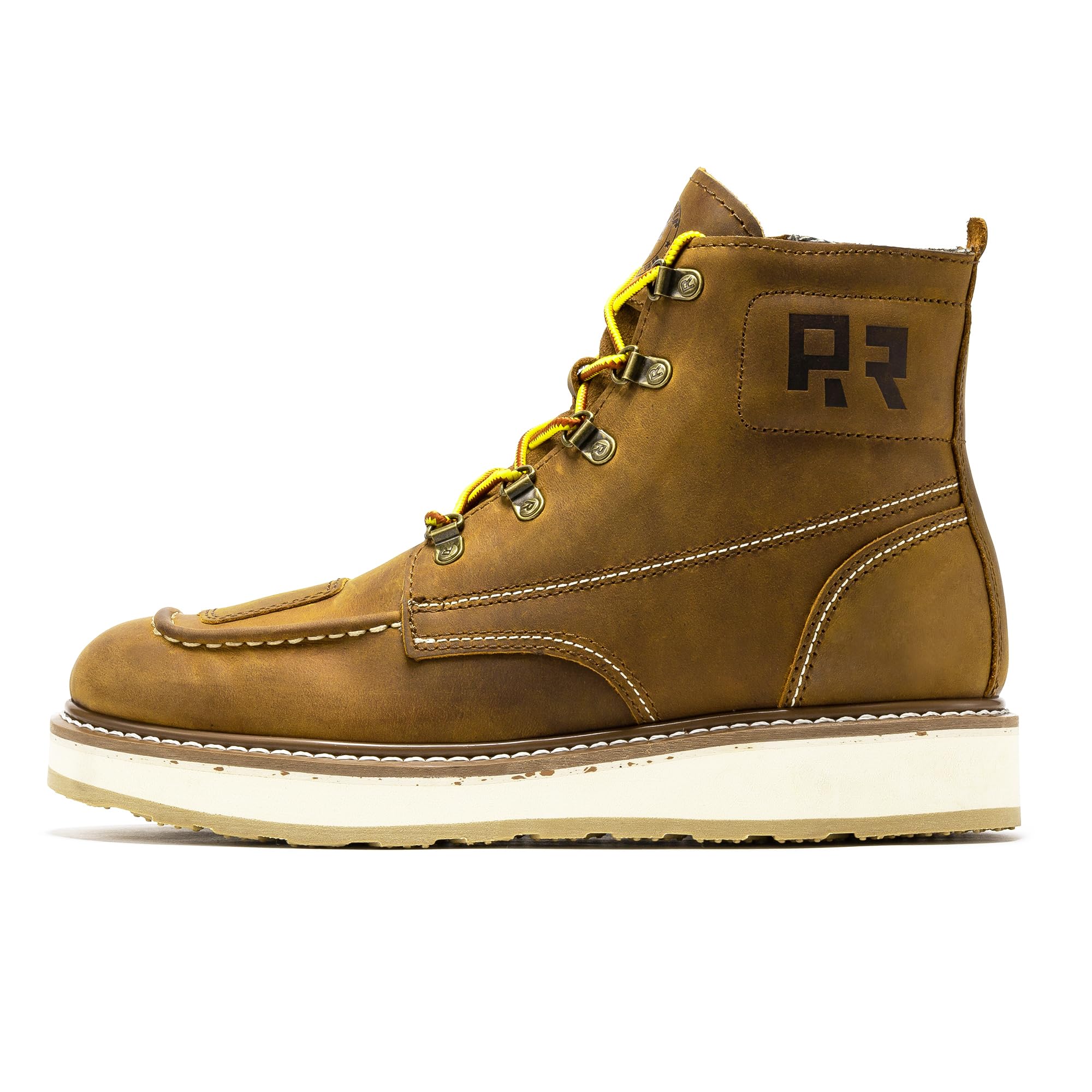
3. ROCKROOSTER Magnolia 6″ Side-Zipper Wedge Boots
Tie the laces once, then live in the side zip — with leather that breaks in soft.
Here is the real draw: lace these up to your comfort and set the knot for good, then use the YKK side zipper for everyday on and off. That matters if you are pulling boots on before an early shift or kicking them off after a ride. The thick leather starts stiff but gives quickly — a rider-style owner had them soft after about three wears. Construction is Goodyear welt, which stitches the sole to the upper instead of gluing it, so a cobbler can resole the boot down the road.
The weight is genuinely manageable at about 1.95 lbs per boot in a men’s US 10, which keeps a day of standing from dragging on you. Quality is the thing buyers praise most about this boot, and the fit runs wide enough for a forefoot with room to spare. One consequence of that thick leather and cork filling under the foot is a cushioned, supported feel rather than a mushy one.
The catch is water. The side zipper and lack of a gusseted tongue mean rain and puddles can find their way in, so treat it as a dry-condition boot, not a wet-weather one. A few owners note the creaking when new and some heel slip when sized without care. It is a stylish, easy-on leather boot first; a rain boot it is not.
A protective shift pad is added where the boot meets a motorcycle shifter, so the leather is not worn through by friction. Grab it if you want a good-looking wedge boot for riding, light work, and casual wear.
Worth grabbing for: riders and light-duty workers who want quick on/off and a leather boot that softens fast.
Not the one for: anyone who needs a boot to keep feet dry in steady rain or deep puddles.
4. KEEN Utility Men’s Kenton Mid Composite Toe Work Sneakers

Work-boot protection in a package that skates between the job and the weekend.
What sets this one apart is weight. Each shoe comes in at 18.3 oz / 519 g, and it sits on KEEN’s traditional wider footwear form — that is the wider last that gives your forefoot more spread than a standard sneaker-style work shoe. A composite toe protects your toes without the cold-transfer and heft of steel, and the casual skate-shoe look means you are not changing shoes when the shift ends.
What people rave about is the lightness paired with real toe protection, and the look earns a strong second-place nod in feedback. The grip holds on smooth concrete, even with coolant, oil, or transmission fluid on the floor — one reviewer noted the soles showed minimal tread wear despite that abuse. There is real toe room up front, which is exactly why so many wide-footed workers end up here.
Two things to know before you order. Sizing is genuinely mixed — several buyers find it runs large and go a half size down, and one size-14 buyer found the fit two sizes small, so check the size chart and be ready to exchange. The other is water: this boot is not waterproof, and water above the rubber sole soaks through in seconds. Size it right and it is a genuinely comfortable wide-fit composite-toe work sneaker.
Why the crew likes it
- 18.3 oz / 519 g per shoe — one of the lightest protective options in this group.
- Built on KEEN’s traditional wider form for extra forefoot room.
- Composite toe plus grippy soles that hold on oily concrete.
- Skate-shoe look works on the job and off.
Order with eyes open
- Fit is mixed — many go a half size down, and one size-14 buyer found it two sizes small.
- Not waterproof; water above the sole seeps in.
Pick it when: you want a light, wide composite-toe shoe for warehouse, assembly, or maintenance work.
Skip it when: your work puts you in standing water or rain for hours at a time.
5. 5.11 Tactical ATAC 2.0 8-Inch Side-Zip Duty Boots

A tall duty boot that shortens a wide-foot break-in to a couple of days.
Eight inches of ankle coverage plus a YKK side zipper sounds like a boot that fights your foot, but this one gives quickly. Even on wide feet, a short break-in is the pattern — a tight first day or two, then a fit that settles in. A full-length dual-durometer Ortholite footbed (a cushioned insole with two densities of foam) plus an Achilles heel flex zone let the boot bend where your foot wants to flex.
Where it shines is variable conditions. The full-grain leather toe and 840D nylon upper take abuse, a shock mitigation system softens hard landings, and the ASTM slip- and oil-resistant outsole holds on slick surfaces. One duty buyer in a condensed review wore a pair through jail work and praised the grip, the easy on/off, and how the sizing matched the chart. Another 30-year boot wearer switched from a premium brand to this one for the comfort at a lower outlay.
What it does not do is apologize for being a boot. It weighs 3.9 pounds, so it is not a lightweight sneaker comparison — more structure, more stability, and a little more heft than the composite-toe options higher up this list. If you are on your feet in varied, dirty, or wet settings and want a zippered boot that handles it, this is the one.
Built for the job: Leather and 840D nylon upper, waterproofing, and a slip- and oil-resistant outsole add up to a boot that handles mud, rain, and slick floors.
Quick to don: The YKK side zipper means you can suit up fast when every minute counts, without unlacing the boot each time.
Perfect for: public safety, security, and outdoor work where the terrain changes hour by hour.
Think twice if: you want featherweight footwear for an indoor, concrete-only day.
6. KEEN Utility Men’s Gibson Mid Composite Toe Work Boots

The safety toe that does not feel like one, thanks to a carbon cap and soft leather.
The carbon fiber safety toe here is the headline — a non-metal protective cap that meets ASTM F3445-21 and F2413-18 standards while feeling almost invisible inside the boot. That is the point of a carbon toe over a clunky steel one: your toes keep their room and the boot stays flexible when you kneel or step. The upper is full-grain water-resistant leather with a mesh liner, so feet stay cooler in warm weather than a fully waterproof boot would allow.
The comfort is what people note first. One buyer described them as feeling like a tennis shoe, and many rate the comfort and quality at the top of the feedback. The KEEN.ReGEN midsole resists compression, so the cushioning does not flatten out over a long shift. The outsole meets ASTM F2913-19 SATRA non-slip testing, which matters if you work around wet or oily floors. And the carbon toe means a mid-cut boot with real protection still moves with your foot.
Be honest with yourself on two fronts. The safety toe runs narrow for some buyers, especially less-wide feet, and a few find it rubs the top of the foot when kneeling — if you have a high instep, size carefully. Durability feedback is split between boots that hold up and a few that split within a couple of months. It is a lighter-duty industrial boot, so keep it off heavy construction and it earns its keep.
Your match if: you need a certified safety toe with a flexible, sneaker-like feel for light industrial work.
Not ideal if: you have a high instep or need a hard-wearing boot for heavy construction.
7. Timberland PRO Boondock Ultralight 6″ Comp Toe Waterproof
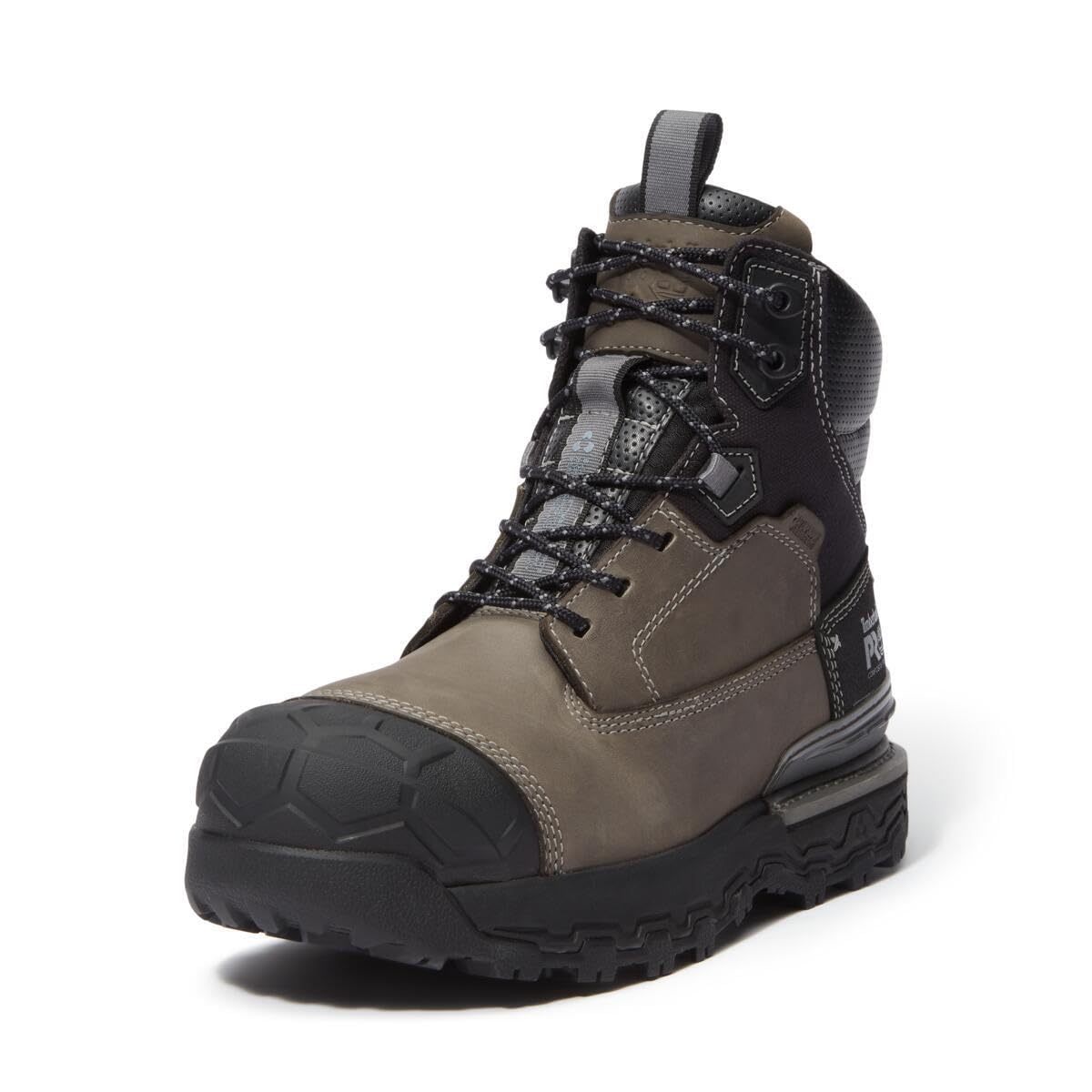
Industrial protection that stays dry in snow and slush without the usual boot heft.
For a hard-working site boot, the width matters as much as the protection, and the Boondock delivers both. A buyer who took a size 11 with wide feet found the toe box spacious while the boot stayed comfortable all day. The composite safety toe (a non-metal cap that shields your toes from impact) protects your feet. Electric hazard protection adds a second layer of safety. The internal waterproof, breathable membrane keeps wet out while letting sweat vapor escape — so a snow day does not turn into a soaked-sock day.
What buyers praise most is comfort — a full-grain Premium Timberland leather upper with Ever-Guard abrasion-resistant leather and molded TPU reinforcements for the rough patches. The HoverSpring foam midsole and ventilated anti-fatigue polyurethane footbed work together to cushion steps and spread pressure, which matters when you are walking on pavement all day. One buyer mentioned the HoverSpring midsole eases knee shock while walking, and several note the boots stay warm in winter. They look the part, too.
The fit is the split point. Most find it perfect, but a few report it slightly tight, so try a half size up if you are between sizes or plan on thick socks. There is also the occasional rain-leak report, which can happen when a boot meets deeper standing water than its design handles. And the Boondock Ultralight is bulky in profile — light for its class, not slim. For cold, wet, industrial work, it is a strong pick.
The cold-weather case
- Composite toe plus electric hazard protection for site safety.
- Waterproof membrane keeps feet dry in snow, ice, and slush.
- HoverSpring foam midsole and anti-fatigue footbed cushion long walks.
- Ever-Guard leather and TPU reinforcements handle abrasion.
The fine print
- Fit leans slightly tight for some — size up if you wear thick socks.
- Bulky profile and a rain-leak report when overrun by deep water.
Reach for this: when your shift runs through snow, slush, and freezing rain and you need a safety toe.
Look elsewhere: if you want a slim, low-profile boot for dry indoor work.
8. Ariat Men’s Rebar Lift 6″ Waterproof Composite Toe
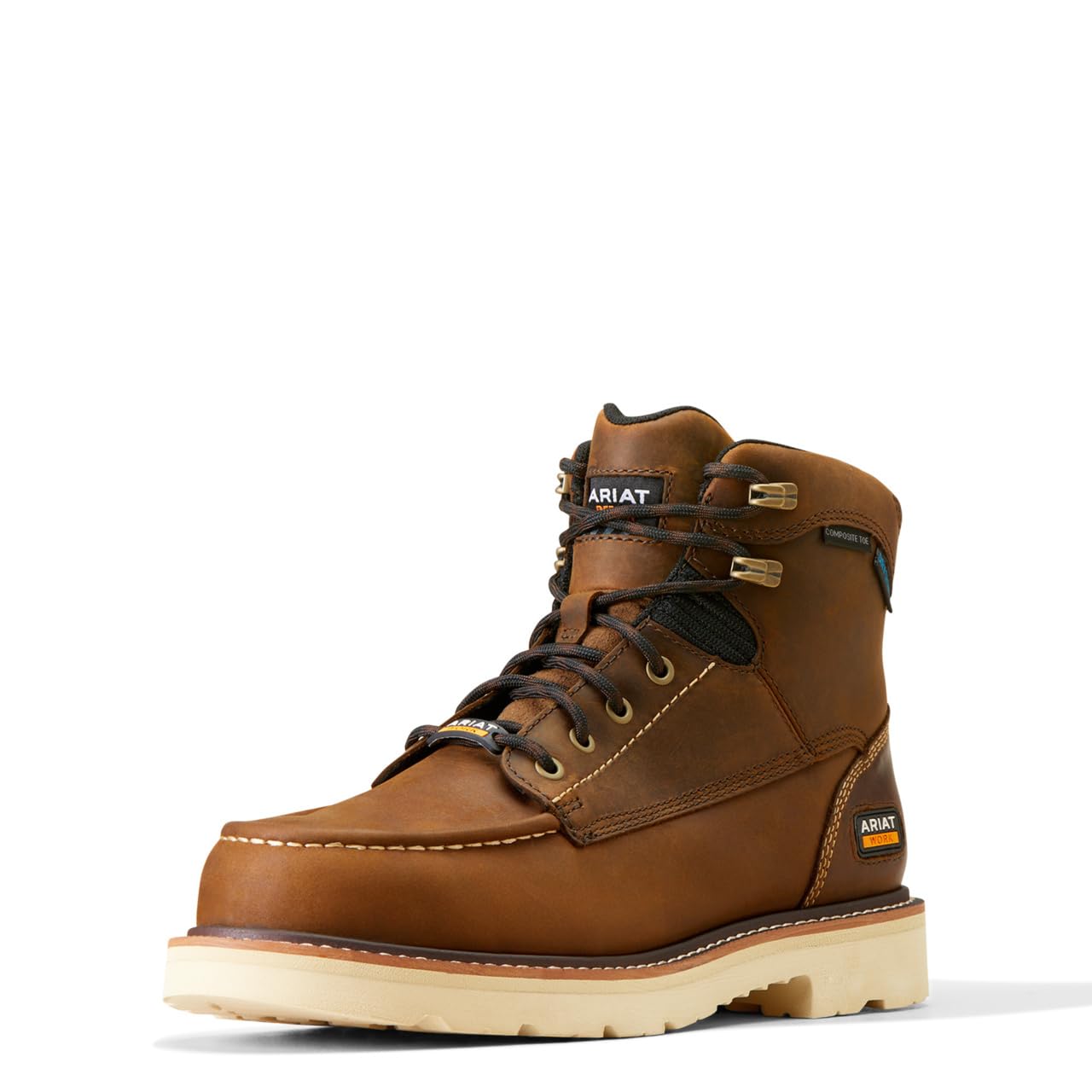
A waterproof composite-toe boot that feels like a high-top sneaker on concrete.
This boot’s defining feature is how little it feels like a work boot. Buyers describe it as wearing high-top basketball shoes, and one industrial worker standing all day said they finish the shift without feeling tired. The composite toe takes the sting out of impact while keeping the boot light, and the waterproof leather keeps feet dry when the site gets wet. The leather is rich brown with triple-stitched detailing at the heel and mid, so it also looks sharp when the shift ends.
The fit is the main thing to plan for. Several buyers find the collar (the padded opening around your ankle) runs big and size down a half size. Some say the composite toe pinches if your foot is wide — which is why sizing up to the wide width is the honest move if you are unsure. There is a real caution flag on the wider-foot fit and on heat: the boot runs warm, and one HVAC worker on a roof found feet overheated within a day. That is an environment trade-off — waterproofing that keeps rain out also traps warmth in.
Set against the Boondock above, the Rebar Lift is the softer, more flexible option and the better choice if you want sneaker comfort with a composite toe. It is not the hardiest boot here for punishing durability, and heavy users may wear the sole faster. But for standing, walking, and mixed duty work, it delivers the comfort people talk about most.
Comfort lead: Lightweight, waterproof leather and a composite toe combine for all-day wear that one refinery worker called dependable through the whole shift.
Sizing caution: The collar runs big for many buyers, so drop a half size — and if your forefoot is wide, choose the wide width.
Go for it: if you stand for long stretches and want a waterproof composite-toe boot that skips the break-in misery.
Best to avoid: if your work is hot-roof or boil-weather with little airflow and you need a cool-running boot.
9. Zamberlan Men’s 1996 VIOZ LUX GTX RR Backpacking Boots

The single boot here built to be resoled and passed down, not replaced.
This is the serious backpacking choice — stiff, supportive leather that can carry a heavy pack over rough ground and last long enough that a cobbler can refresh the sole rather than a landfill taking it. A true size 11.5US/46EU fits, with a slightly wider forefoot than other European brands, which lets you add a thicker insole or heavier socks without sizing up. The reinforced toe adds protection where you kick rocks and roots, and the leather can be oiled to stay water-resistant.
What owners praise most is quality of build, and the fit rewards patience. These stiff soles take break-in — a 4.5-mile hike can leave a heel hot spot that heals in about a week, and a buyer pushing a heavy pack over scrambles found the traction and ankle support sure-footed. One backpacker who has owned a pair for nearly a decade says the earlier version is still going. The new pair here is described as gorgeous, super comfortable, sturdy, and completely waterproof in a verified review.
The trade-off is real: this is not a weekend-warrior boot that feels broken in on day one. The stiff sole and high heel can cause initial arch cramping that settles after a mile or so, and it is heavier than the sneaker-style boots on this list. If you backpack with weight on your back and want a boot that lasts, the Zamberlan is worth it. If you want immediate softness for light walking, it will feel firm and slow to give.
Why backpackers pick it
- Reinforced toe and resoleable construction for long-term durability.
- GORE-TEX lining keeps feet dry on wet trails.
- Slightly wider forefoot than other European brands, with room for a thicker insole.
- Sure-footed grip and ankle support for rough terrain and heavy packs.
Before you commit
- Stiff sole and high heel demand real break-in time and patience.
- Heavier and firmer than the sneaker-style work boots here.
For the trail: if you backpack with a loaded pack and want one leather boot you can resole for years.
Pass if: you want instant softness for casual walking or a light, flexible daily shoe.
Know the Specs
Toe box shape and width
The toe box is the front section of the boot where your toes sit. A wide toe box gives your toes room to spread flat instead of stacking, which is what prevents the pinch that shows up as pain after hours on your feet. Leather uppers give a little, but a safety toe cap is rigid, so its width is fixed — pick a model with a roomy forefoot on day one rather than hoping it stretches.
Composite vs. steel safety toe
A composite toe is a non-metal protective cap; a steel toe is metal. Composite caps avoid the cold-transfer and heft of steel and often let the boot stay flexible at the ball of the foot. Steel is hardier for the heaviest abuse. Either way, the cap eats a little interior room, so a composite-toe boot with a wide last is the more comfortable choice for a broad forefoot.
Waterproof membrane vs. water-resistant leather
A waterproof membrane is a thin liner that stops liquid water getting in while letting sweat vapor pass out. Water-resistant leather repels light rain but can soak given enough time or standing water. Membranes suit cold, wet sites; water-resistant leather breathes better in heat. This is why waterproof boots can run warm.
Shank and midsole support
A shank is a stiff strip inside the sole that supports your arch and keeps the boot from folding. A midsole is the cushioning layer under your foot; on good boots it resists compression so it does not flatten by lunch. Together they decide whether a roomy boot feels supportive or floppy underfoot after a long shift.
Common Questions
Will a wide toe box boot fit if I normally wear regular width? How should I size?
Is a composite toe better than steel for a wide foot?
Do boots with a wide toe box need a break-in period?
Are wide toe box boots waterproof enough for rain and puddles?
Can I put my own orthotic or insole inside these wide boots?
How long should a wide toe box work boot last?
Is a soft moc toe better than a safety toe for toe room?
Do these wide toe box boots run true to size?
Are these boots suitable for standing on concrete all day?
What is the difference between the Timberland Redwood Falls and the Timberland PRO Boondock?
The Bottom Line
The winner for most people is the Timberland Redwood Falls Waterproof. It pairs a genuinely roomy toe box with a waterproof layer, a steel shank, and a break-in that is close to nonexistent — the complete everyday boot with wide-toe comfort. If your main pain point is a forefoot squeezed for years, the Orthofeet Granite gives you extra depth and a removable insole you can tune. The KEEN Kenton is the light, sneaker-feel option at 18.3 oz / 519 g per shoe. For cold, wet job sites, the Timberland PRO Boondock Ultralight keeps feet dry in snow and slush with a composite toe. For serious backpackers, the resoleable Zamberlan 1996 VIOZ LUX GTX RR is the one built to last years.
How we choose
We do not accept paid placement. Every pick is matched to a real buyer and a real use-case; we do not hands-on test units.
Sources
Specifications: manufacturer listings and product documentation. Review insights: verified customer reviews, as of October 2026. Pricing: not shown on this page (it changes often); check the current price via the retailer link.
As an Amazon Associate, Aappliancez earns from qualifying purchases. This does not affect which products we feature.