Disclosure: Some links in this post are affiliate links. As an Amazon Associate I earn from qualifying purchases, at no extra cost to you. Learn more
Specs are compiled from manufacturer listings and verified buyer reviews and can change over time — please confirm the key details on the product page before buying.
You broke something you love — a mug, a bowl, a plate your grandmother handed down — and now you want to put it back together with gold running through the cracks instead of hiding them. The catch is that kintsugi stands or falls on one thing: the resin. Pick a glue that never fully hardens, and your beautiful repair turns into a sticky, sliding mess. The five kits below cover the full range: a 72-hour food-safe epoxy, a 5-minute general-purpose epoxy, a linseed bio-resin, and two 30-minute slow-cure beginner kits.
This guide is built by comparing the manufacturers’ published specifications and the patterns across verified customer reviews, so you get each pick’s real strengths and trade-offs instead of marketing spin.
Some kits here set in five minutes and cure clear for everyday household fixes, while others take their time but leave a food-safe golden seam you can eat off. Read on to find the glue for kintsugi that matches your cure time, surface, and food-contact needs.
Top Picks

How To Choose The Best Glue For Kintsugi
Cure time and resin type decide whether your repair lasts a week or a decade. Before you buy a kit, you need to answer two questions: what are you repairing, and will that object ever hold food or go into a dishwasher?
Cure time is the number that shapes your whole repair
Cure time is how long the glue takes to reach full strength after you mix it. A fast-setting epoxy, like the 5-minute handling strength of the Starbond kit, lets you bond a handle back onto a mug almost immediately. But a fast cure also gives you very little time to reposition a piece once it starts to grab. Slower, food-grade epoxies give you far more working time — the iienjoy kit lists a 30-minute slow cure. The trade-off is simple: the Starbond’s 5-minute grab suits small breaks, while the iienjoy’s 30-minute slow cure suits careful, decorative seams.
Food-safe matters only if you eat off the repaired piece
Food-safe means the cured resin has been tested so it can touch food without leaching. The key word is cured — the resin has to harden completely before it is safe to use, and many kits also recommend gentle handwashing over a hot dishwasher cycle. If your repaired plate is purely decorative and just sits on a shelf, you can skip food-safe resin and buy for bond strength instead.
Match the glue to the material you are mending
Not every kintsugi glue grips every surface. Most two-part epoxies here bond ceramic, glass, and wood, but some also list metal, marble, concrete, and even jade. Check the compatible materials on the label before you buy a kit for a specific broken piece — the Kintsugi Repair kit bonds wood, metal, ceramics, glass, concrete, and precious stones, while the Starbond lists ceramic, glass, metal, and wood.
Side-by-Side Comparison
| Model | Best For | Full Cure Time | Food Contact | Bonds | Amazon |
|---|---|---|---|---|---|
| Kintsugi Repair kit: Modern Repair Kit – Gold★ Best Overall | Complete food-safe kintsugi kit | 72 hours | Food contact safe (cold foods) | Wood, metal, ceramics, glass, concrete, precious stones | Amazon |
| 8 oz. XL Starbond 5 Minute Epoxy Pro KitSpeed Pick | Fast general-purpose craft and repair | 24 hours | — | Ceramic, glass, metal, wood | Amazon |
| PLEARTY Kintsugi Repair Kit 50ml Linseed Resin | Eco-friendly beginner kit with video guide | — | Food-safe, dishwasher proof | Ceramic, glass, wood, marble, concrete | Amazon |
| iienjoy Kintsugi Repair Kit, 4 Colors | Gifting and mindful crafting | 24 hours (dishwasher-safe after) | Food safe | Ceramics, glass, metal, jade, wood | Amazon |
| iienjoy Kintsugi Repair Kit, 4 Colors | Gifting and mindful crafting | 24 hours (dishwasher-safe after) | Food safe | Ceramics, glass, metal, jade, wood | Amazon |
Detailed Reviews
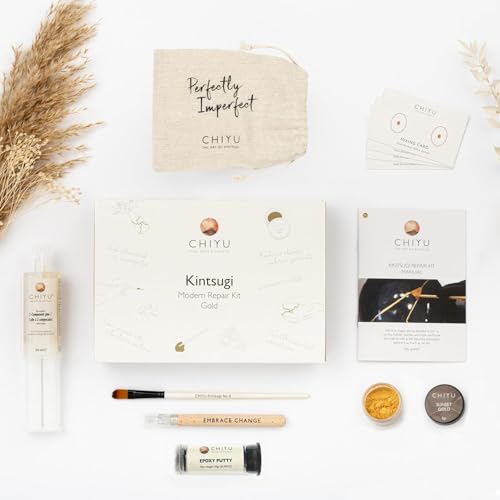
1. Kintsugi Repair kit Gold
Our pick — 4.5★ from 400+ verified ratings; the strongest balance of quality and price.
The do-it-all kit that lets a broken plate hold your charcuterie again.
You get the full kintsugi ritual — mixing the resin, fitting the broken pieces, then brushing gold powder into the seam — and a bowl you can actually use afterward. The CHIYU glue is a transparent two-component epoxy (a glue that only hardens once you combine two liquids). It bonds ceramics, glass, marble, and concrete, and the bond is waterproof, so a repaired mug won’t come apart when you wash it.
What separates it from every other pick here is patience and permanence. Its full cure time is 72 hours, the longest on this list. Compare that to the Starbond’s 24 hours — the difference is real when you are sealing a seam you want to last. Once fully cured and used as directed, the repair is rated for limited contact with food, which means cold items like bread, pastries, cheese, and charcuterie are fine. It is dishwasher safe, though gentle handwashing is preferred to protect the golden finish.
Buyers report that it simply works: pieces turn out “really good,” and they note the epoxy-based bond is “super strong,” even though it is not traditional kintsugi. The kit includes a manual printed in six languages, so you can follow the steps even if English is not your first language. It holds enough material to repair roughly 6 to 8 medium-sized broken items. One honest caveat: the molding clay can be stubborn to blend, so if you are patching a large chip, expect to use more of it than you guessed.
What Earns The Top Spot
- 72-hour full cure for a durable, permanent seam
- Food contact safe for cold foods once cured
- Bonds wood, metal, ceramics, glass, concrete, and precious stones
- Manual in six languages and enough material for 6 to 8 repairs
Where It Asks For Patience
- 72-hour cure means a long wait before the piece is usable
- Not for hot liquids, microwaves, or ovens
- The molding clay can be hard to blend on large chips
Best for: anyone repairing a food bowl, platter, or mug who wants the strongest, most permanent result and does not mind waiting.
Think twice if: you need to reattach a handle and use the piece this evening — the 72-hour cure sets the schedule.
2. Starbond 5 Minute Epoxy Pro Kit
Five minutes of working time, then a flexible 2,600 lb hold.
If your morning routine depends on a cracked mug that needs its handle back by breakfast, this is the kit. The Starbond reaches handling strength in about 5 minutes and fully cures in 24 hours — a fraction of the Kintsugi Repair kit’s 72-hour wait. At 2,600 lb shear strength, it is built to grip under real load, and it mixes 1:1 by volume, which removes the guesswork many beginners hit.
The eighth-ounce size is the value story here: a small amount goes a long way. Owners use it on knife handles, woodworking, lathe projects, and furniture fixes, and report it holds under high stress during turning. The flexible toughened formula is designed to absorb vibration and stress instead of cracking the way a brittle glue might, which suits repairs on pieces that get handled.
A few buyers have noted a batch that took longer to cure (harden completely) and stayed rubbery instead of going rock hard — so if you are buying it specifically for a decorative kintsugi seam, mix a small test batch first. The bigger issue most people mention is the smell, which is strong while it sets. The one-two-punch advantage over the food-safe kits is speed; the disadvantage is that this is a general-purpose epoxy, not a food-safe resin.
The speed advantage: five-minute handling strength and a 24-hour full cure mean you can bond a break and be back to using it far sooner than the 72-hour Kintsugi Repair kit.
The honest trade-off: general-purpose epoxy, not food-safe — treat this as a strong craft and repair glue rather than the resin for the plate you eat off, and mind the smell while it cures.
Reach for this if: you want fast, strong, flexible bonds for wood, knife handles, furniture, and everyday ceramic cracks.
Look elsewhere if: your repaired piece needs to touch food — none of the day-to-day food-safe picks can be beaten here on safety.
3. PLEARTY Kintsugi Repair Kit 50ml

A plant-based resin that smells natural and leaves a beginner-friendly golden line.
This is the pick for the crafter who cares what is inside the tube. The PLEARTY kit uses a bio-based epoxy resin made from linseed — a plant oil — and describes it as BPA-free and low VOC, meaning it gives off fewer of the chemical fumes a standard epoxy can. Once cured, the repaired ceramics are rated safe for food and can go into the dishwasher, which makes it one of the more practical picks for a plate or bowl you actually use.
The beginner support stands out. You get a 15-page booklet plus a free online video tutorial that walks you through mixing the gold powder to finishing the seam. A dual syringe handles the measuring, so you get a consistent mix without fuss. The kit is often bought as a gift, with Japanese-inspired kraft packaging, three different tints of gold, and two practice cups to get your hand in before you touch anything precious.
The trade-off buyers hit is firmness and technique. A recurring note is that the resin can be slow or reluctant to harden for some users, and the gold liquid can be tricky to apply cleanly — one buyer described the result as being “like a kid drawing out of line.” The nozzle on the two-part glue and the paintbrush are also described as one-time-use, so plan to buy extras. That said, the bond is called smooth, strong, and durable by people who get the technique down.
Why it earns its place: a linseed-based, BPA-free, low-VOC resin that is dishwasher proof once cured, with a 15-page booklet and a video guide behind it.
The technique tax: apply the gold liquid in tiny amounts and expect the glue nozzle and brush to be single-use, so buy spares before you start.
Best for: eco-conscious beginners and gift-givers who want clear guidance and a natural-scented resin.
skip it if: you want a simple to use, mess-free bead of gold on the first try — this kit rewards a steady hand.
4. iienjoy Kintsugi Repair Kit, 4 Colors Food Safe Kintsugi Kit for Ceramics
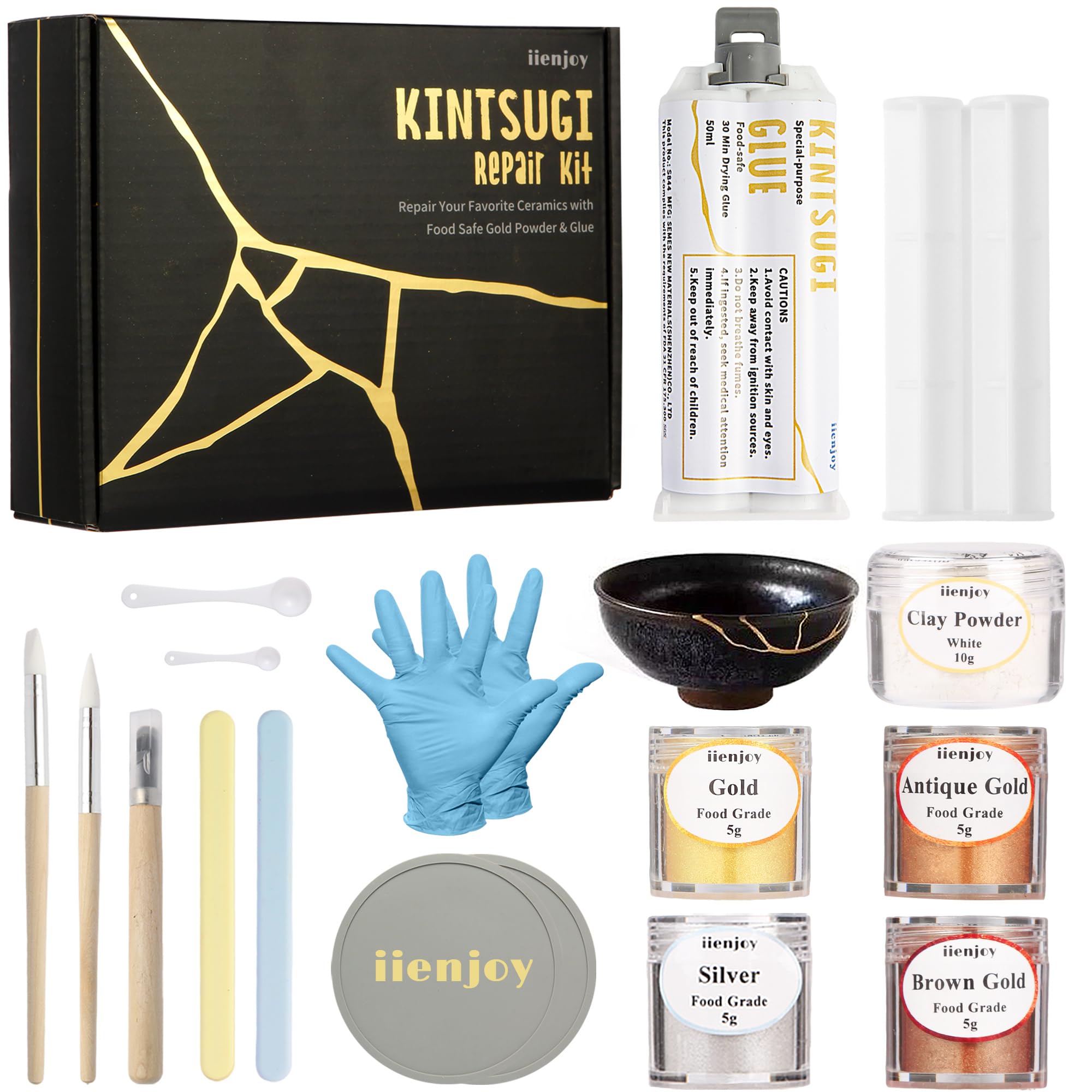
Four metallic pigments and a slow cure that gives your hands room to work.
What you get here is a complete starting point: a 50ml food-safe AB epoxy glue, four metallic-colored pigments, gloves, wooden sticks, and reusable silicone mixing tools that wash up clean. The glue runs a 30-minute slow cure, which is the opposite philosophy to the Starbond’s quick grab — if you are nervous about lining up a broken rim, the extra working time is forgiving. The finished repair is rated safe for food and dishwasher-safe after 24 hours.
The kit is loved for a simple reason: it explains itself. Buyers fix chips in mug rims, hairline cracks in glazed platters, and broken handles, and describe the instructions as easy to follow with helpful images. The three gold shades and one silver let you match the tone of the repair to the piece. It is also often bought as a mindful, gift-worthy craft project rather than a pure repair job.
Two things to know before you buy. The mica pigment (a shimmering mineral powder) in this kit can look less like real metal than the gold in a premium kit, and the glue tube carries no measurement markings, so squeeze carefully — that is a technique adjustment rather than a flaw. Watch too for the rare kit that arrives with one chamber of the dual dispenser already hardened; if yours does, that is a packaging fault worth swapping, not a sign the design is bad. And like the other food-safe pick here, this is not meant for real liquid gold-luster perfectionists on the first attempt.
The beginner-friendly case: a 30-minute slow cure plus reusable silicone tools and clear image-led instructions make first-time repairs far less stressful.
Set expectations: the four pigments are a coloring option, not genuine metal powder, so the finish reads more decorative than the pricier gold kits.
Reach for this if: you are new to kintsugi, want four color options, and value forgiving working time over speed.
Look past it if: you want a hyper-realistic metal gold finish on your first repair.
5. iienjoy Kintsugi Repair Kit, 4 Colors Food Safe Kintsugi Kit for Ceramics

The single kit that fixed a glass table, a mug handle, and a wall hanging.
This is the same iienjoy formula as the pick just above, and it earns a spot on its own because of how widely the food-safe AB epoxy gets pushed — not just on fragile ceramics. Owners have used it to reattach a broken mug handle, mend two broken ceramic wall hangings, and even repair a glass table after a foot went through it, then set things back on top without worry. That range is the argument: a 50ml tube of food-safe resin with four metallic pigments covers a lot of household damage.
The protocol matches the sibling kit. The glue runs a 30-minute slow cure for forgiving placement, then the repaired piece is dishwasher-safe after 24 hours. You get gloves, wooden sticks, and silicone tools that clean up easily and last beyond the first project. For a repair that is more about structure than decoration — a table, a heavy wall piece — the sturdy result after curing is what buyers point to.
Two cautions carried over honestly. Pigment goes airborne easily when you open the powder, so work over a tray and away from drafts. And the instructions do not hand-hold every step, so some owners mention pieces slipping despite holding them for a full 10 minutes — spreading the glue thinner and taping the break while it sets solves most of that. If you are buying this as a gift, the packaging and the four-color palette make it a thoughtful present for anyone who likes mindful making.
The proof in use: the same food-safe AB epoxy has held a repaired glass table under everyday load and survived as dishwasher-safe after 24 hours.
Small habits that help: tape the break while the 30-minute slow cure does its work, and open the pigment powder over a tray to catch the dust.
Points in its favor: a versatile food-safe resin for structural repairs on ceramic, glass, and wood, with four pigments and reusable tools.
Heads up: the instructions are light on detail, so beginners should expect a little trial and error on their first break.
Know the Specs
Full cure time
Full cure time is how long the mixed glue takes to reach its final, hardest state — the point at which the repair is as strong as it will ever be. The Kintsugi Repair kit here lists 72 hours, the longest of these picks, while the Starbond lists 24 hours. A longer cure is not automatically better; the Kintsugi Repair kit’s 72 hours simply means more time before the piece is ready to use than the Starbond’s 24. Fast-curing glues like the Starbond’s five-minute handling strength are what you reach for when a handle needs to be back on a mugs today, and the slower food-grade epoxies are what you use for careful decorative seams.
Food-safe resin
Food-safe describes a resin that has been tested so the cured repair can contact food without leaching (releasing chemicals into your meal). The detail that matters most is the word cured — the resin must harden completely first. Most of these kits also distinguish what the repair can touch: the Kintsugi Repair kit is rated for limited contact with cold foods like bread, cheese, and charcuterie, but is not meant for hot liquids, food storage, or the microwave. Others list the piece as dishwasher proof once cured. If your piece is purely decorative and never touches a meal, food-safe status may not matter to you — the Starbond’s 2,600 lb shear strength is the better trade.
Common Questions
Is kintsugi glue actually safe to eat off once it is cured?
How long do I have to wait before the repaired plate or mug is usable?
Can I put a kintsugi-repaired bowl in the dishwasher?
Do these kits work on glass and wood or only ceramic?
Is a fast-curing epoxy or a slow one better for a first kintsugi repair?
How much material does one kit actually give me?
Why does my gold powder look less shiny than real gold?
Can I fix a large chip or a missing piece of a broken bowl?
Why did one side of my dual-chamber dispenser arrive hardened?
Which is better for a decorative kintsugi on a treasured vase versus everyday dishes?
The Bottom Line
For most people repairing ceramics they actually use, the glue for kintsugi winner is the Kintsugi Repair kit: Modern Repair Kit – Gold because its 72-hour full cure delivers the most durable, food-contact-safe seam of the group. If you want fast, strong, flexible bonds for wood, knife handles, and everyday cracks, grab the 8 oz. Starbond 5 Minute Epoxy Pro Kit. And for a first-time, eco-friendly project with clear guidance, the PLEARTY Kintsugi Repair Kit is the one to reach for. Whichever you pick, mix a small test batch before you touch a treasured piece — a few minutes of testing saves a whole repair.
How we choose
We do not accept paid placement. Every pick is matched to a real buyer and a real use-case; we do not hands-on test units.
Sources
Specifications: manufacturer listings and product documentation. Review insights: verified customer reviews, as of October 2026. Pricing: not shown on this page (it changes often); check the current price via the retailer link.
As an Amazon Associate, Aappliancez earns from qualifying purchases. This does not affect which products we feature.