Disclosure: Some links in this post are affiliate links. As an Amazon Associate I earn from qualifying purchases, at no extra cost to you. Learn more
Specs are compiled from manufacturer listings and verified buyer reviews and can change over time — please confirm the key details on the product page before buying.
You want a tile that stays glued to porcelain and never lets go. Most glues fail at that. Some grab hard for a day and then let go. Others need a bucket, a trowel, and a dust mask. A backsplash, a chipped plate, and a hollow floor tile each need a different adhesive. Below are five adhesives that each solve a different porcelain problem, sorted so you can find your job fast.
This guide is built by comparing the manufacturers’ published specifications and the patterns across verified customer reviews, so you get each pick’s real strengths and trade-offs instead of marketing spin.
Porcelain is slick and non-porous, so it needs a glue that grips a smooth surface instead of soaking in like concrete. A loose floor tile, a cracked teacup, and a shower hook all call for different chemistry. Here is what actually works.
Top Picks
How To Choose The Best Adhesive for Porcelain
Start with the shape of your problem, not the bottle. A wall tile that needs to hang for years behaves differently from a teacup handle that broke this morning. Run your finger over the surface you are bonding. If it feels glassy and cold, you have porcelain, and that changes everything about which glue will hold.
Match the glue to the job, not the label
A liquid cyanoacrylate, the watery stuff that wicks into cracks, is built for small, tight breaks in china and cups. It sets in seconds and dries see-through so the repair line fades. A two-part epoxy paste is built for chips and gouges in tile, because it cures into something hard enough to sand flat. A tile mat replaces mortar entirely on a wall. The wrong type fights you the whole way. The right one finishes the job in minutes.
Porcelain is smooth, and smooth is the enemy
Most adhesives grip by soaking into a rough, porous surface. Porcelain does not soak. Its surface is dense and non-porous, which is exactly why it wipes clean in a bathroom. That same quality means your glue has to rely on surface grip and chemical bonding instead of absorption. Clean the tile first, dry it fully, and skip any dusty or textured wall, because those surfaces give the glue nothing solid to hold.
Cure time and cure strength are two different numbers
A glue can hold in 15 seconds and still not be finished curing. Several products here set fast but want a full day before they reach their final strength. Read both numbers before you start. If the tile will carry weight or get bumped, wait out the full cure rather than trusting the initial grab. Rushing the cure is the most common way an otherwise good repair fails.
Side-by-Side Comparison
| Model | Best For | Form | Full Cure Time | Compatible Materials | Amazon |
|---|---|---|---|---|---|
| MusselBound Adhesive Tile Mat★ Best Overall | Wall tile without mortar | Peel-and-stick roll | — | Ceramic | Amazon |
| LEENEXUS Super Glue for CeramicBest for Invisible Repairs | Invisible china and cup repairs | Liquid (cyanoacrylate) | 24 hours | Glass, Metal, Rubber, Leather, Plastic, Ceramic, Porcelain | Amazon |
| Grohe Essentials Accessory Adhesive | Drill-free bathroom accessory mounting | Paste (tube) | 24 hours | Plastic | Amazon |
| Ankita Tile Repair Kit | Color-matching floor tile chips | Two-part epoxy paste | — | Ceramic, Porcelain | Amazon |
| Fix-A-Floor Loose Tile Repair PRO Pack | Re-bonding loose and hollow floor tile | Liquid (injectable tube) | 24 hours | Ceramic, Engineered Wood, Marble, Stone, Wood | Amazon |
Detailed Reviews
1. MusselBound® Adhesive Tile Mat with Spacers
Our pick — over 4★ from 250+ verified ratings; the strongest balance of quality and price.
The roll that replaces the mortar bucket entirely on a porcelain backsplash.
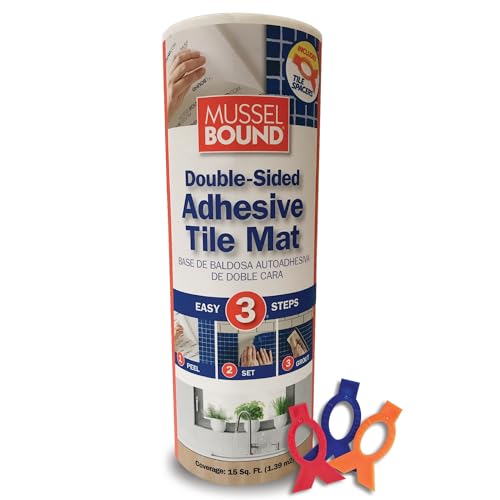
This is the pick for anyone tiling a wall who does not want to mix powder, haul a trowel, or wait on thin-set to cure. It is a double-sided adhesive mat on a roll, and it rolls out 15 sq ft of coverage from a 12 inch by 15 foot strip. Cut it with scissors, press it to a clean wall, and your tile sticks to the face of it. No bucket, no dust, no mixing mistakes. That last part matters more than you might think, because most first-time tile jobs go wrong at the mixing stage.
The bond holds up in the long run. A backsplash done with this mat was still solid a year later with no tiles dropping, and the same story repeats across kitchens and tabletop projects. The thing people praise most is the build quality of the hold itself — two buyers’ worth of crowd confidence sits there, well ahead of the next thing they bring up. What wins people over after that is how quickly the sheet goes up, because there is no mortar to mix and you can grout the same day. It also lifts off cleanly if you change your mind, and it does that without wrecking the drywall underneath, which is a rare trick for a tile adhesive.
The catch is surface prep, and it is not optional. The mat wants a smooth, even wall, so textured or uneven surfaces will not give it a solid grip. There is also an honest split in how the stickiness holds up over time — some porcelain and mosaic jobs stay put for years, while a few report tiles working loose. That gap usually traces back to a dusty or bumpy wall rather than the mat itself, so clean and level your surface first and press each tile firmly.
What earns it the top spot
- Covers 15 sq ft from one 12 inch by 15 foot roll, enough for a standard backsplash run
- Grout immediately — no mortar mix and no dry time before the next step
- Mosaic sheets and glass tile cut with scissors and hold their place on the wall
- Lifts off cleanly if you change the layout, and spares the drywall underneath
Where it asks more of you
- Needs a smooth, clean wall — textured or uneven surfaces will not hold
- Adhesion holds for some jobs and weakens on others, so prep decides the result
Your job if: you want a porcelain or ceramic backsplash up without mixing a single batch of mortar.
Think twice if: your wall is rough, painted, or anything less than smooth and level.
2. LEENEXUS Super Glue for Ceramic – 40ML Liquid CA Adhesive
The watery glue that hides inside a hairline crack instead of sitting on top of it.
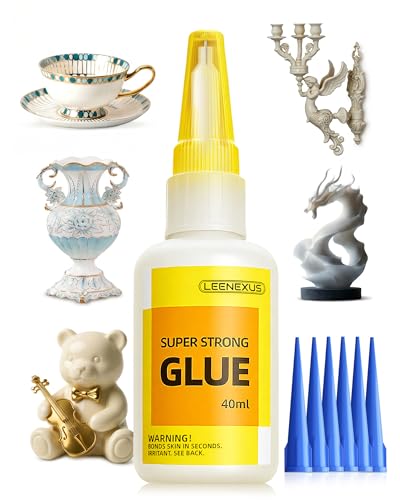
Broken china and cracked porcelain vases are a different problem than a wall. You want a repair nobody can see, which means the glue has to disappear into the break rather than glob over it. This one is a water-thin liquid that wicks into hairline cracks by capillary action, the same way a paper towel pulls in water. It forms a bond layer thin enough to cure clear, so the repair line all but vanishes. That is the whole reason to reach for it over a thick gel.
You get more usable glue out of the bottle because it is built to stop waste. The 40ML supply includes 6 precision tips (thin nozzles for tight spots), a cleaning needle, a dual-threaded cap, and an airtight seal that keeps humidity out — humidity is what hardens an open bottle of this type of glue from the inside. Leave it standing upright and capped and it stays usable. The bond cures see-through and holds up to 212°F, so a mug that sees hot coffee stays fixed, and it shrugs off washing.
Speed is a two-edged sword here. It sets in 15 to 45 seconds, but the full cure takes 24 hours. So the piece grabs fast and still needs a full day before you trust it. You also apply a tiny drop and no more, since too much glue slows the bond and can leave a whitened haze. Keep acetone nearby for drips, but know it can damage some finishes. Handy for more than ceramics too — the same bottle reattached a rubber sandal lift and re-bonded a loafer sole, which is why shoe repair shows up in the reviews as much as plates do.
What makes it worth it: a seethrough, fast-grabbing bond on a 40ML bottle with 6 tips, so you can repair a beloved cup without the glue line giving you away.
Buy it for: fine china, mugs, decorative porcelain, and any clean break where looks matter.
One honest limit: the thinness that hides the seam also runs fast, so you need a steady hand and a small drop.
3. Grohe 40915000 Essentials Adhesive for Accessories

Grab this if you rent and want a towel hook on the tile without touching a drill.
Renters and anyone who hates drilling into glazed tile should look here. This is a white paste resin for hanging bathroom accessories — a towel hook, a soap dish, a shelf — straight onto tile without screws. It is meant for porcelain-style surfaces and works on tiles, marble, stone, glass, cement, wood, plastic, and metal. Clean the surface first and the bond takes hold; one buyer mounted a towel hook this way and it held firm for two years without a wiggle.
Two things to plan around. First, the cure takes 24 hours, so whatever you hang stays propped or supported for a full day. Second, the tube is small — it weighs in at a hair under an ounce — so a big accessory or a very rough surface will empty it faster than you expect. The syringe-style applicator is the standout feature, because it lets you lay a precise bead along the exact back edge of a bracket rather than smearing paste across the tile. It also cleans up off glazed porcelain more easily than off porous stone, which is a quiet advantage if you ever want to remove the fixture.
This one is for smooth, glazed surfaces like porcelain tiles. It is not suitable for walls with wallpaper, plaster, or cladding, so rough or painted walls are the wrong home for it. The crowd behind it is large and mostly happy — comfortably past eight hundred owners with a solid score, and buyers report it does what it promises once you clean the surface and respect the cure time.
Pick it if: you rent, you hate drilling glazed tile, and you are hanging a light bathroom fixture.
Pass if: your wall is wallpapered, plastered, or clad, or your fixture is heavy.
4. Ankita Tile Repair Kit for Chips & Cracks
A hard-curing filler for gouged floor tile that you can tint to match the shade around it.
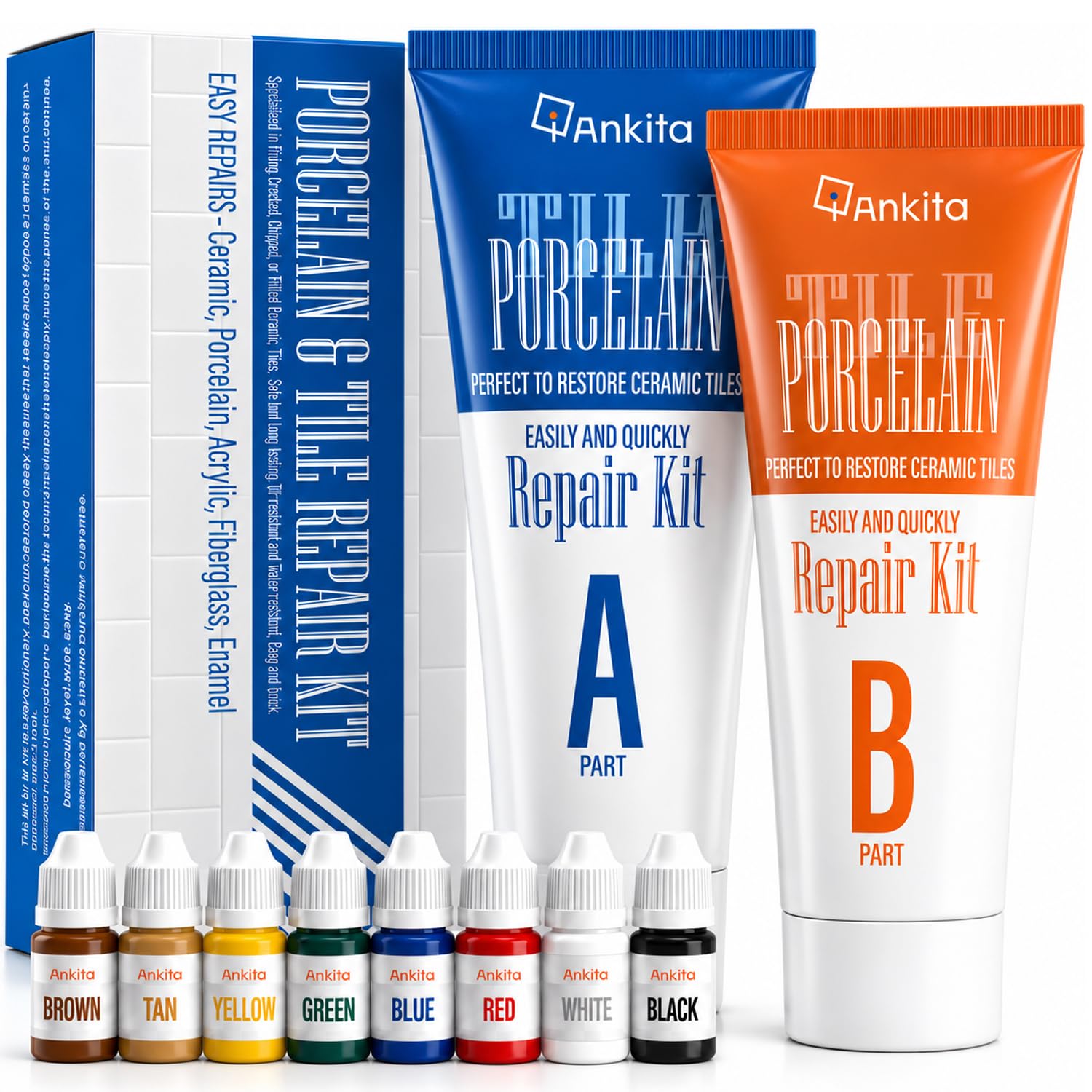
When a chip or gouge scars a floor tile, you have two choices: live with it or replace the whole tile. This kit exists to make the first option look decent. It is a two-part epoxy paste, mixed from Part A and Part B, that fills chips, cracks, holes, and broken edges on porcelain and ceramic tile. The repair cures hard and non-shrinking, so you can sand it level with the tile face instead of feeling a lump underfoot. It is rated water-resistant after a full cure and built to take everyday floor traffic.
Pigments are the reason someone picks this over a plain white filler. A set of dyes lets you nudge the color toward white, off-white, gray, beige, almond, and other tile shades, so a patch on a beige floor does not glare white. The kit is as approachable as a tile repair gets, and ease of use is its clear strength — well ahead of any other single point the reviews raise. The instructions, tools, and tint ship together, and one china repair matched so well the chip all but disappeared. If you want the short answer from buyers: a mended plate came out looking close to original, and the reviews sum it up as a strong result for a small repair job.
Two things to go in knowing. It is built for localized damage — small chips and cracks — not for a broken tile you need to hold weight. And color matching is the honest weak spot: the tint works best when you creep up on the shade a little at a time, because the pigments are so concentrated that a nudge too far overshoots. Mix a tiny amount first and test a corner. A few also noted the black bottle actually reads green, so if you need true black, plan to source it separately.
The value read: one kit repairs many small spots and can save you from pulling an otherwise fine tile, which is the entire point of a filler like this.
Where it stumbles: color matching takes practice, and the pigments are strong enough that a heavy hand overshoots the shade fast.
Reach for it on: small chips and cracks in floor or wall tile you want to blend in without replacing the tile.
Skip it for: large breaks or any repair that needs to carry real weight — this is a cosmetic filler for small damage.
5. Fix-A-Floor Loose Tile Repair Adhesive PRO Pack
The hollow-tile fix you inject through a drilled hole instead of tearing up the floor.
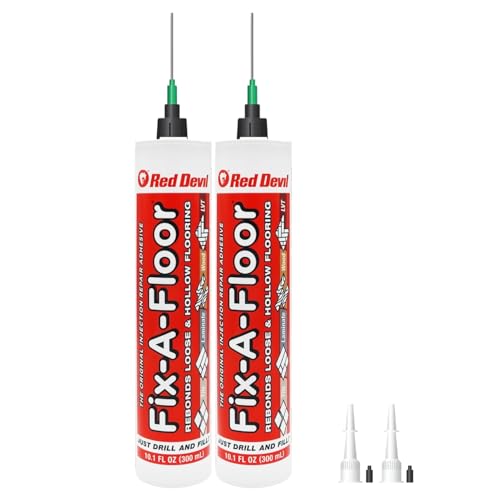
If a floor tile has gone hollow and thuds under your heel, you do not have to pry it up. This kit re-bonds the tile from underneath. You drill a small hole, inject the adhesive into the void, and let it cure into a firm base so the clack goes quiet. It is compatible with ceramic, engineered wood, marble, stone, and wood, so a mixed floor is fair game. The PRO pack ships with 2 tubes at 10.1 oz each, 2 syringe adaptors with resealable caps, and 2 blunt steel injection needles.
This method works, and it earns repeat buyers when it does — owners have ordered more tubes after their first floor came out solid, and one took three years and fixed more than twenty tiles. The process rewards patience more than muscle: drill, inject, and let it cure. After a full 24-hour cure the tiles firm up and lose the hollow thud. Cleanup is genuinely easy, since stray adhesive wipes off with plain water before it sets.
The friction is in the tooling, and it shows up in the reviews. The two included drill bits are a common complaint — several broke immediately, so buying a carbide bit ahead of time is worth it. The tube also drips and leaks during injection, so keep a cloth or a box underneath. The instructions leave some owners guessing, and the tube wants a caulk gun that the brand does not include. Buy a proper caulking gun, expect a caulk-gun cartridge to flow slowly, and the job goes far smoother than fighting it barehanded.
Why it still earns a spot
- Quietens loose and hollow floor tile without pulling a single one up
- 2 tubes of 10.1 oz cover a lot of tiles, and water wipes the drips away
- Cures firm enough to end the hollow thud after a full 24-hour wait
What owners grind against
- The two included drill bits are weak — plan on a carbide bit
- Leaks and drips during injection; keep a cloth under the work
- Needs a caulk gun you supply, and the directions leave gaps
Worth it for: a floor of loose, noisy tiles you would rather inject than rip out.
Not for: floating floors, which the maker says to leave alone, or anyone unwilling to buy the right caulk gun.
Know the Specs
Cure time — fast grab versus full strength
Almost every adhesive has two speed numbers, and confusing them is the top cause of a failed repair. The first is set time, how long the glue needs to grab and stop moving. The second is full cure, how long before the bond reaches its real strength. A liquid ceramic glue here grabs in 15 to 45 seconds but wants a full 24 hours to finish. Several picks in this guide, including the mounting paste and the tile repair filler, name 24 hours as the full cure. Respect the longer number before you load the repair with weight or let anyone lean on it.
Why porcelain needs a specific kind of glue
Porcelain is fired dense and smooth, so its surface does not soak up liquid the way a brick or a piece of raw wood does. Adhesives that grip by soaking in will struggle here. What works instead is a product built to bond to a slick surface directly — a water-thin liquid that wicks into a crack, a two-part epoxy filler that cures into something you can sand, or a peel-and-stick mat that holds the tile to its face. Clean the tile and dry it fully before you bond, because dust and moisture both weaken an otherwise sound grip.
Common Questions
Can I glue tile directly onto a painted or tiled wall?
How long before I can grout the wall tile?
Is liquid ceramic glue stronger than epoxy paste for porcelain?
Will these adhesives hold on a shower or bathroom wall?
Can I fix a cracked teacup or plate with an adhesive for porcelain?
What do I need besides the bottle to fix a loose floor tile?
How do I color-match a tile chip repair so it blends?
Are these glues safe around food and drink surfaces?
Why does my adhesive dry out in the tube between uses?
Can I use a wall adhesive to repair a cracked plate instead?
The Bottom Line
For most porcelain jobs, the adhesive for porcelain winner is the MusselBound Adhesive Tile Mat because it removes the mortar-mixing step that ruins most first tile jobs, and it holds up over the long run. If you are fixing a broken cup or plate and want the seam to disappear, the LEENEXUS Super Glue for Ceramic is the one to reach for. And if a floor tile has gone hollow and noisy, the Fix-A-Floor Loose Tile Repair PRO Pack lets you fix it through a small hole instead of pulling up the floor. Each one solves a specific porcelain problem better than a generic glue.
How we choose
We do not accept paid placement. Every pick is matched to a real buyer and a real use-case; we do not hands-on test units.
Sources
Specifications: manufacturer listings and product documentation. Review insights: verified customer reviews, as of October 2026. Pricing: not shown on this page (it changes often); check the current price via the retailer link.
As an Amazon Associate, Aappliancez earns from qualifying purchases. This does not affect which products we feature.