Disclosure: Some links in this post are affiliate links. As an Amazon Associate I earn from qualifying purchases, at no extra cost to you. Learn more
Specs are compiled from manufacturer listings and verified buyer reviews and can change over time — please confirm the key details on the product page before buying.
The short answer: the Elmer’s E855 six-pack is the pick that hides nail holes in baseboard and trim with the least fuss, and the Spackle Color Match kit is the one to grab if your walls are anything other than plain white. Everything below is sorted by what you’re actually filling — bare trim, painted drywall, real wood furniture, or a hollow anchor hole.
This guide is built by comparing the manufacturers’ published specifications and the patterns across verified customer reviews, so you get each pick’s real strengths and trade-offs instead of marketing spin.
Colour is the deciding factor more often than people expect, so the picks lean hard on matching: how many pigment options you get, whether the filler dries white or clear, and whether it needs paint over the top. That single question — paint over it or not — shapes this whole list of nail hole filler picks.
Top Picks
How To Choose The Best Nail Hole Filler
A nail hole is small, but it is not shallow. The nail pushed wood fibres out of the way on the way in, and a filler that cannot bridge that little crater will dry and leave a visible dip where the paint sits in a hollow. So the first thing you want to know about any filler is whether it dries hard enough to sand flat and stay flat.
Decide whether you are painting or matching
If the trim or baseboard is already painted and you have matching paint left over, a white fill-and-paint filler is the quickest path. A 3.25-ounce tube or a 22-ounce tub gives you plenty of working time to push paste into the hole with a putty knife and scrape the excess flush. If the surface is bare wood, stained wood, laminate, or a painted wall you cannot repaint, you want a colour-matching product instead, with wax sticks, markers, or mixable pigments to blend into the existing finish.
Check the dry time before you plan the second coat
Water-based pastes set faster than most people expect, which is the whole reason you can finish a hallway of trim in an afternoon. The catch is that a fast initial set is not the same as a full cure, so the label’s full-cure number is the one to plan around before you sand or paint. Read both numbers if the listing gives them.
Side-by-Side Comparison
| Model | Best For | Format | Colour Options | Dry / Cure Time | Amazon |
|---|---|---|---|---|---|
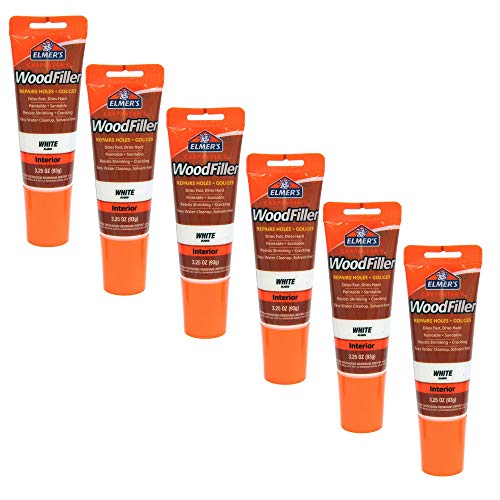
| Elmer’s E855 Carpenter’s Wood Filler 6-Pack★ Best Overall | Painted trim and baseboard nail holes | 3.25 oz tube, paste | White | — | Amazon |
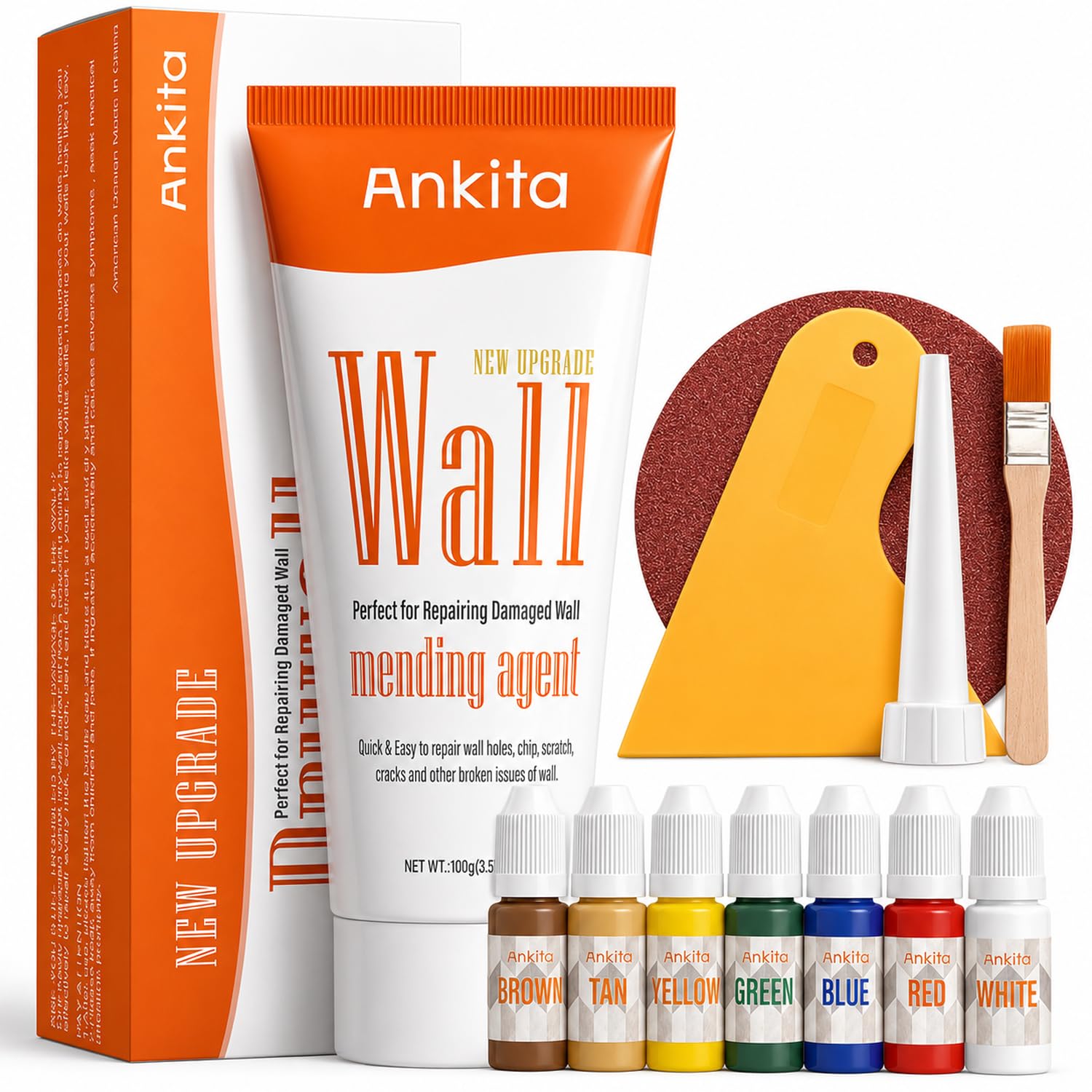
| Spackle Wall Repair Kit (Color Match)Best For Wall Colour | Painted walls, no repainting needed | Kit with 8 pigments | 8 pigments | Dry in 4 hours | Amazon |
| A-HEYIDA Wood Filler Putty Sticks | Furniture, floors and cabinets in many tones | 24-pc wax sticks and markers | 16 wax colours plus 8 markers | Fast-drying, permanent | Amazon |
| Dry Wall Patch Repair Kit (22 oz) | Bigger wall holes and cracks | 22 oz tub with tools | White | 3 hours set, 6 hours full cure | Amazon |
| Hupeyna Wood Furniture Repair Kit | Mixed shade matching on stained wood | 21-pc kit with fillers and polish | 12 colours | 48 hours for complete drying | Amazon |
Detailed Reviews
1. Elmer’s E855 Carpenter’s Wood Filler 3.25-Ounce Tube
Our pick — over 4.5★ from 150+ verified ratings; the strongest balance of quality and price.
The six-tube trim filler that sands flat, holds paint, and never needs a second trip to the store.
This is the filler you want if your project is painted trim, baseboard, molding, or a hardwood floor, because the paste dries to a hard, bright white surface that takes primer and paint without argument. It is a solvent-free PVA paste — that means it cleans up with soap and water instead of mineral spirits, so you are not hunting for a chemical solvent to rescue a putty knife at nine at night. The tube mouth lets you squeeze straight into the hole, then scrape the excess off with a finger or a blade.
The pack maths works out well here. Six tubes total 19.5 ounces, and against the Spackle wall kit’s single unit that is a six-to-one difference in how many nail holes you can fill before restocking. It also travels light: at 4.48 ounces per package, this box weighs roughly a fifth of the Spackle kit’s 8.4 ounces, so a tube slides into an apron pocket and stays there for the next cabinet door. Interior projects only, so keep it out of the garage door frame.
What wins people over is the sanding finish — the quality of the dried fill is the thing that gets talked about, and the ease of working it comes right behind. A neat trick that comes up again and again: if you take your time sanding, you can get away with skipping the paint on already-white trim. The honest trade-off is shrinkage on a deep hole. Buyers report that it cracks on thick fills, so on a hole deeper than a screw-head you want a second pass after the first one dries rather than one fat blob.
The finish people keep coming back for
- Dries hard and bright white, so it takes primer and paint cleanly.
- Water cleanup means no solvent smell and no ruined rag.
- Tube tip gets paste right into the hole with minimal tools.
- Maker rates it shrink- and crack-resistant once dry.
Where it makes you work
- Interior projects only — not formulated for exterior trim.
- Thick fills can crack, so deep holes need two thin passes instead of one.
- You still need matching paint on top if your trim is not already white.
Buy it if: you are patching painted trim, baseboard, or a hardwood floor and you already have the matching paint.
Think twice if: the hole is deep and you plan one thick fill — two thin fills dry far better here.
2. Spackle Wall Repair Kit
Eight pigments in one tub, so you can colour a wall patch instead of repainting the wall.
The pitch here is simple and it is the reason this kit stands apart from the Elmer’s tubes above: eight different pigments let you mix a colour to match the wall you are filling. That means you can push paste into a picture-hanging hole or an old anchor hole and walk away without dragging out a can of paint. The kit is water resistant and crack resistant, and it is rated for indoor and outdoor use, so a porch column is fair game.
Speed is the other real advantage. The maker states the fill can be completely dry in four hours. At 8.4 ounces it outweighs the Elmer’s 6-pack’s 4.48 ounces by a clear margin, and that extra paste is what pays for the depth of an anchor hole rather than a surface nick. Both the material list — wall glue, vegetable gum, resin, and carbonate cover — and the no-formaldehyde claim are stated by the maker.
Here is the part you need to hear before buying. Colour matching is genuinely hit and miss. Some fills blend beautifully and beat plain white spackle outright; others land somewhere off, and the pigment can look different on the wall than it did in the bottle. Several owners mention the colours are very hard to match and the result did not look the same on the wall as inside the bottle. The fix is to stir properly and test a dab in a hidden corner first. There is also a one-off note that the finish reads glossy rather than matte, which shows under a lamp.
The honest verdict: a colour-match kit is only as good as the match, and this one earns its place by giving you eight pigments instead of one white paste. Mix small, test on a scrap, and add pigment gradually.
Where it can trip you up: the supplied applicator tube is narrow and can clog, so a finger or a small scraper is the more reliable tool on thick paste.
Reach for this if: your wall is beige, tan, or off-white and you would rather blend a colour than repaint a whole panel.
Look elsewhere if: the wall is a tricky saturated shade — no eight-pigment kit will nail a custom colour, and you will end up touching up with paint anyway.
3. A-HEYIDA Wood Filler Putty Sticks
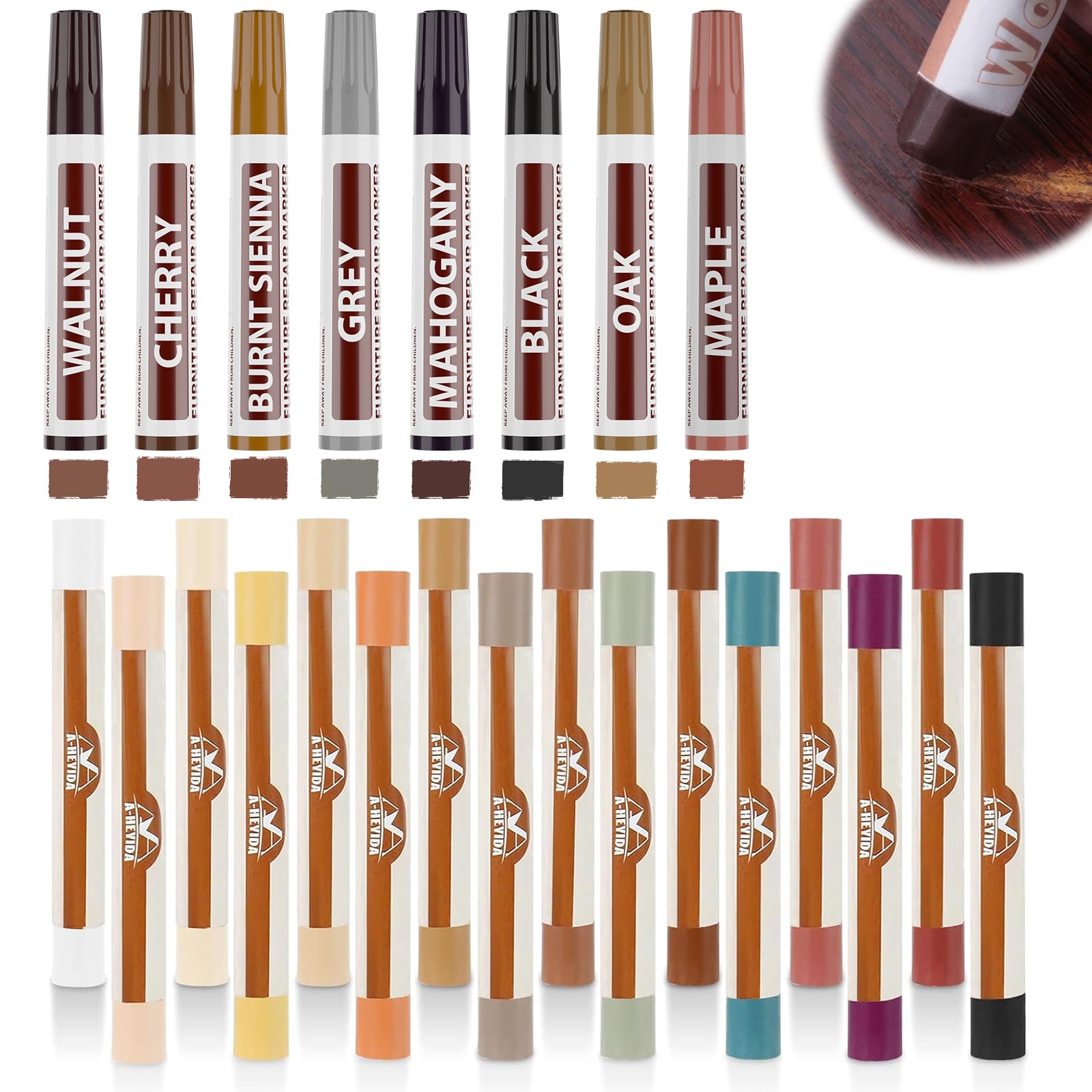
Twenty-four pieces of wax and marker in a rainbow of wood tones, for when the hole is in something you cannot repaint.
Nothing in this group is better suited to a mixed-tone house. The set carries 16 wax filler sticks plus 8 touch-up markers, covering tones across maple, oak, cherry, walnut, espresso, gray, and dark wood — so a nail hole in a cabinet, a floor plank, and a door frame can all be handled from one box. There is no paste to dry and no sanding step: you rub the wax stick straight onto the hole for a fill, or draw the marker along a fine scratch. For a deep hole the maker suggests a light melt of the wax for a smoother seat.
This is the pick for a rental, a flip, or anyone patching a scratch before guests arrive. Owners who were sceptical because of the low price came away surprised by the quality, and the set has been used on both real and fake wood. One buyer bought a second set for a friend who restores furniture, which says a lot about how readily it gets passed along. Most striking is the set’s ability to hide damage outright — customers note you cannot even see the scratch after a pass. nail hole filler work in wax form is different from paste: you are tinting and sealing the surface rather than building a hard, sandable plug.
Test-first is not optional here. Colours shift on screen, and the wax can look different against the actual grain, so the maker advises a test on a discrete area or white paper before you commit. It is not a professional-grade filler. On a quality piece you plan to keep or flip, reviewers point out looking at something better; on a scratched bench, a scuffed door, or a chipped cabinet edge, this is the fast, cheap, invisible fix.
Pick this one for: furniture, floors, and trim in a house with several different wood tones under one roof.
Skip it for: a hero piece of solid walnut you plan to refinish — wax fills are cosmetic, not structural, and the finish will not stand up to a true restoration.
4. Dry Wall Patch Repair Kit 22OZ Spackle
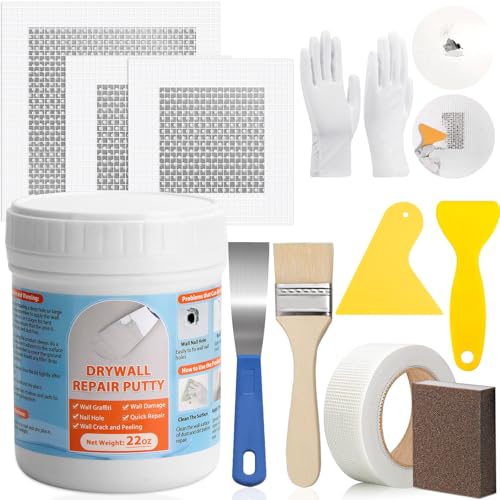
A tub, a patch, and a putty knife in one box, sized for the hole a door handle made.
When the hole is bigger than a nail — a doorknob dent, a peeled corner, a ceiling crack — you need paste by the tub and mesh to bridge the gap. This kit ships with 22 fluid ounces of white putty plus aluminum wall patches, mesh tape, a sanding block, a paint brush, gloves, and tools, so there is nothing else to buy before you start. The white putty spreads smoothly and blends into a standard white wall without colour matching, which makes it the simplest option for a plain painted surface. At 1.4 pounds it is the heaviest single item on this list, which is the trade for a tub large enough to cover a big patch.
Timing is clearly spelled out, and it is worth reading twice. The paste sets in about 3 hours and fully cures in 6 hours. Plan the paint coat for the following day if you can. The maker also notes that a damp bathroom wall, or a misty or rainy day, will push the cure time longer.
What does the work here is the completeness of the kit — quality and functionality are what get talked about most, and the recurring theme is that everything you need to patch a hole is already in the box. One buyer summed it up: the patch “made the hole disappear and felt solid after drying”. The mixed note you should know about is durability, so on a high-traffic wall corner a reinforcing layer is worth the extra few minutes. Owners also suggest bringing your own rubber or plastic gloves, because this putty sticks to hands readily.
Why it earns its spot: it is the only pick built for holes that need patching material behind them, not just paste in front of them. Mesh plus aluminum patch plus a sanding block in one box is a genuine time saver.
Read the fine print: a damp environment adds cure time, so add a day to the schedule on a wet job.
Get this if: the hole is fist-sized or larger, or you are patching a whole wall’s worth of cracks in one go.
Look at the Spackle kit instead if: the wall is not white and you want the patch to disappear without touching up the paint.
5. Hupeyna Wood Furniture Repair Kit 21 Pcs

Twelve tubes of colour, a pot of filler, and a block of beeswax polish for furniture you actually care about.
This is the kit for a stained or veneered surface where one pre-set colour will never be right. Its 12 wood filler colours — white, black, light gray, white maple, yellow maple, deep pine, earthy yellow, yellow teak, red cherry, cedar, dalbergia, and walnut — are meant to be mixed, not used straight, and that is the whole skill of it. The method the maker describes is simple: put the lighter colour down first, add the darker one a little at a time, and stop when the tone lines up. Test a swipe on white paper and let it dry before committing, because the wet colour reads different from the dry one.
Alongside the colour tubes there is a pot of filler, sandpaper and pads, a tail scraper for smoothing the surface, and a beeswax wood furniture polish that works on both finished and unfinished wood. That combination is why this kit earns its keep on a mixed-damage piece — a pet mark, a strap-worn patch, a faded edge, and a nail hole can all be worked in one sitting. For deep holes you fill first, let it dry, then colour over the top.
Effectiveness is the reputation this kit has built, with the breadth of colour options close behind. An antique bedroom set with minor damage and scratches gets repaired with it, and large worn patches on a mottled china hutch have been blended clean with three shades layered up, drying and light-sanding between coats. The one thing to plan for is the clock: the maker says to allow 48 hours for complete drying and to keep the repair away from water during that window, so this is a weekend job, not a lunch break.
Why it stays in the toolbox
- 12 mixable colours handle mottled and multi-tone wood that single-tone kits cannot.
- Comes with the sanding and finishing pieces, including beeswax polish.
- Handles scratches, dents, pet marks, fading and nail holes on the same job.
- Scraper and colour guide keep even a first attempt tidy.
What to plan around
- Full drying takes 48 hours, so one more coat cannot be rushed.
- Mixing colours by eye takes patience, especially on a mottled grain.
- Keep the repair dry for the full drying window.
Worth it for: stained furniture, antiques, and scratches on a matte or satin wood finish that needs a real colour match.
Not for: a same-day repair — the 48-hour dry window means anything you want done in one afternoon is a job for the wax-stick set instead.
Know the Specs
Format — Paste, Wax, or Marker
Paste is the format you want for anything that needs to be sanded flat: it pushes into the hole, dries hard, and takes paint. Wax sticks and markers are cosmetics, and they are the right call on a surface you cannot repaint because there is no sanding step — you rub the colour in and blend the edge. If your filler must hold a screw anchor later, lean toward paste with a mesh patch behind it, not wax.
Dry Time vs Full Cure Time
These are two different numbers and they matter for different things. The initial hardening time is when you can gently sand or scrape the surface — 3 hours on the larger wall kit. Full cure is when the patch is at full strength and safe to paint or load. Where a maker states only one number, treat the longer of the two as your safe paint window and give it a full day if the room is damp.
Colour Options and Match Risk
A single pigment like white is the fastest route when the surface is already painted and you have the paint to touch up over it. Multi-pigment and multi-tone kits remove the repainting step, but colour match is a judgement call every time — a colour can look different on the wall than it did in the bottle, and a matte or glossy mismatch will show under a lamp no matter how well the tone matches.
Shrink and Crack Resistance
Water-based paste shrinks as it dries, and a shrinking fill pulls away from the edges of a deep hole and leaves a dip that catches every light. This is why a “shrink resistant” formula and a two-thin-coat method beat one thick fill every time. Crack resistance is a separate claim again, and it tends to hold up better on thin layers than on thick ones.
Common Questions
How do I fill a nail hole so it disappears completely under paint?
Can I use nail hole filler on a wall instead of wood trim?
Does nail hole filler need to be painted over afterwards?
How long should I wait before sanding or painting a filler patch?
Will nail hole filler crack if I fill a deep hole in one go?
What is the difference between wood filler paste and wax putty sticks?
Can I use nail hole filler outside on a porch or exterior trim?
How do I match a filler colour to an existing stained wood finish?
Is one large tub of filler better than a multi-tube pack?
Will filler hold a screw or a wall anchor after it dries?
The Bottom Line
For most people patching trim and baseboard, the winner is the Elmer’s E855 Carpenter’s Wood Filler 6-Pack, because paint or not, it dries hard, sands flat, and cleans up with water — and the six-tube pack means you are not ordering again halfway through the house. If the holes are in a painted wall you would rather not repaint, the Spackle Wall Repair Kit gives you eight pigments to blend a match. And for nail holes and scratches across furniture, floors, and cabinets in several wood tones, the A-HEYIDA Wood Filler Putty Sticks set fits the job without a single tube of paste. One last nudge, from the size of the crowd behind it: if you want the widest real-world track record of furniture fixes, the Hupeyna 21-piece kit has the strongest history on that score and deserves a look before you decide.
How we choose
We do not accept paid placement. Every pick is matched to a real buyer and a real use-case; we do not hands-on test units.
Sources
Specifications: manufacturer listings and product documentation. Review insights: verified customer reviews, as of October 2026. Pricing: not shown on this page (it changes often); check the current price via the retailer link.
As an Amazon Associate, Aappliancez earns from qualifying purchases. This does not affect which products we feature.