Disclosure: Some links in this post are affiliate links. As an Amazon Associate I earn from qualifying purchases, at no extra cost to you. Learn more
Specs are compiled from manufacturer listings and verified buyer reviews and can change over time — please confirm the key details on the product page before buying.
A kids alarm clock is not really about waking your child up — it is about teaching them when to stay in bed. That is the whole job. A good one pairs simple color signals (green for “you can get up”, red for “still sleep time”) with a gentle night light, so a four-year-old who cannot read a digital display still knows what to do at 5:40 in the morning. Below you will find the five models that do this best, sorted by what they actually solve.
This guide is built by comparing the manufacturers’ published specifications and the patterns across verified customer reviews, so you get each pick’s real strengths and trade-offs instead of marketing spin.
Every pick here has been checked against what parents actually report after months of nightly use. The one that balances the clearest wake-up signal with the simplest setup is the ANALOI, and it holds the strongest owner satisfaction in this group. Read on for the full picture of the kids alarm clock options that genuinely earn their place on a nightstand.
Top Picks

How To Choose The Best Kids Alarm Clock
The mistake most parents make is shopping for an alarm clock. What you actually need is a sleep trainer — a device that tells a child who cannot read a clock face what to do next. Get the sleep-trainer cue right and the alarm function is a bonus. Get it wrong and you own a very cute object that rings at the wrong time.
Start with the wake signal, not the ringtone
The core feature is a color cue. Red or a closed-eye face means bedtime; green or a smiley face means the child may leave the bed. A pre-reader understands that instantly, which is why these clocks work on two-year-olds. Look for a clock where the wake color is set separately from the alarm sound — several models can show the light cue with no sound at all, which suits a child who wakes naturally.
Look at the night light timer
A night light that stays on all night can keep a sensitive sleeper awake and drain a rechargeable battery. The better models let you set the light to fade after a fixed stretch — 15, 30, 60 or 120 minutes are the common choices. That fade-out timer is what turns a glowing toy into an actual sleep aid.
Decide between wall power and a rechargeable battery
Wall-powered clocks never run flat, so the wake light is always correct in the morning. Rechargeable ones free the nightstand from a cord but need charging, and several only run their display briefly when unplugged. If your child tends to move the clock around, weight and cord length both matter.
Check the controls your child will touch
Buttons on the bottom are harder for small hands to change by accident. A child lock that requires holding two buttons together stops a curious toddler from reprogramming the schedule at 2 a.m. Screen brightness levels matter too — a bright green light in a dark room can be startling rather than reassuring.
Side-by-Side Comparison
| Model | Best For | Wake Signal | Night Light | Power | Amazon |
|---|---|---|---|---|---|
| ANALOI Alarm Clock for Kids★ Best Overall | All-round sleep training | Green / red eye faces | 10 light modes | Wall plug, 5V | Amazon |
| Lampeez Frog Alarm ClockBest for Travel | Portable bedside companion | Dual alarm with snooze | Warm + 7-color RGB | Rechargeable USB-C | Amazon |
| Ok to Wake Sleep Trainer | Staying in bed until morning | Green / red light + emoji | Color light with auto-off timer | — | Amazon |
| Axolotl Alarm Clock | Hug-friendly room decor | Dual alarm, weekday repeat | Warm, gradient, 7 colors | USB cable, battery backup | Amazon |
| Ykall Kids Digital Alarm Clock | Learning dates and time | Scene alarms with voice prompts | Dimmer with auto brightness | Adapter with battery backup | Amazon |
Detailed Reviews
1. ANALOI Alarm Clock for Kids, Ok to Wake Clock for Kids Girls
Our pick — 4.0+★ from 350+ verified ratings; the strongest balance of quality and price.
The cat-shaped clock that turns a closed-eye face into a bedtime rule your kid actually obeys.
The whole idea lives in two expressions. At bedtime the cat’s eyes close and the light glows red. When it is okay to get up, the eyes open and the light turns green. A child who cannot tell 6:15 from 7:00 can still read a grumpy cat, which is exactly why this design works on the youngest sleepers. It measures 5.51 inches wide and 3.93 inches tall — small enough for a shelf but big enough that the face reads from across a dark room.
What wins people over is the sheer amount of routine packed into one shell. There are ten color-changing light modes and seven soothing sounds, and the more musical of those sounds are the ones parents credit with calming a wired-up child rather than startling them. Six ringtones cover the mornings, and two separate alarms mean one can handle school days while the other acts as a bedtime nudge. Setup buttons sit on the bottom, so a curious kid tapping the top only ever changes the light, never the schedule.
The honest catch is alarm scheduling by day. The clock cannot be told “weekdays only” — set a school alarm and it will still ring on Saturday morning. A family with a relaxed weekend notices this. It also runs from an included wall plug at 5 volts, so the light cue is always dependable but the clock stays tied to a socket.
What earns the top spot
- Open-eye green and closed-eye red make the wake rule readable for a pre-reader
- Ten light modes plus seven soothing sounds cover wind-down and wake-up in one unit
- Bottom-mounted buttons stop small hands from reprogramming bedtime
- Two alarms let you split school mornings from a bedtime reminder
Where it asks for patience
- No weekday-only setting — the alarm sounds every day once set
- Wall power only, so it needs a free socket near the nightstand
Reach for this if: you want one clock to carry bedtime, night light, and morning wake-up for a toddler through early school years.
Think twice if: a weekend lie-in is sacred and nobody wants to switch the alarm off manually.
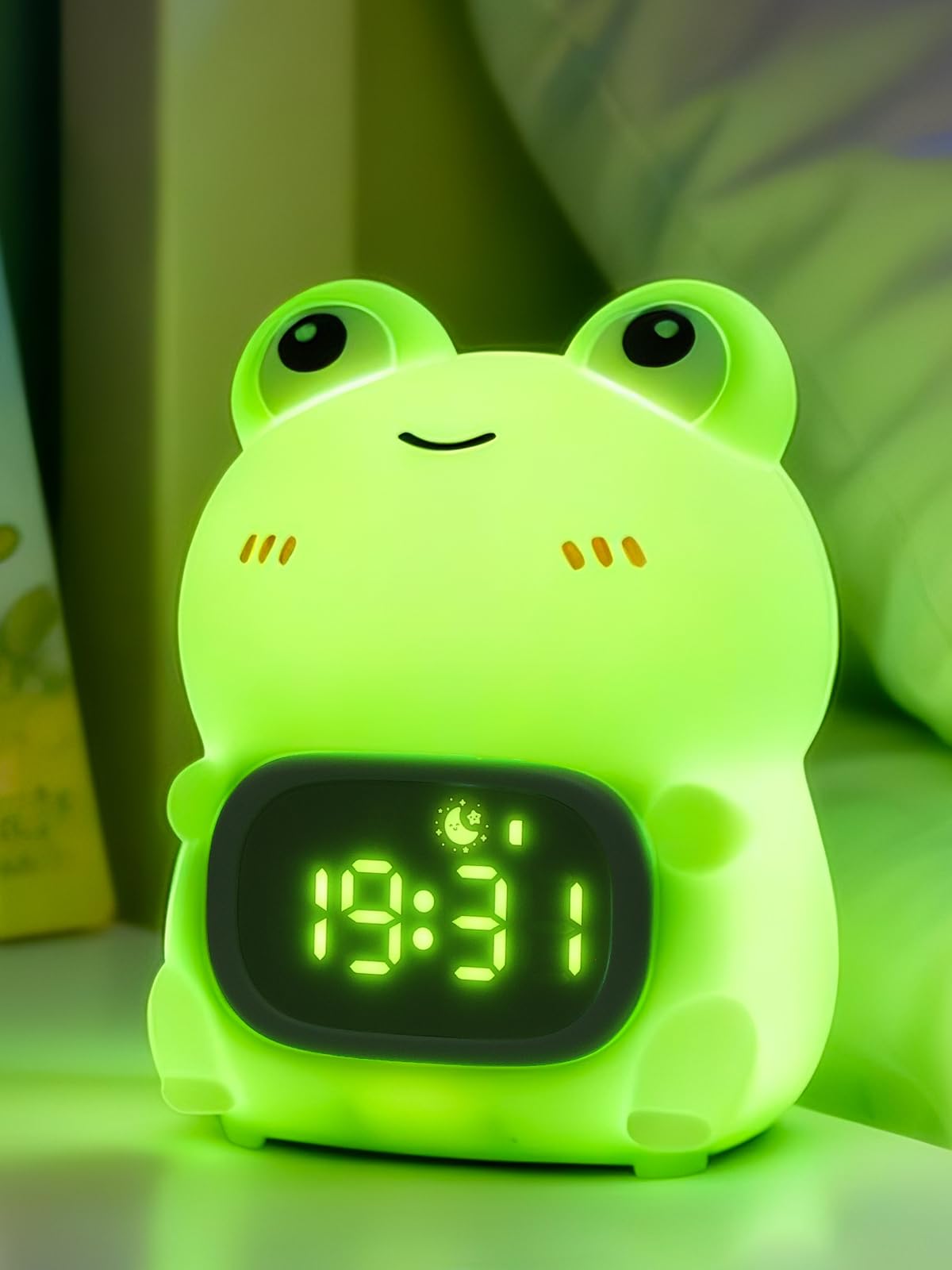
2. Lampeez Frog Alarm Clock
A squeezable silicone frog that snoozes when your kid pats it — no cord, no shouting.
This is the one to pack. It runs on a built-in rechargeable battery charged over USB-C, so it works on a hotel nightstand, a sleepover, or a road trip without hunting for the right adapter. A charging icon flashes when it is low and stays solid when full — a small thing that removes the guesswork of whether it is ready for the night.
Two alarms can each be given their own ringtone and volume. When one goes off, a shake or a light pat on the frog triggers a ten-minute snooze, repeatable up to three times, and any button stops it outright. The silicone body is soft in a small hand, and it doubles as a warm-light lamp with a rainbow RGB mode. Brightness runs across three screen levels, and the display can either stay on or switch off after 20 seconds. Timers cover both directions: a countdown from 1 to 99 minutes and a stopwatch from 00:00.
Worth knowing before you buy: the light is not waterproof, so keep it off wet countertops. The screen is also modest in size, which is fine for a bedside gadget but not a wall-readable clock. Lampeez backs the frog with a one-year warranty.
What it does differently: the shake-to-snooze motion and the rechargeable freedom make it the only pick here built for the outside-the-house night.
Small footprint, small screen: it sits at 4.7 inches wide and 3.4 inches tall in silicone, so it slips into a bag without a thought.
Best matched to: families who move between rooms and houses and want the sleep routine to travel with them.
Less suited to: a child who needs a big, bright readout visible from the far side of the room.
3. Ok to Wake Alarm Clock
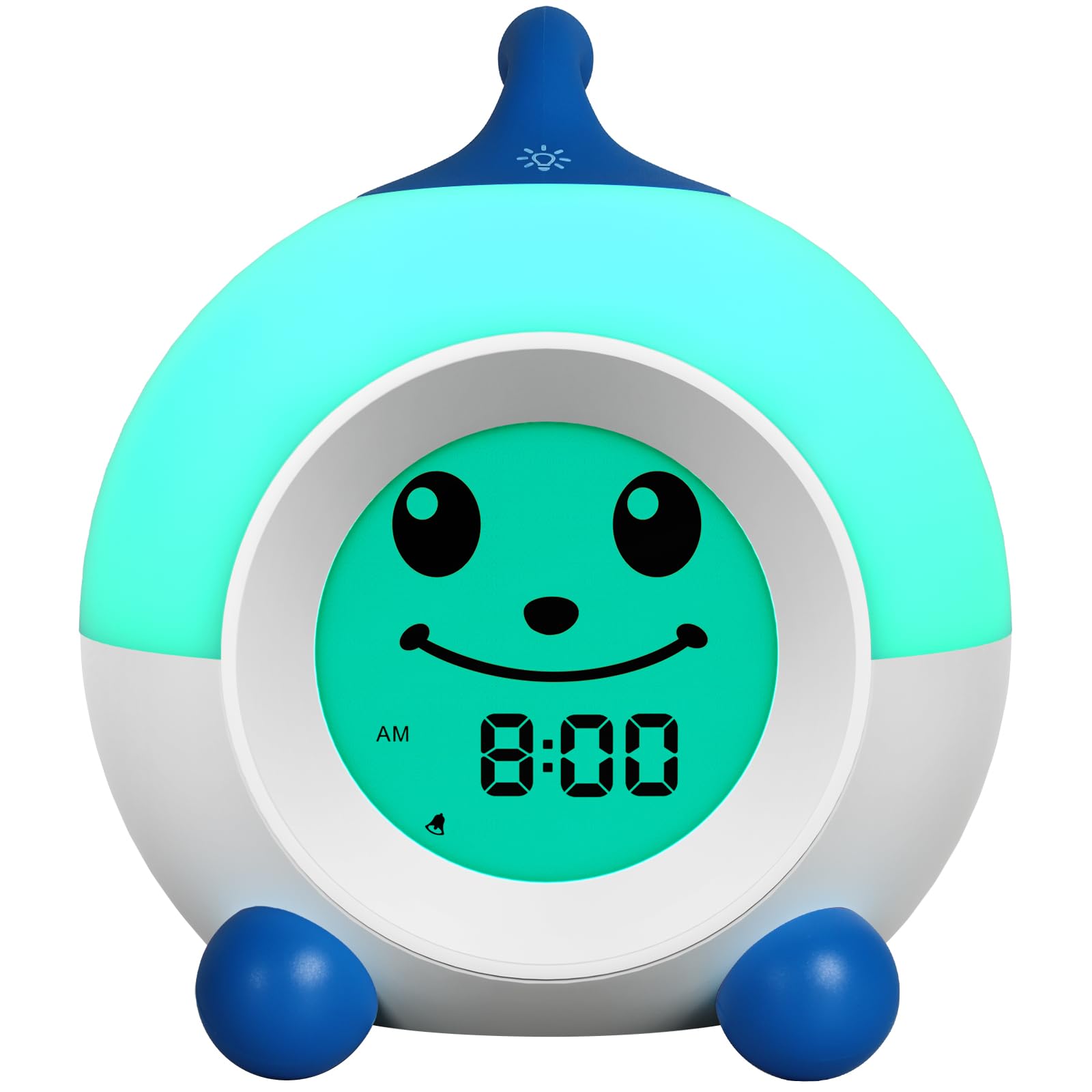
The straightforward one: red light means sleep, green light means get up, and nothing else to argue about.
Its philosophy is pure simplicity. A sleepy face and red light mark bedtime; a smiley face and green light mark the morning. That is the entire rule, and it is why parents of very young children find it takes hold so quickly. It is also a compact device — 4 inches wide and 4 inches tall — so it sits on a shelf without crowding the room. The body is built from ABS, a hard-wearing plastic chosen for a device a small child will handle.
The night light is the supportive half. A top button cycles the colors and adjusts the warmth, and a built-in sleep timer at 15, 30, 60, or 120 minutes fades it out so the room goes dark once your child is settled. A nap mode offers 15, 30, 60, 90, or 120 minutes and doubles for time-outs. The child lock — hold the sleep button and the 12/24 button together for three seconds — is the setting that keeps a schedule intact.
The one recurring note from owners is brightness. The green and red signals are strong, and without a dimming control they can feel fierce in a fully dark room. That is the trade for a signal bright enough to be unmistakable in daylight. Setting the clock is not instant either; it asks for a few minutes with the manual the first time.
Why it works so fast
- Emoji faces plus red and green lights read as a rule, not a clock face
- Child lock guards the schedule from small fingers
- Night light timer runs 15, 30, 60, or 120 minutes
- Nap countdown covers 15, 30, 60, 90, or 120 minutes
Where it falls short
- No dimming control on the bright wake and sleep colors
- Alarms cannot be limited to weekdays
Pick this one if: you are teaching a two- to five-year-old to stay in bed and want the clearest possible color rule.
Pass on it if: a light-sensitive sleeper shares the room and needs a soft, adjustable glow.
4. Axolotl Alarm Clock Pink

A huggable axolotl that survives a five-foot drop and still glows a soft gradient at bedtime.
The material is the headline. The whole body is soft, squeezable silicone rated to withstand drops from up to 5 ft (1.5 m) — the kind of every-surface case a kid actually needs. It is built as decor first and clock second, and that is not a criticism. It sits happily on a desk or a nightstand as an axolotl figure that happens to tell time.
Two alarms each carry a weekday or every-day repeat pattern, and a tap buys a five-minute snooze, up to three times. The display has three brightness levels. The light side offers three warm tones plus a gradient mode and seven vivid colors, which makes it a reading lamp as much as a night glow. Power runs through a USB cable (adapter not included); keep it plugged in for daily use, and the built-in battery covers short cordless stretches, with the display switching off after 15 seconds offline and a tap waking it back up.
Two real limits to weigh. The sleep-training red indicator is not designed to hold all night — it reverts to its prior color, which undoes the “red means stay in bed” rule for a child who is watching it. The music-and-sounds section adds atmosphere, but the sleep cue itself is where this one asks the most patience.
The trade-off: if a persistent overnight red light is your reason for buying, look at the Ok to Wake instead and treat this one as a character-and-lamp first.
Made for: a child who wants a character on the nightstand and parents who want it to survive being thrown in a bag.
Not the fit for: strict sleep-training, where the bedtime cue has to stay put all night.
5. Kids Digital Alarm Clock 7″

The teaching clock: seven inches of cartoon lettering that shows the date, the day, and when to get moving.
This one is built for the child who is past the color stage and ready to learn time for real. The 7-inch display uses colorful, drawwing-style cartoon fonts to lay out time, date, day, month, and year together, and the formats and background art can be changed to suit your child. A 7.5-inch width and 5.5-inch height put it at the larger end of this group, so it needs real space on a desk or dresser. Weight sits at 16 ounces.
The schedule engine is where the planning pays off. You get five daily alarms plus twelve scene alarms, and each scene can trigger a cartoon image with a spoken prompt, so a child hears what to do next rather than just hearing a bell. The display can flip between text, digital, and a traditional clock face with one button, and it supports multiple languages for learning numbers in another tongue. A dimmer tracks the room’s light through day and night, and a battery insurance feature keeps the date and time stored if the adapter is pulled.
The caution here is reliability over the long run. Some units have stopped keeping time after months of use, and the setup menus take patience — it is the opposite of a one-button clock. The 12-hour format has also been reported to swap AM and PM on some units, so check that first thing. If it holds, the format is genuinely a teaching tool.
The learning angle: five daily alarms plus twelve scene alarms with picture and voice prompts turn the morning routine into a set of named steps.
The honest flaw: setup is menu-heavy and long-term durability is the weak link in the reviews — keep the receipt and confirm the AM/PM reading within the first week.
Suits: a school-age child learning days and dates who benefits from a big readable screen and spoken reminders.
Choose something simpler if: you want a clock that punches a button and forgets about it.
Know the Specs
Ok to Wake lights and emoji faces
A wake signal is a color or face that tells a pre-reader whether it is still sleep time. Red or a closed-eye face means stay in bed; green or a smiley face means you may get up. The reason this beats a digital number is simple — a two-year-old can match a color long before they can compare 6:40 against 7:00. When you shop, look for a wake color you can set separately from the alarm sound, so a peaceful child who wakes on their own still gets the cue without a bell.
Night light timers and dimming
A light that dims or switches off after a set stretch is what separates a sleep aid from a lamp. Timers commonly run from 15 minutes up to a couple of hours, and screen dimmers adjust the display to the dark. This matters because a bright green or blue light in a pitch-black room can wake a child rather than settle them. Pick a model whose brightness you can turn down, or whose light fades on a timer you control.
Alarm scheduling and repeat modes
Repeat modes decide whether an alarm rings every day or only on school days. A weekday-only option keeps a Saturday lie-in intact; a clock without one needs its alarm switched off manually at the weekend. Count the alarms too — two separate alarms let one handle the morning and the other act as a bedtime reminder, while a single alarm forces a choice.
Power: wall adapter, USB-C, and battery backup
Power choice shapes how the clock lives on the nightstand. An always-plugged adapter means the wake light is guaranteed correct at dawn. A rechargeable battery is free of cords but must be topped up, and some displays switch off when unplugged. Battery backup is the in-between: run on mains, but keep the date and time saved if the plug is pulled.
Common Questions
Will a kids alarm clock help my toddler stay in bed at 5 a.m.?
Can a kids alarm clock show the wake light without the sound alarm?
Is a kids alarm clock safe to leave plugged in overnight?
How long should the night light stay on for a toddler?
What is the difference between an alarm clock and a sleep trainer for kids?
Can my child change the settings by accident?
Do these clocks work for children with visual difficulties?
Can a kids alarm clock run on batteries alone?
Why would my child’s clock ring on a weekend?
How long does a kids alarm clock last?
The Bottom Line
For most families, the winning kids alarm clock is the ANALOI, because its open-eye green and closed-eye red cue is the clearest rule a pre-reader can follow, and its ten light modes and seven sounds carry bedtime through morning. If you are teaching a very young child to stay in bed, the Ok to Wake Sleep Trainer pairs the same color logic with a child lock that keeps the schedule intact. And for nights away from home, the rechargeable Lampeez Frog lets the routine travel. Pick the one that matches your child’s stage, set the light cue, and give it a week to take hold.
How we choose
We do not accept paid placement. Every pick is matched to a real buyer and a real use-case; we do not hands-on test units.
Sources
Specifications: manufacturer listings and product documentation. Review insights: verified customer reviews, as of October 2026. Pricing: not shown on this page (it changes often); check the current price via the retailer link.
As an Amazon Associate, Aappliancez earns from qualifying purchases. This does not affect which products we feature.