Disclosure: Some links in this post are affiliate links. As an Amazon Associate I earn from qualifying purchases, at no extra cost to you. Learn more
Specs are compiled from manufacturer listings and verified buyer reviews and can change over time — please confirm the key details on the product page before buying.
If you suspect your breathing stalls at night, the fastest way to see it is a wearable oxygen recorder you strap on before bed and read the next morning. That is the whole idea behind the picks below: each one clips a soft sensor to your finger, logs your blood oxygen and pulse all night, and hands you a report you can take to your doctor. None of them diagnose you — they show you the pattern.
This guide is built by comparing the manufacturers’ published specifications and the patterns across verified customer reviews, so you get each pick’s real strengths and trade-offs instead of marketing spin.
You will see which devices record oxygen plus airflow, which one sits under the mattress with no finger clip at all, and which ones carry a clear sports-only label rather than a medical one. Here is how each option handles a real night’s sleep, so you can choose a home sleep apnea test with confidence.
Top Picks

How To Choose The Best Home Sleep Apnea Test
What you are really shopping for is a full night of recorded data, not one spot-check reading at bedtime. A fingertip pulse oximeter tells you what your oxygen is at that moment. An overnight wrist recorder tells you when it dipped, for how long, and how often — and that pattern is what a doctor wants to see.
Start with oxygen, then decide if you need airflow
Blood oxygen saturation (SpO2) is the percentage of oxygen your red blood cells are carrying. A wearable that logs SpO2 continuously through the night shows you the dips. Some devices go further and add a nasal tube to record your breathing flow, which is the difference between seeing low oxygen and seeing the pauses that cause it.
Sensor comfort decides whether you get a clean night
A rigid clip that pinches your finger will get pulled off at 2 a.m. Soft silicone ring sensors and soft-touch probes are built to stay put without numbing your finger, so you actually wear it to morning. Look at what the sensor is made of before anything else.
Check the report format before you buy
Some devices export a PDF or CSV you can hand to a physician; others only show numbers inside an app. If you plan to bring the results to your doctor, PDF or CSV export matters as much as the sensor itself. Check for PC software or a shareable report in the listing.
Side-by-Side Comparison
| Model | Best For | Battery | Sensor Type | Report Export | Amazon |
|---|---|---|---|---|---|
| FL330 Wearable Band★ Best Overall | Standalone wrist recording, no phone | 16 hours | Patented silicone ring sensor | PDF or CSV via PC software | Amazon |
| EMAY SleepO2 ProAlso Great | Oxygen plus airflow tracking | 15 hours | Soft silicone O2 sensor + nasal tube | PDF (AHI & ODI) via PC software | Amazon |
| Wellue O2 (Checkme O2 Max) | Multi-night recording, long battery | 72 hours | Patented silicone ring sensor | App + O2 Insight Pro software | Amazon |
| Vibeat OxyU | Small, light ring sensor | 12-16 hours | Lightest silicone ring sensor | PDF, CSV or Binary via PC | Amazon |
| SkyPad | Contactless monitoring for a caregiver | — | Contactless under-pillow pad | App viewing, no print option | Amazon |
| Withings Sleep | Long-term sleep habit trends | — | Under-mattress pneumatic sensor | App viewing, no O2 data | Amazon |
Detailed Reviews
1. FL330 Wearable Blood Oxygen Band with Ring Sensor
Our pick — 4.0+★ from 50+ verified ratings; the strongest balance of quality and price.
It logs the whole night by itself, so a dead phone or a forgotten app never costs you a night of data.
The FL330 straps to your wrist and records oxygen, heart rate and motion with up to 16 hours of battery on one full charge. Its real edge is built-in memory: it works stand-alone, no smartphone needed to capture the night. When you are ready, the free PC software exports your records as PDF or CSV, and the iOS/Android app lets you share the trends from your phone.
The soft patented silicone ring sensor holds onto your finger without numbing it and leaves your hand free to move — a point that makes overnight wear bearable. The wake feature is genuinely useful: a buzzer in the finger sensor fires when your saturation drops below the level you set, so it prompts you to breathe. There is a report to download and review afterward.
Two caveats worth knowing before you buy. The display is bright in a dark room, and there is no dimming setting, so light sleepers may want to cover it. The charger is also non-standard, so if you lose it you may struggle to source a replacement. Neither stops it recording a clean night.
Where it earns its keep: the stand-alone memory plus alarm buzz is the combination to buy for if you want overnight oxygen logging with an alert that nudges you awake when your level falls.
Fits: you keep your phone in another room, or you want a vibration alert in the sensor itself, not just a morning report.
Skip the bright-screen gripe: if you need a dimmable display or a standard charger, weigh those against the stand-alone recording here.
2. EMAY SleepO2 Pro Wrist Pulse Oximeter
It watches your oxygen and your airflow at the same time, which is the closest thing here to a night in a sleep lab.
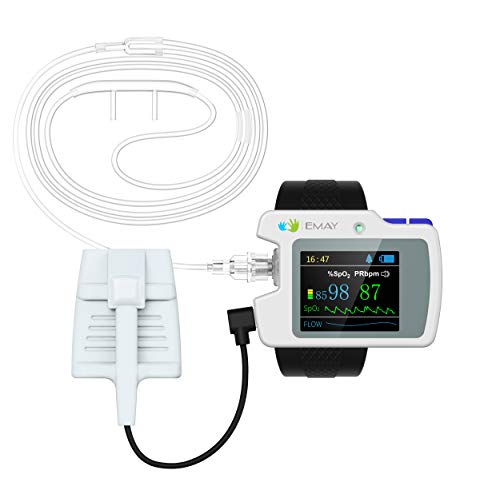
The SleepO2 Pro pairs a wrist recorder and a soft silicone finger sensor with a soft-touch nasal tube that tracks airflow through your nose. That second channel matters. Oxygen alone tells you your level fell; the flow tube tells you your breathing actually paused. Its measuring range is 70-100%, so it captures deep dips rather than bottoming out at a floor.
What wins people over is how much detail lands on the report — minute-by-minute data, automatic flagging of events, and a PDF you can email straight to your physician. The included PC software builds that overnight report with AHI and ODI figures. The battery runs 15 hours per charge and the device stores up to 8G of data, so you are not juggling clouds or accounts. One buyer who wore it to compare against a clinic test found the old at-home test “cumbersome, one night only,” while this lets you record night after night at home.
The honest catch is the nasal tube. It takes a little practice to seat it so it stays in place all night, and the disposable cannulas are replaced from the maker’s site. The finger sensor itself is snug and stays put. If the airflow channel sounds fussy, the oxygen-only option below skips the nose entirely.
What earns it the top spot
- Two signals in one night — oxygen saturation plus nasal airflow — for genuine breathing-pause data
- Overnight report with AHI and ODI figures, exportable as PDF for your doctor
- 15-hour battery and built-in 8G storage cover a full night without a phone nearby
- Soft silicone finger sensor rated to stay comfortable and not slip through the night
- Minute-by-minute recording with automatic event flagging
Where it asks a little patience
- The nasal tube has to be seated carefully or you lose the flow trace
- Replacement cannulas come from the maker’s website, not your local store
- The PC software is a bare-bones, medical-style interface with a learning curve
Reach for this if: you want the most complete picture available at home — oxygen and airflow — in a report a physician can read.
Look elsewhere if: you know you will not tolerate a tube at your nose; the oxygen-only bands cover that need without the fuss.
3. Wellue O2 Pulse Oximeter Checkme O2 Max

Three nights of recording on a single charge — you charge it once a week, not once a night.
Most wrist recorders give you one night before they need topping up. The Checkme O2 Max claims up to 72 hours of continuous use from a single charge, which covers several nights of overnight logging without reaching for a cable. It reads oxygen across a 70%-100% range and pulse from 30 to 250 bpm, and stores four groups of 10-hour data before you sync.
Its comfort is the other draw. The patented silicone ring sensor is shaped to leave your finger free so it does not go numb, and owners routinely wear it multiple nights in a row. Alerts are adjustable: the unit vibrates and sounds a “drip” tone when your saturation crosses the level you set, which helps if you want to be nudged to change position or wake up. The Vihealth app and O2 Insight Pro software handle the trend reading and Bluetooth sync.
The recurring gripe is durability at the sensor connection, and the charging cable is a proprietary part rather than a standard USB. A few owners also note the pulse reading can drift during walking or exercise, so treat it as a sleep device, not a workout monitor. If long battery and multi-night streaks matter more than airflow data, this is the one.
The night-to-night play: if you want a device you can forget about between charges and wear for a week of continuous nights, the 72-hour claim is the spec that sells it.
Suits: anyone who wants multiple nights of oxygen data before one recharge, with a wake-up alert built in.
Not for: someone chasing airflow or breathing-pause measurement — this tracks oxygen and pulse, not nasal flow.
4. Vibeat OxyU Wrist Pulse Oximeter

The lightest ring sensor of the group, made for people who hate the feel of a finger clamp.
The OxyU pairs a small wrist unit with a silicone ring sensor and records oxygen, heart rate and body motion for up to 12-16 hours after a full charge. Its sensor is billed as the lightest and smallest of this style, and at night that translates to a device you barely notice on your finger. It stores four groups of 10-hour data on board and uploads to the app over Bluetooth as you sync.
Alerts are adjustable in the app: you can set the threshold and the intensity, and the device will vibrate while the app beeps if your saturation crosses it. The PC software exports detailed records as PDF, CSV or Binary, showing data every four seconds alongside an O2 score. For the person who wants the numbers to hand to a doctor, that export is the feature to focus on.
Be clear about one label before you order: the maker states this is not a medical device and is intended for sports and aviation use only. In practice owners use it to watch overnight dips, but the readings carry that caveat. The connector and app link also need re-pairing after a charge, and a few units have reported charging or sensor failures. It is a light, compact recorder rather than a clinical-grade monitor.
Small on the finger, big on alerts: the vibration and beep when your level drops is the reason to pick it, and the ring sensor size makes wearing it overnight far easier than a clamp.
Good match for: you prioritise a tiny, comfortable sensor and want adjustable alarm thresholds you control in the app.
Know first: the maker labels it sports and aviation use, not medical — if you need a clinically positioned device, weigh that.
5. SkyPad Contactless Heart & Breathing Monitor
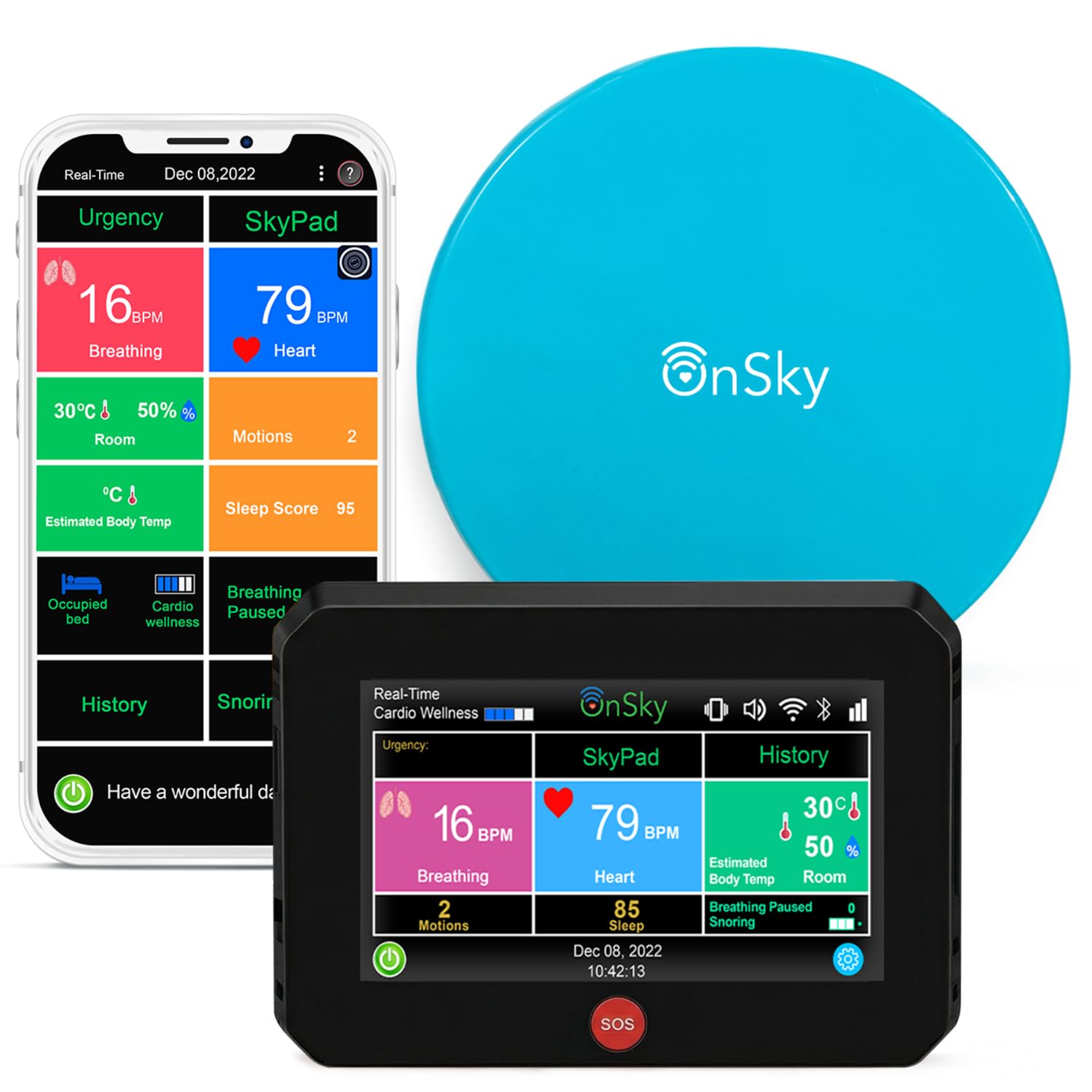
No finger clip, no wristband — the sensor slides under a pillow and watches breathing from a distance.
SkyPad takes a different route to the same question. A sensor pad sits below a pillow or under the sheet, and a hub with a 5-inch touchscreen collects heart rate, breathing, movement, sleep patterns and sleep apnea signals without touching skin. It is FDA-Cleared and positioned for senior and in-home patient care, including children one year or older. Data lands in the free OnSky Health app for remote viewing.
The emergency side is what caregivers value most: if the red SOS button on the hub is pressed, SkyPad pushes a notification and calls your phone — and no subscription is required. Setup runs under 15 minutes with a manual calibration, and the heart rate figures line up with a smartwatch in about a minute. The long-term history in the app makes it a remote well-being check for a loved one at home.
Two honest limits. It needs a low-bandwidth 2.4GHz Wi-Fi connection, and it currently reports only within its own app — no Apple Health integration and no data export or print option. Owners who read it alongside a ring monitor find the two agree, but that closed ecosystem is the trade-off. If you want a printout to hand a physician, the wrist recorders above are easier.
Why caregivers like it
- Completely contactless — nothing on the finger or wrist to disturb sleep
- SOS button calls up to 3 phones with no subscription
- Tracks heart rate, breathing, movement, sleep patterns and apnea signals
- Free app with long-term history for remote viewing
The trade-offs to weigh
- Needs 2.4GHz Wi-Fi and recalibration to stay accurate
- No Apple Health link, no export or print option
- Presence detection is inconsistent for some owners after recalibration
This one is for: a family member monitoring an older adult from another home who wants an SOS alert, not a nightly chart to interpret.
Pass on it if: your doctor wants a PDF of overnight oxygen — SkyPad shows data in-app but has no print or export route.
6. Withings Sleep Tracking Pad Under The Mattress

It slips under the mattress, needs nothing on your body, and gives you a long view of how you sleep.
Withings Sleep is a pneumatic sensor pad that slides under the mattress and reads your sleep phases, interruptions, heart rate and snoring without a wearable. It is built for trends, not single nights: over weeks the app charts your sleep stages, a nightly score and advice on where to improve. It syncs over Wi-Fi to Withings servers, so your phone is only for viewing — you can leave it in the other room and still record.
What the data does well is behaviour coaching. Owners who kept consistent bed and wake times watched their scores climb over months, and the later software added heart rate variance and enhanced breathing disturbance readings. Setup is simple: position the pad under the mattress, calibrate, and let it run.
The honest boundary is that this is not an oxygen recorder. It does not measure SpO2, so it cannot show you desaturation dips the way the wrist monitors do. It also flags still, awake time in bed as sleep, and needs consistent placement to stay accurate. Reliability is the other thing to know — some pads fail to sync after days or weeks of use, and a few return them for that reason. Treat it as a sleep-habit tracker, not a diagnostic breathing monitor.
What it is good at: showing you, night after night, whether your sleep is improving — useful context around a breathing concern but no substitute for an oxygen reading.
Made for: someone already working on sleep habits who wants passive, wearable-free tracking and snoring detection.
Look past it if: you need SpO2 and desaturation data — this pad deliberately skips oxygen measurement.
Know the Specs
SpO2 and Desaturation Dips
SpO2 is your blood oxygen saturation, a percentage of how much oxygen your red blood cells carry. An overnight monitor logs it every few seconds so you can see dips. A dip below your normal range during sleep is the signal these devices are built to catch.
ODI and AHI on the Report
ODI (Oxygen Desaturation Index) counts how many times per hour your oxygen drops by a set amount. AHI (Apnea-Hypopnea Index) estimates breathing pauses per hour. The SleepO2 Pro exports both as a PDF you can share with a physician.
Ring Sensor vs Finger Probe
A silicone ring sensor holds your finger without numbing it and leaves the hand free — easier for all-night wear. A soft finger probe is snug but can get uncomfortable after hours. A sensor you can tolerate is the difference between a full night’s data and a device pulled off at 2 a.m.
Battery and On-Board Storage
Battery life decides how many nights you get between charges — from 12-16 hours up to 72 hours. Built-in memory lets the device record without a phone, then upload on sync. More on-board storage and longer battery life mean fewer missed nights and fewer gaps in your data.
Common Questions
Can a wrist oxygen monitor tell me if I have sleep apnea?
What is the difference between an oxygen monitor and an airflow sleep test?
How many nights should I record to get useful data?
Will the finger sensor stay on all night?
Are these devices medical devices?
Can I share the report with my doctor?
Do I need a smartphone to record overnight data?
Can the alarm wake me if my oxygen drops at night?
Is the under-mattress Withings pad a sleep apnea test?
The Bottom Line
For most people, the strongest home sleep apnea test pick is the EMAY SleepO2 Pro because it records oxygen and nasal airflow together and hands you an AHI/ODI report your doctor can read — the closest thing to a lab study you can run at home. If you want multi-night battery and long streaks of logging, reach for the Wellue O2 with its 72-hour charge. And if you are monitoring a parent remotely and want a contactless SOS alert, the SkyPad is the one to set up.
How we choose
We do not accept paid placement. Every pick is matched to a real buyer and a real use-case; we do not hands-on test units.
Sources
Specifications: manufacturer listings and product documentation. Review insights: verified customer reviews, as of October 2026. Pricing: not shown on this page (it changes often); check the current price via the retailer link.
As an Amazon Associate, Aappliancez earns from qualifying purchases. This does not affect which products we feature.