Disclosure: Some links in this post are affiliate links. As an Amazon Associate I earn from qualifying purchases, at no extra cost to you. Learn more
Specs are compiled from manufacturer listings and verified buyer reviews and can change over time — please confirm the key details on the product page before buying.
Clematis is a vine that will happily give you a wall of green leaves and almost no flowers if you feed it the wrong thing. The fix is simpler than most gardeners expect: pick a fertilizer with a low first number (nitrogen, the nutrient that pushes leafy growth) and a strong middle and last number (phosphorus and potassium, the bloom and root nutrients), then apply it on a steady schedule through the growing season. Everything below is sorted by how well it actually suits a flowering vine.
This guide is built by comparing the manufacturers’ published specifications and the patterns across verified customer reviews, so you get each pick’s real strengths and trade-offs instead of marketing spin.
Below you’ll find the ratios, the application timing, and the honest trade-offs on each of these picks, all in one place so you can choose the right fertilizer for clematis without guessing.
Top Picks

How To Choose The Best Fertilizer for Clematis
Clematis roots want steady feeding and cool, shaded soil, while the top of the vine wants sun. That split habit is why a slow-release granular feed worked into the soil around the base suits most clematis better than a liquid you spray over the foliage. Read the bag’s three numbers first, then decide on form.
Read the NPK ratio before anything else
The three numbers on a fertilizer bag are nitrogen, phosphorus and potassium, always in that order. Nitrogen drives leafy green growth, phosphorus supports flower and root development, and potassium helps the plant finish blooms and handle stress. A clematis given a nitrogen-heavy feed grows long and lush and flowers sparsely. Look for a ratio where the first number is low and the last two are higher.
Granules, powder or liquid
Granules are the easiest to live with: you scatter them around the drip line (the circle of soil under the outer edge of the plant) and water them in. Powders you dissolve in water reach the roots faster but need mixing and a watering can. For a clematis in the ground, granules worked into the top layer of soil are the least fuss.
Organic labels and what they mean
If you garden organically, look for an OMRI listing or a registered Organic Input Material statement on the bag. These confirm the product meets organic production requirements. Organic granular feeds also break down slowly, which feeds a vine over weeks rather than all at once.
Odor and pets around the bed
Organic fertilizers made from animal and plant meals carry a natural smell that fades after watering. Some also contain bone meal, which dogs and mice will dig for. Store the bag sealed and work the granules into the soil rather than leaving them on the surface.
Side-by-Side Comparison
| Model | Best For | NPK Ratio | Form | Bag Size | Amazon |
|---|---|---|---|---|---|
| Espoma Organic Rose-Tone 4-3-2 (2-Pack)★ Best Overall | Clematis named on the label, plus roses | 4-3-2 | Granules | 128 oz total | Amazon |
| Espoma Organic Holly-Tone 4-3-4Acid Bed Specialist | Acid-loving beds and blue-toned blooms | 4-3-4 | Granules | 64 oz | Amazon |
| Dr. Earth Acid Lovers 4 lb | Organic-first gardeners, potted vines | 0.3-0.4-3 | Granules | 4 lb | Amazon |
| Lilly Miller Bulb & Bloom Food 4-10-10 | Flower push on established vines | 4-10-10 | Powder | 4 lb | Amazon |
| Alpha Chemicals Potassium Sulfate 5 lb | Targeted potassium for soil-test corrections | Potassium and sulfur only | Powder | 80 oz | Amazon |
Detailed Reviews
1. Espoma Rose-Tone 4-3-2 Fertilizer 4 lb Pack of 2
Our pick — 4.5+★ from 750+ verified ratings; the strongest balance of quality and price.
The one bag that puts clematis in the same sentence as roses — and delivers.
This is the clearest match for the job because clematis is literally printed on the target list, right beside roses, viburnum and bougainvillea. The 4-3-2 analysis (a low first number for nitrogen, then phosphorus and potassium) leans away from leafy growth and toward flowering. It also carries 5% calcium, and it is approved for organic gardening as a registered Organic Input Material. You get two 4 lb bags here, a total 128 ounces, which lands at double the 64 ounces you get in the Espoma Holly-Tone bag below.
Working it in takes minutes. The granules are ready to use with no mixing, so you scatter them around the drip line and water thoroughly. Espoma suggests a monthly feed through the growing season, roughly May through September, and that steady cadence is what turns a thin climber into something that flowers in waves. Owners consistently report healthier foliage first, then noticeably more flowers.
The catch is the smell — the natural ingredients are earthy and pungent for a day or two after application, and a few people find it hard going. That is the one gripe worth knowing about before you buy. Otherwise this is a straightforward, honest feed that does what the label promises.
- Clematis is named on the target-species list, so you are not guessing about suitability
- Low first number (4) with phosphorus and potassium behind it steers energy toward blooms
- Two 4 lb bags, 128 ounces total, twice the 64 ounces in the Holly-Tone bag
- Ready to use — no mixing, just scatter and water in
Buy this one if: you want the safest default for a flowering clematis and don’t mind feeding on a monthly rhythm.
Have a plan for: the earthy smell for a day or two after you apply it.
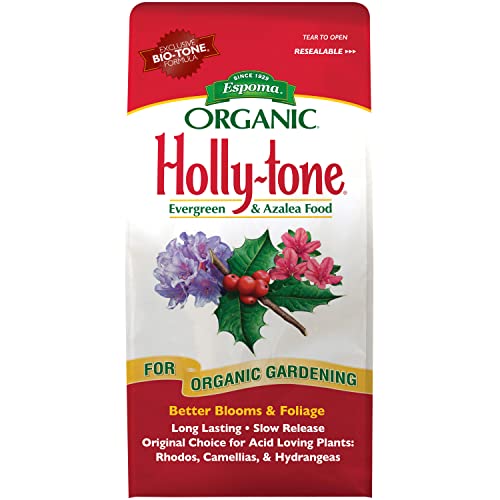
2. Espoma Holly-Tone 4-3-4 Plant Food 4 lb
Built for acid-loving plants, with sulfur in the mix and a longer, slower release.
Clematis in a mixed bed beside azaleas, hydrangeas or rhododendrons often wants the same soil those plants do. This is where Holly-Tone makes sense: its 4-3-4 analysis includes 5% sulfur, which is the nutrient that nudges soil toward the acidic side those shrubs like. The bag holds 64 ounces and weighs 4.1 pounds, and unlike the Rose-Tone two-pack above, this is a single 4 lb bag with one item inside.
What owners come back to again and again is simply how well it works on the plants it names. Reviewers single out rhododendrons, camellias and azaleas, reporting lots of blooms and healthy new growth after yearly feeding. It is a slow-release organic feed you apply in spring and fall, worked around the drip line and watered in.
Here is the honest bit: clematis is not on this bag’s target list. If you have a pure clematis planting and nothing else to feed, the Rose-Tone above is the smarter buy. Holly-Tone earns its place when your clematis shares a bed with acid lovers and you would rather buy one bag for the whole border.
The draw for mixed beds
- 5% sulfur content supports the acidic soil that rhododendrons and hydrangeas like
- Slow-release organics break down over a long stretch, so one spring and one fall feed covers the year
- Approved for organic gardening as a registered Organic Input Material
Worth knowing first
- Clematis is not named on the target-species list — this is a companion-plant choice
- You get a single 64 ounce bag, half the 128 ounces that come in the Rose-Tone pack
Reach for this if: your clematis sits among azaleas or hydrangeas and you want one bag to feed the whole border.
Look elsewhere if: clematis is the only thing you are feeding — the Rose-Tone pack covers more ground.
3. Dr. Earth Acid Lovers Fertilizer 4 lb

The most certified bag on this list, with the gentlest ratio in the lineup.
Read the numbers here and you will spot the difference immediately: this is a 0.3-0.4-3 analysis, a fraction the strength of the Espoma mixes, and that is a 13.3x gap against the 4-3-4 on the Holly-Tone bag. For a young clematis or one in a fresh pot, a gentle ratio like this is far less likely to overwhelm the roots. The bag lists Non-GMO Project Verified alongside OMRI, OIM, CCOF and NOP organic listings, and the maker describes it as people and pet safe with no synthetic chemicals.
Used on gardenias, camellias and blueberries, it earns a loyal following. Gardeners describe scattering it around a plant, watering, and watching tired foliage green up with new leaves. One reviewer’s rhododendron, bloomless for two years, flowered heavily after it was applied. The mix is handcrafted from feed-grade ingredients and enriched with humic acids and trace elements, so it feeds the soil as well as the plant.
That is not a flaw in the formula, just a planning note. If your clematis is one of several plants you feed, buy accordingly.
Why it earns the spot: the gentlest ratio of the group makes it the safest pick for young vines and potted plants, and the certification stack is the longest you will find here.
Best matched to: organic-first gardeners feeding a single young or potted clematis.
Second look: the 4 lb bag disappears quickly across a full border of plants.
4. Lilly Miller Bulb & Bloom Food 4-10-10, 4 lb

A heavy flower push, and it has already been used on clematis by real gardeners.
If leaf growth is not your problem and flower count is, this is the ratio to look at. At 4-10-10 the phosphorus and potassium numbers sit far above the first number, and the bag is built around the idea that the phosphorus and potassium combination pushes bright, vigorous blooms. It is a 4 lb bag of powder with slow-release feeding built in, made in the United States.
This one has a genuine clematis track record. Zone 6 gardeners report applying it to clematis, peonies and Oriental lilies in early spring and again in mid-fall with great results. Others feed their flowers with it all season and report gorgeous color. The resealable zip-lock bag keeps the powder dry between uses.
Two honest notes. It carries the natural odor typical of this kind of feed, and because it contains bone meal it will attract dogs and mice if left exposed — work it in and store the bag well sealed. A minority who tried it on irises saw nothing come up, though that outcome could come from soil, pot or weather as easily as the fertilizer.
Pick this when: you want to chase flower count on an established clematis and are fine working a powder into the soil.
Keep in mind: the bone meal draws dogs and mice, so seal the bag and bury the granules.
5. Alpha Chemicals Potassium Sulfate, 5 lb Bag

One nutrient, done well — for gardeners who already know their soil is short on potassium.
This is not a complete fertilizer and it is not sold as one. It is potassium sulfate, a straight source of potassium and sulfur, shipped in a sealed resealable bag with a tear-off tab. The 5 lb bag, listed as 80 ounces, is meant for correcting a specific deficiency — the kind you confirm with a soil test rather than guess at. It earns its place here because potassium is one of the two nutrients that finishing blooms and strong stems depend on.
Reviewers consistently praise its quality above all else. Gardeners report it dissolving cleanly for lawn spraying, and one account describes fruit trees doubling their growth with weekly applications. In a garden setting it is valued for correcting potassium shortfalls and greening up soil that sulfur helps. It is economical compared to complete blends if you are mixing your own.
The real limitation is texture. It is a fine powder, almost dust, which makes it awkward to blend evenly with coarser phosphate and nitrogen granules — it settles between them instead of mixing. It can also cake or dust when you scoop it. For a clematis, use this only to top up potassium when a soil test says you need to, not as a standalone feed.
Where it fits: a targeted correction for potassium-poor soil, not a bloom formula on its own.
The friction: the fine, powdery texture is hard to blend evenly with coarser granules.
Worth it for: gardeners who have a soil test showing low potassium and want a straight, economical source.
Not the one for: anyone wanting a single bag to feed a clematis from spring to fall.
Know the Specs
NPK Ratio
The three numbers on the bag — nitrogen, phosphorus, potassium, in that order — tell you what the fertilizer pushes the plant to do. A high first number means leafy growth. A low first number with higher second and third numbers means flowers and roots. For a clematis that already grows plenty of vine, a low-nitrogen, bloom-leaning ratio like 4-3-2 or 4-10-10 keeps energy going into flowers instead of foliage.
Granules vs Powder
Granules scatter and dissolve slowly into the soil, feeding over weeks. Powders are finer, mix into water or soil quickly, and can be harder to spread evenly. Granules suit a clematis in the ground; a powder is fine if you are dissolving it or working it into a pot. Either way, apply around the drip line, not against the stem.
Organic and OMRI Labels
An OMRI listing or a registered Organic Input Material statement means the product meets organic production requirements. Look for it if you garden organically or feed edibles in the same bed. Organic granular feeds break down slowly, releasing nutrients over a longer stretch than synthetic quick-release feeds.
Application Timing
Feed a clematis during active growth and around bud set, not after flowering ends. Espoma recommends a monthly feed through the growing season, roughly spring into early fall. Work granules into the top of the soil around the drip line, then water thoroughly so the nutrients reach the roots. Cool, shaded soil at the base is what clematis roots prefer.
Common Questions
What NPK ratio should I use on a clematis?
How often should I fertilize a clematis?
Can I use rose fertilizer on clematis?
Is a high-phosphorus fertilizer better for clematis blooms?
Can I use Holly-Tone on clematis?
Why does my clematis grow lots of leaves but few flowers?
Are organic fertilizers safer around pets?
Can I use potassium sulfate alone on clematis?
How do I apply granular fertilizer to a clematis?
What does OMRI mean on a fertilizer bag?
The Bottom Line
For most clematis owners, the fertilizer for clematis answer is the Espoma Organic Rose-Tone 4-3-2, because clematis is named on the label and the low-nitrogen ratio steers the vine toward flowers. If your clematis shares a bed with azaleas or hydrangeas, grab the Espoma Holly-Tone 4-3-4 and feed the whole border at once. And when flower count on an established vine is the whole goal, the Lilly Miller Bulb & Bloom Food 4-10-10 is the one to reach for.
How we choose
We do not accept paid placement. Every pick is matched to a real buyer and a real use-case; we do not hands-on test units.
Sources
Specifications: manufacturer listings and product documentation. Review insights: verified customer reviews, as of October 2026. Pricing: not shown on this page (it changes often); check the current price via the retailer link.
As an Amazon Associate, Aappliancez earns from qualifying purchases. This does not affect which products we feature.