Disclosure: Some links in this post are affiliate links. As an Amazon Associate I earn from qualifying purchases, at no extra cost to you. Learn more
Specs are compiled from manufacturer listings and verified buyer reviews and can change over time — please confirm the key details on the product page before buying.
If you want the pair that gets you closest to what the artist actually recorded, the CCA C12 is the one to grab — it tops this list for the way it handles detail across every genre. Everything below depends on two things that decide whether an IEM (in-ear monitor — a wired earbud pushed deep into your ear canal) sounds good or disappointing on your head: the seal you get, and the driver setup inside each shell.
This guide is built by comparing the manufacturers’ published specifications and the patterns across verified customer reviews, so you get each pick’s real strengths and trade-offs instead of marketing spin.
Wired in-ears live or die by fit, so the picks here are sorted by how faithfully they reproduce music and speech. Tracking a mix, chasing footsteps in a shooter, or taking a call on a noisy train — the right pair depends on a single well-made iem with mic.
Top Picks

How To Choose The Best IEM With Mic
You do not need a degree in acoustics to pick a wired in-ear monitor. You need to know which three or four numbers actually change how the thing feels in your ear on a long day — and which ones are marketing filler.
Fit and tip seal come before every other spec
A loose in-ear leaks bass out of your ear canal, so even an excellent driver sounds thin and hollow. That is the whole reason the CCA C12 owner community keeps repeating the same point: the seal matters more here than on most pairs. Buy something with a few tip sizes in the box and expect to experiment, because the tip that fits a friend may not seal your canal at all.
Know your connector type
Most in-ears attach to the cable with either a 2-pin connector or a small screw-on MMCX connector. Both let you replace a broken cable instead of tossing the whole pair — the Shure SE215 and the TRUTHEAR ZERO:BLUE2 use different systems, so a spare cable for one will not fit the other. If you plan to swap between a plain cable and one with a microphone, check the connector type first.
Impedance tells you how easy they are to drive
Impedance is measured in ohms — think of it as how hard your phone has to push to get sound out. The TRUTHEAR ZERO:BLUE2 sits at 5.8 ohm, a low figure that most phones handle without strain. A high-impedance pair may want a small DAC (a digital-to-analog converter — a stick-size gadget between your phone and the cable) to sound its best.
Side-by-Side Comparison
| Model | Best For | Driver Setup | Connector | Mic | Amazon |
|---|---|---|---|---|---|
| CCA C12★ Best Overall | All-round listening | 5 balanced armature + 1 dynamic per side | Detachable | Inline media control | Amazon |
| Sennheiser IE 100 PROStage Standard | Stage and studio monitoring | Single dynamic driver | Detachable | — | Amazon |
| Audiovance Vibes 202ML | iPhone calls and daily commutes | Single dynamic driver | Gold-plated MMCX | Smart inline remote and mic | Amazon |
| KZ ZS12 PRO 2 | Competitive gaming | 5 balanced armature + 1 dynamic per side | Detachable | Omnidirectional HD mic | Amazon |
| TRUTHEAR x Crinacle ZERO:BLUE2 | Music and positional audio | Dual dynamic drivers | 0.78mm 2-pin | Optional mic cable | Amazon |
| SIMGOT EW300 | Versatile tuning on the go | 1 dynamic + 1 planar + 1 piezoelectric ceramic | 0.78mm 2-pin | — | Amazon |
| Shure SE215 PRO | Heavy isolation and travel | Single dynamic MicroDriver | MMCX with lock-snap | — | Amazon |
Detailed Reviews
1. CCA C12 in Ear Monitor Headphones
Our pick — over 4.5★ from 600+ verified ratings; the strongest balance of quality and price.
Five balanced armatures plus a dynamic driver per side, and still the smoothest all-rounder here.
If you want one pair that sounds right on classical as well as heavy metal, start here. Each shell carries five balanced armatures (tiny drivers that handle fine detail in mids and treble) and one dynamic driver (the larger unit that moves air for bass) per side. The tuning comes out warm rather than shouty, so vocals sit forward and cymbals stay clean instead of turning harsh. A zinc alloy faceplate over a resin body gives it a sturdier feel than the price suggests, and the rounded shape is cut to sit still in the ear.
The cable is where this pair earns extra points for anyone who swaps hardware often. It runs as an anti-interference 8-strand low impedance wire (a low-resistance design that keeps the signal steady), and it detaches so a frayed cable never kills the whole set. It also carries inline media controls, so you can pause a call without digging out your phone. Owners who gig with these describe pairing them with foam tips for stage isolation and a fuller low end — the same trick works if you just want more punch on a commute.
Here is the honest catch, and it is a fit issue rather than a sound issue. A perfect seal matters more with these than with most in-ears, and the stock tips do not always deliver it — swap to silicone or foam and the metallic edge disappears, the bass fills out, and the imaging snaps into place. Get that right and the detail is genuinely competitive with far pricier buds; skip it and you will blame the earphones for a problem your ear canal created.
What earns it the top spot
- Five balanced armatures plus a dynamic driver per side give a wide, layered sound stage across genres.
- Detachable 8-strand cable with inline media control means easy swaps and call handling.
- Zinc alloy cover and skin-friendly resin build with slot protection for longer service life.
Where it asks patience
- Stock tips often fail to seal, and the wrong seal makes bass thin and treble metallic.
- Getting the best isolation usually means buying foam tips separately.
Made for multi-genre listeners: musicians, DJs, and anyone who wants one wired pair that handles ACG, rock, and electronic without fatigue.
Think twice if: you refuse to experiment with tips — this set rewards the fifteen minutes you spend finding the right size.
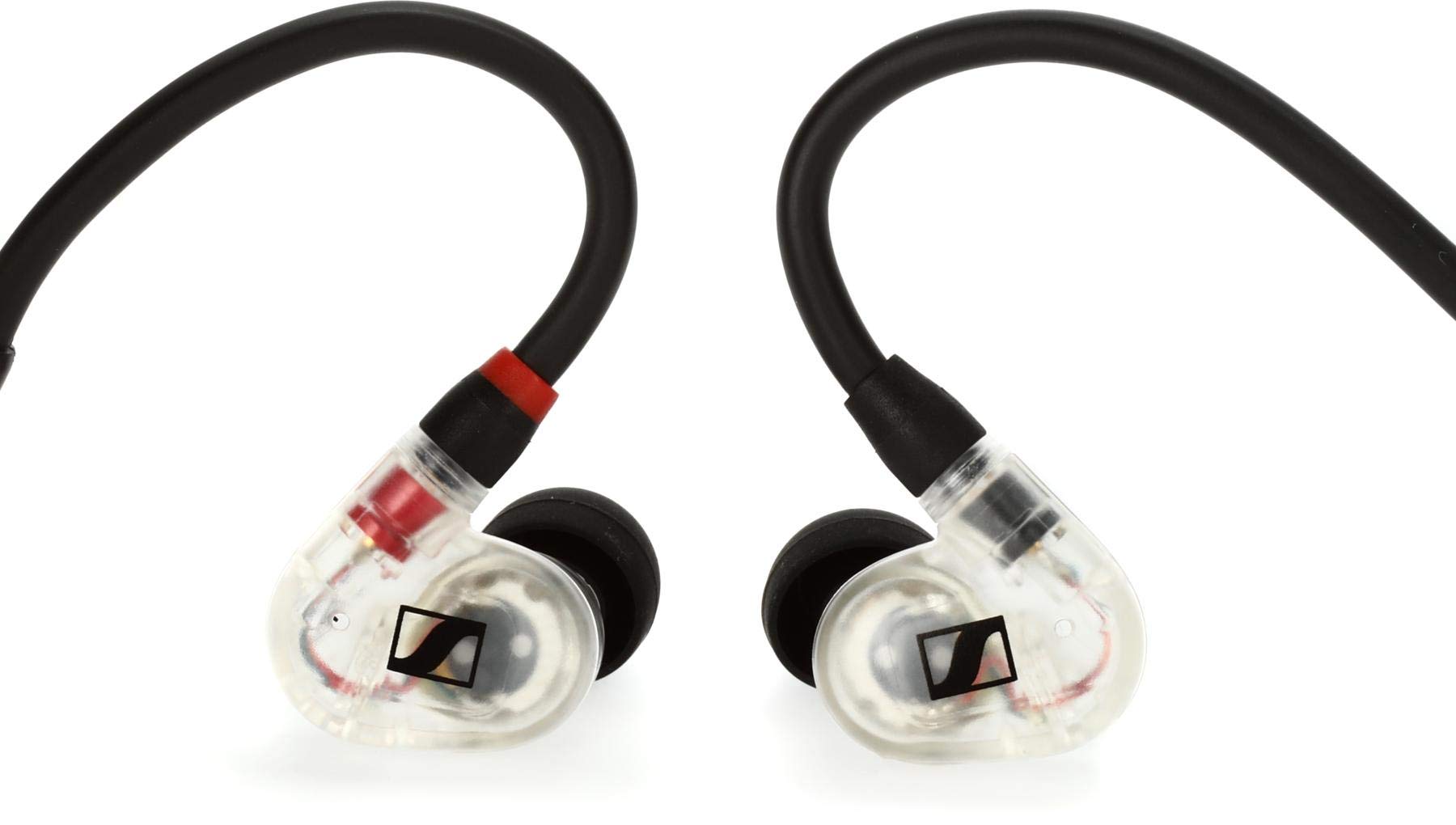
2. SENNHEISER IE 100 PRO In-Ear Monitoring Headphones
One driver, tuned to stay honest through a three-hour set instead of flattering the first song.
People who monitor live sound want a flat, uncolored picture of the mix, and the IE 100 PRO is built around exactly that idea. A single 10mm broadband transducer (a dynamic driver sized to cover the full range from one unit) does the work, and the point of the one-driver approach is a slimmer, more ergonomic shell. Less acoustic stress inside the housing means less distortion to smear the details you are listening for. The bundled kit is genuinely complete for working musicians: a protective case, a cleaning tool, and both foam and silicone ear adapters are in the box.
The over-ear cable routing and flexible tips are there for movement. On stage you are turning your head, leaning into a mic, and reaching for pedals, so the wire is designed to stay put rather than catch on everything. The cable itself detaches, which matters over the life of a working pair because the cable is usually the first part to fail. A compact design keeps the shell small enough to sit deep, which is how you get the shielding these are known for.
What buyers describe most is a natural, colorless presentation — one review sums up the appeal as the closest thing to authentic sound without added coloration. The trade-off to expect: these are monitoring tools, not a bass-first crowd-pleaser, and a few owners note that fit takes some trial before the low end locks in. If your phone produces a weak signal, a modest DAC will do more for these than any tip swap.
The monitoring angle: an tune earpiece plus both silicone and foam tips give you the shielding that lets you hear a click track clearly in a loud room.
The daily reality: the kit travels well — a soft case, a cleaning tool, and swappable sleeves mean nothing is a separate purchase on day one.
Built for the working player: drummers, touring guitarists, and anyone who needs to hear the mix clearly on a loud stage.
Not the pick if: you want a bass-forward fun sound for casual listening — that is not what a flat monitor is tuned to do.
3. Audiovance Vibes 202ML Wired Earbuds
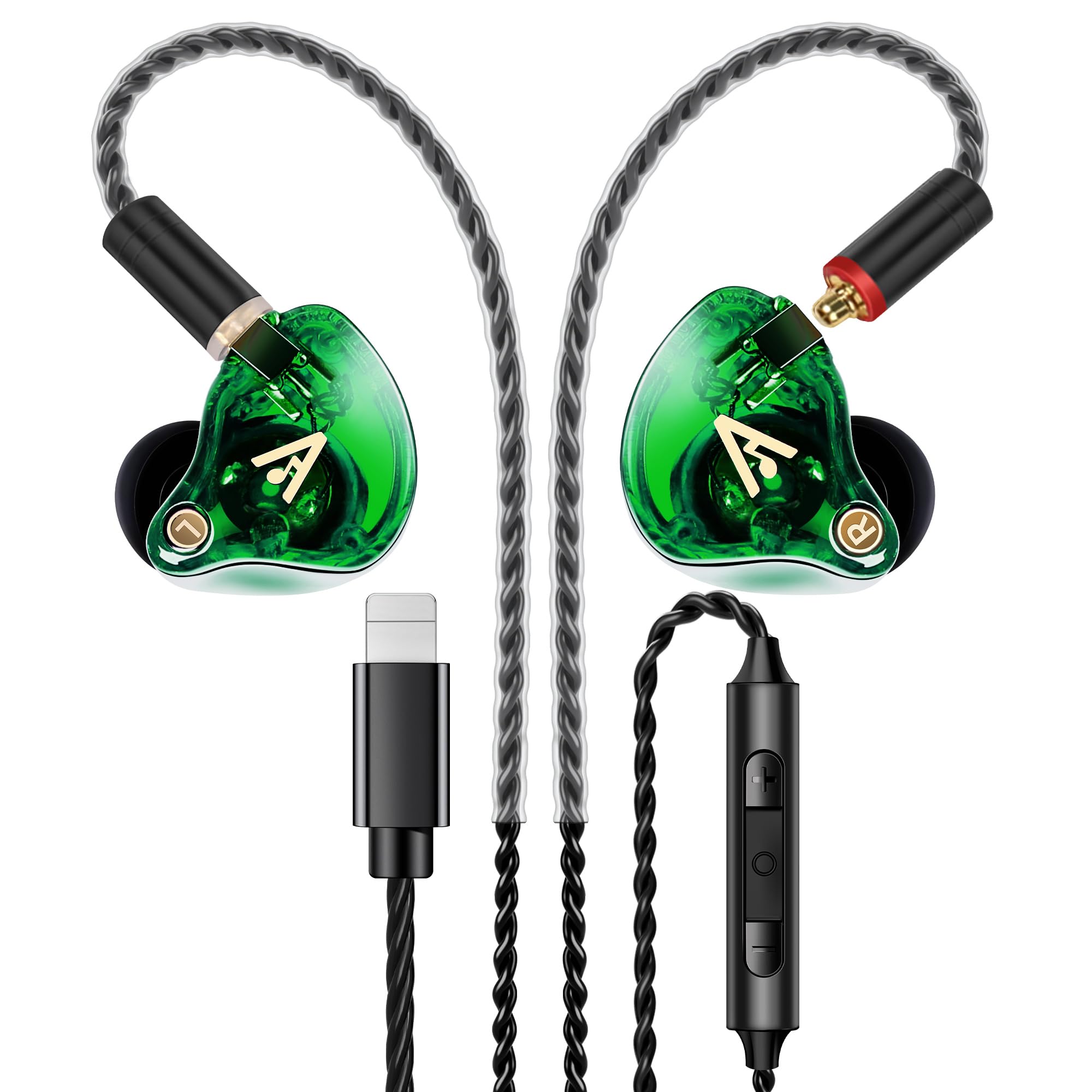
A lightning-plug pair for the iPhone you already own, with a mic that actually handles calls.
If your phone still has a Lightning port, this is the simplest way into a proper wired in-ear. It plugs straight in with no adapter and no Bluetooth pairing, and the driver runs to a 1-Tesla magnetic figure with master-tuned acoustic chambers covering a stated 8 to 23k Hz range. That spread is why cymbals and breath detail come through without the top end turning brittle. The high-purity silver-plated, Litz-braided cable is there to keep the signal clean and stop the wire tangling in a pocket.
The fit engineering is the other half of the pitch, and it shows: preformed over-ear earhooks hold the cable out of the way while the angled nozzle sits naturally in the canal. Six pairs of soft eartips in three sizes and two colors ship in the box, along with a carrying case, a carabiner, and a user manual. Ten color options mean you are not stuck with black. The inline remote handles volume and playback, so taking a call does not mean pulling out the phone.
One thing to check before you buy: this model fits iPhone 14/13/12/11/X/8/7/6/5, iPads, and iPods with a Lightning port — it does not fit the iPhone 17/16/15, which needs the other model in the range. Volume is also its hard ceiling. Bass thumps happily up to about 75% volume, but push past that and the sound turns tinny rather than simply louder, so plan to listen below the top of the dial.
Why owners keep it: the angled fit stays secure through a workout, and the MMCX connectors rotate and detach, so the cable is replaceable rather than terminal.
Know before you order: confirm your exact iPhone model — this Lightning version simply will not mate with the newer USB-C iPhones.
Reach for these if: you are on an iPhone 14 or older and want HiFi sound plus a working call mic without any dongle.
Look elsewhere if: you own a newer USB-C iPhone, or you like to run your music at full volume — this one tops out before the dial does.
4. KZ ZS12 PRO in Ear Monitor Headphones
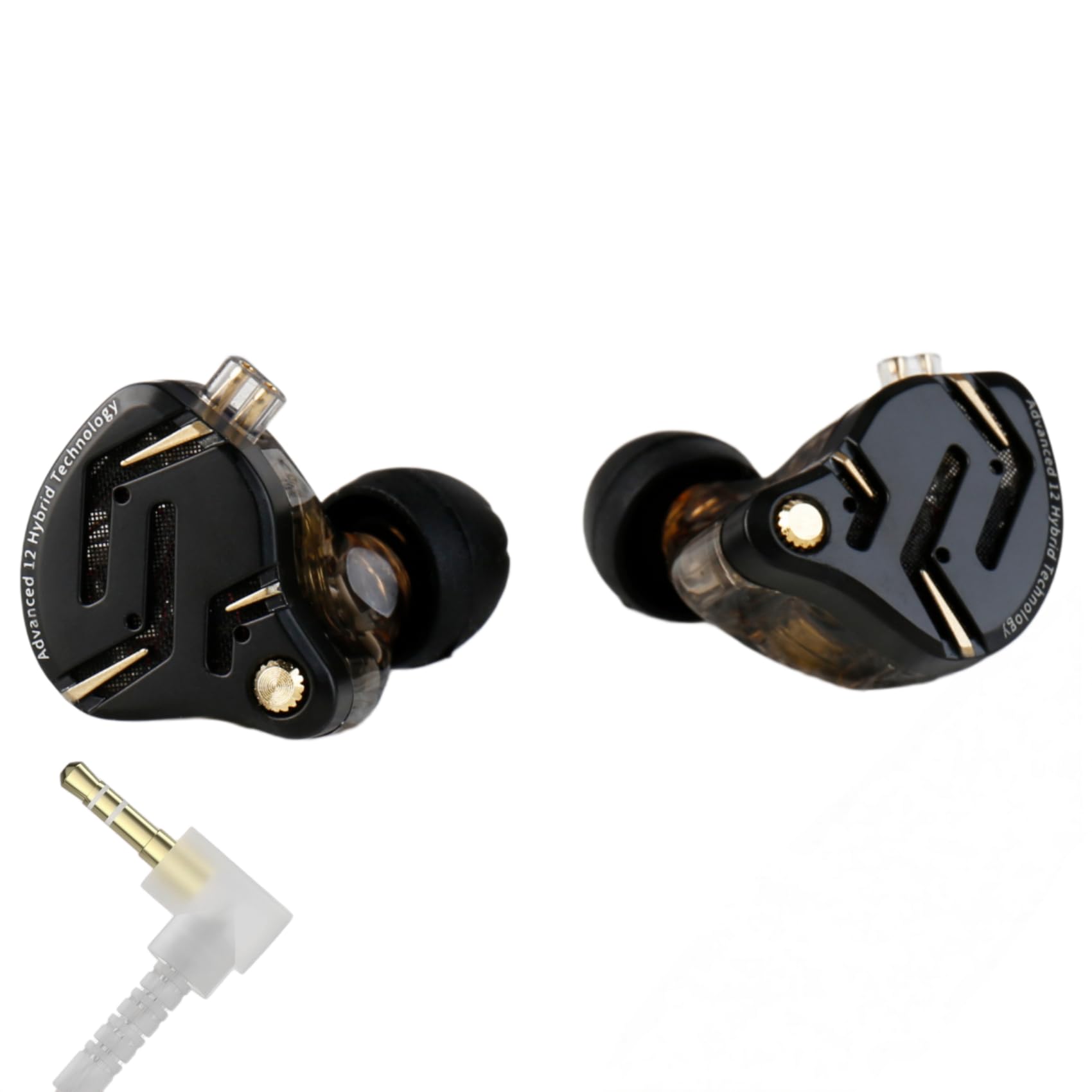
Positional audio sharp enough to turn footsteps into a direction, with a mic for the team call.
This one is aimed squarely at gamers and stage players who need to place a sound, not just hear it. Each side runs four 31736 ultra-high frequency balanced armatures plus one 30019 mid-high unit plus a single 10mm ultra-low frequency dynamic driver. The reason that matters in a shooter is transient response — how fast the driver reacts to a sudden noise — because a fast reaction is what makes a footstep read as left, right, or behind. A professional electronic crossover board sits inside to split the frequency range between the drivers and keep them from fighting each other.
Comfort over long sessions got real attention here too. The shell was shaped from ear-fit modeling, and the metal faceplate over a skin-friendly resin body keeps the weight down without feeling flimsy. An over-ear cable design anchors the wire so it does not drag on a head-turn. The bundled omnidirectional HD microphone captures voice clearly enough for remote calls and team chat, so you can move from a ranked match to a work meeting on the same pair. It terminates in a standard 3.5mm jack, and it works with laptops, desktops, tablets, consoles, and phones.
The recurring note from owners is a fit that some find snug and others find slips during a long session, so budget time for tip rolling. As for value, the sound quality and the build are regularly described together — one review of the line puts the performance alongside headphones costing far more. It is a natural step up from the CCA C12 if gaming imaging is your priority rather than all-round music warmth.
For competitive play: precise imaging and fast transient response help you locate an opponent before you see them.
For long calls: the built-in HD mic keeps a remote meeting or a team comms channel intelligible without a separate headset.
Pick this if: you game seriously, want a wired pair for positional cues, and still need a mic for calls.
skip it if: you need a guaranteed snug fit straight from the start — plan on trying the spare tips first.
5. TRUTHEAR x Crinacle ZERO:BLUE2 in-Ear Headphone

Two dynamic drivers, a DLP-3D printed cavity, and a mic cable option that doubles as a work headset.
Two dynamic drivers from one brand is unusual, and the ZERO:BLUE2 splits the work between them deliberately. A 10mm unit with a solid silica gel suspension liquid crystal dome and an N52 magnet handles one part of the range, while a 7.8mm unit with an upgraded polyurethane suspension liquid crystal dome and an N55 magnet focuses on mid and high frequencies. The housing is printed with a DLP-3D process and sealed with a silicone capping technique — methods normally kept for high-end multi-driver and custom builds. At 5.8 ohm, these are easy for a phone to push without strain.
The cable is where this pair quietly becomes a headset. It uses a 0.78mm 2-pin connection and ships with an upgraded two-strand 294-core copper and silver-plated coaxial cable, with more internal wires for tangle resistance. Choose the mic version and you also get an oxygen-free copper mic cable — the same one used on the GATE — which is what turns these from a listening tool into a calls-and-gaming companion. With a DAC in the chain, owners describe detail, separation, and clarity that hold up for long sessions, plus imaging good enough for positional cues in shooters.
The honest caveat is a V-shaped tuning — warm bass, a slightly pulled-back midrange, and a forward but controlled treble. That makes them entertaining rather than analytical, so a bass adapter bundled in the box is widely seen as unnecessary. Fit and comfort draw mixed reactions, and a durable-feeling cable is not the same as a permanent one, so treat the 2-pin joint gently when you swap cables.
The engineering worth paying for
- Dual dynamic drivers, an N52 magnet on the 10mm unit and an N55 on the 7.8mm, split the frequency load.
- DLP-3D printed cavity and silicone capping — techniques usually reserved for custom and high-end builds.
- 0.78mm 2-pin connection with an optional oxygen-free copper mic cable for calls and gaming.
What to weigh up
- V-shaped tuning pushes the midrange back, which some prefer and others do not.
- Fit and comfort draw mixed reactions, so the stock tips will not suit every ear.
The mic is the seller: choose the mic cable version and you get one pair for music, gaming, and calls.
The sound is the trade: warm and fun rather than neutral, so a midrange purist should look at the flat-monitor picks instead.
6. Linsoul SIMGOT EW300 1DD+1Planar+1PZT Hybrid Driver IEMs

Three driver types and two swappable nozzles give you two different earphones in one box.
The unusual feature here is the replaceable nozzle. Unscrew one set and thread on the other, and the tuning shifts — a silver nozzle that leans bright and detailed, or a gold one that comes across warmer and clearer. Each set runs its own tuning system, and the threaded connection makes the swap quick enough to do between tracks. That is genuinely rare at this tier, and it is the reason this pair suits listeners who cannot decide whether they want sparkle or warmth.
Underneath the nozzle sits a three-driver hybrid: one dynamic driver, one planar driver (a flat diaphragm that moves fast and stays controlled), and one piezoelectric ceramic driver per side. Getting those three to work together took material work and acoustic testing before the final tri-matrix layout was settled. A 10mm driver anchors the low end, and the whole assembly lives in a high-density alloy shell cut with CNC machining, so it protects the internals and shrugs off daily wear. The 0.78mm 2-pin silver-plated oxygen-free copper cable is multi-strand, encased in anti-oxidation PVC, and reportedly resists tangling.
What you give up is bass quantity. The tuning is neutral rather than thumpy — a deliberate choice that one buyer flagged plainly, warning that anyone who lives for heavy bass will be let down. Fit is the other split: some ears find the shell comfortable, others do not get a secure seat, so the three included tip sizes are worth cycling through. This sits at the top of the mid-range here, and it is the pick for someone who wants to experiment rather than settle.
The standout: two sets of detachable nozzles, one bright and one warm, let you retune the pair without buying a second set of earphones.
The texture: a heavy CNC alloy shell with a mirror-plated finish feels substantial — and shows fingerprints, so keep the cloth handy.
Ideal for experimenters: gamers and media listeners who want neutral, accurate sound and the option to switch tuning on a whim.
Wrong choice if: you want an assertive bass shelf — the neutral tuning deliberately holds that back.
7. Shure SE215 PRO Sound Isolating Wired Earbuds, Clear

Up to 37 dB of ambient noise blocked — the highest isolation figure in this guide.
If your problem is the world around you rather than the mix in front of you, this is the pair to shortlist. The SE215 claims up to 37 dB of ambient noise reduction, enough to quiet a long flight or a loud commute. A single dynamic MicroDriver handles the sound, tuned for detailed full-range output with clear highs and deep bass. A compact zippered carrying case and a detachable MMCX cable with a 360-degree rotation and lock-snap mechanism round out the package.
The design is built for the road. The wireform cable routes over your ears so the earphones stay anchored while you move, and because the cable detaches, a worn cable is a replacement rather than a funeral. Three sizes of both flex and foam sleeves ship in the box, and getting a proper seal is the whole game here — that seal is what delivers the isolation figure, not a battery or a chip. These are meant for musicians and stage monitoring, which is why the base model has no inline controls at all.
Two honest limits come with that isolation. First, the stock foams can be stubborn to remove from the nozzle, and switching sleeves takes patience on a new pair. Second, this level of sealing is genuinely blocked-off — fine for a flight, unwise on a bike path where you need to hear traffic. It is also the priciest and by far the most widely owned pair here, with a following that has built up over years rather than months.
Why it lasts: the detachable cable with the rotating MMCX lock-snap connector is the single most replaceable-wear-point design on this list.
The one catch: no inline mic on this base model, so pairing these with a phone call means a cable upgrade.
For flights and loud commutes: anyone who needs to shut out a noisy cabin or a crowded train without turning the volume up.
Not for you if: you need hands-free calling from the start — the base cable carries no microphone.
Know the Specs
Driver type and count
Dynamic drivers use a moving coil to push air and tend to deliver the bass you feel. Balanced armatures are tiny units tuned to narrow slices of the range, which is why hybrid pairs like the CCA C12 and the KZ ZS12 PRO 2 pair them with a dynamic driver. A planar driver is a flat diaphragm that reacts fast and stays controlled, and a piezoelectric ceramic driver adds high-frequency sparkle. More drivers is not automatically better — the crossover board that divides the work between them is what decides whether the result sounds coherent or messy.
Impedance and how easy they are to drive
Impedance, measured in ohms, tells you how much resistance the earphone puts up against your phone’s output. The TRUTHEAR ZERO:BLUE2 sits at 5.8 ohm, which a phone drives without trouble. Higher-impedance pairs usually want a dedicated DAC or amp to reach their full potential. If you plan to listen from a laptop or a games console headphone jack, a lower figure makes life simpler.
Connectors and cable swapping
Two main systems dominate wired in-ears: the small push-in 2-pin connector, used by the TRUTHEAR ZERO:BLUE2 and SIMGOT EW300 at 0.78mm, and MMCX, the screw-and-click connector on the Audiovance Vibes 202ML and the Shure SE215 PRO. Both let you replace a damaged cable. A cable with an inline mic is how a monitor becomes a headset, so check that your chosen connector is available in a mic variant before you commit.
Seal, tips, and noise isolation
Isolation is mostly physics, not electronics. When a tip seals your ear canal, outside noise has a harder path in and bass has nowhere to leak out. That is why the Shure SE215 PRO can claim up to 37 dB of ambient reduction with a single driver, and why CCA C12 owners insist the seal is the first thing to fix. Foam tips generally seal deeper; silicone tips are quicker to insert. Sized sleeves in the box are a strong signal that the maker expects you to experiment.
Common Questions
Will a wired IEM with a mic work on my phone for calls?
Do I need a DAC or amp to run these in-ears?
What is the difference between a 2-pin and an MMCX connection?
Why do my in-ears sound thin on some tracks and full on others?
How much ambient noise can these block?
Can I use a gaming IEM for music as well?
Are detachable cables really worth having?
How do two dynamic drivers compare with a hybrid setup?
Will a mic cable that ships with one pair fit another pair?
What tip type should I start with on a new pair?
The Bottom Line
The best iem with mic for most people is the CCA C12, because five balanced armatures and a dynamic driver per side give it the widest, most detailed sound of anything here, and the detachable inline-control cable keeps it practical for calls. If you need a mic cable that doubles as a work headset, or you want dual dynamic drivers and a DLP-3D printed cavity, the TRUTHEAR x Crinacle ZERO:BLUE2 is the one to reach for. And if blocking out a roaring commute matters more than tuning, the Shure SE215 PRO with its up-to-37 dB isolation figure is the pair that will change your day.
One nudge if you are still deciding: the CCA C12 carries a 4.6 rating and the Shure SE215 PRO holds 4.4 across thousands of owners. Start with the C12, spend the time to get a proper seal, and you will not need to look further.
How we choose
We do not accept paid placement. Every pick is matched to a real buyer and a real use-case; we do not hands-on test units.
Sources
Specifications: manufacturer listings and product documentation. Review insights: verified customer reviews, as of October 2026. Pricing: not shown on this page (it changes often); check the current price via the retailer link.
As an Amazon Associate, Aappliancez earns from qualifying purchases. This does not affect which products we feature.