Disclosure: Some links in this post are affiliate links. As an Amazon Associate I earn from qualifying purchases, at no extra cost to you. Learn more
Specs are compiled from manufacturer listings and verified buyer reviews and can change over time — please confirm the key details on the product page before buying.
You walked out to check your tomatoes and found half-eaten fruit, curled leaves, or a plant that looks yellow and tired. If that sounds familiar, the short answer is this: match the spray to the pest, and you fix the problem. A caterpillar chewing holes needs a very different bottle than aphids sucking sap or a fungus spreading spots. Read the label first, because the active ingredient tells you what the bottle actually kills.
This guide is built by comparing the manufacturers’ published specifications and the patterns across verified customer reviews, so you get each pick’s real strengths and trade-offs instead of marketing spin.
Every pick below is sorted by what it kills, how you apply it, and whether you can spray it on tomatoes you plan to eat. The right best insecticide for tomatoes is the one whose label lists your pest and a days-to-harvest interval you can live with.
Top Picks

How To Choose The Best Insecticide for Tomatoes
Tomatoes attract two very different kinds of trouble. One is chewing pests — hornworms, fruit worms, and cabbage loopers that eat leaves and bore into fruit. The other is sucking pests and disease — aphids, spider mites, thrips, and the fungal spots that follow stressed plants. A spray that handles one may do nothing for the other.
Before you buy anything, identify what is actually on your plant. Look under leaves, check the growing tips, and smell the soil. A caterpillar leaves droppings and chewed stems. Aphids cluster in sticky patches. Fungus shows as powdery white or dark spots. Your answer comes from that inspection, not from the loudest label on the shelf.
Match the active ingredient to your pest
Malathion is a contact insecticide, which means it kills the bugs it touches or that crawl across the dried residue. It handles aphids, thrips, spider mites, and lace bugs. Bacillus thuringiensis, the bacteria behind B.t. products, only kills caterpillars and worms, which makes it the gentle pick for hornworms. Systemic formulas get absorbed by the plant so sap-sucking insects take the poison in as they feed.
Check the days-to-harvest interval
This is the number of days you must wait between spraying and picking tomatoes you plan to eat. Some products let you spray up to the day before harvest. Others cannot go on vegetables at all. Always read this line on the label before you commit, because it decides whether a bottle is even usable in a tomato bed.
Decide between concentrate and ready-to-use
Concentrates cost less per application because you mix them with water yourself. A 32 fluid ounce bottle of concentrate can stretch across a whole season, while a smaller 16 fluid ounce bottle covers fewer plants. The trade-off is that you need a hose-end or tank sprayer and a place to mix safely, ideally outdoors.
Side-by-Side Comparison
| Model | Best For | Active Ingredient | Liquid Volume | Item Form | Amazon |
|---|---|---|---|---|---|
| Hi-Yield (32029) 55% Malathion★ Best Overall | Fast knockdown of aphids and mites | 55% Malathion | 32 fl oz | Oil | Amazon |
| Bonide Captain Jack’s Orchard SprayMost Versatile | Fruit trees and mixed garden beds | Lemon-based blend | 32 fl oz | Spray | Amazon |
| Monterey B.t. Caterpillar & Worm Killer | Hornworms and caterpillars only | Bacillus thuringiensis | 8 fl oz | Oil | Amazon |
| Bonide Systemic Insect Control | Ornamentals, not vegetable beds | Systemic formula | 16 fl oz | Spray | Amazon |
| Fertilome Triple Action | One bottle for bugs and fungus | Triple action blend | 16 fl oz | Liquid | Amazon |
Detailed Reviews
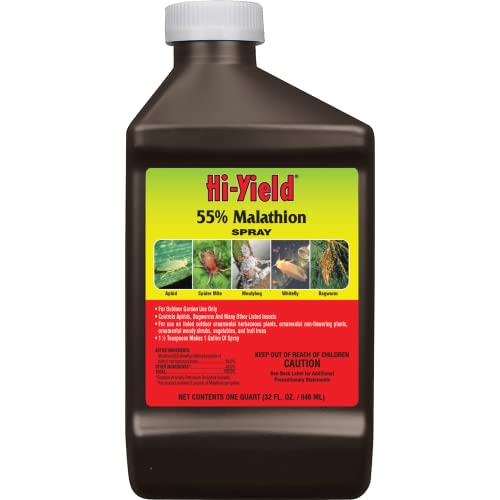
1. Hi-Yield (32029) 55% Malathion Spray, 32 oz
Our pick — over 4.5★ from 650+ verified ratings; the strongest balance of quality and price.
A serious 55% Malathion concentrate for gardeners who want one bottle to knock down crawling pests fast.
If aphids, thrips, spider mites, or lace bugs have taken over your tomato leaves, this is the bottle that hits them directly. The active ingredient here is 55% Malathion, a contact insecticide, which means it kills pests it touches or that crawl across the dried spray residue. That 55% Malathion concentration is why buyers rate it 4.7 stars across hundreds of reviews.
The 32 fluid ounce bottle is an oil-form concentrate you mix with water and apply with a hose-end or tank sprayer. You can use it on vegetables, fruit trees, shrubs, and ornamental non-flowering plants. One important label note: apply it in calm weather and only when rain is not expected for the next 24 hours, because rain will wash it off before it works. It also helps to know exactly what it targets, and bagworms come up again and again on the review pages, along with carpenter bees, borers on peach trees, and even squash bugs.
The honest catch is that this is not a gentle, pollinator-friendly spray, and it carries a strong odor. Buyers who mix it describe a powerful smell, so plan to mix it outdoors. Cost-effectiveness is also a split topic on the review pages — some owners find it a bargain for how far 32 ounces stretches, while a few feel it runs pricey for smaller gardens.
Where this bottle wins
- 55% Malathion delivers a strong contact kill on aphids, thrips, spider mites, and lace bugs
- The 32 fluid ounce concentrate covers a full season for most home gardens
- Labeled for vegetables, fruit trees, and shrubs, so it fits a mixed planting
- Effectiveness is the most-praised trait across its owner feedback
What to plan around
- Strong odor — mix and spray outdoors, never in a closed space
- Must be applied in calm weather with no rain forecast for 24 hours
- Not a pollinator-safe pick, so spray away from open blossoms
- Cost-effectiveness feedback is genuinely mixed among buyers
Grab this if: you want a proven contact insecticide for aphids, mites, and thrips on tomatoes and mixed fruit trees.
Pass it by if: you need a spray you can safely apply around blooming plants and pollinators.
2. Bonide Captain Jack’s Citrus, Fruit & Nut Orchard Spray
One bottle that fights both bugs and disease, and you can spray it the day before you pick.
Tomatoes rarely have just one problem, and this is the pick for that mess. It works as a fungicide, insecticide, and miticide at once, so it goes after beetles, fruit flies, caterpillars, mealybugs, spider mites, thrips, scale, and leafhoppers on the bug side, and powdery mildew, rust, blight, brown rot, and leaf spots on the disease side. You get 32 fluid ounces of concentrate, and it comes in a spray form you dilute with water.
Mix economics matter with a concentrate, and this one is generous. One pint makes up to 6.4 gallons of finished spray at a mix rate as low as 2 and 1/2 fluid ounces per gallon of water. Buyers report that same pint covering about four to five applications on 15 fruit trees. You apply it with a hose-end or tank sprayer, and the label allows use up to the day before harvest.
The apple-tree proof: buyers describe leaf spots fading and foliage turning visibly greener after a few rounds. One peach, cherry, and pear grower put it simply: “Whenever I get red leaf curl, it will clear it up with one spraying.” Citrus owners chasing discolored leaves saw dark green growth return after three weekly treatments.
The trade-off to weigh is that this is a fruit-tree and orchard formula first. It is labeled for apples, avocados, cabbage, broccoli, carrots, peppers, pecans, citrus, onions, roses, and shrubs — tomatoes are not on that list, so check your specific crop and pest before you rely on it. Diluted spray left sitting can also clog your sprayer, so mix only what you need and clean up after. Value feedback splits here too, with some calling it a good deal and others finding it pricey.
The best fit: growers managing both insects and fungal disease on fruit trees and a broad garden mix who want one bottle to do double duty.
Think twice if: your whole problem is caterpillars on tomato plants — a caterpillar-specific product will serve you better.
3. Monterey B.t. Caterpillar & Worm Killer, 8 oz with Spoon
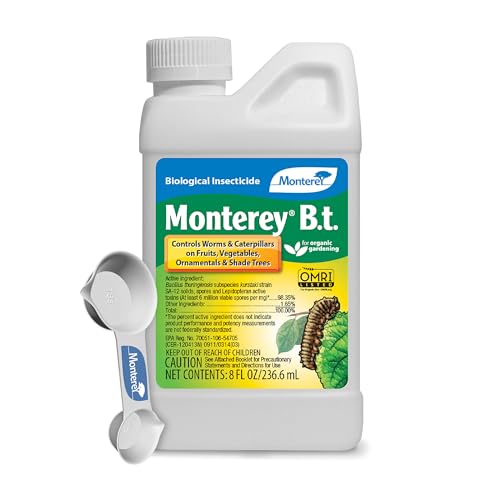
The narrowest spray on this list — built for hornworms and caterpillars and nothing else.
If you have spotted a fat green hornworm stripping your tomato plant bare, this is your answer, and it comes with a measuring spoon in the box. Bacillus thuringiensis is a bacterium that only goes after caterpillar and worm-type insects, so it targets cabbage looper, bagworm, gypsy moth, fall cankerworm, and elm spanworm. Anything with a hard shell or a sucking mouthpart is simply not its job.
That narrow focus is exactly the point, though, because it lets you spray without wiping out the good guys. When used as directed, Monterey B.t. has no effect on birds, earthworms, or beneficial insects such as honeybees or ladybugs. It carries an OMRI listing for organic gardening — the Organic Material Review Institute checks products against the USDA’s National Organic Program standards — and it is designed for use on tomatoes, broccoli, celery, cabbage, turnip greens, mustard greens, cauliflower, melons, lettuce, shade trees, and ornamentals.
Applying it is straightforward. The product instantly mixes with water and goes on with a trigger spray bottle or pressure tank sprayer. What wins buyers over is the effectiveness on the pests it does target, and the results speak for themselves. Anyone who has watched it save a row of brassicas or knock webworms off a Mountain Laurel will tell you it earns its spot in the garden. The bagworm crowd is especially sold — as owners put it, “The perfect product for treating bag worms.”
Where this pick falls short is volume and range. It also does nothing for aphids, mites, thrips, or fungus, so if your problem is broader, it is the wrong tool. Value feedback is mixed, driven largely by the small size.
Pick this when: caterpillars, worms, or hornworms are your only issue and you want to protect pollinators while you treat.
Keep looking if: you need to cover a large garden or fight aphids and mites at the same time.
4. Bonide Systemic Insect Control, 16 oz Concentrate
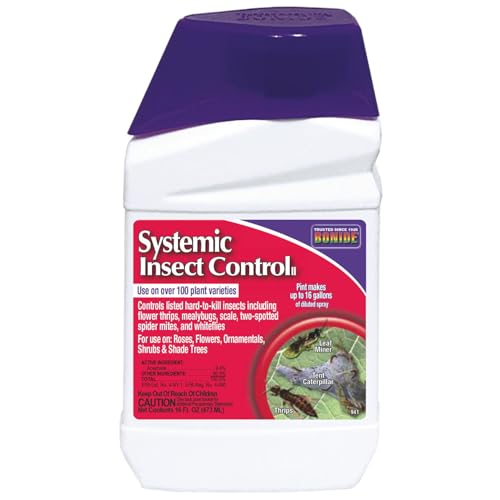
Gets soaked up by the plant so sap-sucking pests take the poison in as they feed.
Systemic means the insecticide is taken in by the plant itself, so insects that suck sap — thrips, mealybugs, scale, 2-spotted spider mites, whiteflies — get dosed as they feed, and it keeps working from the inside. This 16-ounce concentrate makes 16 gallons of finished spray, enough to treat a full bed of ornamentals. You mix it with water and can combine it with certain fungicides or fertilizers for a single spray pass.
The one thing you must know before buying is the label boundary. This product is not intended for vegetable or fruit plants. It is labeled for flower beds, roses, shrubs, and over 100 other ornamental varieties, for outdoor residential use only. So it belongs in the same garden as your tomatoes, but it does not go on them. Owners who used it on affected ornamentals describe a plant that looked dead coming back to green after one spraying, and rose growers report the mites that plagued their bushes were gone.
The scent is the biggest point to brace for. Multiple owners compare it to a garbage truck or worse, and the smell lingers for a while after watering. One buyer’s practical advice was to move treated plants into the garage for a couple of weeks so the odor does not fill the house. Apply it every 7 to 10 days while the infestation lasts, and note that the formula mixes easily with a measuring cup included in the box.
What it gets right: an immediate knock-down that owners mention on fungus gnats and thrips, plus the staying power of a systemic that keeps protecting new growth.
The honest trade-off: the strong smell is the most common warning, so plan your spray day around it and keep treated pots away from living spaces for a while.
Reach for this if: you are fighting hard-to-kill sucking insects on roses, azaleas, and flowering shrubs, and you don’t mind a strong odor.
Look elsewhere if: your pest problem is on the tomatoes themselves — the label does not cover vegetables or fruit.
5. Fertilome Triple Action Insecticide Miticide Fungicide
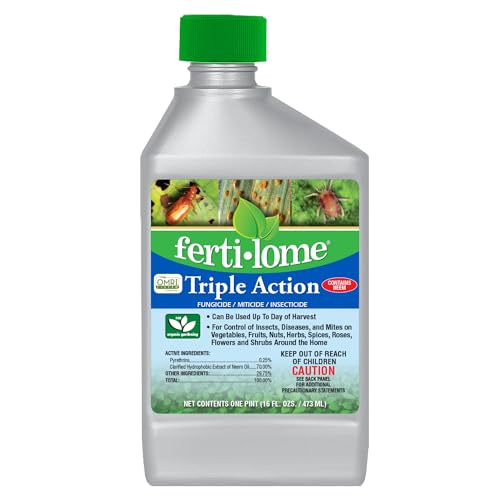
Kills bugs, mites, and fungus in one 16-ounce bottle — and it is cleared for vegetables you eat.
This is the all-in-one for a tomato bed fighting more than one battle. It works as an insecticide, a miticide, and a fungicide at the same time, controlling aphids, spider mites, leafminers, leafrollers, and armyworms while preventing powdery mildew, rust, and leaf spot. The 16 fluid ounces of liquid concentrate is labeled for fruits, herbs, nuts, spices, vegetables, roses, flowers, and shrubs, so it is usable on the tomatoes themselves.
How often you spray decides whether it works, so plan for a schedule. For best results, reapply on a 7 to 14 day cycle, which is a similar rhythm to the systemic product above. Home growers report it clearing aphids, whiteflies, and white scale quickly, and using preventive sprays to keep tomatoes, cucumbers, and peppers thriving rather than waiting for a flare-up.
Why it earns a spot
- One bottle covers insects, spider mites, and fungal disease at once
- Labeled for vegetables and fruits, so it fits a food garden directly
- Customers note fast results on aphids, whiteflies, and scale
- Also revives stressed ornamentals like azaleas fighting fungus
Keep in mind
- Needs a 7 to 14 day reapplication schedule to hold the line
- Value feedback is mixed — several buyers call it overpriced
- It is a smaller 16-ounce bottle, so a big garden will go through it
The complexity is that this is a juggling act, not a one-and-done. Because it does three jobs, plant-health reactions can vary, and a few growers note leaves turning yellow while others see trees looking their best. Reapply it on schedule and it holds; skip the follow-ups and the fungus creeps back. If you would rather buy one bottle than juggle an insecticide and a fungicide, this is the one to try.
Choose it for: a vegetable and fruit garden where you want one product to handle both pests and disease.
Not your pick if: you prefer a single-purpose spray you can dose precisely for one problem.
Know the Specs
Active Ingredient
The active ingredient is the chemical or organism doing the killing, and it decides which pests the bottle can handle. Malathion is a contact insecticide that kills what it touches, so it works on aphids, thrips, and spider mites. Bacillus thuringiensis only affects caterpillars and worms. Systemic formulas get absorbed by the plant so sap-sucking pests take them in as they feed. Read the active-ingredient line first, because a bottle that is great for one pest may ignore yours entirely.
Concentrate vs Ready-to-Use
A concentrate is a strong formula you dilute with water before spraying, while a ready-to-use bottle is already mixed. Concentrates usually cost less per application and stretch further — a 32 fluid ounce bottle often covers a full season, and a 16-ounce bottle of systemic formula can make 16 gallons of finished spray. The trade-off is that you need a hose-end or tank sprayer plus a safe place to mix, ideally outdoors, and you should mix only what you will use that day to avoid clogging.
Days-to-Harvest Interval
This interval is the wait time between spraying and picking food you plan to eat, and it is the number that decides whether a product even works in a tomato bed. Some formulas let you spray right up to the day before harvest. Others cannot go on vegetables or fruit at all. Always read this line before you commit to a bottle, because a powerful spray that cannot touch an edible plant is useless on your tomatoes.
Liquid Volume and Coverage
Liquid volume tells you how much product is actually in the bottle, measured in fluid ounces. A 32-ounce bottle lasts longer between reorders than an 8- or 16-ounce one, but only if the mix ratio is comparable. A 32 fluid ounce concentrate typically outlasts an 8 or 16-ounce bottle, which matters during a heavy pest season. Pair the volume with the mix ratio, since a small bottle that dilutes far can still cover more ground than a bigger bottle that uses a strong ratio.
Common Questions
Which insecticide can I safely spray on tomatoes I plan to eat?
What kills tomato hornworms without harming bees?
How do I know if my tomatoes have aphids versus a fungal disease?
Can I use a systemic insecticide on my tomatoes?
How long before harvest can I spray tomato insecticide?
Will these sprays kill earthworms and other good garden bugs?
Do I need a special sprayer for tomato insecticides?
How often should I reapply insecticide to tomato plants?
Is a concentrate or a ready-to-use bottle better for tomatoes?
What is the difference between a contact and a systemic insecticide?
The Bottom Line
For most tomato growers, the best insecticide for tomatoes winner is the Hi-Yield (32029) 55% Malathion Spray, because its 55% Malathion contact formula knocks down aphids, thrips, and spider mites and the 32-ounce concentrate lasts a full season. If caterpillars and hornworms are your only problem, the Monterey B.t. Caterpillar & Worm Killer is the pollinator-friendly pick. And if you are fighting both bugs and fungus at once, the Fertilome Triple Action covers a vegetable garden in a single bottle.
How we choose
We do not accept paid placement. Every pick is matched to a real buyer and a real use-case; we do not hands-on test units.
Sources
Specifications: manufacturer listings and product documentation. Review insights: verified customer reviews, as of October 2026. Pricing: not shown on this page (it changes often); check the current price via the retailer link.
As an Amazon Associate, Aappliancez earns from qualifying purchases. This does not affect which products we feature.