Disclosure: Some links in this post are affiliate links. As an Amazon Associate I earn from qualifying purchases, at no extra cost to you. Learn more
Specs are compiled from manufacturer listings and verified buyer reviews and can change over time — please confirm the key details on the product page before buying.
Gluing HDPE is the repair that humbles almost everyone. Polyethylene is a waxy, low-energy plastic — think milk jugs, kayak hulls, cutting boards, ice packs — and ordinary super glue simply beads up and flakes off it. The fix is the right chemistry for a slick surface, not more glue. It is the right chemistry for a slick surface, and often a primer or reinforcing powder to give the bond something to grip. This guide sorts the products that actually bond HDPE from the ones that bead up and peel off.
This guide is built by comparing the manufacturers’ published specifications and the patterns across verified customer reviews, so you get each pick’s real strengths and trade-offs instead of marketing spin.
A plastic adhesive has to match the material you are bonding, not just the label on the tube. This breakdown of the strongest options for a glue for hdpe repair focuses on what holds under load.
Top Picks

How To Choose The Best Glue for HDPE
Most HDPE repairs fail because the adhesive chemistry does not match the plastic. Polyethylene has a very low surface energy, which means most liquid adhesives cannot grip it — they sit on top like water on a waxed car and peel away under the first real load. No glue “just works” on HDPE; you need either a surface-priming activator or a powdered filler that mechanically locks into the joint.
Surface energy and why it matters
A low-energy surface like HDPE resists wetting, so the adhesive never fully contacts the plastic. Two-part systems solve this by applying a primer or activator first, which raises the surface energy so the glue can bite. If you are bonding HDPE to a higher-energy plastic such as polycarbonate, a two-part system can bond it well, though HDPE-to-HDPE is always the harder case and typically holds less strongly.
Two-part systems versus single-bottle adhesives
A single-bottle cyanoacrylate sets in seconds and is fine for quick, non-structural fixes on smooth, hard plastics. For anything that will flex, vibrate, or carry weight, a two-part kit with a separate activator, or a kit that adds a reinforcing powder around the seam, gives a far tougher joint. That powder is often the difference between a repair that pops apart and one that holds.
Cure time and working time
Working time is how long you have to position the parts before the glue grabs; full cure time is how long until the bond reaches its final strength. Some of these products set in seconds but still want a full day to reach their rated strength. Leave the joint clamped or untouched for the full cure window before you stress it.
Side-by-Side Comparison
| Model | Best For | Container Type | Full Cure Time | Water Resistant | Amazon |
|---|---|---|---|---|---|
| DAP Weldwood Landau Top & Trim HHR★ Best Overall | Auto upholstery and trim | Can | 24 hours | Yes | Amazon |
| K Tool International 90002 Q Bond KitBest Value | Hard plastics, PVC and metals | Bottle | — | — | Amazon |
| J-B Weld 50133 Plastic Bonder | Filling cracks and patching plastic | Syringe | 30 minutes | Yes | Amazon |
| Loctite Plastics Bonding System | Hard-to-bond plastics like PE and PP | Kit | 24 hours | Yes | Amazon |
| 3M Scotch-Weld PR100 | Difficult plastic and rubber substrates | Bottle | 24 hours | — | Amazon |
Detailed Reviews
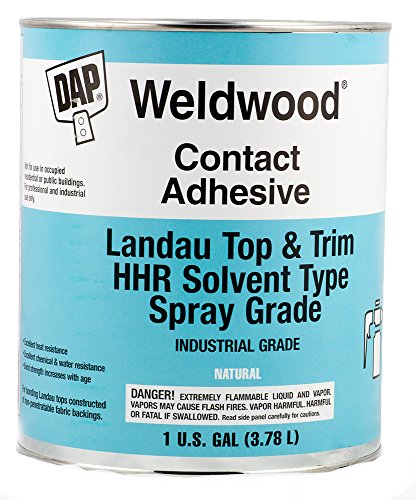
1. DAP Weldwood Landau Top & Trim Contact Adhesive 1 Gal
Our pick — over 4.5★ from 900+ verified ratings; the strongest balance of quality and price.
The spray-grade workhorse that holds car ceilings and trim through heat, weight, and time.
If you are bonding a large, flexible surface — a headliner, a trim panel, foam or vinyl — the format matters as much as the formula. This DAP contact adhesive comes as a full-can spray-grade liquid in a can, item form listed as a gallon spray, so you can coat broad panels evenly instead of dabbing at them with a tube. It is rated for interior and exterior use, forms a permanent bond, and is both water resistant and high heat resistant.
What it does well is exactly this kind of flexible-material work: applying a fabric liner and pressing both the fabric and the receiving panel before joining them. Bonding holds well once dried, and it stays thin on thin fabrics rather than soaking through. In a truck, this is the adhesive that lays a suede headliner liner under a skylight and keeps it up there.
One can covers a whole panel, not a single drip: it weighs 7.4 pounds and arrives as a single can, so its item package quantity is a wildly different proposition from the small glue tubes on this list. That makes it right for panel-wide jobs rather than single drop repairs. The honest catch is the fumes. The odor is extremely strong, so ventilation and a respirator are strongly suggested, and it is flammable — that combination means you spray outdoors or in an open bay, never in a closed cab. It is also designed around fabric and vinyl-type materials, so it is not the tool for a rigid HDPE structural joint.
The real strengths
- High heat resistant and water resistant for interior and exterior use.
- Spray-grade form lets you cover large flexible panels evenly, not just spot-fix.
- Permanent bond with a 24-hour full cure time, and it stays thin on thin fabrics.
Where it asks patience
- The solvent odor is very strong — ventilation and a respirator are strongly suggested.
- It is flammable, so it needs an open, well-ventilated space to use safely.
- Aimed at fabric and vinyl-type materials, not rigid hard-plastic joints.
Grab the can when: you are laying headliners, trim, foam, or vinyl across wide panels and you can work with real airflow.
Leave it for the tube jobs: a small rigid plastic crack does not need a gallon of spray-grade solvent solvent adhesive.
2. K Tool International 90002 Q Bond Adhesive Kit
Two glues and two powders that turn a cracked plastic mount back into a solid part.
This kit is built for the repair that a plain super glue bottle loses every time: a broken mount, bracket, or housing that has to carry load and take vibration. It is a four-piece system — one adhesive bottle for plastics, one for metals, and a matching reinforcing powder for each — meaning it holds one more piece than the J-B Weld Plastic Bonder’s three-piece count. The powder is the whole trick. You run the fast-setting glue, then build the powder around the seam so it cures into a hard, structural mass rather than a thin brittle line.
The materials list covers metal and plastic, and it is aimed squarely at garages, repair shops, and home projects. This is the pick for fusing plastic back together where the piece has to survive real force — the kind of fix that saves you from replacing an entire assembly. Set-up happens in seconds, so you need your parts positioned before you commit.
The trade-offs are worth knowing before you open the box. The fumes are strong, so work outside with a mask and gloves, and the liquid can rapidly bond skin — nitrile gloves are not optional here. It also struggles on shiny, smooth plastic until you scuff the surface, so sanding a slick HDPE face first is part of the protocol. And a few builders find it overpriced once they realize the glue is essentially a runny cyanoacrylate with the powder doing the heavy lifting. The payback, though, is the replacement part you never buy.
Why it earns its place: The powder-and-glue method delivers a tough, filled bond that makes a broken plastic mount look like it was never cracked, and it sets fast enough to keep a repair moving.
Prep is not optional: It fails on glossy smooth plastic without sanding, and the rapid skin-bonding, strong-fume nature means gloves, a mask, and open air every single time.
Reach for this if you are fixing load-bearing plastic that has already defeated cheaper glue and you want a filled, reinforced repair.
Think twice if you want a spotless, invisible seam on a decorative surface — this method is about strength, not cosmetics.
3. J-B Weld 50133 Plastic Bonder Adhesive 25 ml Pack Of 3

A tan, water-resistant syringe adhesive that cures in half an hour and blends into most plastic.
When you want a repair you can stress the same afternoon, this syringe earns a look. Its full cure time is listed at 30 minutes, far quicker than the 24-hour full cure of the Loctite and 3M picks, and it arrives as a pack of three syringes so you have spares on the shelf. The two-part liquid is engineered for plastic, dries tan to blend with many plastic surfaces, and is water resistant for outdoor or wet environments. Tensile strength is rated at 3770 psi.
The syringe format is the quiet advantage. You can push a precise bead straight into a crack or a pinhole rather than squeezing a tube and hoping for accuracy, which makes short work of filling and sealing jobs. It is the pick for repairing cracks and patching worn spots on plastic parts that see the weather.
The honest limit is durability on troublesome plastics. The bond holds up well in many repairs but has popped loose from recessed areas on tricky polypropylene jobs, where a plug grips only temporarily before working free. So treat this as an excellent filler and sealer for accessible cracks — and if your part is a slippery low-energy plastic that must bear constant load, expect to back the repair with a mechanical fix. It performs best where you can give it clean access and a bit of surface roughness.
Where it shines: The 30-minute cure gets you back to using the part fast, and the tan color and 3770 psi tensile strength suit visible plastic repairs that need to hold and look tidy.
The durability note: On stubborn polypropylene surfaces it can hold only temporarily in recessed spots, so reach for a reinforcing method on slippery, load-bearing plastics.
Best fit: cracks, chips, and pinholes on common plastics that you want to seal and get back into service quickly.
Not the match for: a flexing, load-bearing slippery-plastic joint that needs the mechanical grip of a powder-reinforced bond.
4. Loctite Super Glue Plastics Bonding System 6 Pack
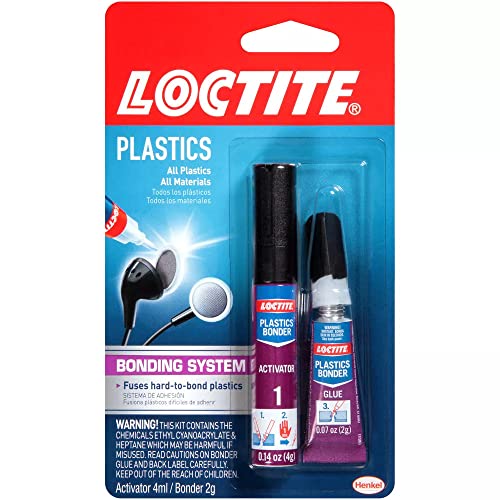
The two-part glue-and-activator kit built specifically to reach plastics other super glues cannot touch.
This is the product that speaks directly to the HDPE problem. Instead of a lone cyanoacrylate, it pairs a cyanoacrylate glue with a separate activator that primes the surface so the glue can actually grab. Loctite lists it as able to bond polyethylene (PE), polypropylene (PP), and polytetrafluoroethylene (PTFE) — the three traditional “nothing sticks to this” plastics. It sets in seconds, dries clear for invisible repairs, needs no clamping or mixing, and is resistant to water, most chemicals, and freezing temperatures.
Its real specialty is mixed-material work. Bonding HDPE to polycarbonate has held overnight at good strength, and HDPE-to-HDPE comes out stronger than a plain cyanoacrylate would manage. So if you are joining a polyethylene part to a different plastic, this is your best single-bottle-plus-activator option here.
The catch is that HDPE-to-HDPE still is not a structural bond — it is stronger than ordinary super glue but can be broken by hand or pliers, so it is not the tool for a load-bearing joint. A few kits also arrive with a dry activator that never primes anything, and polypropylene or heavily textured surfaces are the failure cases; the liquid is also non-returnable because it is flammable. Keep your expectations matched to the job and this earns its keep for non-structural HDPE fixes.
what separates it
- Two-part glue-plus-activator formula is designed to bond PE, PP, and PTFE.
- Sets in seconds and dries clear for nearly invisible repairs, with no clamping or mixing.
- Resistant to water, most chemicals, and freezing temperatures.
Keep in mind
- HDPE-to-HDPE bonds are not structural and can be broken by hand or pliers.
- Some kits ship with a dry activator pen that fails to prime textured or polypropylene surfaces.
- Flammable and non-returnable, so buy deliberately.
Your move if: you are joining polyethylene to polycarbonate or making a low-stress HDPE repair and want the classic glue-and-activator approach.
Rethink it if: the joint will carry real load or flex — that is a job for the reinforcing-powder kits above.
5. 3M Scotch-Weld Plastic & Rubber Adhesive PR100 20 Gram

A precise, fast-handling instant adhesive for the awkward pairings other glues quietly give up on.
This is the specialist in the group, and its target is the material no one else wants to bond. 3M rates it for plastics, silicone rubber, and EPDM, along with heavily plasticized PVC, ABS, Nylon, and Santoprene — a roster that goes well past the standard plastics the other picks cover. Time to handling strength is under 20 seconds, which is quick enough to hold a part by hand and move on. It dispenses from a flexible container you pinch for a single drop or squeeze for a steady bead, and it is designed not to drip during vertical applications.
The bond line is thin and precise, which makes it a natural fit for small joints, gasket attachment, jewelry assembly, and electronic parts. It reaches full cure in 24 hours and is rated for high overlap shear strength once cured. In the field it handles the jobs that send people back to the store — bonding plastic and rubber surfaces where other glues simply fail.
Two things to weigh. It is sold for industrial or occupational use rather than consumer sale, and 3M itself marks it not for consumer sale or use, so it is a deliberate buy for someone who wants pro-grade chemistry. And on silicone it is a mixed story: bonding silicone to silicone works when paired with a 3M silicone primer, but without proper surface prep it can crack and flake. That is a workflow note, not a defect — clean and sand your surfaces and it performs.
The specialist’s edge: Under-20-second handling strength and a drip-free flexible dispenser make it the tool for precise small joints across plastic, rubber, and EPDM that standard glues cannot hold.
Know before you buy: Marked for industrial use and not for consumer sale, and it needs a separate 3M silicone primer to bond silicone reliably — prep drives the result.
Worth it for: precise, fast bonds on difficult plastic-and-rubber pairings and small assembly work where accuracy matters.
Look elsewhere for: a casual household tube — this is pro-grade chemistry that wants clean, prepped surfaces and proper handling.
Know the Specs
Full Cure Time
Full cure time is how long the joint needs before it reaches its final, rated strength — not just when it feels stuck. Several products here set in seconds but still want 24 hours to fully cure, while the J-B Weld syringe is listed at 30 minutes. Treat the cure window as time you should not stress the repair, because loading a joint early can pull it apart even when the glue is good.
Tensile Strength
Tensile strength is a measure of how hard you can pull the bonded parts apart before the joint fails, usually given in psi (pounds per square inch). The J-B Weld syringe here is rated at 3770 psi, which is a useful baseline for a strong plastic adhesive. It is a lab figure, though — real-world strength depends on surface prep, joint design, and whether the plastic itself is a slippery low-energy type that resists adhesion.
Common Questions
What kind of glue actually sticks to HDPE?
Why does ordinary super glue fail on polyethylene and polypropylene?
Can I bond HDPE to polycarbonate?
How long should I wait before stressing an HDPE repair?
Do I need to sand or clean the surface before gluing plastic?
Is a two-part glue better than a single-bottle super glue for plastic?
What is the reinforcing powder in an adhesive repair kit for?
Is adhesive safe for outdoor or wet HDPE applications?
Can I use a contact adhesive to bond HDPE panels?
Should I wear gloves and work outside when using plastic adhesive kits?
The Bottom Line
For most people tackling a hard-to-bond plastic repair, the winner is the DAP Weldwood Landau Top & Trim HHR — it is the top-rated, most-reviewed pick for broad flexible surfaces and it holds under heat and moisture. The one honest note is that it is a full-can spray-grade product weighing 7.4 pounds, built for panel-wide jobs and only usable with strong ventilation, so it is not the tool for a single small crack. If you are bonding hard plastics to metal and want a reinforced, filled joint, grab the K Tool International 90002 Q Bond Kit. And for joining polyethylene to another plastic like polycarbonate, the Loctite Plastics Bonding System is the one to reach for.
How we choose
We do not accept paid placement. Every pick is matched to a real buyer and a real use-case; we do not hands-on test units.
Sources
Specifications: manufacturer listings and product documentation. Review insights: verified customer reviews, as of October 2026. Pricing: not shown on this page (it changes often); check the current price via the retailer link.
As an Amazon Associate, Aappliancez earns from qualifying purchases. This does not affect which products we feature.