Disclosure: Some links in this post are affiliate links. As an Amazon Associate I earn from qualifying purchases, at no extra cost to you. Learn more
Specs are compiled from manufacturer listings and verified buyer reviews and can change over time — please confirm the key details on the product page before buying.
When a storm knocks out the grid, you want a backup that starts itself and keeps your heat pump, well pump and fridge running without you touching a fuel valve. A 26kW-class home generator fits most houses well: it is big enough to run central air and a water heater at the same time, yet small enough not to overload your service panel. Here is the catch most buyers miss: the machines labeled 26kW here are not the same kind of animal. One is a 26,000-watt standby that feeds a 200-amp transfer switch (the panel box that switches your home from grid power to generator power). One is a 28,000-peak portable on a wheel kit. One is a battery-inverter setup that stores 5,040Wh (watt-hours, a measure of stored energy) and hums instead of rumbles.
This guide is built by comparing the manufacturers’ published specifications and the patterns across verified customer reviews, so you get each pick’s real strengths and trade-offs instead of marketing spin.
We’ll walk through what each of these seven actually powers, what the install demands, and which one matches your house before the power company calls. Here’s the breakdown of every 26kw home generator worth your attention.
Top Picks
How To Choose The Best 26kW Home Generator
Your first decision is not the brand. It is if you want the machine to start itself, or whether you are willing to roll it out, plug it in and pull a cord. A standby generator wires permanently into a transfer switch and fires up on its own the moment the grid drops, so your power comes back without you stepping outside. A portable gives you the same watts for less money up front, but you do the connection work yourself. Neither one is better; they fit different houses and different comfort levels.
Start with running watts, then add surge headroom
Every generator quotes two numbers: running watts (what it holds continuously) and peak watts (the brief surge it survives while a compressor kicks on). Your central air, well pump and furnace all draw a jolt at startup. A machine rated 20,000 running and 28,000 peak, like the Westinghouse units here, gives you room for that start-up spike. Size to the appliances you truly need, not the entire panel.
Decide fuel before you decide model
Natural gas never runs out during an outage as long as the utility’s gas line stays pressurized, and propane tanks can be sized to your tolerance. Gasoline means storing fuel and rotating it. The Generac and Westinghouse tri-fuel options here run on natural gas, propane or gasoline, which matters in a long winter outage when one supply line fails.
Budget for installation, not just the unit
A standby generator needs a licensed electrician, a transfer switch and often a concrete pad. Owners of the Generac Guardian in this list report paying a licensed electrician for the hookup, plus a poured concrete pad for the unit to sit on. A portable paired with a manual interlock kit is cheaper to wire but hands you the job of starting it. Battery systems need an electrician for the transfer switch but no fuel plumbing at all.
Side-by-Side Comparison
| Model | Best For | Power Rating | Fuel Type | Backup Style | Amazon |
|---|---|---|---|---|---|
| Jackery HomePower 3600 Plus★ Best Overall | Quiet indoor-friendly battery backup | 3600W (7200W parallel) | Solar / AC | Battery + solar panels | Amazon |
| Generac Guardian 26kWFully Automatic | Fully automatic whole-home standby | 26 KW maximum | Natural Gas or LP Gas | Standby + 200A ATS | Amazon |
| Jackery Solar Generator 5000 Plus | Solar backup with smart circuit control | 7200W (14,400W surge) | Solar | Battery + smart transfer switch | Amazon |
| Westinghouse 28000 Peak Watt | Portable whole-house power on gas | 20,000 running / 28,000 peak | Gasoline | Portable + transfer ready | Amazon |
| Westinghouse 28000 Peak Tri-Fuel | Fuel flexibility on a portable frame | 20,000 running / 28,000 peak | Gas, Propane, Natural Gas | Portable + WATS200 ready | Amazon |
| Honda EU7000iS | Quiet inverter power for home and RV | 7000W class inverter | Gas | Portable inverter | Amazon |
| EF EcoFlow DELTA Pro Ultra | Scalable home battery from 6144Wh | 7200W output | Electric / Solar | Battery + inverter + panels | Amazon |
Detailed Reviews
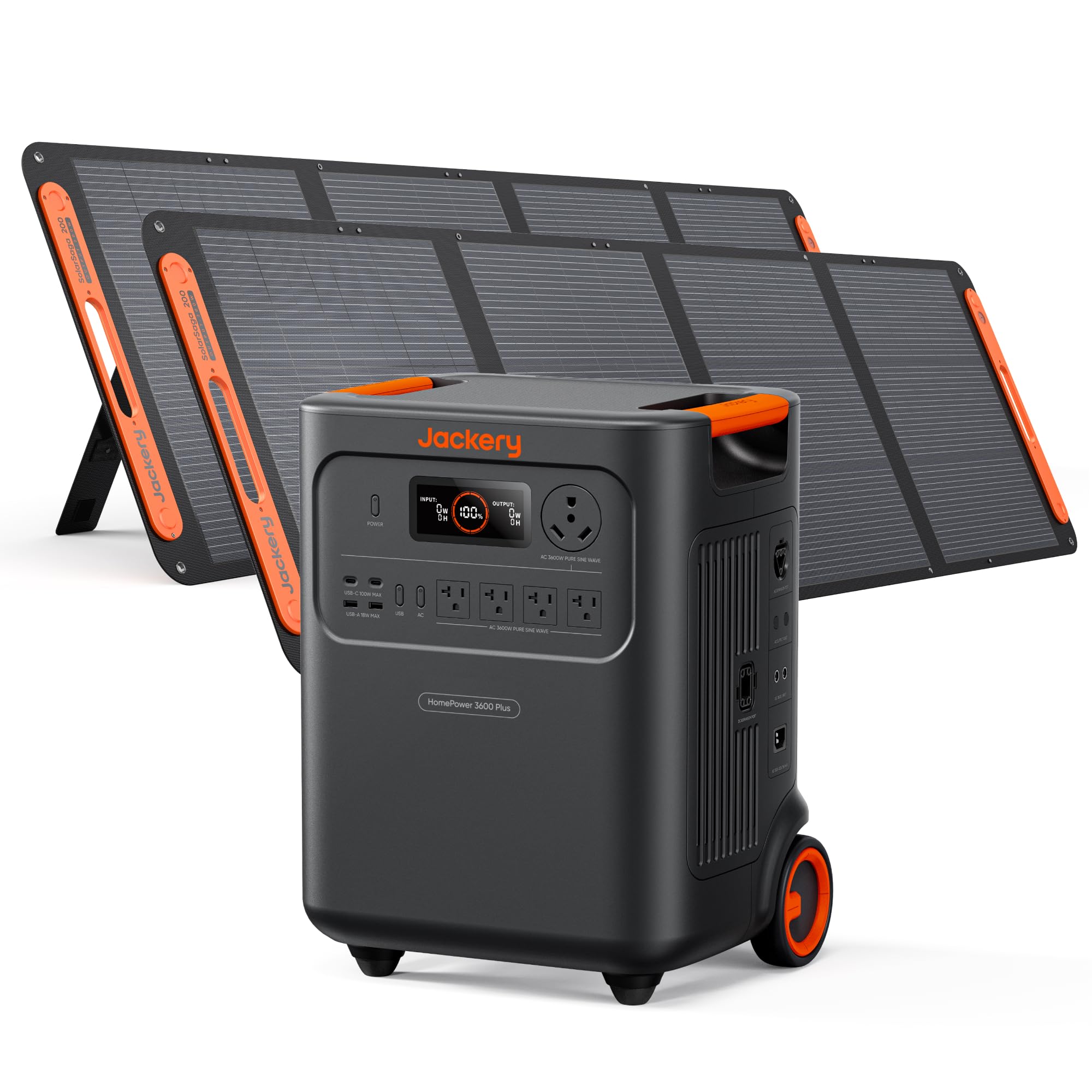
1. Jackery HomePower 3600 Plus & 2x200W Solar Panels
Our pick — 4.5+★ from 100+ verified ratings; the strongest balance of quality and price.
The quietest way to keep the fridge cold is a battery you wheel around like a suitcase.
What you get here is 3584Wh of stored energy with a 3600W AC output, and that pairing is why it tops this list. Unlike the fuel-burning machines below, it makes zero exhaust and zero engine noise, so you can park it in the kitchen during an outage. Expand it to 21kWh per unit, or 43kWh with multiple units, and it can carry a three-person household for well over two weeks by the maker’s own numbers.
The battery chemistry is the part worth understanding, because it decides how long the pack lasts. It uses ceramic membrane cells, which the manufacturer says are tested at 302 °F to resist thermal runaway (a runaway heat reaction inside the cell). Jackery rates the pack at 6,000 cycles and a 10-year lifespan, and says it runs down to -4 °F in blizzards, so a winter outage does not shut it down. Compare that to the EcoFlow DELTA Pro Ultra further down: that one starts at 6144Wh against this unit’s 3584Wh, so the EcoFlow stores more from the first box. But this Jackery is the lighter, wheeled option at 77.2 pounds.
Charging speed is where owners get enthusiastic, because a fast refill means less time without power. Hybrid AC plus DC charging takes it from 0 to 100% in 2 hours, AC alone in 2.5 hours, and solar in 4. Owners single out the build quality, and one ran a 7-hour outage covering the kitchen fridge/freezer, a garage freezer, the WiFi modem, router and security cameras on just 18% of stored power. The honest trade-off is weight. At 77.2 pounds it is heavy to lift, and the solar panels are heavy on their own. The telescopic handle and wheels roll fine on flat ground, but stairs are a two-person job.
What earns it first place
- Zero fumes and near-silent running indoors, unlike a gas generator
- 0–100% in 2 hours with hybrid AC + DC charging
- 3584Wh expandable to 21kWh per unit, 43kWh with multiple units
- Rolls like luggage on wheels with a telescopic handle
What to plan around
- 77.2 pounds is heavy for lifting, not just rolling
- You only power what you can plug into its 4 outlets
- Split shipments — the unit and panels may arrive separately
Reach for this if: you want silent, fume-free backup and can wheel it to where the fridge plugs in.
Look elsewhere if: your furnace is hard-wired and you need automatic, hands-off transfer.
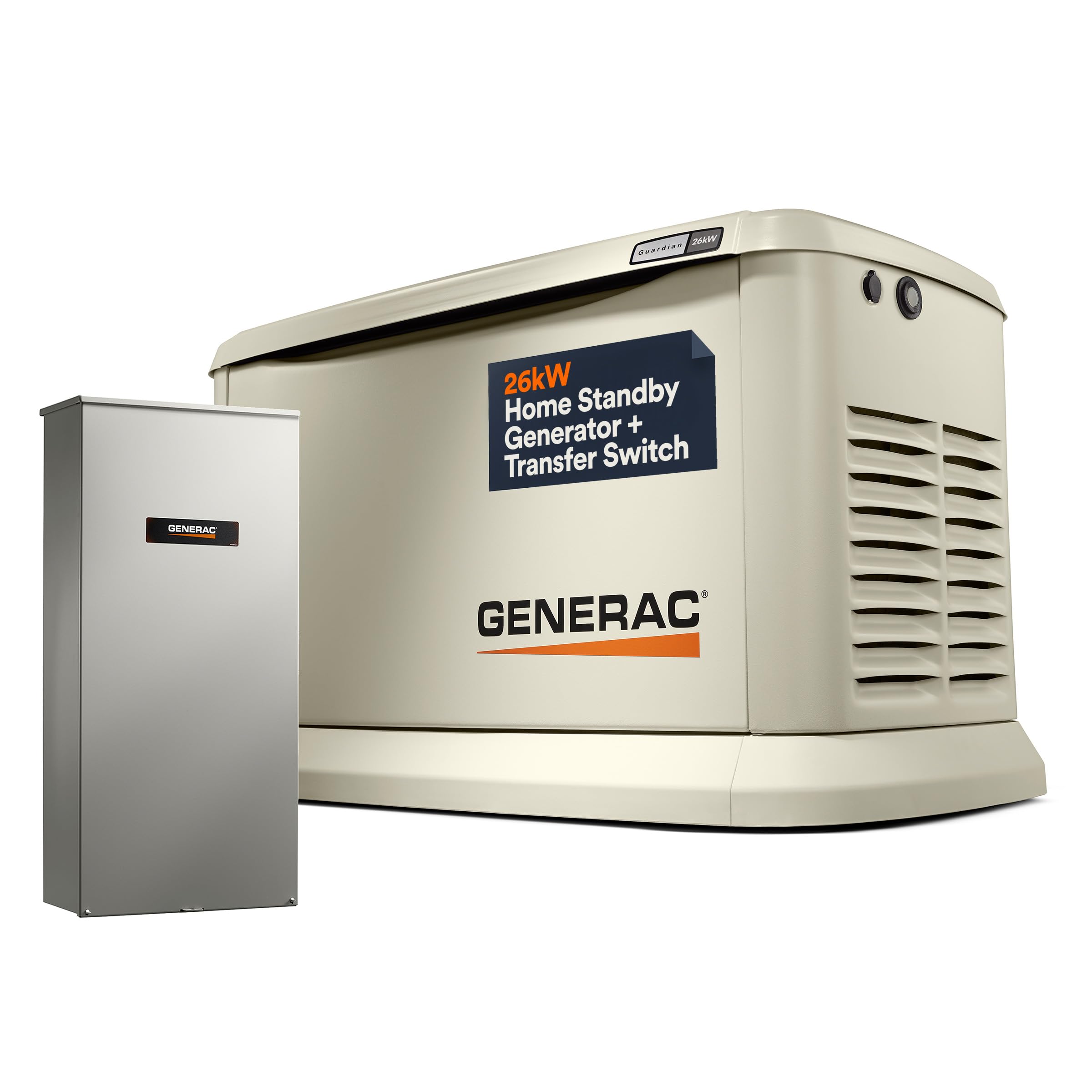
2. Generac Guardian 26kW Home Generator
The machine that starts itself while you’re still looking for a flashlight.
This is the true 26kW standby in the group, and its defining number is the 26,000 watts it holds with under 5% harmonic distortion (a measure of how clean the electrical wave is). Clean power like that is what lets a modern furnace control board and a router tolerate the supply. It runs on natural gas or LP gas through a 200-amp automatic transfer switch, so when the grid drops, the switch moves your panel over and the generator carries the load. The included 5-year limited warranty covers the switch too.
This Generac earns its spot because it starts itself and reports to your phone, so you never have to walk outside in a storm. Compared to the Westinghouse 28000 Peak Watt portable below, the Generac pushes 26 KW maximum engine power against that unit’s 28 KW peak. The Westinghouse carries a higher peak rating, but it also needs someone to roll it out and start it. This Generac runs a purpose-built G-Force 1000 Series engine at 999 cubic centimeters (a measure of engine size), and the Wi-Fi module lets you check status and maintenance alerts from your phone. One owner set scheduled test runs through the app to keep the engine lubricated and got fault notifications pushed to their device.
Here is the honest part. A certified electrician has to install it, and buyers report the technician bill plus a poured concrete pad as the two costs that land on top of the unit price. The unit also ships without the propane conversion kit and without a battery, which catches propane users off guard. Noise is real too — audible indoors, though owners describe it as bearable and reassuring rather than intrusive. It’s the right pick if you want to do nothing when the lights go out.
Where the value sits: a 200-amp transfer switch, clean sub-5% THD power and app monitoring in one package, wired permanently so the house never goes dark.
The cost you don’t see on the listing: professional install plus a slab, and the propane conversion kit and battery are extra.
Built for: homeowners who want automatic whole-house coverage and will pay for a licensed install.
Think twice if: you plan to run propane — budget for the conversion kit and battery separately.
3. Jackery Solar Generator 5000 Plus

Enough stored sun to run a five-ton air conditioner without a drop of fuel.
The number that changes the conversation is 7200 watts of rated output with a 14,400-watt surge, delivered at both 120V and 240V. That 240V line is what lets it start a 5-ton AC or heat a water heater — appliances a 120V-only battery cannot touch. It stores 5040Wh and expands up to 60kWh, which the maker frames as backup lasting 13 days. Pair it with the Jackery 60A Smart Transfer Switch and it feeds up to 12 circuits at 120V or 6 circuits at 240V.
This unit stores 5040Wh, which is more than the smaller HomePower 3600 Plus above at 3584Wh, and it carries the higher output too. The LiFePO₄ cells (a lithium-iron-phosphate chemistry known for long cycle life) are rated for up to 11 years of daily use under Jackery’s ChargeShield 2.0 tech. Solar input tops out at 4000W and recharges it in about 2 hours, so a sunny afternoon refills it. Owners praise the build quality, and a Florida user ran fully off-grid for a week in February with one angled panel keeping the battery charged overnight, powering ceiling fans, TV, dishwasher and laundry.
The catch is the “whole-home” framing. It is honestly a 60A circuit-level backup, not a full 200-amp panel replacement, and owners note that unless your house is tiny you’ll want extra backup batteries and a professional electrician for the transfer switch. It is heavy, but wheels and an extendable handle make it manageable on flat ground. If you want a battery that runs the big 240V loads and can grow with your needs, this is the one.
The standout spec: 7200W rated / 14,400W surge at 120V and 240V lets it start a 5-ton AC, something 120V-only batteries simply can’t do.
Read the fine print: it powers selected circuits through the 60A switch, not your whole 200-amp panel — expect to add batteries and hire an electrician.
Pick this if: you have big 240V appliances and want solar backup that scales toward 60kWh.
Pass if: you expect plug-and-play whole-panel coverage — this is circuit-level, not panel-level.
4. Westinghouse 28000 Peak Watt Home Backup Portable Generator

A rolling 28,000-peak-watt engine that powers a whole house for the price of a mid-range standby.
Two numbers define this machine: 20,000 running watts and 28,000 peak watts on gasoline. That peak figure is what a 2,600-square-foot house with central air actually needs at the moment the compressor kicks, and owners confirm it handles full home loads including HVAC and workshop gear. The 999cc four-stroke engine uses full-pressure lubrication and an automotive-style oil filter, which is the kind of engineering that extends engine life rather than just surviving a season.
For sensitive electronics, Westinghouse claims under 5% THD from copper windings — clean enough for phones, computers and TVs. Push-button electric start and a remote key fob mean you’re not yanking a cord in the rain. There’s a CO sensor (carbon monoxide detector) that shuts the engine down if exhaust builds up, plus automatic low-oil shutdown to protect the engine. Against the Honda EU7000iS further down, this Westinghouse carries a far larger peak rating — but the Honda runs at just 52 to 58 dB(A), quieter than a normal conversation, while this one is a conventional open-frame engine.
The honest trade-off is weight and fuel. At 541.1 pounds it moves on heavy-duty wheels and lift brackets but is not a one-person carry, and it drinks gasoline, so you’re storing and rotating fuel. A small number of long-term owners mention reliability problems, which is worth knowing as a “who this isn’t for” note rather than a reason to avoid the model — most describe professional-grade performance. Pair it with an interlock kit or the Westinghouse WATS200 automatic transfer switch (sold separately) and it becomes semi-automatic home backup.
Why buyers keep it
- 20,000 running / 28,000 peak watts handles full home HVAC loads
- Under 5% THD copper-winding power protects electronics
- Push-button and remote key-fob start
- CO sensor and low-oil shutdown built in
Where it asks for patience
- 541.1 pounds — needs wheels, ramps or two people
- Gasoline only, so plan your fuel storage
- The WATS200 auto transfer switch is sold separately
Best matched to: a big house that needs serious peak watts and can roll a heavy unit into place.
Not your fit if: you want push-button automatic operation with no manual hookup at all.
5. Westinghouse 28000 Peak Watt Tri-Fuel Generator

Same 28,000-peak brute as the gas model, but it can drink from three different fuel lines.
Identical engine and output to the gasoline-only model above — 999cc, 20,000 running watts, 28,000 peak — but here you can switch between gasoline, propane and natural gas. That flexibility is the whole pitch. In a long winter outage, if the gasoline runs dry you can hook to a propane tank; if the propane runs out and the gas main is still pressurized, natural gas keeps you running. A 17.2-gallon gas tank supports extended operation on gas alone, and the under-5% THD copper windings keep laptop and TV power clean.
Owners describe it as a beast that sets up easily, with enough muscle to run two 4-ton air conditioners plus most everything else in a 7,000-square-foot house. That is the kind of load a 26kW standby would also carry, but here you paid for a portable and wired it yourself. It has the same push-button and remote start, CO sensor (a sensor that detects carbon monoxide) and low-oil shutdown as the gas-only version. Whereas the Generac Guardian installs permanently and starts itself, this one pairs with the Westinghouse WATS200 automatic transfer switch (sold separately) to gain automatic backup without committing to a fixed foundation.
Weigh the trade-offs honestly. It’s 557 pounds — heavier than the gasoline-only Westinghouse by 15.9 pounds, since tri-fuel hardware adds mass — so unpacking and mounting the wheels wants a second set of hands or a front loader. A few customers note units that randomly died, so reliability is the fair caveat to check against your tolerance for a mobile setup. For most, the tri-fuel flexibility and category-leading peak watts outweigh the weight.
The fuel-flexibility edge: three fuel sources (gas, propane, natural gas) mean a single failed supply line doesn’t take your backup down with it.
The heft to respect: 557 pounds, 15.9 pounds more than the gas-only twin, so plan for help getting it into place.
Suited to: buyers who want portable whole-house power and refuse to depend on one fuel supply.
Look elsewhere if: you need the lowest-weight unit possible or true automatic start with zero hookup.
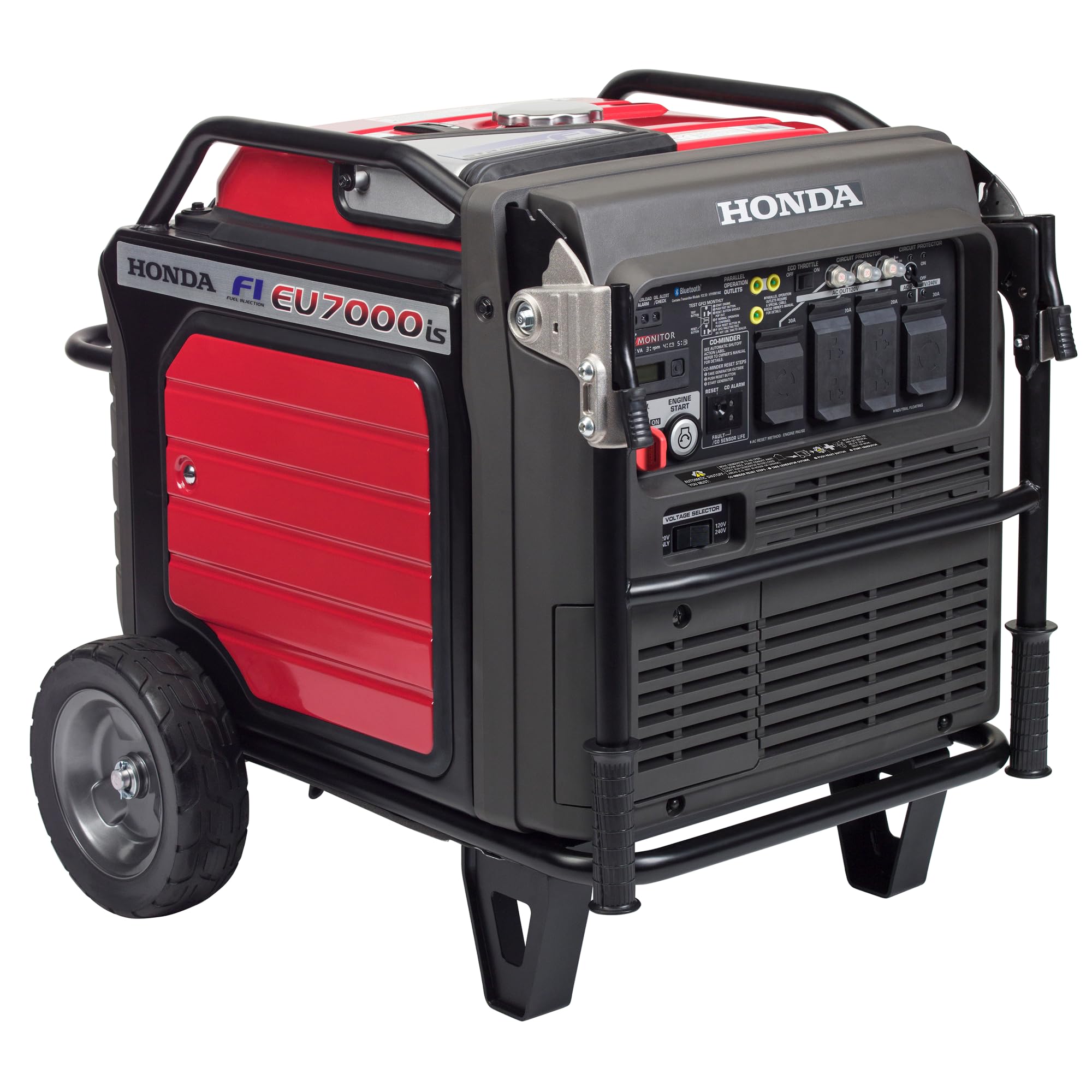
6. Honda EU7000iS 7000 120/240V Watt Inverter Generator
Inverter power so quiet your neighbors won’t know the grid is down.
Honda’s headline spec is the sound level: 52 to 58 dB(A), which the maker notes is quieter than a normal conversation. If you’ve lived through a storm with a screaming open-frame generator next door, that number alone is worth the premium. Inverter technology (which cleans the electrical output) supplies power stable enough for computers, and it runs on a single 5.1-gallon fuel tank for 6.4 to 16 hours depending on load. An Eco Throttle System trims engine speed to save fuel when the load drops.
Wire it into a Generlink or transfer switch and owners run an entire house with breaker management, so you switch off big loads as needed instead of buying more generator. One reports running a 3-ton Trane A/C and hot water heater, and another pairs two units with Honda’s Parallel Cable Kit to hit 11KWt stable. It started on the first try for one owner straight from the start, with steady output at 122VAC/244VAC (volts of alternating current), and it is noticeably quieter than the Generac it replaced. Against the Westinghouse portables, this Honda’s 7000-watt inverter class runs smaller loads, but it wins decisively on noise and on portability.
It carries a 3-year residential warranty and Honda’s My Generator app for remote start, stop and service reminders over Bluetooth. The CO-MINDER system (a carbon monoxide monitor) shuts it down before levels get dangerous. One honest note: it isn’t sold in California, where the EU3200IAC2 is the suggested alternative. And at a premium asking price for a 7000-watt-class unit, you’re paying for quiet and reliability, not raw wattage — so if peak watts are your metric, a Westinghouse outguns it.
What sets the price: 52–58 dB(A) operation, inverter-clean power for sensitive gear, and a 3-year warranty back it up.
The compromise: 7000-watt class is smaller than the 28,000-peak Westinghouses, and it’s not available in California.
Ideal for: campers, RVers and homeowners who value near-silent running and clean inverter power over maximum watts.
Consider another if: you need to start two central AC units at once or live in California.
7. EF ECOFLOW DELTA Pro Ultra

One inverter, one battery, and the ability to grow to 90kWh without changing systems.
Stack three inverters and EcoFlow claims 21.6kW AC output. The capacity scales from that single 6144Wh battery all the way to 90kWh, which the maker frames as over 30 days of essential power for a standard North American household.
Charging is quick for this class: a single 6144Wh battery recharges fully in 2 hours, and it can pull from EV piles, solar, wall outlets or an outdoor generator. The included 400W panels fold into an adjustable carry case at 35.3 pounds and carry an IP68 rating (dust-tight and water-resistant when submerged to a rated depth). Owners back up the reliability claims: one ran a furnace and two fridges for more than three days, another carried a fridge, freezer and furnace on three batteries at 18kWh for two days. Owners say it simply keeps the house powered, outage after outage.
Now the catch. Charging performance and cost-effectiveness both draw mixed feedback, and one owner detailed reserve-drain while idle, battery-percentage readout that jumps around, and slow solar restart after shade. It is also heavy — 218 pounds across the components — and arrives as separate packages for the inverter, battery and panels. If you want the largest scalable battery system here and can wire a smart panel, this is the ceiling; if you want the smallest fuss, it isn’t.
The growth argument: starting at 6144Wh, more than the Jackery HomePower 3600 Plus, and scaling to 90kWh makes it the most expandable system in this group.
The friction to expect: 218 pounds arriving in separate boxes, plus mixed reports on reserve drain and charge-readout accuracy.
Choose this if: you want a home battery that grows to 90kWh and can run 240V loads like central air.
skip it if: you want one clean box and no wiring — this wants a smart panel and an electrician.
Know the Specs
Running vs Peak Watts
Running watts are what the generator holds continuously; peak watts are the brief surge it survives. Motors like AC compressors and well pumps pull a spike at startup, so you size to peak to get them going, then the machine settles to running watts. A machine rated 20,000 running and 28,000 peak carries a house that a same-running-watts unit without surge headroom would stall on.
Transfer Switches (200A vs 60A)
A transfer switch safely moves your home’s power from the grid to the generator so the two never meet. A 200-amp automatic switch, like the Generac’s, can cover a whole panel and flips on its own. A 60-amp smart switch, like the Jackery’s, covers selected circuits — up to 12 at 120V or 6 at 240V — and is common on battery systems. Choose based on how many circuits you need live, not on the amp number alone.
THD and Inverter Power
THD (total harmonic distortion) measures how dirty your electrical wave is. Under 5% is clean enough for computers and TVs, which is what the Westinghouse units claim. Inverter generators clean the output to a similar standard, and battery systems supply it inherently. If you’re running a furnace board or a router, clean power prevents nuisance shutdowns.
Battery Capacity in Wh and Cycles
Watt-hours (Wh) measure stored energy — a 3584Wh battery can supply 3584 watts for one hour, or 358 watts for ten. Cycle life is how many full charge-discharge rounds a battery survives before it degrades. A rating like 6,000 cycles, or up to 11 years of daily use, tells you how long the battery holds up compared with a fuel engine that simply needs oil and maintenance.
Common Questions
Will a 26kW generator run my whole house including central air?
Do I need a transfer switch with a portable generator?
Can a solar battery really replace a fuel generator?
What is the difference between running watts and peak watts?
How much does professional installation cost?
Can the Westinghouse tri-fuel run on natural gas?
Is the Honda EU7000iS quiet enough to run at night?
Does the Generac Guardian include a battery and propane conversion kit?
How long does a battery backup system last?
Is a battery system like the EcoFlow DELTA Pro Ultra a true whole-house generator?
The Bottom Line
For most households the 26kw home generator winner is the Jackery HomePower 3600 Plus, because it delivers silent, fume-free backup you can wheel to the fridge, charges to full in 2 hours and expands toward whole-home capacity. If you want fully automatic whole-house power with no hookup, the Generac Guardian 26kW is the one — just budget for the electrician, slab, battery and propane kit. And if you need maximum peak watts with fuel flexibility, the Westinghouse Tri-Fuel 28000 is the reach-for pick.
How we choose
We do not accept paid placement. Every pick is matched to a real buyer and a real use-case; we do not hands-on test units.
Sources
Specifications: manufacturer listings and product documentation. Review insights: verified customer reviews, as of October 2026. Pricing: not shown on this page (it changes often); check the current price via the retailer link.
As an Amazon Associate, Aappliancez earns from qualifying purchases. This does not affect which products we feature.