Disclosure: Some links in this post are affiliate links. As an Amazon Associate I earn from qualifying purchases, at no extra cost to you. Learn more
Specs are compiled from manufacturer listings and verified buyer reviews and can change over time — please confirm the key details on the product page before buying.
If you have a cracked sink, a chipped floor tile, or a broken ceramic handle sitting in a drawer, you do not need a contractor — you need the right adhesive and a little patience. The tricky part is that ceramic is unforgiving: it flexes slightly with heat and weight, so a glue that dries rock-hard and brittle can pop off the moment the surface moves. The picks below range from a flexible two-part epoxy that survives vibration to dedicated tile-repair kits built specifically to hide chips and match aged colors.
This guide is built by comparing the manufacturers’ published specifications and the patterns across verified customer reviews, so you get each pick’s real strengths and trade-offs instead of marketing spin.
Some glues here set in minutes and cure clear, while others are built for color-matched cosmetic repair. Whichever route you take, matching the adhesive to the surface matters more than brand loyalty when you are choosing the ceramic glue for repairs.
Top Picks

How To Choose The Best Ceramic Glue for Repairs
Ceramic repairs fail for one of two reasons: the glue is too brittle, or the surface was not prepped. Vibration from a drawer closing or a footstep travels through the ceramic and cracks a rigid bond. A flexible, toughened adhesive absorbs that movement instead of fighting it.
Match the adhesive to the damage
A hairline crack in a structural piece wants a thin, high-strength epoxy that flows into the gap. A chipped surface on a visible tile or sink wants a putty or color-matched filler you can sand flush. Buying one product for both jobs usually means doing neither well.
Check the mix ratio before you buy
Two-part epoxies are mixed by volume or weight, and a 1:1 ratio is the easiest to get right without a scale. Push-rod dispensers eliminate guesswork entirely. If the ratio looks fussy, you will waste material on bad batches.
Read the cure-time fine print
Handling strength — the point where you can stop holding the piece — is not the same as full cure. Some products reach handling strength in about 5 minutes but take 24 hours to fully harden. Plan your repair around the longer number.
Side-by-Side Comparison
| Model | Best For | Format | Full Cure Time | Unit Count | Amazon |
|---|---|---|---|---|---|
| Starbond 5 Minute Epoxy Pro Kit★ Best Overall | Flexible structural repairs | Paste (two-part) | 24 hours | 8 Ounce | Amazon |
| Weldbond Multi-Surface GlueBest Value | Mosaics, crafts, wood-and-tile work | Liquid (PVA) | 24 hours | 5.4 Fluid Ounces | Amazon |
| MendMight Tub & Tile Repair Kit | Color-matched sink and tub chips | Putty | — | 5.64 Ounce | Amazon |
| LET’S RESIN 5 Minute Epoxy Glue | Fast household repairs and hole filling | Liquid (two-part) | 1 hour | 3.4 Fluid Ounces | Amazon |
| COCONIX Tile & Ceramic Repair Kit | Chips, cracks, and cosmetic tile work | Putty plus color compounds | — | 0.64 Fl Oz (Pack of 11) | Amazon |
Detailed Reviews
1. Starbond 5 Minute Epoxy Pro Kit
Our pick — 4.5★ from 400+ verified ratings; the strongest balance of quality and price.
The flexible epoxy that bends where rigid glues crack.
If your repair is on something that gets knocked around — a chair leg, a drawer handle, a dropped mug handle — you want an adhesive that moves with the ceramic instead of snapping off it. That is exactly what this Starbond kit is engineered for. Its flexible toughened formula (a mix designed to absorb vibration and stress) is rated to a 2,600 lb shear strength, meaning the joint resists a heavy sliding force before it gives way. Handling strength arrives in about 5 minutes; full cure takes 24 hours.
Mixing is a straight 1:1 ratio by volume, so you are not chasing a fiddly third-part measurement. The kit ships with screw-cap bottles, reusable mixing trays, and tools — no leaky syringes to wrestle with, which also means less waste and a longer shelf life once opened. It cures clear, so a repair on a white sink or a light tile does not leave a dark seam. It also bonds many plastics like ABS and PVC alongside wood, metal, glass, and ceramic, so one kit covers most of the household repair jobs you would otherwise buy three products for.
What wins people over is simply how well it performs — effectiveness and overall quality are what buyers talk about first, with the easy mixing a close third. The trade-offs are honest ones: bonding strength and drying speed both draw split opinions, and a rare unit arrives sluggish and stays rubbery instead of hardening. As buyers report, at least a few found this batch “takes much longer to cure” than their earlier purchases. The flip side is the smell — it is strong, and you should vent the room while it sets. That is the price of a genuinely tough, flexible bond.
What holds up
- 2,600 lb shear strength with flexibility built in
- 1:1 mix, clear cure, 5-minute handling strength
- Screw-cap bottles and reusable trays beat leaky syringes
Where it stumbles
- Strong odor while curing — ventilate the room
- Consistency varies between batches for a small share of buyers
- 24-hour full cure means overnight projects
Reach for this if: you need a strong, flexible bond on ceramic that takes daily bumps and stress.
Look elsewhere if: you want a fast cosmetic fix on a visible tile, where a colored putty does the job better.
2. Weldbond Multi-Surface Glue
The craft-table classic that vanishes on glazed surfaces.
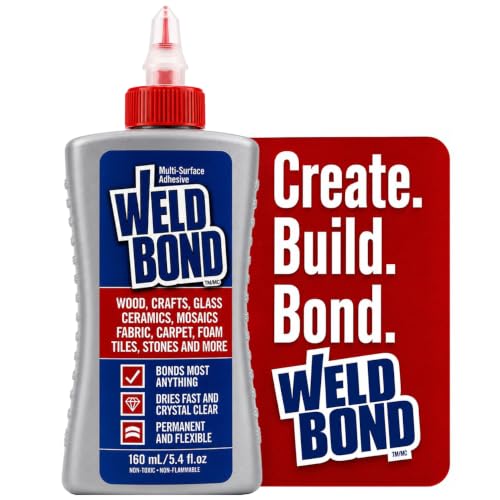
For mosaic artists and crafters, the priority is often a clean, invisible seam on a glazed surface — not maximum structural load. This Weldbond bottle fits that job exactly. It is a PVA glue (a liquid adhesive that dries clear), and it is non-toxic with no solvents and no harsh fumes, so it earns a spot at the kitchen table, in a classroom, or in a small studio with the windows shut. That is not a small detail if you are working indoors for hours.
The white PVA dries invisible, so seams vanish on glass, acrylic, porcelain, and light-toned wood with no yellowing or cloudy halo. It dries in about 20 minutes with no clamping, then sands and paints like the wood around it. The precision tip lays a neat bead instead of flooding the piece. If you need it thinner for porous work, you can add a little water and brush it on as a primer or sealer. Coverage is generous at 5.4 fluid ounces, and with a bottle weight of just 3.2 ounces, it is light to hold during long mosaic sessions.
Bear two things in mind. First, this is a bonding adhesive, not an instant glue, so your repair has to sit undisturbed while it sets. Second, the maker’s own note is explicit: it does not bond metal with ceramic — so if that is your pairing, choose a two-part epoxy instead. The recurring packaging gripe is leaking bottles in transit, worth checking when your order lands. Overall, effectiveness and drying time are what buyers rave about, and versatility across craft projects follows close behind. On a wood-and-tile join it dried fast and held firm with no slipping, and a 20-year mosaic artist rates it ideal for the craft — strong, workable hold and easy water cleanup. At entry-level pricing and 5,000-plus reviews, the value is hard to argue with.
The craft-room favourite: Dries clear in about 20 minutes, needs no clamping, and cleans up with water — a genuine indoor-safe pick for mosaics, pottery, and tile.
The pairing limit: It will not bond metal to ceramic, and the fairly high strength reputation is not unanimous — a minority find it separates or fails to stick on certain surfaces.
Best for: mosaic artists, crafters, and anyone fixing a wood-and-tile or pottery join indoors.
Not your bottle: if you are bonding metal to ceramic, or you need an instant-grab glue.
3. COCONIX Tile & Ceramic Repair Kit
Built to hide a chip so well that nobody spots it.
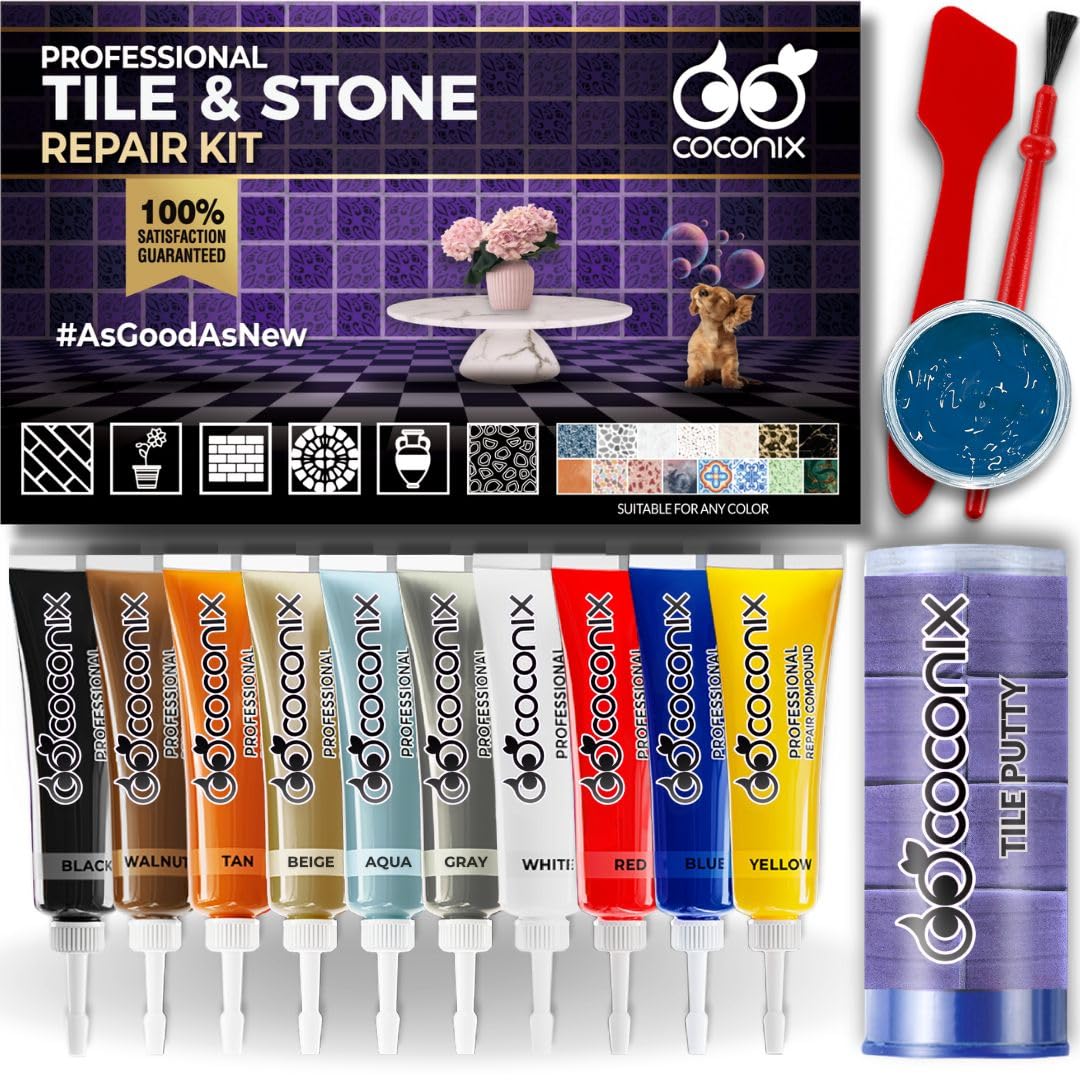
Chips and cracks on a visible surface are a cosmetic problem, and cosmetic problems want cosmetic tools. This Coconix kit lands in the premium tier because it hands you the full package: versatile fillers, color compounds, and kneadable epoxy putty, plus a mixing jar, tile putty, spatula, and applicator brush all in the box. You are not chasing down extra supplies mid-repair. That all-in-one approach is exactly why it commands a premium-friendlier spot in the lineup.
The color system is the real selling point. You get a wide spectrum — classic white, slate gray, terracotta, aqua, and sand beige through to red, blue, yellow and more — plus a mixing guide for dialling in the match. The kneadable putty molds easily and cures super-strong, waterproof, and durable, so your fix survives a wet sink or a mopped floor. It is built for cracks, chips, holes, discoloration, stains, and even broken tiles, across porcelain, fiberglass, granite, marble, and metal.
What buyers praise most is the overall quality of the kit, with repair effectiveness a strong second and, tellingly, color match third among the positives — so the matching generally works when you put in the effort. One buyer patched a cracked Italian clay entrance tile so cleanly that guests assumed the tiles had been replaced. Another buyer hid hairline cracks on marbled tile almost completely, though a raised settling crack stayed visible. The honest catch is color mixing: getting an exact shade takes patience and a few test attempts, and on high-sheen tiles the paint dries matte and shows a little more than on matte surfaces. The single most-quoted gripe is actually about workspace tidiness — a coloring-paint lid leaked inside the box in transit. Order it knowing you will do a little mixing homework first.
What earns its price: Nine pigment shades, kneadable waterproof putty, and a full tool set get you close to an invisible repair on ceramic, marble, quartz, and stone.
What takes practice: The color formula is not set-and-forget. Matching an aged shade demands trial, and the matte finish stands out slightly on glossy tiles.
Your kit if: you want a permanent, color-matched cosmetic repair on a chip or crack in a visible tile, sink, or countertop.
skip it if: you want to slap glue on and walk away — this one rewards a slow, careful mix.
4. LET’S RESIN 5 Minute Epoxy Glue
A starter epoxy kit with push rods so the mix is never off.
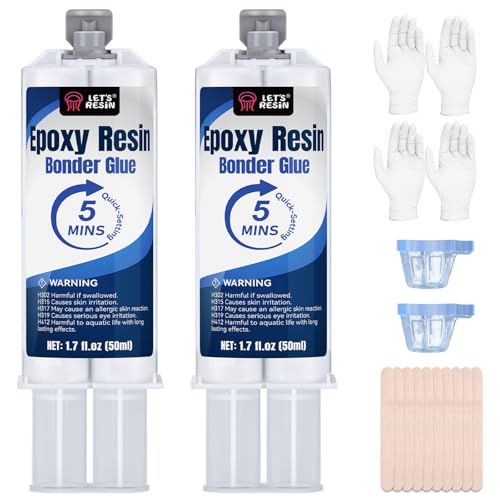
If the reason you keep putting off a repair is that you own none of the mixing gear, this kit removes that excuse. It arrives complete: two epoxy bottles, 20 disposable mixing cups, 10 stirrers, two push rods for exact 1:1 mixing, and four gloves. Nothing else to buy — unbox, mix, apply. Compared to the Starbond above, the working window is noticeably tighter: you get about 2 minutes before the mix starts to set, initially curing in roughly 5 minutes and reaching full cure in 1 hour. That is far faster than a 24-hour wait, but it also means you cannot dawdle.
The formula is high-viscosity, so it clings to the surfaces instead of running, and once cured it hardens enough that you can drill, sand, or paint over it to restore an item’s original look. It handles wood, ceramics, glass, metal, and plastic, covering most household repair needs: a loose chair joint, a cracked porcelain piece, a snapped storage-bin clasp. The push-rod design means squeezing out the exact 1:1 ratio is genuinely easy, no scale required.
The practical warning the maker flags up front: mix small batches, because the 2-minute window is unforgiving and a big batch turns to waste. Buyers rate the kit’s quality highest, with effectiveness close behind and ease of use rounding out the praise. One buyer sealed water bottles flawlessly with it, and it also held up on a water fountain. It ships in a compact 3.4 fluid ounce size, so it suits a single repair or a couple of smaller jobs rather than a whole project.
Why it earns its place
- Full kit included — cups, stirrers, push rods, and gloves
- 1-hour full cure beats a 24-hour wait
- Cured resin can be drilled, sanded, or painted
What to plan around
- 2-minute working window is tight — work fast
- 3.4 fluid ounces suits a single repair, not a big project
- Small-batch mixing is essential to avoid waste
Pick this one: if you want a self-contained epoxy starter kit and a fast 1-hour cure.
Know going in: the 2-minute working window rewards quick hands, so pass on it if you like to take your time.
5. Tub & Tile Repair Kit
The starter chip kit for an aged sink or tub.
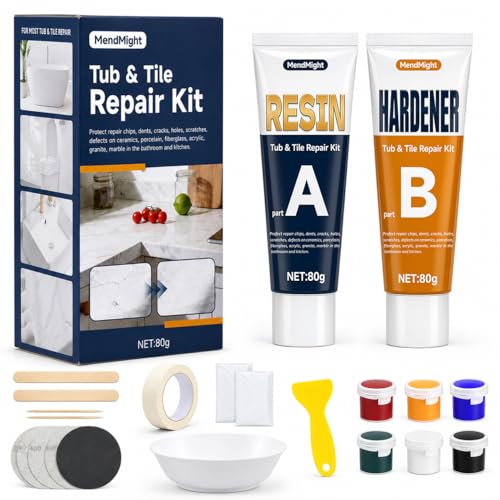
When the damage is a small chip on an aging sink or bathtub, a color-matched putty is the right tool, and this MendMight kit keeps the entry cost low. The six-color palette blends to match, per the maker, over 90% of aged household shades — almond, biscuit, bone, and classic white among them. At 5.64 ounces, it packs more filler than the Coconix kit — useful if you expect retries while learning the color mix. It is a putty (a moldable paste), and once cured it is sandable and paintable for a smooth finish.
It is designed for small-area enamel damage rather than structural joins: porcelain sinks, bathtubs, ceramic tile, shower bases, and granite countertops are all on the list. The high-strength epoxy bonds to porcelain, fiberglass, enamel, and marble, and it resists moisture and daily wear, so a wet sink is not a problem. The maker notes the cured compound is waterproof. A full included guide rounds out the package.
Here is the honest trade-off you need to weigh. Color matching is the most-discussed issue with this kit, and splitting the shades takes experimentation — mixing basic colors toward the tone you want is a skill you build, not a setting you flip. One buyer found the shade match imperfect but the repair far less noticeable and no longer collecting dirt, and another reports the surface yellowed and stained within a week on an area hit by dirty water. That is a who-is-it-for catch: it holds best on spots that stay dry, and it is less suited to zones that see constant dirty water. The flip side is real value — the kit fills imperfections precisely and, for many buyers, the results are good enough to avoid a full tub or tile replacement.
The budget route in: Six blendable colors, waterproof cured putty, and a low entry cost make it a sensible first repair kit for a small chip on an aged surface.
The catch to accept: Shade matching takes trial, and on areas exposed to constant dirty water, the finish can discolor — treat it as a dry-spot kit.
Go for it if: you want a budget-friendly, waterproof putty to fill a small chip on an aged sink, tub, or tile.
Pass if: your repair sits in constant water contact, where this one struggles to stay looking clean.
Know the Specs
Two-Part Epoxy vs. PVA Glue
Two-part epoxies mix a resin and a hardener, then harden by chemical reaction — strong, gap-filling, and often flexible if the formula is toughened. PVA glues like Weldbond are single-part liquids that cure by drying, bond porous surfaces like wood and ceramic well, dry clear, and clean up with water. Epoxy wins on structural strength; PVA wins on clean indoor craft work and easy handling.
Handling Strength vs. Full Cure
Handling strength is the point where a bond is secure enough to let go and leave alone. Full cure is when the adhesive reaches its final hardness and strength, and it can take hours longer. A 5-minute handling time with a 24-hour full cure is normal for epoxy, so plan to leave the repair undisturbed overnight, even if it feels firm after a few minutes.
Common Questions
Will ceramic glue hold up in a sink that sees water every day?
How long does ceramic glue take to dry?
Can I glue ceramic to metal?
What is the difference between a ceramic glue and a tile repair kit?
Does ceramic glue dry clear?
Can I sand or paint over cured ceramic glue?
Why did my ceramic repair come loose after a while?
How do I match the color of an aged tile or sink?
Is ceramic glue safe to use indoors and around the kitchen?
Can I use a porcelain sink repair kit on a bathtub or shower base?
The Bottom Line
For most repairs, the strongest overall pick is the Starbond 5 Minute Epoxy Pro Kit: flexible, toughened, 2,600 lb shear strength, and a clean clear cure means it handles the repairs that stay under load without cracking. If you want a clean, invisible join for mosaics and crafts, reach for the Weldbond Multi-Surface Glue, whose non-toxic, water-cleanup formula dries clear in about 20 minutes. And for hiding a chip or crack on a visible tile or sink, the COCONIX Tile & Ceramic Repair Kit and the budget-friendly MendMight Tub & Tile Repair Kit both give you matching putty for a cosmetic fix — the Coconix rewards patience with a wider color palette and full tool set.
How we choose
We do not accept paid placement. Every pick is matched to a real buyer and a real use-case; we do not hands-on test units.
Sources
Specifications: manufacturer listings and product documentation. Review insights: verified customer reviews, as of October 2026. Pricing: not shown on this page (it changes often); check the current price via the retailer link.
As an Amazon Associate, Aappliancez earns from qualifying purchases. This does not affect which products we feature.