Disclosure: Some links in this post are affiliate links. As an Amazon Associate I earn from qualifying purchases, at no extra cost to you. Learn more
Specs are compiled from manufacturer listings and verified buyer reviews and can change over time — please confirm the key details on the product page before buying.
If you have mild-to-moderate hearing loss and you are tired of asking people to repeat themselves, the fastest fix is a bone conduction device that sends sound through your cheekbone instead of blocking your ear. That is the whole point of this category: your ear canal stays open, so speech comes through clearly while traffic, doorbells, and conversations still reach you. The catch: “bone conduction hearing aid” covers two different products — self-fitting hearing aids with a companion app, and open-ear headphones that just keep your ears unblocked. Picking the wrong type is the top reason buyers return these.
This guide is built by comparing the manufacturers’ published specifications and the patterns across verified customer reviews, so you get each pick’s real strengths and trade-offs instead of marketing spin.
Below are the models that deliver, sorted by what each does best rather than by price tier. From battery figures and waterproof ratings to how each one behaves in a noisy room, everything here is drawn from published specs and real owner experiences so you can match a device to your own ears. The right bone conduction hearing aids should sound natural on day one, not after a month of fiddling.
Top Picks


How To Choose The Best Bone Conduction Hearing Aids
Start with a single honest question: what is your hearing loss level? Devices in this category split into two clear groups, and the group you pick matters far more than any individual feature. Self-fitting hearing aids are built to amplify voices and are tuned through a phone app, usually for adults 18 and older with perceived mild to moderate hearing loss. Open-ear bone conduction headphones are built for listening, with the side benefit that your ears stay unblocked. Buying across those lines is where most returns happen.
Match the device to your hearing level, not to the loudest spec sheet
A true hearing aid, like the Lexie B1 or the ELEHEAR-Beyond Pro, amplifies the sounds around you and lets you shape them. The Lexie app, for example, offers World Volume to lift quiet sounds while amplifying loud ones less, plus treble and bass sliders so voices sound natural. An open-ear sport headphone, like the SHOKZ models, plays audio you send it and keeps your ear canal open — useful for safety and awareness, but it is not tuned to correct hearing loss. If your loss is more than mild, an over-the-counter device may not reach the gain you need.
Battery hours and the charging routine you actually want
Hearing devices sit on your head for a full day, so battery time is a daily-life spec, not a footnote. The range here runs from 8 hours of listening time on the SHOKZ OpenComm2 up to 20 hours of runtime plus four extra charging-case refills on the ELEHEAR-Beyond Pro. Quick charge matters just as much: a 5-minute top-up on the SHOKZ OpenRun Pro yields about 1.5 hours of playback, and 15 minutes on the ELEHEAR-Beyond Pro gives up to 6 hours. If you forget to charge, a fast top-up is what saves your morning.
Water resistance, mic quality, and the fit details that decide returns
Water resistance is written as an IP rating, where the number after IP tells you how well the shell keeps out dust and water. The SHOKZ OpenComm2 carries IP55, which resists sweat and splashes but not a swim. The Blue Deer amplifier rates IPX5, protected against sweat, rain, and water splashes. Then look at the microphone, because calls are half of daily use: the OpenComm2 pairs a noise-canceling mic with DSP technology, which is digital processing that filters background sound. Finally, check the frame and ear-hook shape — fit is the single most common reason these get sent back.
Side-by-Side Comparison
| Model | Best For | Battery Life | Bluetooth | Water Resistance | Amazon |
|---|---|---|---|---|---|
| SHOKZ OpenRun Pro★ Best Overall | All-day wear with glasses | 10 hours | 5.1 | Sweat resistant | Amazon |
| CXK IPX8 Wireless EarbudsBest for Water | Swimming and underwater use | ~15 hours | 6 | IPX8 | Amazon |
| Lexie B1 Powered by Bose | Self-fitted mild hearing loss | Replaceable batteries | Bluetooth-enabled | — | Amazon |
| SHOKZ OpenComm2 | Work calls and conference rooms | 16h talk / 8h listening | 5.1 | IP55 | Amazon |
| SHOKZ OpenRun Pro 2 | Runners and cyclists | 12 hours | 5.3 | Sweatproof | Amazon |
| Blue Deer Hearing Amplifier | Seniors who want simple buttons | 8h amplifier / 6h Bluetooth | 5.3 | IPX5 | Amazon |
| ELEHEAR-Beyond Pro | Speech clarity and streaming | 20 hours + 4 case charges | Bluetooth | — | Amazon |
Detailed Reviews
1. SHOKZ OpenRun Pro Headphones
Our pick — 4.5★ from 22,000+ verified ratings; the strongest balance of quality and price.
The open-ear daily driver that gets speech and podcasts through without plugging a single thing into your ear.
This is the one to buy if you want to hear people talking to you while you are also listening to something else. Sound travels through your cheekbone from a bone conduction driver, so your ear canal stays completely open — the awareness that makes these so popular with cyclists and walkers. The wraparound titanium frame is built to hold steady through movement, and a Shokz headband is included in the box. The claimed battery runs 10 hours of music and calls, with a 5-minute quick charge that adds up to 1.5 hours of listening when you are rushing out the door.
Battery stamina and all-day comfort are what owners praise most. It is comfortable enough to wear with glasses and even on your side while sleeping. A 10-month update from a long-term user reads: “battery ~80%, power button got sticky; 2-yr warranty replacement via serial number.”
The trade-off is honest and specific. In genuinely noisy surroundings — a busy street, a loud kitchen, an open-plan office — the sound competes with everything around you, and reviewers consistently say it is at its best in low-to-medium noise. Bass is the other limit: without a seal, deep low-end is thin on critical music listening. High volume also produces a tingling sensation against the cheekbone that not everyone enjoys.
What earns its place here
- 10 hours of music and calls per charge, plus a 5-minute quick charge for 1.5 hours
- Open-ear design keeps you fully aware of traffic, alarms, and conversations
- Lightweight titanium frame stays put during intense training
- Multipoint pairing holds two Bluetooth devices at once
Where it asks for patience
- Sound quality drops off in genuinely noisy environments
- High volume can cause a tingling vibration against the cheekbone
- Charging uses a proprietary magnetic cable, so pack the one in the box
Built for: anyone who needs to stay tuned in to surroundings while listening — cyclists, runners, and people who wear glasses all day.
Think twice if: you mostly listen in loud places or want deep bass, because an open ear lets the room in.
2. CXK IPX8 Waterproof Wireless Earbuds
The only pair here that owners take underwater, and the newest wireless standard in the whole list.
The headline number is IPX8 — the toughest water rating here, meaning it is built to keep working in water. Buyers report it stays connected underwater on scuba dives, with roughly 15 hours of battery use. The wireless version on board is Bluetooth 6, which is a step ahead of the 5.1 in the SHOKZ OpenRun Pro. The tech spec sheet here is short, so go in knowing this is a simple device rather than a fully featured one.
Owners who like it point to clear sound, a lightweight build, and a secure fit. The price-to-capability read is straightforward: bone conduction driver, IPX8 shell, MP3 mode so you can play files without a phone connected at all, and 32GB of storage — though the computer reports about 16GB usable. Set your expectations on the shell rather than the software.
What owners do flag is the build feel and the band. The band is inflexible, so if you wear glasses the pressure behind the ears becomes noticeable after about 30 minutes, and the bundled song app is not worth the time. Volume tops out lower than a traditional headphone, and one buyer found the frame too small for their head. It is a specialist pick — brilliant in water, average on land.
Choose it for: swimming, diving, or anywhere water is the main hazard, where the IPX8 shell and on-board MP3 mode genuinely pay off.
Pass on it if: you wear glasses for long stretches or you need a flexible band that conforms to a larger head.
3. Lexie B1 OTC Hearing Aids Powered by Bose
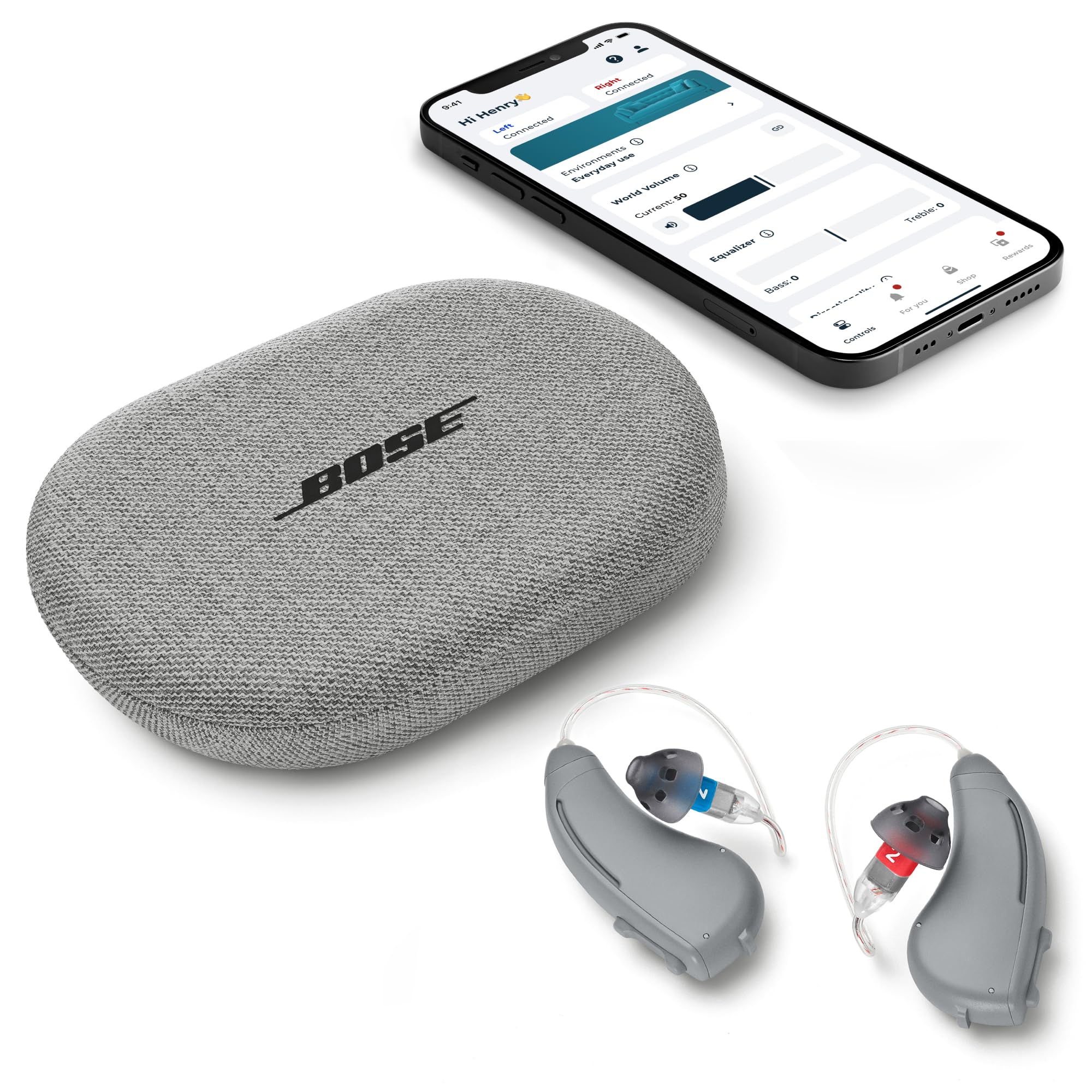
A real hearing aid you tune yourself, with a behind-the-ear shape most people will not notice.
If your goal is hearing voices more clearly rather than streaming music, this is the shape of product you want. The Lexie B1 is a behind-the-ear design with multiple dome sizes and an ear measuring tool in the box, so you can find a fit at home. It pairs to the Lexie app over Bluetooth, and everything is self-tuned — the app is built to provide customization for adults 18 and older with perceived mild to moderate hearing loss. Note the manufacturer’s own line here: these do not stream music or take calls.
The app is where the value sits. World Volume lifts the sounds around you while amplifying quiet sounds more than loud ones, so speech comes up without everything else coming up with it. Treble and bass sliders let you make voices brighter or richer to taste. A Front focus mode concentrates on whoever is in front of you — the setting you want for a conversation in a crowded restaurant — while Everywhere listens all around for walks outdoors. Favourite places can be saved as environment settings, so switching to your usual restaurant is one tap.
The catch is the wireless side. Pairing to phones and other devices proves fussy for a number of owners, and some report whistling in enclosed spaces. This is a hearing-first device, so treat music and calls as a different job entirely, and be prepared to work through the setup once.
Where it is strong: the everyday quality of the thing is what gets noticed — the fit, the build, and the discreet behind-the-ear shape that is barely visible to others. Multiple dome sizes plus the measuring tool take the guesswork out of the initial fitting.
Before you commit: plan for the setup session. The app does the tuning, but pairing this to your phone is the step that trips people up, and enclosed rooms can bring on whistling that needs adjusting.
Reach for this if: you want a discreet hearing aid you set up yourself and control from your phone, and you do not need music streaming.
Look elsewhere if: hands-free calls and Bluetooth audio are must-haves — those are explicitly outside this model’s job.
4. SHOKZ OpenComm2 Open-Ear Bluetooth Headset

A boom-mic headset built for people who live on calls and cannot stand earbuds all day.
At 35g this weighs almost nothing, and the flexible frame with an IP55-rated soft silicone finish is built for workwear worn day after day. IP55 means it shrugs off sweat and splashes but is not meant for a swim. The real differentiator is the microphone: a noise-canceling boom mic with DSP technology, paired with Shokz 7th generation bone conduction technology and PremiumPitch 2.0 audio. The claimed talk time is 16 hours, listening time is 8 hours, and a 5-minute quick charge returns 2 hours of talk time. Bluetooth range runs to 98 feet, which is far more freedom to walk away from your laptop than the 33 feet on either OpenRun model. Multipoint pairing holds two devices at once.
Two areas get the most praise, and neither is the music. The first is how it sounds on voice — loud and clear, with the noise cancellation holding up in genuinely hostile places. Owners describe it working through car washes and wind, and one calls the mic clarity “exceptional” on conference calls. The second is comfort: with a flexible frame and open ear, you can forget it is on, and it works alongside earplugs for people who need protection and communication at the same time.
The honest limit is music: several owners call it subpar, so treat this as a voice-first headset. Small heads are also a poor match, and battery life draws split opinions, with a few owners pointing to long charge times. Charging is USB-C, so you lose the magnetic convenience of the OpenRun Pro but gain a cable you already own. The USB-C port cover is stiff and takes a fingernail to open.
Why callers notice the difference
- Noise-canceling boom mic with DSP cuts through wind and machine noise
- 16 hours of talk time per charge, with 5 minutes giving back 2 hours
- 98-foot Bluetooth range — three times what the OpenRun models offer
- 35g frame and open ear stay comfortable through back-to-back meetings
Set expectations here
- Music playback is a weak point — this is a voice-first headset
- Owners split on battery life, with some noting slow charge times
- The USB-C port cover is awkward to open without a tool
Made for: remote workers, field staff, and anyone who takes calls all day and wants their ear canal left alone.
skip it if: music is your priority, or you have a small head that struggles with over-ear frames.
5. SHOKZ OpenRun Pro 2 Headphones

Dual drivers that finally put real bass behind a bone conduction frame — built for runners who left AirPods behind.
Here is the headline: two drivers instead of one. A bone conduction driver handles the clear highs while a separate air conduction driver adds the deep bass, which is the exact gap most bone conduction headphones never close. It uses Bluetooth 5.3, a newer version than the 5.1 in the OpenRun Pro and the OpenComm2. The unibody frame integrates a Ni-Ti alloy memory wire, a metal that springs back into shape, with ergonomic ear hooks that resist slipping during gym sessions or cycling. Call handling uses dual wind-resistant microphones and an AI noise reduction algorithm.
Sound is why this pick ranks here — it is the model’s most-praised quality by a wide margin. The dual-driver arrangement earns frequent comparison against premium in-ear options for depth, and the Shokz App includes a Classic Mode for pure bone conduction and a Volume Boost Mode for noisy environments. Runners who moved across from AirPods describe staying in place with no ear fatigue, and they get situational awareness at the same time. The open-ear design keeps audio leak-free so the person next to you does not hear your playlist.
Two things to know before you buy. The titanium band presses into the back of your neck when you lean back into a couch or a headrest, so it is not a lounging headphone — running and cycling yes, reclining no. And the volume ceiling splits opinion: some hear plenty, others want more. If you wear glasses, put the headphones on before the glasses and the fit works well.
The two-driver advantage: the air conduction driver is what separates this from every other bone conduction model on this page, filling in low-end that open-ear designs normally lose. Twelve hours of playback handles a long run plus the commute home.
The honest catch: that memory-wire band is designed to lock onto your head, which is exactly why it digs into your neck the moment you lean back.
This is your pick if: you want the fullest sound an open-ear sport headphone can produce, plus the 12-hour battery to carry it through a long day.
Not the one for: couch listeners or anyone who reclines with headphones on, given the band pressure at the back of the neck.
6. Blue Deer Bone Conduction Personal Sound Hearing Amplifier
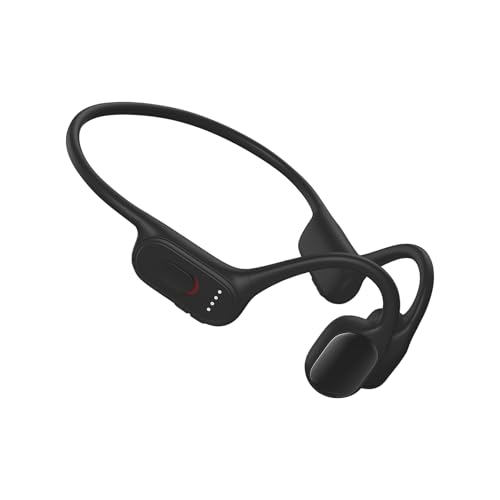
Slides on, three buttons, no app to learn — built for anyone who does not want a phone involved.
If a smartphone app is the part of modern hearing aids that puts you off, this is the alternative. You slide it on and off, use the plus and minus buttons for volume, and double-click the M button to switch to Bluetooth. A single click cycles between indoor, outdoor, and voice modes, so the whole device is operated by feel. At 1.23 oz it is light enough to forget you have it on, and the IPX5 rating protects it against sweat, rain, and water splashes for walks and workouts.
The dual-mode design is the clever bit: switch to Hearing Amplifier mode for conversations and Bluetooth mode for calls, music, and TV, and the device auto-connects to your phone in under 5 seconds. English voice prompts announce battery status so you never have to guess. Claimed battery runs up to 8 hours in Hearing Amplifier mode and up to 6 hours in Bluetooth mode, with a 1-hour quick charge back to full. Bluetooth 5.3 matches the OpenRun Pro 2.
Voice amplification is what owners single out most, describing speech that comes through clearly with noise suppression that does its job. The main caveats are physical. Hair and heavy sideburns can break the contact the device needs against your head, and one owner found it worked better as a TV Bluetooth device than as a hearing aid. Faint hum in voice mode and incomplete music tones are worth knowing about.
Ideal for: older users who want amplified speech and simple physical buttons with no app, no pairing ritual, and a fast 1-hour charge.
Not ideal for: heavy sideburns or thick hair at the contact point, where the fit can prevent solid coupling to the bone.
7. ELEHEAR-Beyond Pro Bluetooth Hearing Aids for Seniors
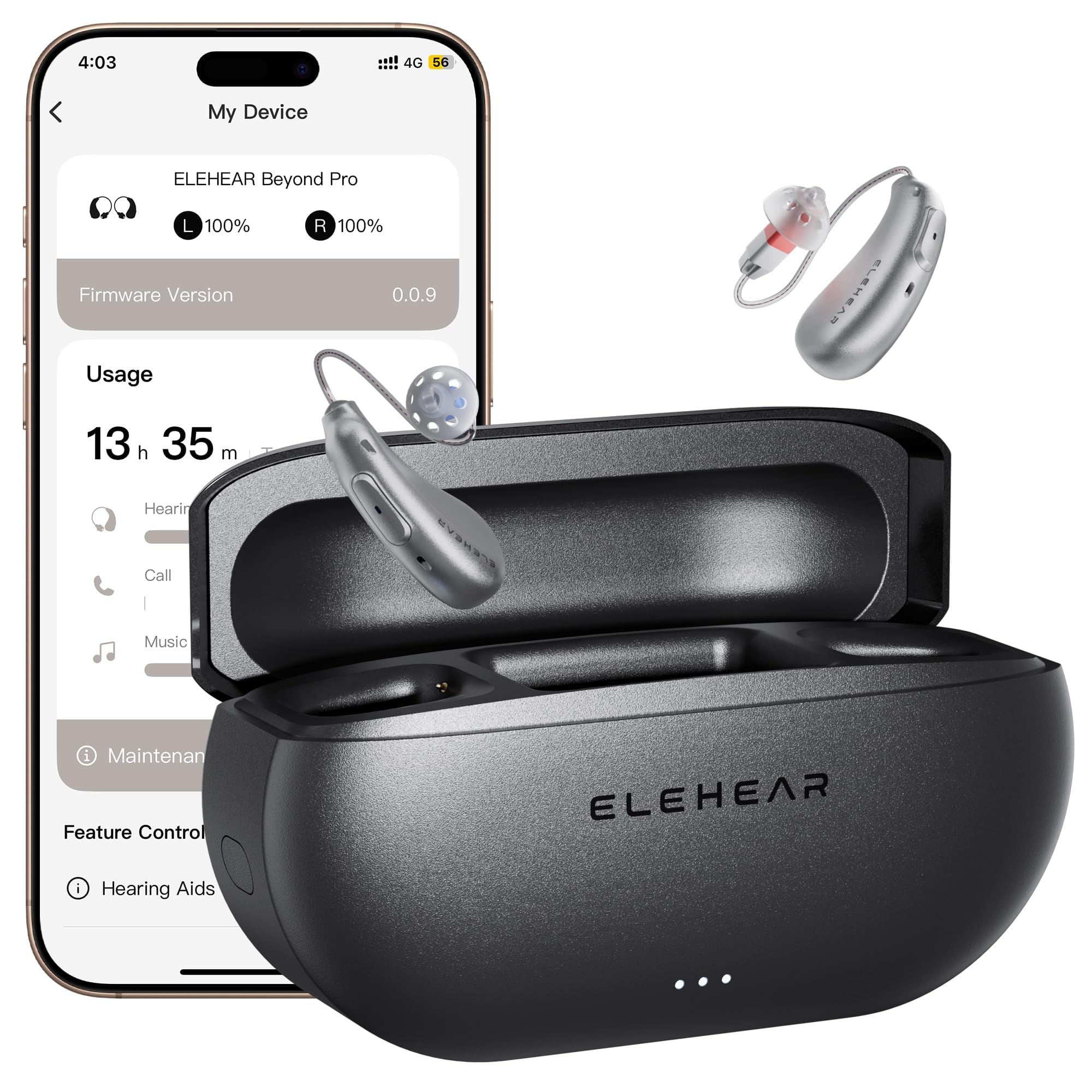
Speech-first hearing aids with the longest runtime and the fastest top-up in this whole group.
VocClear 2.0 delivers 30% clearer speech, with high-frequency detail up to 8500Hz and 8ms latency. Latency is the delay between a sound reaching you and you hearing it, and 8ms is small enough to stay out of the way of natural conversation. Battery is the other standout: up to 20 hours of runtime on a single charge, plus a charging case holding an additional 4 full charges, and 15 minutes of fast charging returns up to 6 hours. The receiver-in-canal design is featherlight and comes with multiple dome sizes.
Owners who came from prescription aids describe the sound as crisp in the upper frequencies, the Bluetooth pairing as easy, and the battery as lasting a full day with streaming on top. The app does a lot: an in-app hearing test, tinnitus masking, environment modes, noise reduction, and remote support from hearing care specialists for personalised adjustments. There is also real-time AI translation across 20 languages, and the aids switch on and off automatically as you lift them out of the case or set them back in.
Where it gets honest is a mismatch of hearing level and the noisy-room experience. This is an over-the-counter device, and if your loss runs severe, it will not deliver the gain you need — that is a fit issue, not a fault. In loud rooms, several owners find it struggles, and the app’s presets can feel limited once you want fine control. Durability over the long term is the other question mark in owner reports.
What stands out: the combination of 8ms latency, 8500Hz detail, and a 20-hour runtime puts speech first in a way most over-the-counter aids do not. Fifteen minutes on the charger buys 6 hours, which covers a forgotten overnight charge.
Before you buy: be realistic about your hearing level. This is designed for perceived mild to moderate loss, and severe losses are outside what an over-the-counter device of this class can correct — the long-term reliability questions in owner reports are worth weighing alongside the strong early impressions.
Your best match if: you have mild to moderate hearing loss, take calls and stream audio, and want the longest battery and fastest charge available.
Consider alternatives if: your hearing loss is severe, or you spend most of your day in very noisy rooms where clarity falls away.
Know the Specs
Battery Hours: Talk Time vs Listening Time
These two numbers are not the same thing, and the gap between them surprises buyers. Talk time is measured with the microphone active, which drains the battery faster than plain playback. The SHOKZ OpenComm2 claims 16 hours of talk time but 8 hours of listening — so far more talk time than listening time on the same charge. By contrast, the ELEHEAR-Beyond Pro claims up to 20 hours of runtime plus 4 extra charges in its case. Read both figures for whatever you plan to do most, and check the quick-charge line: 5 minutes on the OpenRun Pro returns 1.5 hours, and 15 minutes on the ELEHEAR-Beyond Pro returns up to 6 hours.
IP Ratings: What the Numbers Actually Mean
An IP rating has two parts — the first digit covers dust and the second covers water, so IP55 means it resists dust and low-pressure water spray but is not built for immersion. The SHOKZ OpenComm2 carries IP55. Some products use an X in place of a dust number, meaning dust was not rated: the Blue Deer amplifier is IPX5, protected against sweat, rain, and water splashes. The CXK earbuds are rated IPX8, the highest water-protection level in this group, which is why owners can take them underwater. Match the rating to your day, not to the biggest number, and choose accordingly.
Common Questions
Do bone conduction headphones actually work as hearing aids?
Will a bone conduction device help if I am deaf in one ear?
Can I wear these with glasses?
How long does the battery actually last in daily use?
Can I use these in the shower or while swimming?
Do bone conduction headphones leak sound to people around me?
What is the difference between an OTC hearing aid and an open-ear headphone?
Are these comfortable enough to wear all day?
Will these pair with both my phone and my laptop?
Do I need an app to set these up?
The Bottom Line
The bone conduction hearing aids that suits the widest range of buyers is the SHOKZ OpenRun Pro, because it combines 10 hours of playback with a complete open-ear design, all-day comfort with glasses, and a 5-minute quick charge that rescues a forgotten morning. If your priority is being understood on calls, the SHOKZ OpenComm2 pairs a noise-canceling boom mic with 16 hours of talk time and a 98-foot Bluetooth range. And if what you actually need is amplified speech rather than audio, the ELEHEAR-Beyond Pro delivers 30% clearer speech, 8500Hz detail, 8ms latency, and a 20-hour runtime for the most demanding listening day of the group. Whatever you pick, match the device to your hearing level first — that single decision prevents more returns in this category than any spec on the box.
How we choose
We do not accept paid placement. Every pick is matched to a real buyer and a real use-case; we do not hands-on test units.
Sources
Specifications: manufacturer listings and product documentation. Review insights: verified customer reviews, as of October 2026. Pricing: not shown on this page (it changes often); check the current price via the retailer link.
As an Amazon Associate, Aappliancez earns from qualifying purchases. This does not affect which products we feature.