Disclosure: Some links in this post are affiliate links. As an Amazon Associate I earn from qualifying purchases, at no extra cost to you. Learn more
Specs are compiled from manufacturer listings and verified buyer reviews and can change over time — please confirm the key details on the product page before buying.
Most glue fails on Styrofoam for one simple reason. Ordinary craft glue and standard super glue attack the foam and eat right through it. What you actually need is a foam-safe adhesive. That means a glue mixed so it will not dissolve the foam it touches, and one that stays a little flexible after it dries so a bump or a crash does not crack the joint. This guide cuts straight to five adhesives that do exactly that, from quick-setting tubes for model planes to instant-tack bottles for craft builds.
This guide is built by comparing the manufacturers’ published specifications and the patterns across verified customer reviews, so you get each pick’s real strengths and trade-offs instead of marketing spin.
You will see how cure times, tack speed, and compatibility change which bottle belongs in your hand. By the end, you will know which adhesive for styrofoam matches your project, your material, and your patience level.
Top Picks

How To Choose The Best Adhesive for Styrofoam
Styrofoam is the trade name most people use for expanded polystyrene, often shortened to EPS. It is mostly air. That airy structure is exactly why a glue meant for wood or plastic can destroy it in seconds. The wrong solvent soaks in, melts the cell walls, and leaves you with a pitted crater instead of a joint. So the first filter is simple: the bottle must say foam-safe.
Foam-safe is non-negotiable
A foam-safe formula is blended so it bonds the surface without dissolving it. Standard cyanoacrylate, the watery stuff sold as super glue, is the usual culprit behind melted foam. Foam-safe CA exists and behaves completely differently. If a label does not state foam-safe or name polystyrene as a compatible material, put it back. This one check saves more projects than any other buying decision.
Match the cure speed to the job
Full cure time is how long the glue needs to reach its final, strongest bond. A fast five-minute cure suits repairs you want to handle quickly. A twenty-minute or overnight cure gives you working time to reposition a piece before it locks. Quick set and strong final bond are two different things. Several foam glues grab fast but keep getting stronger for days, which is normal and not a fault.
Know your foam type
EPS, XPS, EPP, and EPO are the four foams you will meet most often, and they do not all react the same way. EPS is the beaded white foam in packaging and craft blocks. XPS is the denser, smoother board used for insulation and scenery. EPP and EPO are the springy foams in model aircraft. A glue that lists the foams it is compatible with removes the guesswork before you buy.
Side-by-Side Comparison
| Model | Best For | Full Cure Time | Capacity | Container | Amazon |
|---|---|---|---|---|---|
| UHU por 50ml Tube★ Best Overall | All-round foam and model repairs | 20 minutes | 50ml | Tube | Amazon |
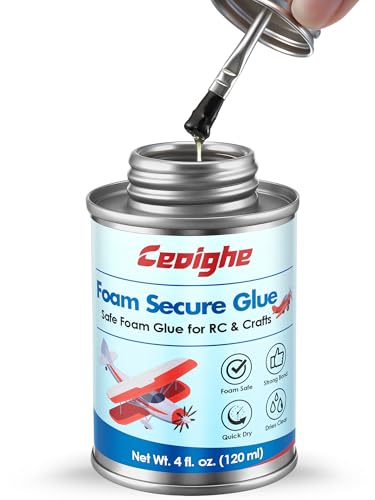
| 4 OZ Foam GlueBest for Big Builds | Tidy brush-on RC repairs | 24 hours | 4 oz | Bottle with brush cap | Amazon |
| Great Planes Pro Foam Safe CA Thin Glue 20g, GPMR6067 | Fast hold on tight joints | 5 minutes | 20g | Bottle | Amazon |
| DELUXE MATERIALS AD34 Foam 2 Foam, Clear, High Tack Glue 50ml | Flexible hobby-grade bonding | — | 50ml | Bottle | Amazon |
| Hot Wire Foam Factory StyroGoo 8.5oz | Mixed-material craft builds | 12 hours | 8.5 oz | Bottle | Amazon |
Detailed Reviews
1. UHU por 50ml Tube
Our pick — over 4.5★ from 800+ verified ratings; the strongest balance of quality and price.
The 50ml tube that sets a foam-plane repair in 20 minutes instead of writing off the airframe
If you fly foam models, this is the bottle that ends the search. UHU por is a quick-setting special adhesive made for bonding hard foam such as Styrofoam, and it also works when you are joining foam to other materials. It is manufactured in Germany and sold in a 50ml tube. The company also states it dries to an elastic adhesive film that is colourless, non aging, and waterproof, so an outdoor airframe will not come apart in damp grass or a rain shower.
Speed is where it makes its case. Full cure time is 20 minutes, which is far quicker than the 24 hours the brush-cap bottle next to it needs. In a side-by-side read, a 20-minute finish beats a 24-hour wait whenever a repair is standing between you and the field. The working style is the classic modeler’s routine: press the parts together, pull them apart briefly to let the solvent flash off, then seat them for good and let it set.
Owners describe the bond as flexible and long-lived, and the numbers back up their patience. Buyers report “sticky quick but even better after a few days to cure”, with that same field-kit habit of repairing one airframe many times over. The material list names cork and rubber, so it also handles grip strips and padding on foam bodies. The catch is honest and specific. It stays workable rather than rock-hard, which is what you want on a flying surface but not if you need a rigid joint on a load-bearing craft piece. It can also string slightly as you draw the tube away, so go slow on the pull-apart step.
Why it takes the top slot
- 20-minute full cure is the fastest working window on this list
- Waterproof, colourless, non-aging film holds up outdoors
- Bonds foam to cork and rubber, not just foam to foam
- Elastic film takes vibration without cracking
What to weigh first
- Stays flexible, so it is not a rigid structural joint
- The 50ml tube runs dry faster than a larger bottle if you build often
- Pull-apart technique takes one practice run to learn
Reach for this if: you want one tube that handles foam planes, cork, and rubber with a fast 20-minute cure.
Look elsewhere if: you need a rigid, hard-set joint on a craft piece that carries weight.
2. 4 OZ Foam Glue
The 4 oz brush-cap bottle that paints glue onto intricate RC joints without squeeze-out on the wing
This is the one for anyone who has ever squeezed a tube and watched a bead of glue run somewhere it should not. Rather than a squeeze tube, you get a 4 oz bottle with a brush built into the cap. You paint the glue exactly where you want it, even into small or intricate spots. That makes it a tidier choice than a tube for detailed work, and it is the reason it earns its place here.
Foam compatibility is broad and clearly stated. The formula is designed for RC aircraft and foam models, and it lists EPP, EPO, EPS, balsa wood, and carbon fiber as compatible materials. So one bottle covers assembling a plane and repairing a mixed-material frame. It sets within minutes and fully cures in 24 hours, and the maker states the finished bond is waterproof and UV resistant. It also stays somewhat flexible rather than turning brittle, so it absorbs the vibration and shock an airframe takes during takeoff and landing.
What wins people over is the adhesion and the grab. Reviews point to glue that “flowed nicely and was easy to spread on foam”, and the brush application is widely preferred over tubes because it avoids the squeeze-out and bare patches a bead leaves behind. The bottle holds 4 oz, and if you compare capacity across this list, the StyroGoo bottle holds 8.5 oz, which is roughly double the volume for anyone who works at scale. Two practical notes. The glue itself is dark yellow, not clear, so it shows on visible joints. And it carries an odor while wet that fades once fully cured.
The brush is the point: accurate placement on small parts, no stained fingers, and faster clamp-off because it grabs quickly.
Set your expectations on color: a dark yellow glue line is visible on white foam, and the 4 oz bottle will not last a heavy seasonal builder.
Who it beats: anyone weighing it against the UHU tube on tack speed alone will find this grabs faster and comes off the clamps sooner.
Who should pass: builders who need an invisible joint on white foam should choose a clear dried film instead.
3. Great Planes Pro Foam Safe CA Thin Glue 20g, GPMR6067

The water-thin foam-safe CA that wicks into hairline cracks and flush seams a thick glue cannot reach
Here is the spec that decides it for this bottle. Full cure time is 5 minutes, and if you set that beside the UHU tube, the difference is stark. A 5-minute cure against a 20-minute cure is the gap between a quick field fix and a coffee break. That speed suits tight joints where the parts already fit flush and you just need them held.
Thin is the whole personality. This is a foam-safe cyanoacrylate, the watery kind of super glue, sold in a 20g bottle weighing 27.22 g total. Because it is water-thin, it wicks into seams and cracks by itself, which is why it is a favorite for repairs on CA-sensitive foams like Styrofoam. It is white in the bottle and bonds to foam. But thin cuts both ways: review pages note it “will run” if you are careless, so apply sparingly with a small brush rather than squeezing straight from the tip.
The honest trade-off is time and technique. With excess on the surface it can mark or dissolve paint, and it can bond skin instantly if you touch it. Reviewers who use it plain describe a slow kick, taking minutes rather than seconds to set, and they tape the parts together while it dries. Pair it with a foam-safe activator spray and it does grab fast, and that combination works well for patching a clean hole. For a joint that fits neatly and needs a thin, invisible line of glue, this is the tool.
Where the thin formula wins: it wicks into flush seams and hairline cracks that a thicker glue simply cannot reach.
The technique tax: water-thin means it runs if you over-apply, marks paint on contact, and needs taping while it sets unless you add an activator.
Pick this for tight, well-fitted repairs where you want a fast 5-minute cure and a near-invisible glue line on foam.
Step past it if your parts are loose, gappy, or hard to clamp — a thicker glue forgives a poor fit far better.
4. DELUXE MATERIALS AD34 Foam 2 50ml

The clear, high-tack 50ml bottle that grips on contact and stays flexible with the foam
Deluxe Materials AD34 Foam 2 Foam is a clear, high-tack glue sold in a 50ml bottle, and it is made for models. Deluxe Materials is a United States based company, with parts sourced from global producers, and this is their DLMAD34 part. It lists plastic and wood among its compatible materials, and it is intended for model use. That high tack means it grips on contact, so parts do not slide while you line them up.
Owners mention the glued join outlasting the foam around it. Because it stays flexible, it moves with the foam instead of fighting it. And a flexible, clear joint is a genuine advantage over the thin CA bottle above, which leaves a brittle weld and can mar paint. Here you get an undetectable clear line on white foam plus a joint that absorbs impact.
Two things to know before you order. There is no full cure time listed for this one, so plan on giving it time to dry rather than expecting a same-minute set. And cost is worth a look: the same tube can turn up for less through other hobby channels, so it pays to check before committing. The 2.08-ounce bottle is a reasonable size for occasional repairs, though a heavy builder who is always gluing will want to know how far it stretches.
The hobbyist verdict
- Clear, high-tack and flexible — bonds move with the foam
- Repairs reportedly outlast the original part
- Suits EPO and EPS models plus wood and plastic
- Grips on contact so pieces do not slide
Where it asks for patience
- No stated full cure time, so it is not a speed pick
- Same tube can be found for less through hobby channels
The right call when you want a clear, flexible joint and you are happy to let it dry properly.
Look past it if you need a documented fast cure or a fixed price you can plan around.
5. Hot Wire Foam Factory StyroGoo 8.5oz
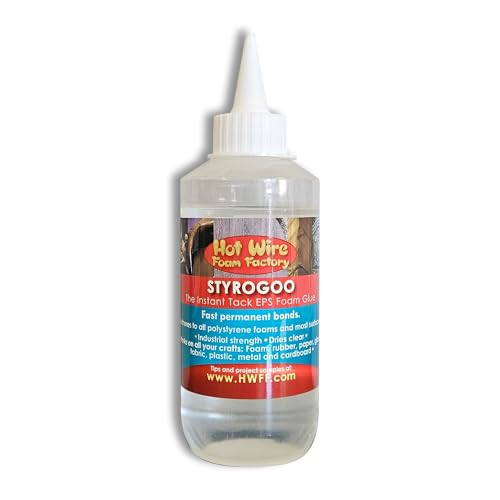
The 8.5 oz solvent-free squeeze bottle that bonds EPS and XPS foam to wood, metal, glass, and fabric
Volume and versatility are the reasons this bottle stands out. At 8.5 oz it holds roughly double the 4 oz of the brush-cap glue, which matters if you build often. And StyroGoo is a solvent-free foam-safe adhesive that bonds EPS and XPS foam to wood, metal, glass, rubber, paper, plastic, fabric, and cardboard. It dries clear and sets up with an instant tack that forms an immediate bond, then allows you to reposition pieces before it fully sets. Full cure time is 12 hours.
Its real strength is mixed-material work. Anyone gluing a foam diorama, a village scene, or a foam-topped board knows that finding one adhesive for foam and everything else is the hard part. This lists all of those materials together, so you reach for one bottle instead of three. It is also the forgiving choice: it tacks quickly but lets you nudge a piece into position before it locks, and it stays solvent-free.
The one thing to go in eyes open about is that the adhesion feedback is mixed. Many confirm a strong bond on XPS and Styrofoam, while some report it not adhering at all. That spans from glowing reports to no-grab complaints, so surface prep genuinely matters here. Clean, dry, and slightly roughed surfaces give it the best chance. If your material is glossy or greasy, wipe it first. On a prepared surface it earns its keep, and the 8.5 oz bottle gives you room to practice without rationing.
The mixed-material pick: foam, wood, metal, glass, and fabric all sit on one label, so one squeeze bottle covers a messy bench.
Prep before you glue: adhesion results vary, and clean, dry, scuffed surfaces are what separate a solid hold from a failed one.
Best fit for crafters and diorama builders gluing foam to a wide mix of other materials.
Be wary if you want a guaranteed grab on a smooth, slick surface without any prep.
Know the Specs
Full Cure Time
This is how long the glue needs to reach its final strength, and it is the number that most changes how a product feels in use. It is not the same as set time, which is when the parts hold on their own. A glue with a 5-minute full cure will lock fast and suits tight, well-fitted joints you want to handle soon. A glue with a 20-minute or 24-hour full cure gives you more working time to slide things into place. Faster is not automatically better. A quick cure usually demands a snug fit, because it sets before it can fill a gap. A slower-curing adhesive often tolerates a looser fit and keeps getting stronger for a while after the initial grab. Match the number to the job.
Foam Compatibility
Expanded polystyrene, which most people call Styrofoam or EPS, is the most common foam you will glue. But EPP, EPO, and XPS are different materials with different surface behavior, and a label that names the foams it bonds removes the guesswork. The word “foam-safe” is what tells you the formula will not melt the foam. That matters because the solvent in ordinary super glue dissolves polystyrene on contact. A foam-safe glue either avoids that solvent or is blended to sit on the foam without attacking it. Before you buy, check that your specific foam type appears in the compatible materials list.
Common Questions
Will regular super glue melt Styrofoam?
How long does foam glue take to fully cure?
What is the difference between EPS, XPS, EPP, and EPO foam?
Can I use foam glue to attach Styrofoam to wood or metal?
Is a brush-cap bottle better than a squeeze tube for small repairs?
Does foam glue stay flexible or does it dry hard?
Can I glue foam outdoors if it might get wet?
Why does the glue look dark yellow instead of clear?
How should I store foam glue so it lasts?
Which foam adhesive is best for a beginner?
The Bottom Line
For most foam work, the strongest all-round pick is the UHU por 50ml Tube, because it pairs a fast 20-minute cure with a waterproof, colourless film and handles foam, cork, and rubber. If you want precise, tidy application on small RC repairs, grab the 4 OZ Foam Glue with Brush Cap. And when you need to bond foam to wood, metal, or glass in one bottle, the StyroGoo 8.5oz is the one to reach for, since it covers the widest mix of materials on this list.
Whichever you choose, let it reach its full cure before you stress the joint.
How we choose
We do not accept paid placement. Every pick is matched to a real buyer and a real use-case; we do not hands-on test units.
Sources
Specifications: manufacturer listings and product documentation. Review insights: verified customer reviews, as of October 2026. Pricing: not shown on this page (it changes often); check the current price via the retailer link.
As an Amazon Associate, Aappliancez earns from qualifying purchases. This does not affect which products we feature.