Disclosure: Some links in this post are affiliate links. As an Amazon Associate I earn from qualifying purchases, at no extra cost to you. Learn more
Specs are compiled from manufacturer listings and verified buyer reviews and can change over time — please confirm the key details on the product page before buying.
You broke a plate you love, and now you want the gold seam to look deliberate rather than like a glue accident. That is the whole job. A good kintsugi kit gives you a resin that actually hardens, pigments that read as metal rather than glitter, and enough working time to line the pieces up before everything sets. The tricky part is that kits look nearly identical in photos while behaving very differently on your kitchen table — some cure in a day, some stay tacky for a week, and a few use real urushi lacquer that demands genuine caution. This guide sorts the seven most relevant kits by what they actually do in your hands.
This guide is built by comparing the manufacturers’ published specifications and the patterns across verified customer reviews, so you get each pick’s real strengths and trade-offs instead of marketing spin.
Below you will find honest notes on working time, cure times, food-contact limits and which kits suit a first repair versus a serious practice. The short answer: buy for the cure chemistry first, the gold second when choosing a Kintsugi Repair Kit.
Top Picks
How To Choose The Best Kintsugi Repair Kit
The first decision is the repair material: two-part epoxy resin or natural urushi lacquer. Modern kits use a two-part epoxy resin (a glue you mix from two tubes so it hardens chemically). Traditional kits use urushi lacquer, a natural tree sap that hardens with moisture and humidity instead of a chemical reaction. Epoxy gives you a fast, strong, forgiving bond. Urushi gives you the authentic material and a far longer working rhythm.
Start with the cure chemistry, not the gold
The CHIYU kits list a full cure time of 72 hours, which tells you the bond needs three days to reach full strength even though it feels set much sooner. The iienjoy kit lists a 30-minute slow cure window and says repaired items are dishwasher-safe after 24 hours. Urushi kits behave differently again — one detailed account of the Chimahaga kit describes 15-30 minute sessions spread over 2-3 weeks with cure waits of 3 days to 1 week. Pick the rhythm you will actually keep up with, because an abandoned half-cured repair is the most common way these kits go wrong.
Check the food-contact wording line by line
This is where buyers get burned by assumptions. The CHIYU kit states its glue was tested as a resinous and polymeric coating and that fully cured repairs suit limited contact with food — cold foods like bread, cheese and charcuterie. The same listing says hot liquids, microwaves and ovens are not recommended. The Chimahaga kit takes a different route, using natural urushi and pure gold and stating it is safe to use on dishes. Read that exact wording before you plan to eat soup out of the repaired bowl.
Count the tools before you count the colours
A kit with four pigment colours but one mixing stick will frustrate you faster than a kit with one colour and proper tools. The 4LEAF TREASURE set spells out its contents in detail: 25ml epoxy glue, 10g gold powder, 5 wooden craft sticks, a miniature wood spoon, 2 art brushes, 2 pairs of nitrile gloves, 2 practice ceramic dishes, 4 paper mixing containers, 57g epoxy putty and 4 sandpaper sheets. Compare that to a kit that ships one pair of gloves total and you can see why the practice-run kits win with beginners.
Decide how much mess you can tolerate
Gold powder is fine and light, and it drifts. A repairer working on a snapped mug handle noted the gold powder mixes smoothly but goes airborne and gets messy, and that the epoxy was easy to mix but hard to push out of the tube. Plan for a tray, gloves and ventilation regardless of which kit you buy. Kits with silicone mixing tools, like the iienjoy set, are easier to wipe clean than paper cups.
Side-by-Side Comparison
| Model | Best For | Repair Material | Stated Cure Time | Item Weight | Amazon |
|---|---|---|---|---|---|
| CHIYU Kintsugi Repair Kit (Gold)★ Best Overall | First-timers who want a strong modern bond | 2-component epoxy resin | 72 hours full cure | 240 g | Amazon |
| PLEARTY Kintsugi Repair Kit 50mlBest for Gifting | Eco-minded crafters and gifting | Bio-based linseed resin | — | 11.7 ounces | Amazon |
| iienjoy Kintsugi Repair Kit | Colour variety on a tighter budget | Food-safe AB epoxy | 30-minute slow cure; dishwasher-safe after 24 hours | 13 ounces | Amazon |
| 4LEAF TREASURE Complete Kit | Learning the full method with practice dishes | Epoxy glue plus epoxy putty | — | — | Amazon |
| CHIYU Kintsugi Repair Kit (alt listing) | Buyers who want the same kit from a second listing | 2-component epoxy resin | 72 hours full cure | 240 g | Amazon |
| Mejiro Urushi Kintsugi Kit | Authentic lacquer work on valuable pieces | Natural urushi lacquer | — | 12.8 ounces | Amazon |
| Chimahaga Traditional Kit | Serious students of the traditional craft | Natural urushi and pure gold | — | 6.4 ounces | Amazon |
Detailed Reviews
1. Kintsugi Repair kit Gold
Our pick — 4.0+★ from 400+ verified ratings; the strongest balance of quality and price.
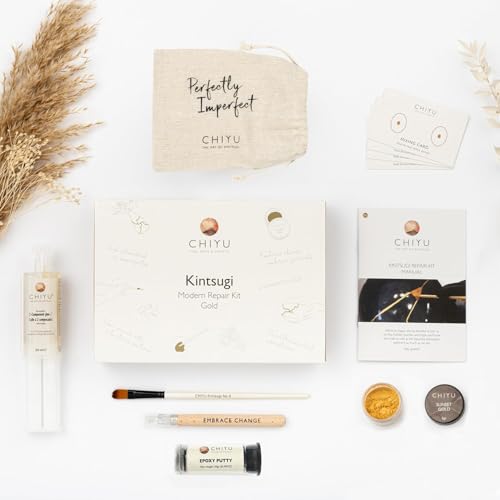
A two-part epoxy kit that bonds ceramics, glass, wood and metal with a 72-hour full cure.
If you want one kit that will not leave you guessing, this is the one the crowd backs — 4.0+ stars across 430+ owners, with working strength as the clear standout. The CHIYU two-component epoxy (a glue that only hardens once you mix the two tubes together) is the reason. It bonds wood, metal, ceramics, glass, concrete and precious stones, and it goes on as a liquid you can steer into the crack with a brush rather than a paste you wrestle with.
The manual matters more than buyers expect. You get detailed tips and tricks in English, Spanish, German, French, Italian and Dutch, and the maker says that is enough material for 6 to 8 medium-sized broken items. That multilingual booklet is a real advantage over kits that ship a single folded sheet. The full cure time is listed at 72 hours, so plan your repair around three days of letting it sit rather than handling it the same evening.
Food contact is where you need to read carefully. The listing says the glue has been tested as a resinous and polymeric coating and that fully cured repairs suit limited contact with food. Cold foods are the recommended use — bread, pastries, chips, nuts, dried fruit, cheese and charcuterie. Hot liquids like coffee, tea or soup, plus microwaves and ovens, are specifically not recommended, and heat can weaken the adhesive. Dishwasher-safe is stated, but gentle handwashing is preferred to keep the gold looking sharp.
Where this kit earns its place
- Effectiveness is what wins people over — the bond holds and the repair looks intentional.
- Works across ceramics, glass, wood, marble, concrete and precious stones, so one kit covers most of your shelf.
- Instructions in six languages, with capacity for 6 to 8 medium-sized repairs.
- Gold powder applies lightly with the brush after the fragments are pieced together.
What to plan around
- Full cure runs 72 hours — this is not an evening project.
- Not cleared for hot liquids, microwaves or ovens.
- Some buyers find the contents list thinner than the “most complete kit” claim suggests.
Reach for this if: you want a strong modern epoxy bond on a decorative plate or mug and can leave it alone for three days.
Think twice if: you plan to drink hot coffee out of the repaired piece — the listing rules that out.
2. PLEARTY Kintsugi Repair Kit 50ml
A linseed-resin kit in kraft gift packaging, with a 15-page booklet and a free video walkthrough.
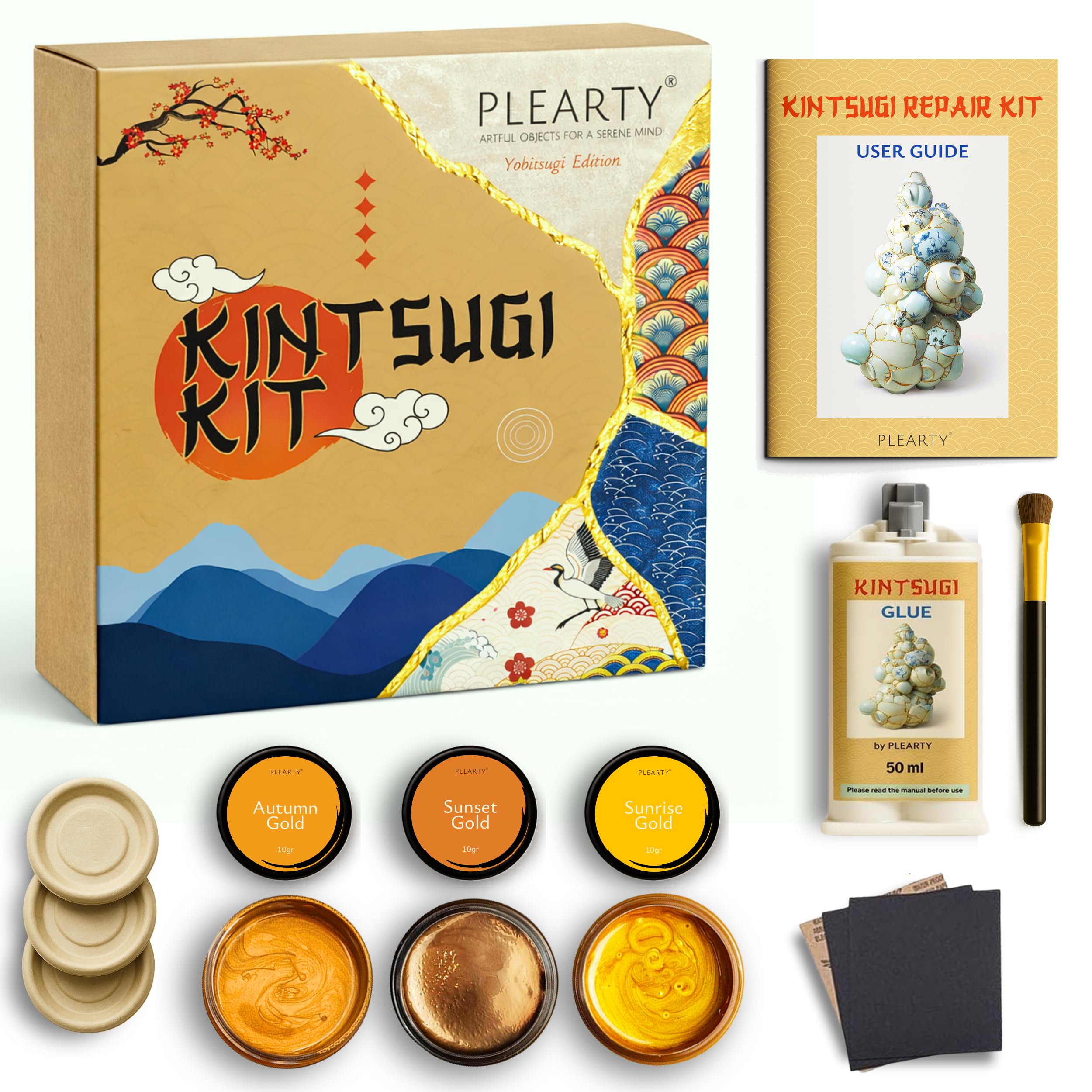
This is the kit you hand to someone rather than keep. It arrives in Japanese-inspired kraft paper packaging, and inside sits a 15-page booklet plus a free online video walkthrough that covers mixing the gold powder through to the finished repair. The resin itself is bio-based and derived from linseed, described as BPA-free and low VOC (volatile organic compounds — the fumes that off-gas while it cures), and it is stated as dishwasher-safe once cured.
Three gold tints come in the box along with two practice cups, and the dual syringe makes measuring and mixing straightforward. One buyer used half the glue to fix a 6-inch vase broken into roughly ten pieces and reported the bond held strong. What buyers describe most is simply that the kit matches its listing — it is what the photos promise, and it functions.
Here is the honest catch. Drying time is the recurring friction point, and not every unit behaves. The instruction to dispense only small amounts is real advice, not boilerplate — the resin sets fast once mixed, and pieces need long, careful holding while they grab. The one-time-use glue nozzle and paintbrush mean you will be rebuying consumables if you keep at the craft. And the durability record is genuinely mixed: some repairs survive for months, while at least one reviewer noted the resin never hardening and staying sticky a week on.
The eco angle is real: a linseed-based resin with low VOC content is a meaningfully different material choice from the standard epoxy kits here, and it still carries a dishwasher-safe claim once cured.
Treat the cure as the test: mix small, work fast, and give the piece its full set time before you judge the kit — the failure stories all trace back to resin that never went off.
Buy it as a present: the packaging and practice cups make it a genuinely thoughtful gift for someone into Japanese craft.
Not for you if: you want a single repair with no leftover consumables — the nozzle and brush are one-use.
3. iienjoy Kintsugi Repair Kit, 4 Colors Food Safe for Ceramics
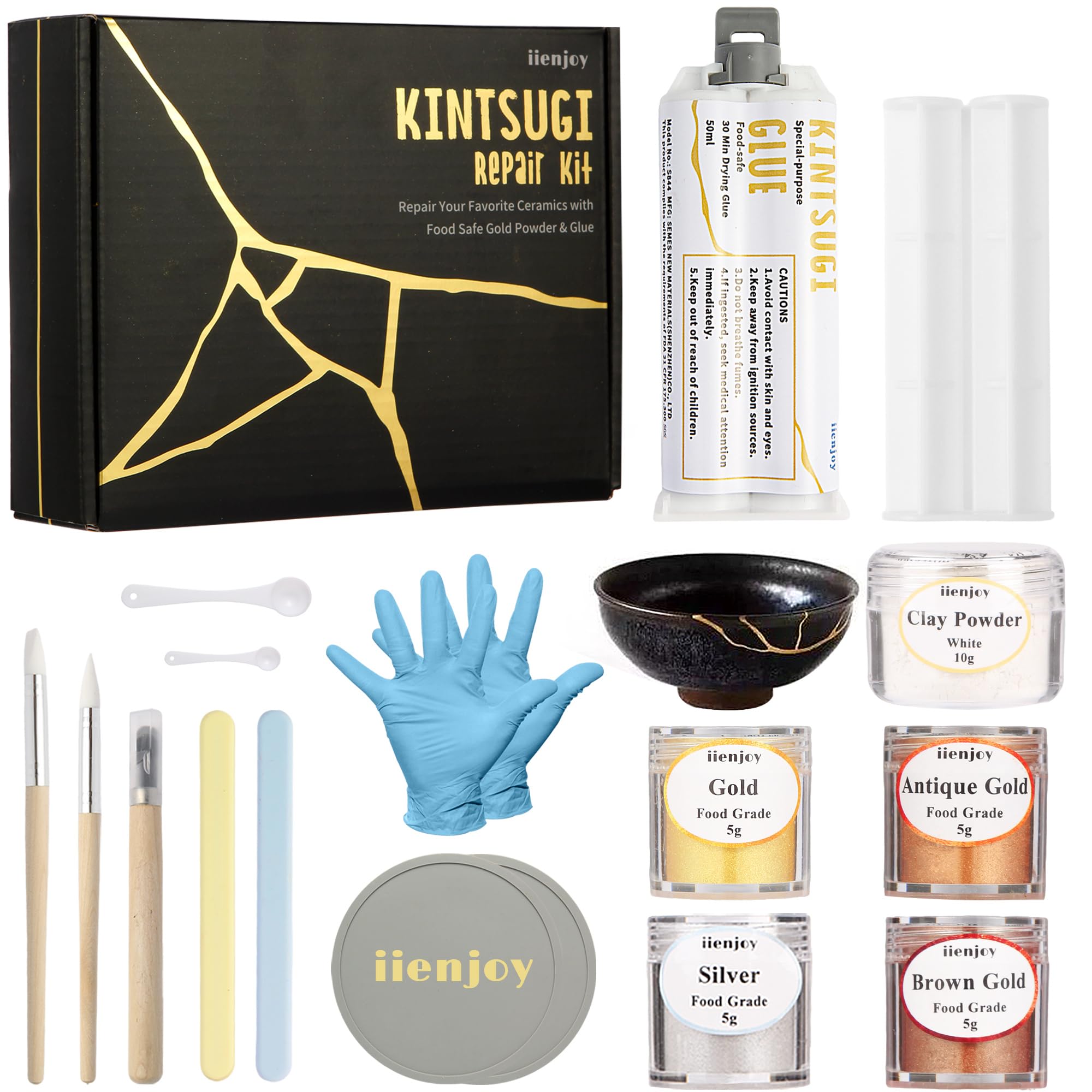
Four metallic pigments and reusable silicone mixing tools, with a 30-minute working window before the epoxy grabs.
At 13 ounces this is the heavier of the two kits with cross-listed weights here, against the PLEARTY at 11.7 ounces. What you get for that extra heft is choice: 50ml of food-safe AB epoxy glue, four metallic-coloured pigments, gloves, wooden sticks and reusable silicone mixing tools that wipe clean instead of soaking through paper cups. Appearance is what buyers talk about most, and the finished repairs read as deliberate decoration rather than damage.
The repair ability earns just as much praise — this kit suits a run of small fixes rather than one heroic rebuild. Instructions cover a 30-minute slow cure, and the listing states repaired items are dishwasher-safe after 24 hours, which is a much quicker turnaround than the 72-hour kits. The slower food-grade epoxy is the reason for the longer working window: you get more time to nudge fragments into line before they lock.
Now the trade-off, and it is the biggest one in this lineup. The adhesive is the most-discussed issue with this kit, and drying time follows close behind. The part B tube can arrive as a nearly dried paste that will not dispense even under two-handed pressure, while the clear resin side is fine. Once mixed, the epoxy can be hard to push out of the tube — one mug repairer wished for a hand-grip dispenser. The mica powders also lean glittery rather than truly metallic, and one experienced crafter recommended a three-step bond-patch-gild method with isopropyl alcohol, tape and sandpaper to get a better finish.
Scaling the downside: most kits arrive usable and the colour range is a genuine draw, but inspect both tubes the day the box lands — if part B is stiff, you want to be inside the return window.
The colour-forward pick: four pigments and reusable silicone tools at an entry-level tier make this a good first kit for someone who wants variety.
Look elsewhere if: you want true metallic lustre — the mica reads as shimmer, not gold.
4. 4LEAF TREASURE Kintsugi Repair Kit
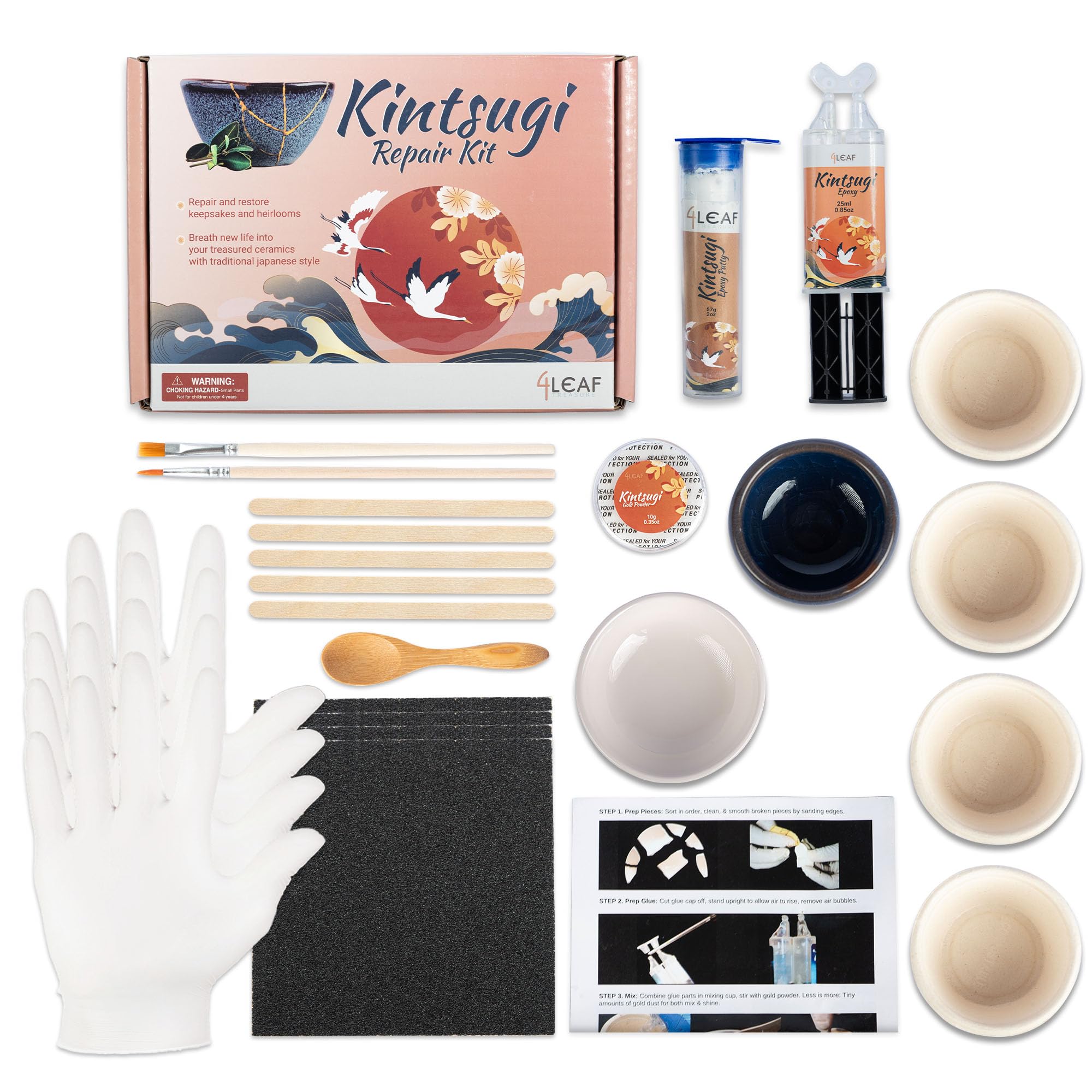
It includes two practice ceramic dishes, one white and one dark blue, so you rehearse before touching anything precious.
Almost every kit assumes you already have something broken. This one hands you two practice ceramic dishes, one white and one dark blue, so you can smash and rejoin them before you touch anything with sentimental value. That is the smartest feature in this whole lineup for a nervous beginner, and it sits alongside a genuinely deep contents list: 25ml epoxy glue, 10g gold powder, 5 wooden craft sticks, a miniature wood spoon, 2 art brushes, 2 pairs of unisex medium-large nitrile gloves, 4 paper mixing containers, 57g epoxy putty and 4 sandpaper sheets.
The putty is the second differentiator. Where most kits only glue fragments back together, this one includes epoxy putty to fill gaps and missing pieces — the listing describes it as suitable for filling large gaps and chinks. The dual-component glue and hardener are set up for a 1:1 mix, which removes the guesswork that ruins more first repairs than anything else. Two pairs of gloves means you can work with a partner, and more than one buyer has done exactly that as a shared evening project.
The honest limits are about waste and precision. Once you mix the epoxy you have to use it, so a small repair wastes some product — a teacher using it with a student found it a bit tedious and costly for that reason. The putty has also arrived opened and dried on at least one occasion, which only matters if you are filling a big gap rather than gluing a crack. Otherwise the reports are warm: beautifully packaged, easy-to-follow instructions, and repairs that hold on items with real sentimental weight.
Why beginners should care: the two practice dishes plus 4 sandpaper sheets and 4 mixing containers turn this into a course rather than a single repair, and the 1:1 ratio takes the anxiety out of mixing.
Small-scale caveat: the supply volume suits roughly two saucers or one teacup, so plan a few repairs together rather than one tiny chip.
Ideal for a first-timer: practice dishes, putty and sandpaper make this the most complete teaching kit of the modern-epoxy group.
skip it if: you already have a single clean crack to fix and would rather not pay for practice bowls and putty you will not use.
5. Kintsugi Repair kit Gold Glue
The same CHIYU0101 kit as our top pick, sold under a second Amazon listing with identical contents.
You will notice the specs are identical to the Best Overall pick — the same CHIYU0101 model, the same 240 g of two-component epoxy, the same 72-hour full cure, the same six-language manual and the same 6 to 8 medium-sized repair capacity. If this listing is the one in stock, you are buying the same product. Effectiveness is again what buyers talk about most, and the “not the traditional kintsugi but still great” framing comes up because this is epoxy, not lacquer.
What differs is the small print of buyer experience. The learning curve is steep even with thorough instructions, and beginners routinely want a second pair of gloves because only one is provided. The epoxy clay in the kit has drawn gripes about feeling gritty with metal-like flecks and blending poorly — one buyer traced that to age, noting the booklet states a 6-month shelf life and the kit had been sitting over a year. That is a useful thing to check on arrival regardless of which listing you buy.
Where this kit genuinely shines is on a well-loved everyday object. One home espresso user repaired a mug used for decades and still makes espresso in it, which says more about the bond than any spec line. Others prefer leaving the crack as a visible crevice and dusting gold or silver powder in as the glue hardens, which produces finer repair lines than filling flush. Expect to spend some artistry on it — this is not a pour-and-done product.
The case for this listing
- Identical formula and contents to the top pick, so quality is not in question.
- Epoxy is described as super strong once fully cured, and it is rated dishwasher safe with handwashing preferred.
- Detailed six-language manual covers the whole process.
What buyers run into
- One pair of gloves only — beginners should have spares ready.
- The included epoxy putty has drawn complaints about grittiness and poor blending.
- Steep learning curve; the “Instagram-easy” expectation does not survive first contact.
Worth grabbing if: this is the listing showing availability and you want the proven CHIYU epoxy formula.
Check first: the 6-month shelf life noted in the booklet — an old kit can mean gritty putty.
6. Kintsugi Repair Kit Urushi Lacquer
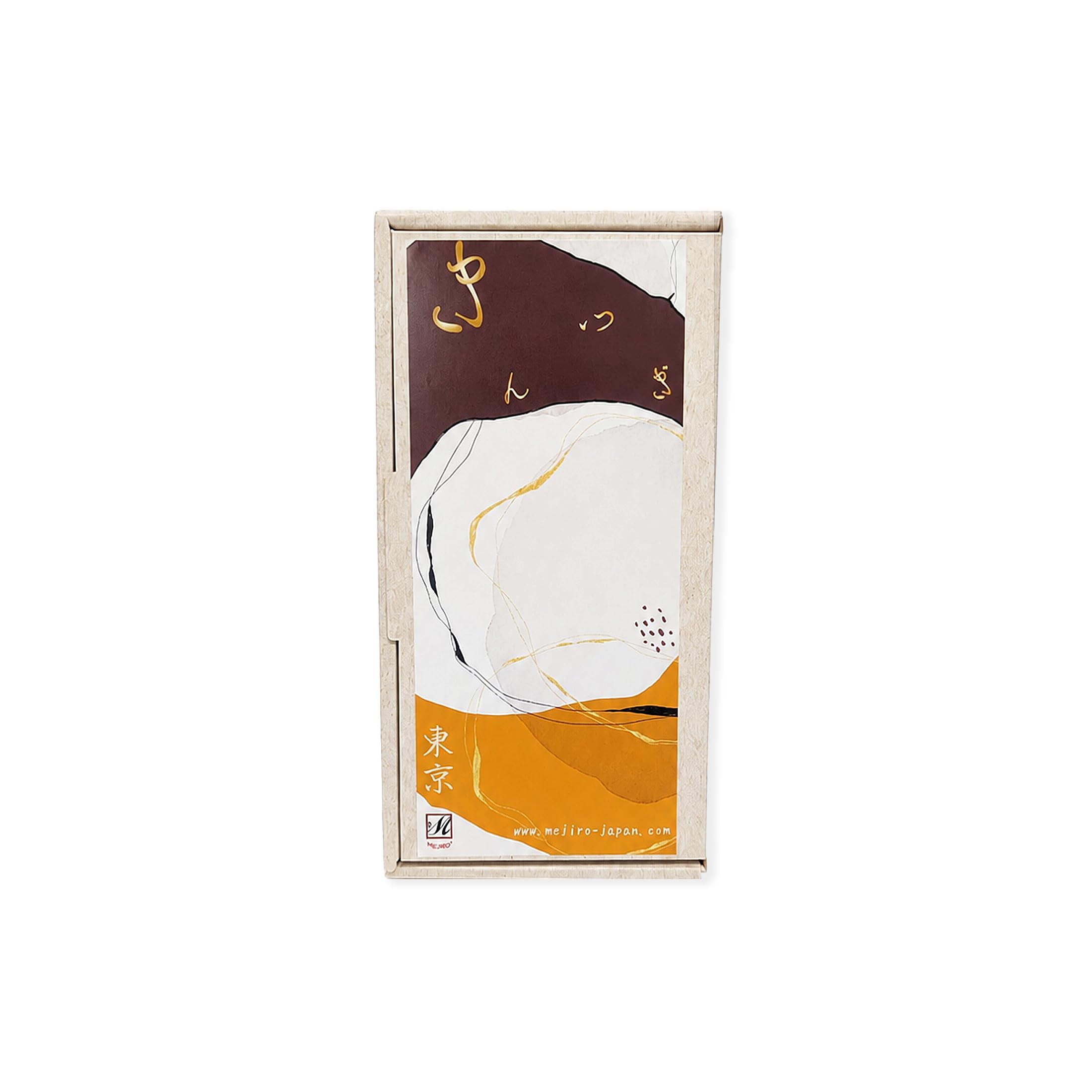
Genuine Japanese urushi lacquer that cures with humidity over weeks, not a chemical hardener.
This kit uses genuine urushi lacquer from Japan rather than epoxy, and it is the authentic material the craft was built on. Quality is what buyers praise most here, and it shows in the contents: a spatula, brushes, a lint-free cloth, masking tape and a silk ball, with enough material for many repairs. One owner used it on a valuable antique Imari jar and was glad to have paid extra for real materials over epoxy and gold paint.
The working rhythm is completely different from the epoxy kits above. Urushi cures with moisture and humidity rather than a chemical hardener, so a dry desert climate can stall it — one repairer resorted to a drying box with a wet towel and found a one-hour wait inadequate, needing closer to two hours. The flour-water-lacquer paste used for filling is tough to handle, and the tonoko-water-urushi mixture is fragile enough that it can break off while sanding and need redoing. Expect to order extra urushi and tonoko separately if you get serious.
The safety note on this listing is not decoration. The maker states plainly that urushi lacquer contains a compound that can cause a reaction similar to poison ivy, and points concerned buyers to a separate low-allergenic listing. Reports back that up: rashes on arms and neck despite nitrile gloves, and a warning that the included gloves are oversized and let the sap through. Urushi also stains badly — turpentine is the reported removal route. Written directions are thin, and the company’s YouTube video is what most people actually learn from.
Read the warning as a gate: if you have ever reacted badly to poison ivy, choose a different kit — this is a known property of natural urushi, not a defect in this product.
The payoff for the effort: authentic lacquer, real depth in the finish, and a kit stocked well enough that one purchase covers repair after repair.
For the committed hobbyist: you want genuine urushi, you will watch the video first, and you have a humid spot to cure in.
Wrong tool for: anyone with sensitive skin or a tight weekend — this craft runs in short sessions across weeks.
7. Traditional Kintsugi Repair Kit Basic
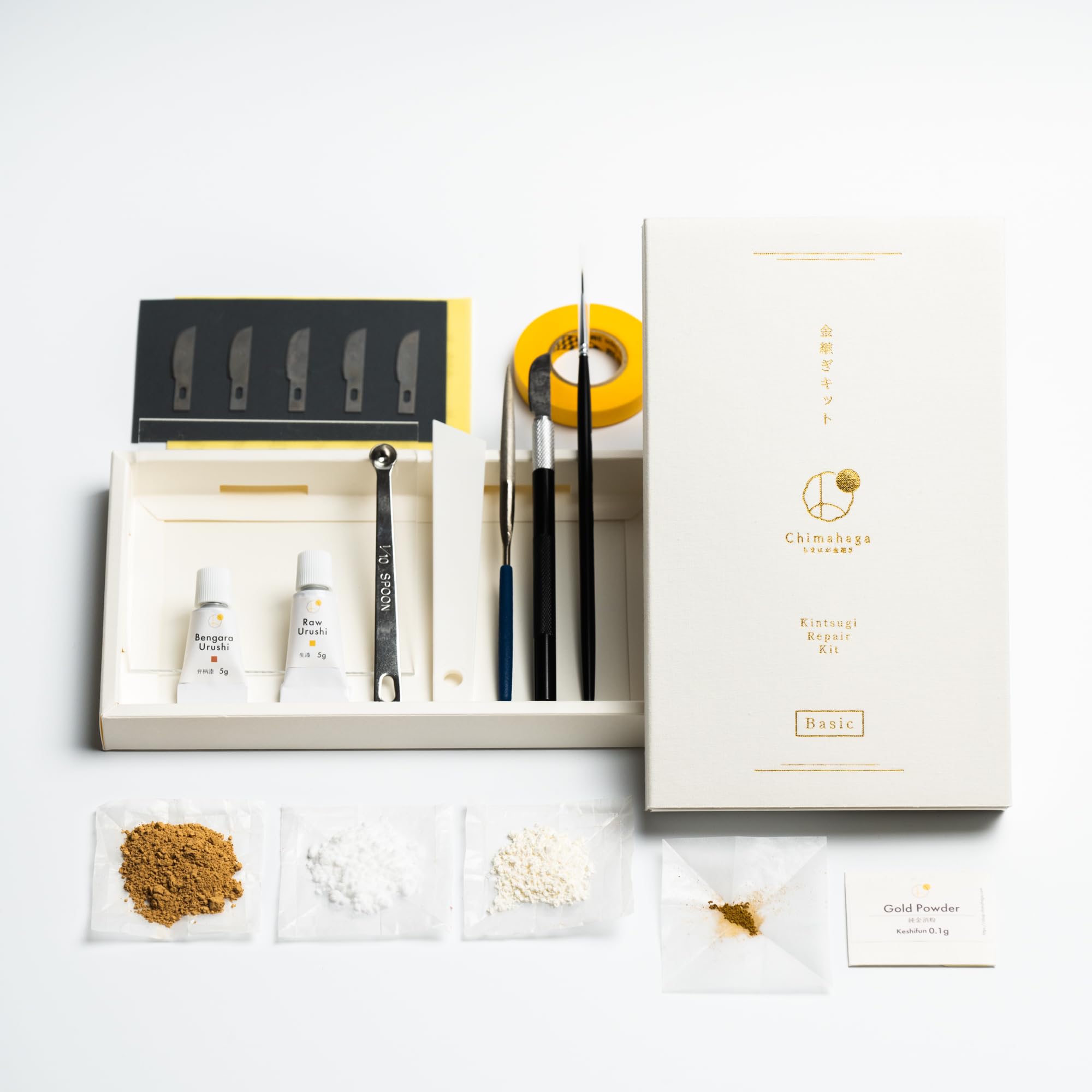
Natural urushi and pure gold, supervised by kintsugi repairer Chimahaga, with tutorial videos and Instagram support.
Chimahaga is a Japanese kintsugi repairer, and this kit is supervised by him — his name is on the box and his Instagram DMs are open if you get stuck mid-repair. The materials are natural urushi and pure gold, and the listing states the combination is safe to use on dishes. Tutorial videos run on YouTube, which matters here because the written material is sparse. At 6.4 ounces this is the lightest kit in the group, and the packaging reflects that: slim, careful, traditional.
Pair it with the video and the process is manageable — one buyer repaired a cracked pottery plate and called it beautiful work, praising the instructions, packaging and authentic materials. A 25-minute tutorial with a clean English translation is the reported learning route, and the sequencing runs in 15-30 minute sessions spread across 2-3 weeks with cure waits of 3 days to 1 week between steps. It behaves better on porous ceramic than on glass. Urushi curing alone took over a month for one small saucer.
Two things need saying plainly. First, this is the genuine article, which means genuine urushiol — the compound in urushi that triggers a poison-ivy-like reaction. Reports describe severe contact dermatitis despite gloves and careful cleanup, in one case requiring medical treatment. That is a property of the material, and the kit lists it as traditional and natural rather than hypoallergenic. Second, this “Basic” version is genuinely basic: one buyer had to add bengara urushi, a spatula and extra gold separately, and recommends the standard kit instead since it bundles those for less than buying them apart.
Why the traditionalists pick it
- Genuine Japanese urushi with pure gold, supervised by a working kintsugi repairer.
- Direct Instagram support from Chimahaga if a step goes wrong.
- Excellent video tutorial with accurate English translation.
- Repair strength reported as good once fully cured.
Know before you open the box
- Urushiol reactions are a documented risk for sensitive skin, even with gloves.
- The Basic version needs extras — bengara urushi, a spatula, more gold — that the standard kit bundles.
- Weeks-long process with cure waits of 3 days to 1 week.
The purist’s choice: real urushi, real gold and a repairer on call make this the most authentic route to the craft.
Seriously consider the standard kit instead: the Basic version leaves out supplies most people end up buying anyway.
Know the Specs
Epoxy Resin vs Urushi Lacquer
Epoxy is a two-part glue that hardens through a chemical reaction once you mix the resin and hardener. It bonds fast, works on ceramics, glass, wood, metal, marble and concrete, and tolerates a clumsy first attempt. Urushi is natural tree sap that hardens with moisture and humidity. It is the traditional material and produces a deeper finish, but it cures slowly, needs a humid environment, and can trigger a poison-ivy-like skin reaction. Choose epoxy for a quick repair; choose urushi when the material itself is the point.
Cure Time and Working Time
These are two different clocks, and confusing them ruins repairs. Working time is how long you have to position fragments before the glue grabs — one kit lists a 30-minute slow cure window for exactly this. Cure time is how long until the bond reaches full strength: the CHIYU kits list 72 hours, and one kit states dishwasher-safe after 24 hours. Urushi works on a longer schedule entirely, with cure waits of 3 days to 1 week between steps.
Food-Contact Wording
Read the exact claim, not the headline. Some kits state the cured repair suits limited contact with food and name cold foods specifically, while ruling out hot liquids, microwaves and ovens. Others state the kit is food safe because it uses natural urushi and pure gold. Those are different promises. If you plan to eat or drink from the repaired piece, match the kit’s actual wording to how you will use it.
Gold Powder, Mica and Real Metal
Not all gold is gold. Some kits supply powdered metal, others supply mica pigment, which is a mineral that shimmers but does not carry the metallic depth of true metal powder. Mica mixes easily and is forgiving; real metal powder looks richer but can cover unevenly over a coloured lacquer. Neither is a fault — just know that a “four colour” kit is usually mica, and that a thinner, finer crack line shows off the material better than a thick fill.
Common Questions
Can I put a kintsugi-repaired mug in the dishwasher?
Is a kintsugi repair safe for hot coffee or soup?
How long does a kintsugi repair take from start to finish?
What is the difference between epoxy kintsugi and real urushi kintsugi?
Can urushi lacquer cause a skin reaction?
Will a kintsugi kit work on glass as well as ceramic?
Do I need to break a bowl before I start?
How many repairs can one kit handle?
Why did my resin stay sticky and never harden?
Does the kit include real gold powder?
The Bottom Line
For most people fixing a favourite plate or mug, the kintsugi repair kit that earns the top spot is the CHIYU Modern Kintsugi Kit, because its two-component epoxy bonds six materials solidly, the six-language manual walks you through it, and a 4.0+ star record across 400+ owners backs the working strength. If you want the eco route with a gift-ready box, the PLEARTY kit uses a linseed-based resin and three gold tints. Want to learn before you risk anything precious? The 4LEAF TREASURE set gives you practice bowls and putty to fill missing pieces.
And if the craft itself is the draw, step up to the Mejiro urushi kit for real lacquer that rewards patience — just read the poison-ivy warning first and plan for weeks, not hours. Whichever you choose, mix small batches, give the cure its full time, and let the crack show.
How we choose
We do not accept paid placement. Every pick is matched to a real buyer and a real use-case; we do not hands-on test units.
Sources
Specifications: manufacturer listings and product documentation. Review insights: verified customer reviews, as of October 2026. Pricing: not shown on this page (it changes often); check the current price via the retailer link.
As an Amazon Associate, Aappliancez earns from qualifying purchases. This does not affect which products we feature.