Disclosure: Some links in this post are affiliate links. As an Amazon Associate I earn from qualifying purchases, at no extra cost to you. Learn more
Specs are compiled from manufacturer listings and verified buyer reviews and can change over time — please confirm the key details on the product page before buying.
If midges are ruining your evenings on the patio, the honest answer is that you need two different tools: a bait-style trap to pull the swarm away from where you sit, and a scent-based repellent for the space you actually occupy. Neither alone is enough. This guide separates the traps that genuinely haul in insects from the ones that just glow prettily, and it explains in plain words why placement distance matters more than almost any spec on the box.
This guide is built by comparing the manufacturers’ published specifications and the patterns across verified customer reviews, so you get each pick’s real strengths and trade-offs instead of marketing spin.
A trap’s job is to move the problem to a corner of the yard, not to your lap. Below you’ll find the models that do that reliably, with their real limits laid out before you commit to one of the midge killer choices here.
Top Picks
How To Choose The Best Midge Killer
Midges are small, they swarm in clouds near water, and they slip through screens you thought were sealed. That changes what you buy. A device that kills a hundred large flies does you little good if it ignores the tiny ones landing on your ankles.
Bait traps versus light traps
A bait trap, like the RESCUE! models, works by releasing an attractant scent that draws insects into a bag where they drown. These are the heavy lifters for outdoor swarms. A light trap, like a solar bug zapper, uses a UV light (ultraviolet, the wavelength insects steer toward) to pull them into a grid. Bait tends to draw a wider range; light works best after dark. Many buyers end up wanting one of each rather than choosing.
The placement distance that decides everything
Attractant-based traps work by drawing insects in, so a trap hung right beside your chair pulls the swarm to your chair. The manufacturer of the RESCUE! bags recommends placing them at least 20 feet from living spaces. The bug zappers carry a similar note: 20 to 40 feet from where people gather. Get this wrong and a good trap feels like a bad one.
How much ground one unit covers
Coverage is usually stated in square feet for indoor-style units and acres for the solar zappers. A scent ball rated to 120 sq ft suits a patio corner or a bedroom. A 1-acre zapper suits an open yard. Match the number to the space you actually have, because an undersized unit in a big yard simply can’t reach the insects.
Power, odor, and maintenance
Electric zappers need a battery or a solar panel, and the battery rating tells you how long it runs once the sun goes down. Bait traps need nothing but water, and scent balls need nothing at all. All of them need occasional cleaning or swapping, and the bait traps in particular produce a strong smell once insects begin decaying inside.
Side-by-Side Comparison
| Model | Best For | Type | Power | Coverage / Count | Amazon |
|---|---|---|---|---|---|
| RESCUE! Disposable Fly Trap (5 Traps)★ Best Overall | Clearing a heavy outdoor swarm | Bait bag | Manual (no power) | 5 traps | Amazon |
| AUDQQM Mosquito Repellent Balls (8 Pack)Most Portable | Patios, tents, and travel bags | Scent balls | None required | Up to 120 sq ft | Amazon |
| RESCUE! Reusable Fly Trap (4 Traps) | Season-after-season outdoor use | Bait bag, reusable | Manual (no power) | 4 traps | Amazon |
| Mosquito Repellent Balls 8 Packs | Big-yield packs for a whole yard | Scent balls | None required | Up to 120 sq ft each | Amazon |
| OnBeam Solar Bug Zapper | Solar yard coverage without wiring | UV shock grid | 4000mAh, solar + USB | Up to 1 acre | Amazon |
| Solar Bug Zapper 4500V | Versatile placement, indoor or out | UV shock grid | 4000mAh, solar + USB | Up to 1 acre | Amazon |
| Katchy Indoor Insect Trap | Fruit flies and gnats indoors | UV + fan + glue board | DC powered | Not stated | Amazon |
Detailed Reviews
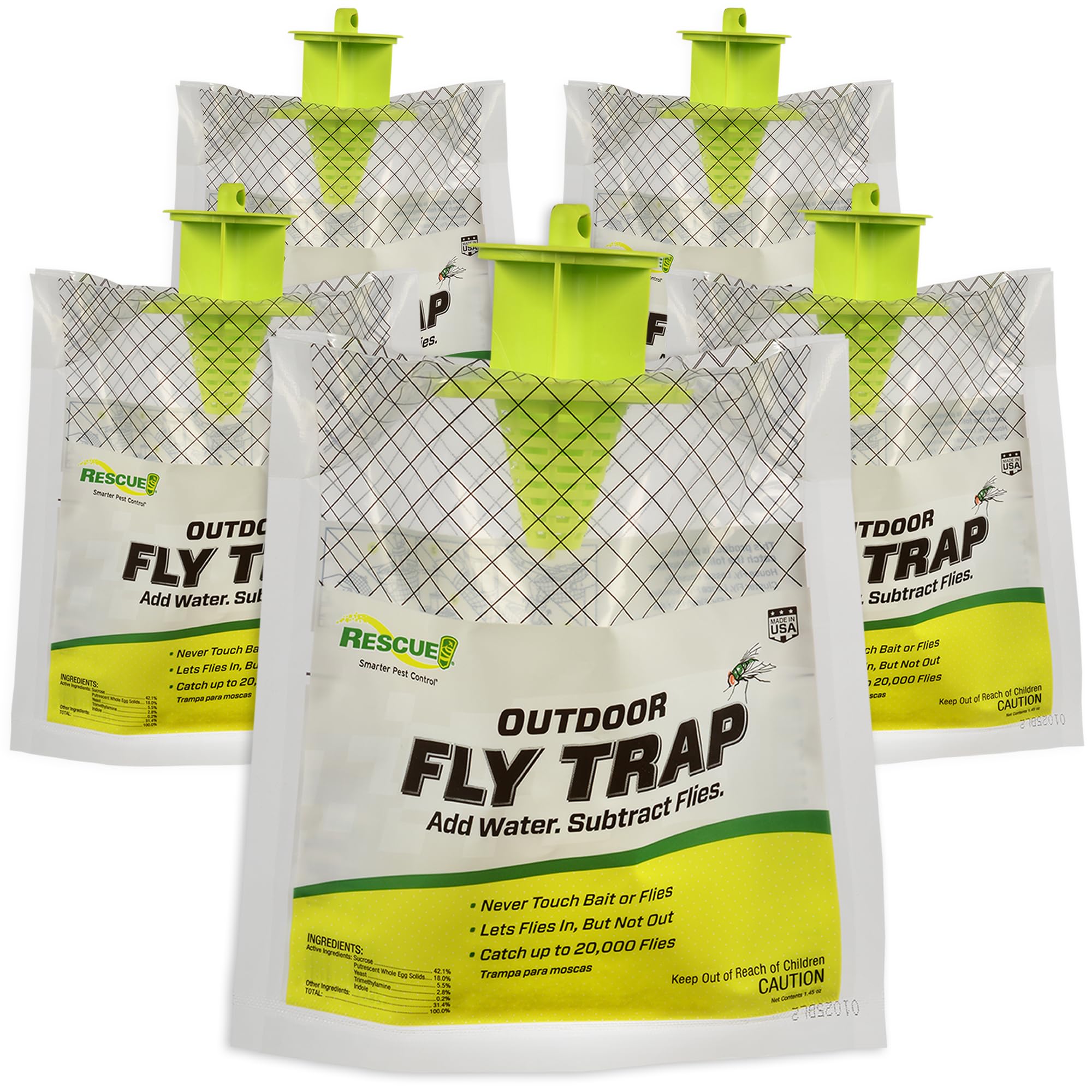
1. RESCUE! Outdoor Disposable Fly Trap 5 Traps
Our pick — 4.5+★ from 900+ verified ratings; the strongest balance of quality and price.
Five water-activated bait bags that turn a swarm into a bag you throw away.
The number worth knowing here is 5 — that’s how many traps arrive in the box, and the verified comparison data shows that is five times the single trap in the RESCUE! reusable pack. Spread across a yard, a fence line, and a barn, that changes the result from “one hotspot handled” to “the whole property handled.” Each bag is a plastic hanging sack you open, fill with water to the line, and hang; the bait inside activates on contact with the water.
What wins people over is sheer effectiveness, and the review pages back that up hard. As owners put it: “This works amazingly!! In a week or two we had thousands of flies in a bag!” Several buyers describe bags filling within a day or two of hanging. The bags weigh 2.4 ounces empty and hang by a string top, so a nail on a fence post or a branch does the job — no bracket, no power, no wiring to sort out.
The catch is the smell, and it is not subtle. The attractant is designed to stink, and once insects start decaying inside the bag, the odor gets considerably worse. The maker’s own guidance says to hang these at least 20 feet from living spaces, and that distance is what keeps the swarm off your patio. Decaying contents can also draw wildlife if a bag sits low or gets knocked over.
What earns it the top slot
- Five traps per pack against a single trap in the reusable version
- Bait activates on plain water — nothing to mix or measure
- Bags fill fast, so nuisance insects drop noticeably within days
- EPA registered and made in the USA, per the manufacturer
- Throw the whole bag away; you never touch the contents
Where it asks something of you
- The attractant and the decaying catch smell strong
- Needs to sit at least 20 feet from where you sit
- One-time use per bag, so it adds plastic waste
Go for it if: you have a yard, kennel, barn, or trash area where insects have taken over and you want that fixed quickly and cheaply.
Hang it far: these bags demand distance from your seating area — put one near the patio table and you will regret it within hours.
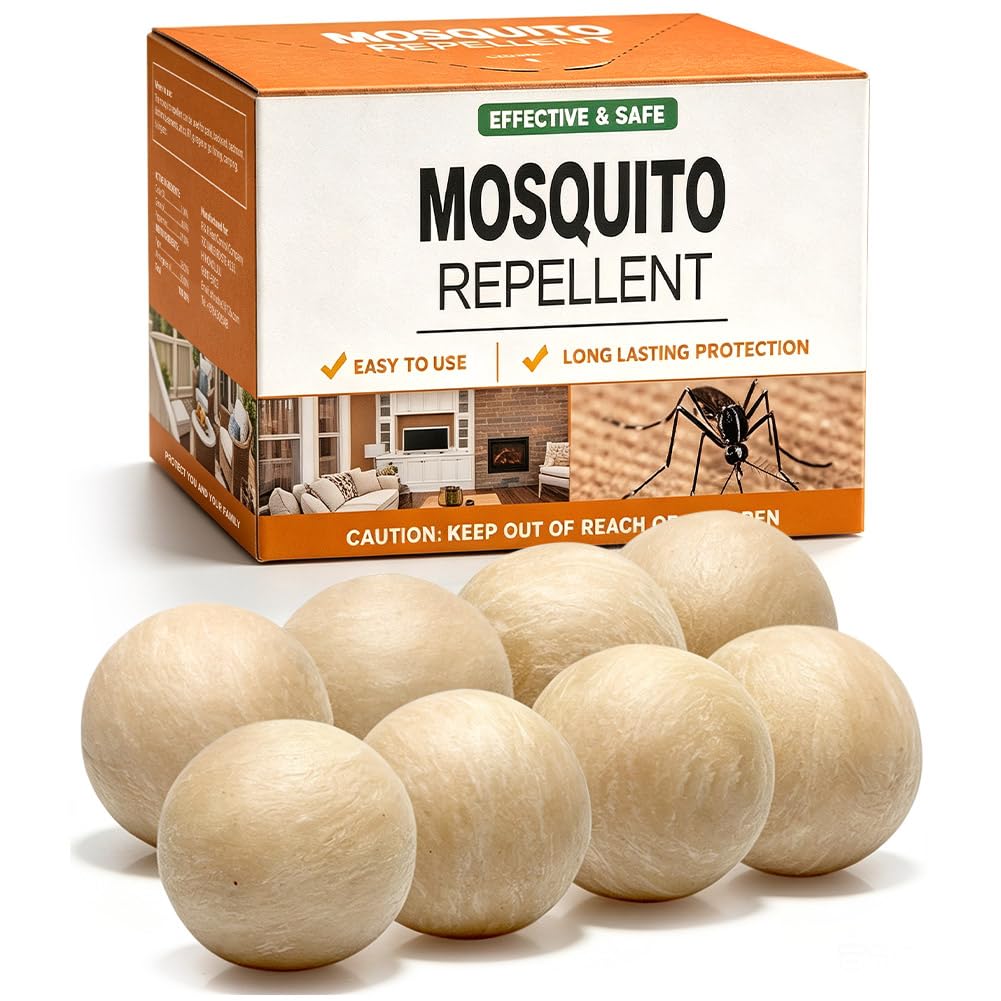
2. AUDQQM Mosquito Repellent Outdoor Patio 8 Pack
Eight scent balls you drop in a bag and forget about for two months.
Weighing 5.3 ounces, this pack is light enough to carry to a lake, a campsite, or a backyard chair without thinking about it. That’s 2.2 times the weight of a single RESCUE! trap, and it travels far better — no water to add, no bag to hang, nothing that leaks in a rucksack. You place a ball where you want protection and leave it. The maker rates each ball for up to 2 months of use and 120 sq ft of coverage.
The scent is a clean, minty, plant-derived one — noticeable when you unwrap it, but not a chemical spray smell you’d flinch at indoors. Buyers consistently describe the difference as less hassle than a spray bottle: no reapplying to arms and legs every hour, no residue on skin. A family camping trip with two kids in early fall is exactly the scenario these suit, with balls tucked near the tent door and the fire pit. One detail to respect: the maker says these work best in enclosed or sheltered spots away from strong airflow, because wind carries the scent away.
The honest limit is what a scent ball can and cannot do. It is a repellent, not a trap — it makes a space less appealing rather than removing insects from the world. In open, breezy ground the effect thins out, and you may still see insects near trees at the edge of your spot.
Carry-anywhere value: light, no setup, no mess, and reusable across trips — the flexible option for anyone who moves between patio, tent, and car.
Read the placement note: sheltered, low-airflow spots keep the scent concentrated; a wide-open windy deck will dilute it.
Reach for this if: you want protection you can carry into a tent, a boat, or a parked car without any equipment.
Look elsewhere if: your problem is a wind-whipped open field where no scent will linger.
3. RESCUE! Outdoor Fly Trap – Reusable – 4 Traps

The same bait-and-drown trap, but you rinse it out and run it again next season.
Instead of throwing the whole thing away when it fills, this version lets you dump the contents, rinse the trap, drop in a fresh attractant packet, and reuse it. That is the single difference that matters against the disposable five-pack above, and it’s a real one for anyone who resents buying plastic sacks year after year. Each unit measures 7.8 by 3.5 by 10.9 inches, so it’s a substantial hanging container rather than a flimsy bag.
It catches more than just house flies, per the maker: stable flies, bottle flies, flesh flies, horse flies, and other common species all go in. There’s no chemical spray involved — the food-based attractant draws them to the trap, and they drown in the water you add. What the review pages keep returning to is the sheer catch volume; the recurring theme is that a trap goes from hung to full in about a day, often with hundreds inside.
The trade-off is twofold. First, the smell: this trap must go outdoors and at least 20 feet from living areas once it’s activated, and the odor is strong. Second, emptying it is the part nobody enjoys — a few owners note that the cleaning and refilling feels unpleasant enough that they end up treating the reusable frame as disposable anyway. Durability also draws mixed notes, with some units lasting roughly two weeks in heavy rain.
The reuse math: refill packets cost less than whole new traps, so the frame pays you back across seasons if you can face the rinse-out.
Weather caveat: heavy, sustained rain can shorten how long a trap keeps working before it needs replacing.
Best fit: a gardener or smallholder who wants the same trap working season after season and doesn’t mind the cleanup ritual.
Think twice if: the idea of rinsing out a container of dead insects turns your stomach — the disposable version exists for exactly that reason.
4. Mosquito Repellent Indoor Repellent Balls 8 Packs

Eight plant-based scent balls rated for up to 60 days and 120 sq ft apiece.
Coverage is the argument for this eight-pack. The maker rates each ball for up to 120 sq ft and up to 60 days of use, so one ball per patio corner, deck edge, and garden border covers several sitting areas at once. The math works in your favor if you have multiple sitting areas — you can dot them around your table, chairs, and walkways without moving one ball from spot to spot all evening.
These are the same plant-based scent approach as the portable pack above, and the appeal is the same: no mixing, no setup, no sprays on skin. Buyers lean on them for regular garden chores and for outdoor markets, because you set one down and get on with your day. What the reviews circle back to is how little fuss they add — you notice the scent at first, then you simply stop thinking about the product while you’re outside.
The limit is the same as any scent-based approach: it works in a zone, so it does not clear an entire yard from one spot. Some buyers still notice insects near trees while their immediate area stays comfortable, which is the realistic expectation for a repellent ball rather than a trap. The 6.4-ounce weight also means one travels easily in a bag if you want protection at a market stall.
Why the big pack makes sense
- Eight balls, each rated up to 120 sq ft and up to 60 days
- Plant-based scent, no spray and no skin contact required
- Zero setup — place one and walk away
- Light enough at 6.4 ounces to carry to a market or a friend’s yard
What to keep in mind
- Protects a zone, not a whole property
- Scent strength fades near open, moving air
- Does not remove insects — it only makes space less appealing
Suits you if: you have several outdoor spots that each need their own quiet protection and you’d rather not shuffle one ball around.
Not for you if: you’re trying to knock down an existing swarm — that’s a bait trap’s job.
5. OnBeam Solar Bug Zapper Outdoor, 4500V Mosquito Zapper
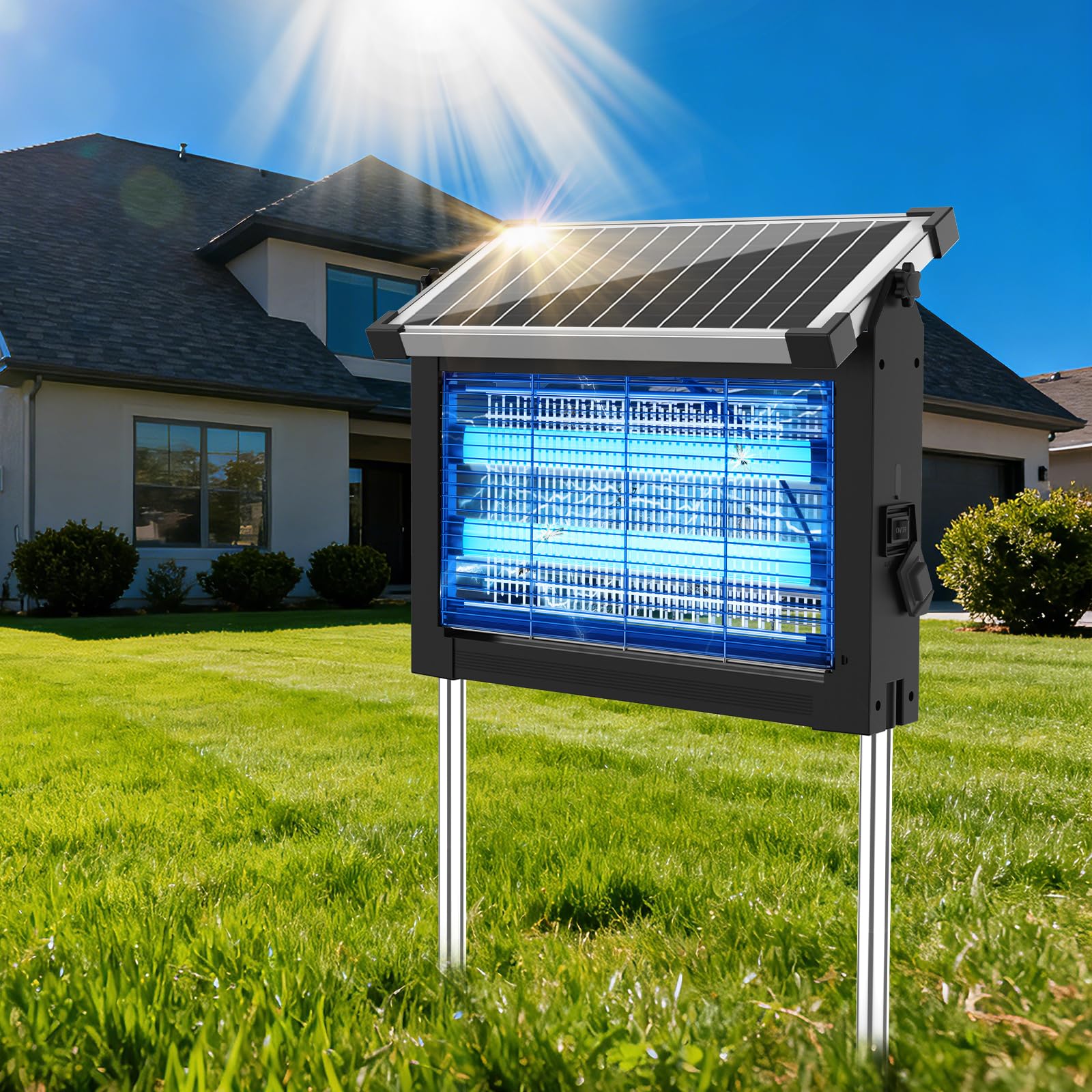
A 4,500-volt grid, a 4000mAh battery, and no cord to trip over.
Two 365-395 nm LED bulbs pull insects in (that’s the ultraviolet range insects steer toward), and a 4,500-volt shock grid finishes the job on contact. The 4000mAh battery is rated by the maker for up to 12 hours of continuous protection on a full charge. Charging happens two ways: a 10W 5V monocrystalline solar panel on top, or the included 4ft USB-C cable for a fuller charge in 3-4 hours.
Setup flexibility is the other strong point. You get a 2.6ft hanging chain, two ground stakes, and a 10ft solar panel extension cable, so the panel can sit in sun while the zapper hangs in shade — a genuinely useful arrangement if your yard’s sunny spot and your insect problem aren’t in the same place. AUTO mode charges through the day and fires up at dusk; ON mode runs continuously. The housing is aluminum-framed and rated IPX5, which means it shrugs off rain spray rather than surviving a dunking.
What buyers rave about is the low-maintenance rhythm: set it, let the sun top it up, and empty the tray every few days with the included brush. The honest caveat is coverage. It’s rated for up to 1 acre, but those claims assume dark conditions — in ambient light the UV pull weakens noticeably, and the maker itself suggests 20 to 40 feet of distance from people so you’re not drawing insects toward your seating.
Placement freedom: the 10ft solar extension is the detail that makes this one easy to site — panel in the sun, zapper over the problem area.
Night-shift tool: expect the best results after dark; in daylight the bulbs don’t pull nearly as well.
Choose this if: you want a cordless zapper that handles a large yard and tops itself up without you remembering to plug anything in.
Weigh this first: it is a attractant-style device, so it belongs out in the yard — not right over the patio table you’re trying to protect.
6. Solar Bug Zapper 4500V, Waterproof Mosquito Zapper Fly Traps

Four jobs in one frame — zapper, hanging lamp, ground stake, camping light.
The headline figure is the 4000mAh battery, rated by the maker for up to 13 hours on a full charge. Against the OnBeam’s stated 12 hours, that’s a long night of running without intervention, and the 10W solar panel plus a 10ft extension cord means you can mount the panel where the sun hits and the zapper where the insects are. USB charging gets you fully topped up in about 4 hours when the weather refuses to cooperate.
The killing hardware is a 15-inch electric grid held at 4500V, lit by dual blue-violet LED bulbs in the same 365-395 nm range. The maker lists midges among the targeted species, and a bright UV grid is built to intercept exactly those small biting insects. Mounting options are the widest here: two ground stakes, a 2.6ft hanging chain, or simply standing it on a tabletop. The ABS and stainless steel body is rated IPX5 for rain.
Effectiveness is the aspect the review pages dwell on longest, and it’s the strongest theme by a wide margin — buyers describe it filling with insects fast and starting work immediately. Solar performance is the second recurring note, with owners impressed the panel keeps pace through a sunny day. The trade-off is reliability in the literal sense: some units don’t run the whole night on solar alone, and the plastic mount holes for the legs feel like the flimsiest part of the build.
Where it shines
- 4000mAh battery rated up to 13 hours per charge
- Four setup modes: stake, hang, stand, or carry
- 10W solar panel with a 10ft extension cord for flexible siting
- USB tops it up in roughly 4 hours
- IPX5 rating and stainless steel hardware for outdoor life
The honest snags
- Solar alone may not carry it through every full night
- The leg mount points feel lightweight — take care when inserting stakes
- Large catches make a louder zap than small ones
Fits best: a renter or camper who wants one zapper that can stand on a patio tonight and hang in a tent tomorrow.
Plan around: charge it by USB before a long evening if you’ve had cloudy days — solar top-up is good, not guaranteed.
7. Katchy Indoor Insect Trap – Fan Powered with UV Light

The kitchen-counter trap for fruit flies, gnats, and moths — no zapping sound.
Three things work together here: a UV light draws small insects near, a fan pulls them down, and a sticky glue board holds them. There’s no zap and no bait smell, which is why it earns a place on a kitchen counter rather than out by the bins. The maker names fruit flies, gnats, and mosquitoes as targets, and states plainly that it is not effective on house flies. That honesty is worth a lot when you’re matching a tool to a problem.
Running cost and noise are the quiet wins. The fan is described as computer-like and unobtrusive, so it can sit in a bedroom or office without distraction, and the unit itself looks like a small nightlight rather than a pest device. Setup is two buttons — standard or low speed — and swapping the glue pad takes seconds. Place it close to whatever is attracting the insects: ripe fruit, potted plants, or a trash bin. Turning off the room lights helps, since ambient light dilutes the UV pull.
Now the part you should weigh carefully. Effectiveness is genuinely mixed in the reviews — plenty of buyers clear a fruit-fly invasion in days, while others find it catches barely anything. Moths are the weakest case: they tend to land on the fan guard without being pulled down. The UV bulb also dims over time, and a power cut means resetting it manually. At this scale of sales, that spread of experience is normal, but it tells you to buy it for small flying insects near a specific source, not as a whole-room solution.
The right use case: parked beside a fruit bowl or a houseplant, in a dark room, it does what it promises for gnats and fruit flies.
Set expectations: it will not clear house flies or moths, and results vary enough that you should give it a week near the source before judging.
Pick it for: a kitchen or plant corner with a persistent gnat or fruit-fly problem and no tolerance for zapping noise or chemical smell.
Don’t count on it for: house flies, moths, or an entire open-plan room — this is a targeted indoor tool.
Know the Specs
Bait traps and how they work
A bait trap is a container with an attractant inside that draws insects in, usually to drown. The RESCUE! bags work exactly this way — you add water, the bait activates, and the scent pulls insects through the openings. The upside is a very high catch rate on a heavy swarm. The downside is that the trap itself becomes smelly as the catch decays, so placement at least 20 feet from living space is built into how the product is meant to be used.
Voltage on a shock grid
The voltage figure on a zapper — 4,500V on both solar models here — describes the charge across the metal grid that insects contact. Higher voltage means a more decisive kill on contact rather than a stun. It says nothing about how many insects the device will attract; that job belongs to the UV bulbs, rated here in the 365-395 nm range, and to where you place the unit relative to the swarm.
Battery capacity in mAh
mAh stands for milliamp-hours, a measure of how much charge a battery holds. Both solar zappers carry a 4000mAh battery, and the maker ratings differ slightly — up to 12 hours on one and up to 13 hours on the other. In practice, that figure tells you how late into the evening the device keeps working after sunset without any sun topping it up.
Coverage ratings in sq ft and acres
Scent balls are rated in square feet — 120 sq ft per ball here — which suits a patio corner or a small room. Zappers are rated in acres, up to 1 acre on both solar units. Treat these as best-case figures under good conditions: dark surroundings for a zapper, still air for a scent ball. Neither number means the device eliminates every insect across that whole area.
Common Questions
Will a bait trap work on midges or only on flies?
How far should I hang a trap from my patio seating?
Can I use a solar bug zapper indoors?
Is the smell from a bait trap dangerous?
How long does a bait trap keep working before it needs replacing?
Do scent balls really last two months?
Will the Katchy trap catch house flies or moths?
Can I leave a solar bug zapper out in the rain?
Do zappers need to run all night to make a difference?
Do I need both a trap and a scent repellent?
The Bottom Line
The strongest pick overall is the RESCUE! Outdoor Disposable Fly Trap — five water-activated bait bags that clear a heavy outdoor swarm faster than anything else here, and the crowd favorite at 4.5+ stars across 900+ ratings. If your evenings are spent on a patio rather than a farm, the AUDQQM Repellent Balls give you light, carry-anywhere protection with no setup. And if you want to cover an entire yard after dark, the Solar Bug Zapper 4500V brings the longest battery rating here plus three mounting options in one unit.
How we choose
We do not accept paid placement. Every pick is matched to a real buyer and a real use-case; we do not hands-on test units.
Sources
Specifications: manufacturer listings and product documentation. Review insights: verified customer reviews, as of October 2026. Pricing: not shown on this page (it changes often); check the current price via the retailer link.
As an Amazon Associate, Aappliancez earns from qualifying purchases. This does not affect which products we feature.