Disclosure: Some links in this post are affiliate links. As an Amazon Associate I earn from qualifying purchases, at no extra cost to you. Learn more
Specs are compiled from manufacturer listings and verified buyer reviews and can change over time — please confirm the key details on the product page before buying.
Your DWC (deep water culture, where roots sit in a still bucket of nutrient water churned by an airstone) run can fail fast if your nutrients gunk up the airstones and drift your pH overnight. You want a two-part base that stays clear in the reservoir, mixes to the same ratio every time, and feeds your plant from seedling through flower without a dozen extra bottles. For most DWC buckets, the Canna Coco A & B set is the safest starting point, the OceanSolution concentrate stretches furthest per gallon, and the General Hydroponics FloraSeries gives you the most control once you want to tune each stage yourself.
This guide is built by comparing the manufacturers’ published specifications and the patterns across verified customer reviews, so you get each pick’s real strengths and trade-offs instead of marketing spin.
Every pick below was chosen for how it behaves in a recirculating reservoir, not just what the label promises. Read on for the full breakdown of the dwc nutrients worth running in your buckets this season.
Top Picks

How To Choose The Best DWC Nutrients
In a DWC bucket, your nutrient solution sits still around the roots and gets churned by an airstone. That setup is unforgiving. Anything that separates, settles, or feeds bacteria shows up fast as slime on the roots and a pH that climbs every few hours. The pick that works for you depends on three things: how the product mixes, how concentrated it is, and whether the NPK ratio (the ratio of nitrogen, phosphorus, and potassium) fits the stage your plants are in.
Liquid versus powder in a DWC reservoir
A liquid two-part base dissolves almost instantly and stays suspended, so it will not settle into the bottom of your bucket and clog an airstone. A powder concentrate can be cheaper per feed, but it needs heavy stirring and it can fall back out of solution if the water sits for a day or two. If you run a small kratky jar or a single bucket and you are not changing water daily, liquid is the lower-risk choice.
Why the A & B split exists
Two-part nutrients keep calcium and phosphate apart until you dilute them. Mix those two concentrates directly and they lock together into a cloudy precipitate your plant cannot absorb. That is why every A & B bottle says to add each part to water separately — never pour A and B into the same cup neat. Follow that one rule and the two-part system stays clear and predictable.
Reading the NPK numbers
NPK stands for nitrogen, phosphorus, and potassium — the three numbers on the label in that order. Nitrogen drives leafy green growth, phosphorus supports roots and flowers, and potassium helps overall plant strength and fruit quality. A veg-stage bottle usually runs high in nitrogen; a bloom bottle flips toward phosphorus and potassium. In a two-part set, each bottle carries part of that profile, which is why you dose them together in equal amounts.
Side-by-Side Comparison
| Model | Best For | Form | Liquid Volume | Mixing Ratio | Amazon |
|---|---|---|---|---|---|
| Canna Coco A & B, 1 L, Set of 2★ Best Overall | Coco and indoor DWC grows | Liquid | 1 liters | 1:1 | Amazon |
| OceanSolution 2-0-3 Liquid FertilizerMost Concentrated | Microgreens and organic setups | Liquid | 32 fluid ounces | 1:128 | Amazon |
| TPS NUTRIENTS Base A+B Two Part Set, 32 oz | Full-cycle feeding on a budget | Liquid | 64 fluid ounces | 1:1 | Amazon |
| General Hydroponics MaxiBloom & MaxiGro Set | Flowering and vegetable crops | Powder | 70.4 Ounce | 15 mL per gallon | Amazon |
| General Hydroponics FloraSeries Trial Pack | Stage-by-stage precision feeding | Liquid | 32 fluid ounces | 1:1:1 | Amazon |
| VIVOSUN Liquid Nutrients Base A & B Bundle, 32oz | Beginners and multi-medium grows | Liquid | 2 quarts | 1:1 | Amazon |
| FOOP Nutes Veg & Bloom Starter Pack | Organic high-yield flower runs | Liquid | 160 fluid ounces | Veg: 1:1, Bloom: 1:1 | Amazon |
Detailed Reviews
1. Canna Coco A & B, 1 L, Set of 2
Our pick — over 4.5★ from 600+ verified ratings; the strongest balance of quality and price.
The coco specialist that keeps a DWC reservoir clean and predictable from week one.
If you run coco in a recirculating bucket, this is the base that earns its place at the top. The A bottle carries a 4-0-1 NPK profile and the B bottle runs 0-4-2 — together they split the nitrogen and the phosphate so nothing locks up in your water. You dose them at a 1:1 ratio, meaning equal amounts of each into the reservoir.
what separates it is the mineral package. Canna builds this around natural chelates, humic and fulvic acids (compounds that help roots pull nutrients in more efficiently). At 5.5 pounds for the pair, the set holds noticeably more product than the 2 pounds in the TPS NUTRIENTS set — so you get more feeds before a reorder. Growers running autopots and coco report explosive growth by day 30 with equal A and B doses, and the line stays simple at just four bottles total, including Calmag and PK 13/14.
What wins people over most here is plain quality — it is what owners bring up again and again. Plants stay healthy, leaves hold a deep green, and nothing clogs the drippers the way a powder line can. The honest caveat is cost: it is not the cheapest per liter, and the set has drawn mixed feelings on value, so it suits growers who value a clean reservoir over squeezing every last dollar. One note on the label — it is built specifically for coco substrates, so if you run straight clay pebbles or rockwool, look at a general-purpose base instead.
Where this one earns its keep
- Two-part A (4-0-1) and B (0-4-2) split keeps calcium and phosphate from locking up in the reservoir
- Simple 1:1 dosing — equal parts of each, no juggling charts
- Natural chelates, humic and fulvic acids built in to support nutrient uptake
- Stays clear in dripper and autopot lines where powders tend to build up
The trade-off to know before you buy
- Formulated around coco substrates, so it is a narrower fit than an all-medium base
- Value sits in the middle — you pay more per liter than the value-tier lines
The safe first buy: reach for Canna Coco A & B if you grow in coco and want a clean, easy-to-read two-part you can trust in a DWC or autopot system.
Look at a different base: pick a general-purpose line if your medium is clay pebbles, rockwool, or a mix, since this one is tailored to coco.
2. OceanSolution 2-0-3 Liquid Fertilizer
One bottle that feeds a whole run because a single ounce treats a full gallon.
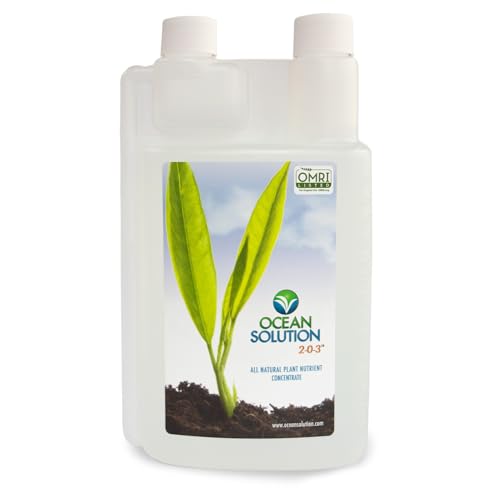
Here is the number that matters for a microgreen tray or a small DWC jar: the mixing ratio. OceanSolution runs at 1:128, which works out to just 1 ounce of concentrate per gallon of water. At a 32 fl oz bottle, that stretches across a lot of reservoir changes, and the review pages back that up — growers running it on trays daily say the bottle lasts a long time despite constant use.
This is a single-bottle mineral feed, not an A & B pair. It is made in the USA and pitched on 90+ ocean minerals, which is a broad-spectrum approach rather than a precise nitrogen-phosphorus split. It is OMRI Listed, meaning it qualifies for certified organic production, and it runs odorless — a real plus in a DWC bucket sitting in a spare room. The 2-0-3 NPK is light on nitrogen, so it leans toward supporting root and fruit development more than pushing leafy growth on its own.
Effectiveness is the thing that keeps it in the cart — that is the thread through the feedback, with users on wheat grass and indoor microgreen runs reporting the fastest visible results. It mixes into the water with no staining and no clogging in the system. The genuine limitation is phosphorus: it is a low-phosphorus formula, and that gets noted as a gap for anyone wanting to push a heavy flowering cycle. Treat it as a clean, organic, high-mileage base rather than a bloom booster.
What it does best: a 1:128 ratio and an odorless, OMRI Listed liquid make it the easiest all-in-one to drop into a small bucket or tray setup with almost no fuss. It is also the lightest bottle here at 2.8 ounces.
The catch: the 2-0-3 profile is low in phosphorus, and one buyer explicitly wished for “a little phosphorus just to even it out some” — so plan a separate bloom feed if you want to boost flower weight.
Buy it when: you want one odorless organic bottle that goes the distance in microgreen trays, wheat grass, or a light-feed DWC jar.
Pass on it when: your target is a heavy flowering crop and you need a phosphorus-forward formula out of the gate.
3. TPS NUTRIENTS Base A+B Set

Full-cycle A & B that feeds from the first set of leaves to the final week.
For a grower who wants one base to carry the entire run, the appeal here is coverage. This is a two-part A & B system at a 1:1 ratio that is formulated to work through both the veg and bloom stages, so you are not buying a separate grow and bloom formula. It runs in soil and hydro alike, and it comes as two 32-ounce bottles — 64 fluid ounces total, which is double the 32 fluid ounces in the OceanSolution bottle.
Owners put this in small DWC and hydro jars and see it work. One grower swapped out their old hydroponic nutrients and watched basil and oregano thrive for three weeks, mixing 5ml of A into one liter of water and 5ml of B into a separate liter, then combining — a reminder to never blend A and B undiluted. In a one-gallon reservoir, the strength goes a long way: it covers roughly eight large plants, and long-term users report a shelf life of about a year and pH that settles easily after mixing.
The thing that lands with buyers is raw effectiveness — it is the trait buyers mention most often, with nutrient content close behind. It has drawn its own share of fans who like that it bundles the micros and enhancers other brands charge separately for. The fair warning is the weight: at 2 pounds it is far lighter than the 5.5-pound Canna set, so you are getting less product for the same shelf space. A handful of users on drip and foliar schedules wish the mixing guidance were simpler, so budget a little time to dial in your chart.
Why it stays in rotation: a single A & B set that carries veg and bloom at a 1:1 ratio cuts the number of bottles on your shelf, and users report it holds pH steady after mixing.
What to plan around: at 2 pounds you will reorder sooner than with the heavier Canna set, and the detailed feed schedules reward growers who track their doses carefully.
Best fit: the grower running one or two DWC buckets who wants one economical base to cover the whole cycle without buying separate bloom bottles.
Think twice if: you want the simplest possible instructions — the flexible schedules here take a bit of study to use well.
4. MaxiBloom MaxiGro Nutrients

The powder pair that splits your grow into a veg tub and a bloom tub.
This set takes a different tack from the liquid lines: you get two powders, one for green growth and one for flowering, at a mixing ratio of 15 mL per gallon. It is the General Hydroponics MaxiGro for vegetables and MaxiBloom for flowering, sold together at 70.4 ounces total, and it is aimed specifically at hydroponics rather than a single all-purpose base.
The concentration is the story. This powder is equal to several bottles of liquid fertilizer, so a tub lasts through plenty of reservoir changes, and it mixes cleanly into water. Growers put it to work in hydro and also mix it light as a soil and coco feed, and report big blooms and good fruit set from tomatoes and peppers. It is a straightforward, budget-friendly way to cover both stages without a cabinet full of liquids.
What buyers value most is the growth it drives, with value for money close behind. But powder in a DWC bucket behaves differently than liquid, and this is where you have to be careful. The recurring caution is salt buildup: in a still-water kratky setup (where roots sit in a jar with no pump or airstone), an over-strength mix can leave salt residue on the roots. If you use RO water (reverse osmosis, water stripped of minerals), you will also need to add a CalMag supplement, and the sediment can fall out of solution if the water sits for a couple of days, so stir it back in before each feed. Dose lower than the label in soil to stay safe.
The powder advantage: one tub of concentrate replaces multiple liquid bottles, covering both veg and bloom, which keeps the cost-per-feed low for a full run.
The powder caution: it needs steady mixing — sediment settles within a day or two and can build up salts on roots in a still-water kratky jar, so this favors growers who stay on top of their reservoir.
Reach for this if: you want a low-cost, high-concentration pair that lets you feed veg and flowering from two simple powders in an active hydro system.
Stick with liquid if: you run a low-maintenance kratky jar and do not want to remix sediment or watch for salt buildup.
5. General Hydroponics FloraSeries Trial Pack

A three-bottle system for growers who want to tune every stage of the run.
Where a two-part base gives you one lever, this gives you three. The FloraSeries trial pack splits the job across FloraMicro, FloraGro, and FloraBloom at a 1:1:1 ratio, and each bottle has a distinct role. FloraMicro carries the nitrogen, calcium, and chelated micronutrients for fast growth. FloraGro brings nitrogen, phosphorus, potassium, and magnesium for structural and leafy growth. FloraBloom is loaded with phosphorus, potassium, magnesium, and sulfur to push flowering and fruiting.
That split is the point: you can dial the blend up or down for each stage instead of running one fixed formula. The pack runs 32 fluid ounces across the three quart bottles and comes with an easy feeding chart that works across many growing mediums, from hydro to coco to leca. Plant response is fast — growers describe vivid color, full foliage, and recovery of struggling plants within a couple of weeks when they follow the chart alongside a pH control routine. Bottles last a long time between reorders.
Effectiveness is what keeps this in so many carts, and it is the strength reviewers cite most often. It is the only pick here that lets you shift the NPK blend at every stage, and that flexibility is also its one demand: three bottles mean three measurements every time you mix, and you get the best out of it only if you read the chart and keep your pH in range. The trial size is smaller at 32 fluid ounces total than the larger multi-bottle kits, so a heavy grow will move through it faster than a big jug would. It is the only three-bottle system here, with a separate FloraMicro, FloraGro, and FloraBloom to adjust at each stage, and it rewards a grower who likes to steer.
Why it leads on control: three separate bottles let you balance veg and flowering week by week, and growers report it can revive a fading plant within days when paired with a pH control kit.
The extra step: three parts means three pours and a feeding chart to follow, so it is more hands-on than a simple A & B set.
For the grower who tunes: this is the pick if you want to shift your formula at every stage and treat feeding as part of the craft.
Not for the set-and-forget: if you would rather measure two bottles and be done, an A & B base will suit you better.
6. VIVOSUN Liquid Nutrients Base A & B Bundle, Set of 32oz

Two bottles, one simple rule, and a formula that plays well in any medium.
If you are new to DWC and want the least complicated path, this bundle strips it back to two bottles and a single habit: use the same amount of Base A and Base B at every watering. It is a two-part concentrated formula at a 1:1 ratio that runs from the vegetative stage through the end of flowering, so there is no mid-grow switch to a separate bloom bottle.
The compatibility is the standout. The maker states it works in soil, hydroponics, aquaponics, and coco coir (a coconut-fiber growing medium), so a beginner can change mediums without changing nutrients. The 64 fluid ounces across the two bottles covers a serious stretch of feeding — the maker notes it can last six months or more with regular use, and it is fully water-soluble and meant to stabilize the pH of your solution. Rich in nitrogen, phosphorus, potassium, calcium, and magnesium, it is built to head off the common single-nutrient deficiencies people hit early on.
The quality of the blend is the trait buyers mention most often, and growth results follow close behind — one grower reported their plants growing significantly in just two feedings. It is also noted for not smelling like liquid organics and for not rotting if it sits mixed for a few days, which makes it forgiving in a reservoir you do not change daily. The one mixed signal is plant health, where experiences vary — as with any feed, over-dosing will tip plants the wrong way, so start light. The golden rule stands: never mix A and B in concentrated form, always dilute them into water separately.
Why beginners get on with it
- Only two bottles and one ratio to remember — equal parts A and B every feed
- Works across soil, hydroponics, aquaponics, and coco coir, so it survives a medium change
- Fully water-soluble and built to stabilize solution pH
- 64 fluid ounces total that can last six months or more with regular use
Where you need to be careful
- Plant health results are mixed for some growers, so start with a lighter dose than the label
- A and B must be diluted into water separately — never blended neat in one container
Pick this for your first bucket: a two-bottle, all-medium formula with the most-reviewed two-bottle A & B base here makes it the low-risk entry point for new DWC growers.
Consider a more tunable line if: you want separate bottles to steer flowering — a three-part system gives you more control once you are past the basics.
7. FOOP Nutes Veg & Bloom Starter Pack, Five 32oz Bottles

An organic kit that folds cal-mag, silica, and a sweetener into five bottles.
For the grower going full organic, this pack is the only kit here that includes veg, bloom, and a sweetener in one box. You get five 32-ounce bottles totaling 160 fluid ounces, covering veg nutrients, bloom nutrients, and a sweetener. The veg bottles are aimed at root development and thick stalks, the bloom bottles lean on organic fish emulsion and kelp for flower development and tight bud stacking, and the sweetener blends eight organic sugars intended to boost flavor and terpene and trichome development.
The convenience line is the real hook: the makers pre-infused the cal-mag and silica, so you are not buying and dosing separate supplements on top. The veg and bloom bottles run at a 1:1 ratio, and the whole kit is certified organic with no synthetic salts, which matters to anyone avoiding salt buildup in a reservoir. The 160 fluid ounces goes the furthest of any pick here, and for a small grow — a handful of plants in a 3×3 — users report it lasts a long time with a simple, repeatable feed recipe.
Effectiveness is what stands out, and ease of use is right behind it — owners like that one kit replaces a shelf of separate fertilizers, and that feeding follows a clear chart. Now the honest part: organics behave differently than synthetics. The recurring gripe is the odor — this fish-based formula smells strong, and the feedback flags that mint oil does not fully mask it. It is also not built for a big batch tank; the guidance is to use it within about three days and keep it mixed, since it can build salts and shift pH if it sits. And because it is an organic feed, some growers still see a slight edge in bud size from synthetic lines.
The organic appeal: cal-mag and silica come pre-mixed in, so five bottles cover the whole cycle without add-on supplements, and the kit is certified organic with no synthetic salts.
The honest caveat: the fish-based formula carries a strong smell and is not meant for a large batch tank — it wants a fresh mix used within a few days and stirred often.
Choose this if: staying fully organic is the priority and you want one kit that handles veg, bloom, and flavor without stacking supplements.
Look elsewhere if: you run a big reservoir and want to mix once for the week — this organic kit wants small, frequent, freshly mixed batches.
Know the Specs
NPK Ratio Explained
NPK stands for nitrogen, phosphorus, and potassium — those three numbers on the front of every bottle, always in that order. Nitrogen drives leafy green growth, phosphorus supports roots and flowers, and potassium helps overall plant strength and fruit quality. Canna Coco splits its profile across two bottles: the A bottle runs 4-0-1 and the B bottle runs 0-4-2, which is why you dose them together. OceanSolution runs a single 2-0-3 profile, meaning it is light on nitrogen and leans toward supporting root and fruit development. Match the ratio to your stage — higher nitrogen for veg, more phosphorus and potassium for flower.
Mixing Ratio and Dilution
The mixing ratio tells you how much concentrate goes into your water, and it decides how long a bottle lasts. A 1:1 ratio means equal parts of each bottle per feed, as with Canna Coco, TPS Base A+B, and VIVOSUN. OceanSolution runs at 1:128, so just 1 ounce treats a full gallon. The powder MaxiGro and MaxiBloom mix at 15 mL per gallon, and the FloraSeries runs 1:1:1 across its three bottles. A more concentrated product is not automatically easier to use — it just means fewer ounces per reservoir, which usually stretches your supply further.
Liquid Versus Powder
Liquid nutrients dissolve on contact and stay suspended, which keeps an airstone and dripper lines clear. Powder concentrates pack more product per container and can cost less per feed, but they need heavy stirring and can settle out of solution if the reservoir sits, so you stir before each use. In a still-water kratky jar especially, a powder line can leave salts on the roots if it is mixed too strong. If you change water often and want minimum fuss, liquid is the safer call; if you want maximum mileage from one container and do not mind mixing, powder delivers.
Certified Organic Labels
A certified organic claim means the product was reviewed against an organic standard, not just that it sounds natural. OceanSolution is OMRI Listed, which qualifies it for certified organic production, and the FOOP kit is certified organic with no synthetic salts. These matter if you sell your crops or simply want to avoid salt-based inputs. Keep in mind that organic feed lines often smell stronger, come from fish emulsion or kelp, and are best used in smaller, freshly mixed batches rather than stored in a big batch tank.
Common Questions
Can I use a two-part A and B nutrient in a DWC bucket?
How long should DWC nutrient solution last before I change it?
What does the NPK number mean on a DWC nutrient bottle?
Is liquid or powder fertilizer better for a still-water kratky jar?
Do I need to add CalMag on top of a DWC base nutrient?
Can I mix nutrient A and B together in one container?
Which DWC nutrient line is simplest for a first grow?
How is a three-part nutrient different from a two-part base?
Does an organic DWC nutrient actually behave differently than a synthetic one?
Will the same DWC nutrients work for microgreens and full flowering crops?
The Bottom Line
The best dwc nutrients pick for most growers is the Canna Coco A & B set, because it pairs a clean two-part 1:1 dose with a mineral package that keeps a recirculating reservoir stable from week one. If stretching every ounce counts, grab the OceanSolution 32 Oz concentrate, since its 1:128 ratio and odorless organic formula feed a full run on very little product. And for a budget full-cycle base, the TPS Base A+B set carries veg and bloom in two bottles. Whichever base you choose, light your first mixes than the label, keep your pH in range, and never combine A and B neat.
How we choose
We do not accept paid placement. Every pick is matched to a real buyer and a real use-case; we do not hands-on test units.
Sources
Specifications: manufacturer listings and product documentation. Review insights: verified customer reviews, as of October 2026. Pricing: not shown on this page (it changes often); check the current price via the retailer link.
As an Amazon Associate, Aappliancez earns from qualifying purchases. This does not affect which products we feature.