Disclosure: Some links in this post are affiliate links. As an Amazon Associate I earn from qualifying purchases, at no extra cost to you. Learn more
Specs are compiled from manufacturer listings and verified buyer reviews and can change over time — please confirm the key details on the product page before buying.
Plastic foam sponges stay damp and start to smell within days; cellulose and coconut husk sponges dry faster and resist that odor. The five picks below are made from cellulose (wood pulp) or coconut husk instead of plastic foam, so they dry faster, smell far less, and can be composted when they wear out. Which one suits you depends on if you want a haul that lasts months, a scrubber that will not scratch your nonstick pan, or a sponge that feels the way a sponge is supposed to feel in your hand.
This guide is built by comparing the manufacturers’ published specifications and the patterns across verified customer reviews, so you get each pick’s real strengths and trade-offs instead of marketing spin.
The five picks below cover a 36-count compressed stash, dual-sided coconut scrubbers, a dishwasher-safe option, a cotton-fiber sponge, and a machine-washable pack.
Top Picks

How To Choose The Best Eco-Friendly Sponges
Three things decide whether a plant-based sponge earns its place at your sink: what it is made of, whether it has a scrubber side, and how it behaves once it gets wet.
Start With the Material, Not the Brand
Cellulose is wood pulp pressed into a sponge shape, and it is the base of nearly every good eco sponge. Coconut husk — sometimes sold as coconut fiber or coir — is the rough brown layer used for the scrubbing side. A sponge that lists both is doing two jobs with one tool. A sponge that lists organic cotton fiber is a different animal entirely: softer, more cloth-like, and gentler on delicate glassware.
Decide if you want a Scrubber Side
A dual-sided sponge pairs a soft cellulose face for wiping with a rougher face for stuck-on food. That rougher face is what lets you skip steel wool on a nonstick pan. If your cookware is coated, glass, or stainless, a non-scratch scrubber saves you from scuffing it. If you mostly wash plates and glasses, a plain soft sponge is easier on the surface and on your hands.
Think About Storage Before You Buy
Compressed sponges ship flat and puff up only when you add water, so a big multipack occupies barely any drawer or cabinet space. A 36-count compressed pack fits in the drawer space three ordinary sponges take up. The trade-off is that you cannot judge the size until the first one hits the sink.
Side-by-Side Comparison
| Model | Best For | Pack Size | Material | Scrubber Side | Amazon |
|---|---|---|---|---|---|
| 36 Pk Pop-Up Compressed Cellulose Kitchen Sponges★ Best Overall | Stocking up without losing drawer space | 36 Count | 100% Natural Cellulose | No | Amazon |
| Natural Sponges for Dishes 12 PackBest for Scrub Power | Scrubbing pots without scratching nonstick | 12 Count | Cellulose and Coconut Husk | Yes | Amazon |
| AIRNEX Natural Kitchen Sponges (12 Pack) | Odor control and dishwasher cleaning | 12 Count | Cellulose | Yes | Amazon |
| Practical Matter Kitchen Sponge | Gentle cleaning on glass and delicate surfaces | 6 Count | Organic Cotton Fibers | No | Amazon |
| bioGo 12 Pack Natural Biodegradable Kitchen Sponges | Odor-free daily washing on a renewable material | 12 Count | Cellulose | Yes | Amazon |
Detailed Reviews
1. 36 Pk Pop-Up Compressed Cellulose Kitchen Sponges
Our pick — over 4.5★ from 350+ verified ratings; the strongest balance of quality and price.
Thirty-six sponges that fit in the space three ordinary ones take up
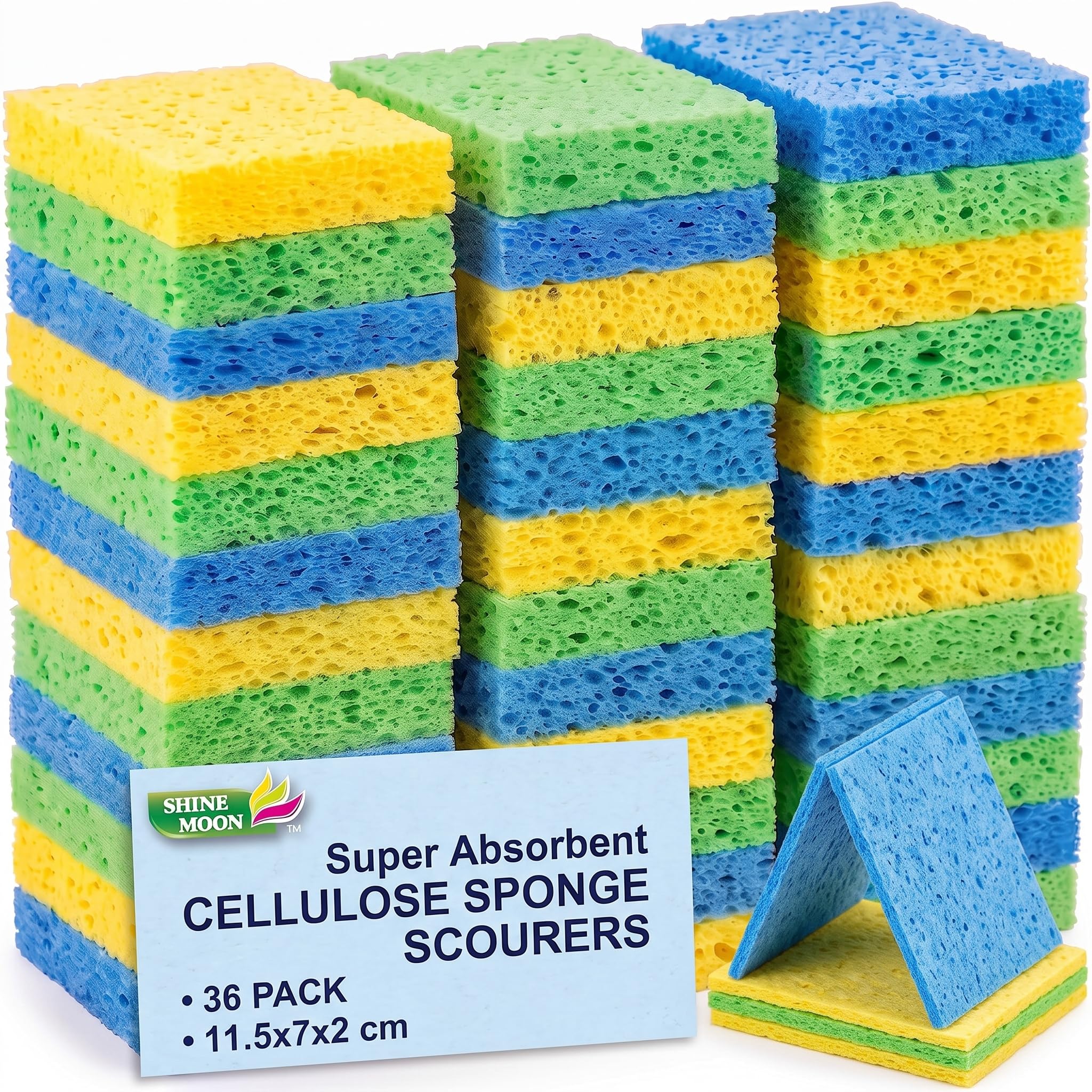
If you go through sponges fast, the math here is what wins you over. You get a 36-count pack of compressed cellulose sponges — a number that dwarfs the 12-count packs that make up most of this category. They start flat and slim for storage, then puff up to a normal working sponge once you add water. The brand describes the dry starting size as roughly 3.9 x 2.6 x 0.08 inches and the expanded size as about 4.6 x 2.8 x 0.8 inches. Nobody should quote the maker’s expansion multiple beyond that, so the honest way to say it is: dry, they are paper-thin; wet, they are a full-size sponge.
The pack itself is genuinely small in the drawer — that is the entire design. One reviewer put it well: “I go thru a lot of sponges, and I really like these for the value and the space-saving while being stored. 36 sponges basically take up the same room as 3 un-compressed ones.” For an RV, a camper, a gym bag, or a cramped city kitchen, that is a real, physical difference you notice every time you open the cabinet. They are 100% natural cellulose and described as biodegradable and compostable, so the end of life is a compost bin rather than a landfill.
Here is the honest part. Owners love the quality, the value, and how these store, but absorbency is the split. The sponge is dense and sturdy — reviewers describe it as thicker and more substantial than the cheap store brand — yet a fair number of buyers find it holds less water than a fluffy plastic sponge. That is the trade you are making for the density and the space savings. It wipes counters fine; it just will not behave like a wet sponge mop. Rated 4.7 stars across 300+ ratings, this is the crowd favorite by a comfortable margin.
What buyers keep coming back for
- 36 sponges in one compact box — a genuinely small footprint in a drawer or cabinet
- 100% natural cellulose, described as biodegradable and compostable
- Compressed storage means you are never short a fresh sponge mid-week
- Non-scratch on glass, plastic, porcelain, stone, and wood surfaces
Where it asks you to compromise
- Absorbency is the one contested point — some owners find it holds less water than a soft plastic sponge
- The dry size tells you nothing about the working size, so the first one is a small surprise
Best for: anyone who wants a long stash that costs the least per sponge and takes up the least room.
Think twice if: a thirsty, fast-soaking sponge matters more to you than density and storage space.
2. Natural Sponges for Dishes 12 Pack
The 12-pack that splits in half so you can compost the white part
This is the pick for anyone whose sink is full of cooked-on food. Each sponge pairs a white cellulose face with a coconut husk scrubber on the back, so you can wipe with one side and attack a burnt ring with the other. The manufacturer lists the material as cellulose and coconut husk, available for glass, wood, stone, iron, stainless steel, and ceramic. The pack holds 12, and each sponge measures 4.3″L x 2.8″W x 0.8″Th — noticeably thinner stock than the compressed pick above, which is part of why a 12-pack here weighs half what the 36-pack does.
Durability is where this earns its keep. Reviewers describe the fibers as stringy enough to scrub a pot but gentle enough for nonstick, and they note the sponge side simply will not stink the way foam does. The brand’s approach to disposal is the smartest part of the package: separate the two halves, compost the white cellulose portion, and dispose of the coconut scrubber separately. You can compost the white cellulose half and bin the coconut scrubber separately.
The caveat is lifespan and color. “Lasts 2-3 weeks max vs. other brand’s 3-4” is how one buyer summed it up, and the same buyer noted the white side breaks apart and the corners separate from the tan over time. Others mention the green scrubbing color being a matter of taste. Those are the normal trade-offs of a cellulose sponge: shorter life, softer corners. Rated 4.6 stars across 400+ ratings, it is a solid everyday workhorse.
The daily reality: if you want one sponge that handles a greasy pan and a wine glass without scratching, this is the shape to buy. Split-and-compost disposal is a nice bonus.
Manage expectations: with regular use you will be rotating through these roughly every couple of weeks, so buy the 12-pack rather than a small bundle.
Reach for this if: nonstick pans and tough pans share your sink, and you want a scrubber you can retire straight into compost.
Look elsewhere if: you want a sponge to behave like a heavy cloth mop and last all month.
3. AIRNEX Natural Kitchen Sponges (12 Pack)
Thick, white, and built to come out of the dishwasher clean
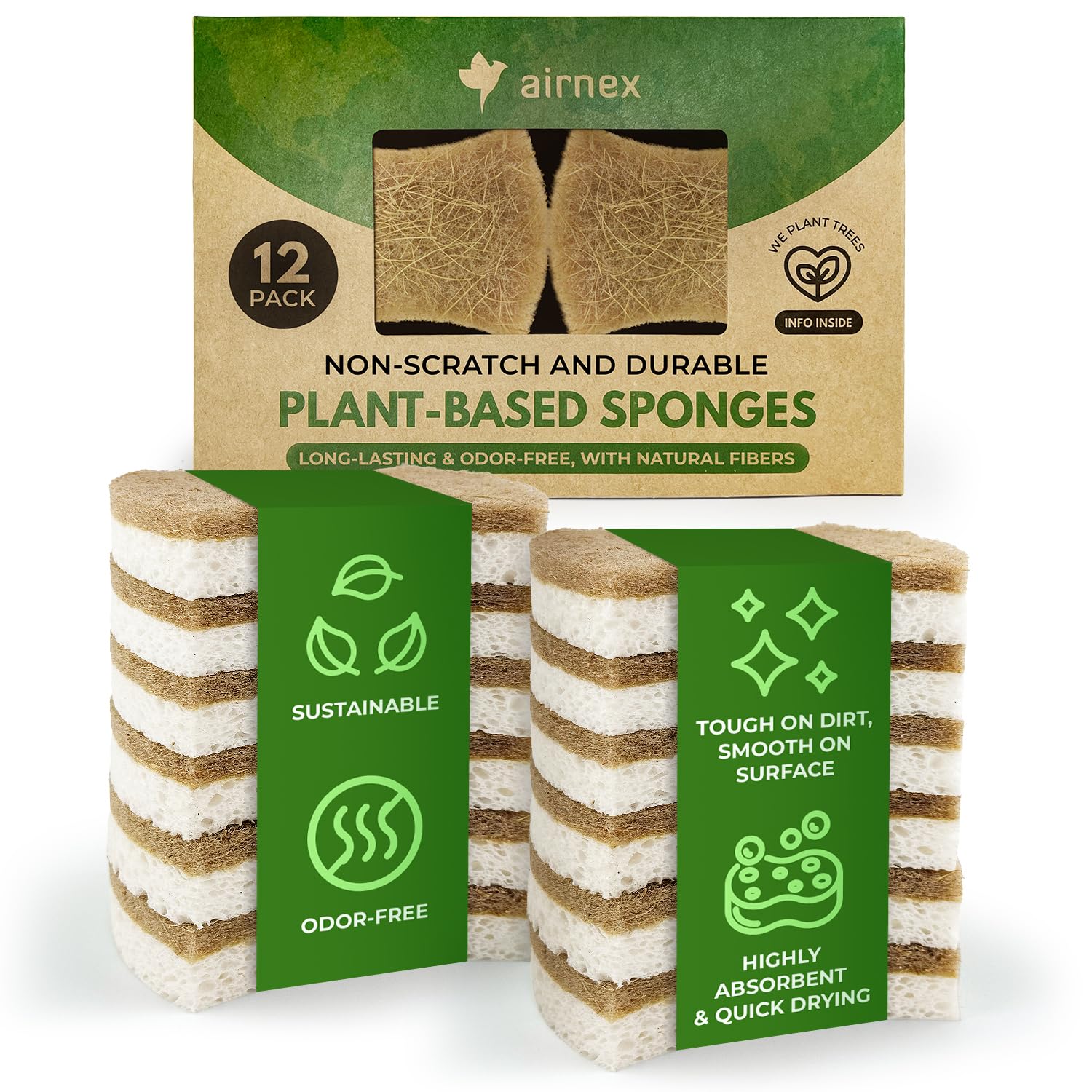
Two features separate this 12-pack from the cheaper plant-based options. First, it is a thicker, more substantial sponge — reviewers describe a dense feel that does not flop when you grip it. Second, and more importantly, it survives the dishwasher. One of the rare eco sponges you can sanitize rather than throw out when it gets gross, which stretches each one further. The sponge side is cellulose, the scrubber side is coconut fiber, and the maker lists it as odor-resistant and quick-drying.
What you notice in daily use is the scratch resistance. Buyers put it right up against the big blue name brand: these do not scratch, and they resist odor for about a week, against the couple of days a standard blue scrubby sponge gives you before it turns. They handle glass cooktops, stainless, and coated pans without leaving a mark — a versatile reach across the exact surfaces most people own.
Now the trade-off. Longevity is the split point in the reviews. Some owners get weeks of heavy use out of each sponge and never look back, while others find it lasts about the same as any other sponge. One buyer put it honestly: “I bought these trying to get a similar sponge to the Grove sponges. They don’t come close to the Grove sponges. They work well and last like most sponges.” It cleans well and lasts about as long as a standard sponge, no longer. Rated 4.6 stars across 800+ ratings, it is the most-reviewed pick here for good reason.
Why it holds up
- Dishwasher-safe — you can sanitize it instead of binning it
- Non-scratch across ceramic, glass, plastic, porcelain, stainless, stone, and wood
- Coconut fiber scrubber handles grease and grime on the tough side
- Odor-resistant and quick-drying thanks to the breathable plant-based material
The honest read
- Lifespan is contested — owners split between weeks of use and about-average wear
- It costs more upfront than the cheapest plant-based packs
Best fit: households that want a durable, dishwasher-cleanable sponge and do not want to think about replacements constantly.
Skip if: you only care about getting the most sponges for the least money.
4. Practical Matter Kitchen Sponge, 6 Count
A woven cotton fiber sponge with the softest feel in this lineup
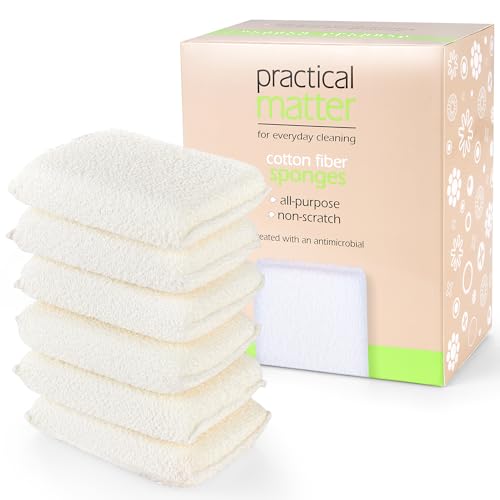
Every other pick here is cellulose and coconut husk. This one is different — organic cotton fibers woven into a scrubbing texture, wrapped around a thick foam inner, in a 6-count pack. The feel in the hand is the giveaway: soft and flexible, nothing like the dense, rigid eco sponges. If your cleaning leans toward delicate — good glassware, coated cookware, cabinets, fixtures — that softness is the whole reason to pick it. The woven outer texture gives you real scrubbing power without the roughness of a coconut pad.
Owners describe a sponge that stays white to show you when it is actually dirty, does not get slimy in use, and holds its shape over time. That last point matters, because the classic sponge complaint is disintegration. As one shopper put it: “I was looking for a sponge that didn’t fall apart in a short time. This sponge has surpassed my expectations! The outer cover is soft but protective, cleans well, and the sponge cleans well.” There is also a thoughtful brand note — the packaging carries Braille to help blind and visually-impaired individuals.
Now the catch. This is the priciest per sponge of the group, and a portion of buyers feel the value is the weak spot rather than the performance. It also does not absorb much water, by design — it is built for scrubbing, not for sopping up a spill. Rated 4.5 stars across 400+ ratings, it earns high marks on quality and cleaning performance; the gripe is purely about cost per sponge. Buy it for the feel and the gentleness, not to save money.
The texture story: a soft woven cotton outer over a thick inner, meant for people who find dense eco sponges too scratchy or too stiff for delicate glassware and nonstick.
What to expect: it scrubs and wipes well, but it will not absorb a puddle — that is a design choice, not a defect.
Choose this if: you want the softest, gentlest sponge in the lineup and you are okay paying more for the feel.
Look past it if: you need one sponge to both scrub and soak, or you are shopping purely on value per sponge.
5. bioGo 12 Pack Natural Biodegradable Kitchen Sponges
The 12-pack that goes in the washing machine when it gets grimy
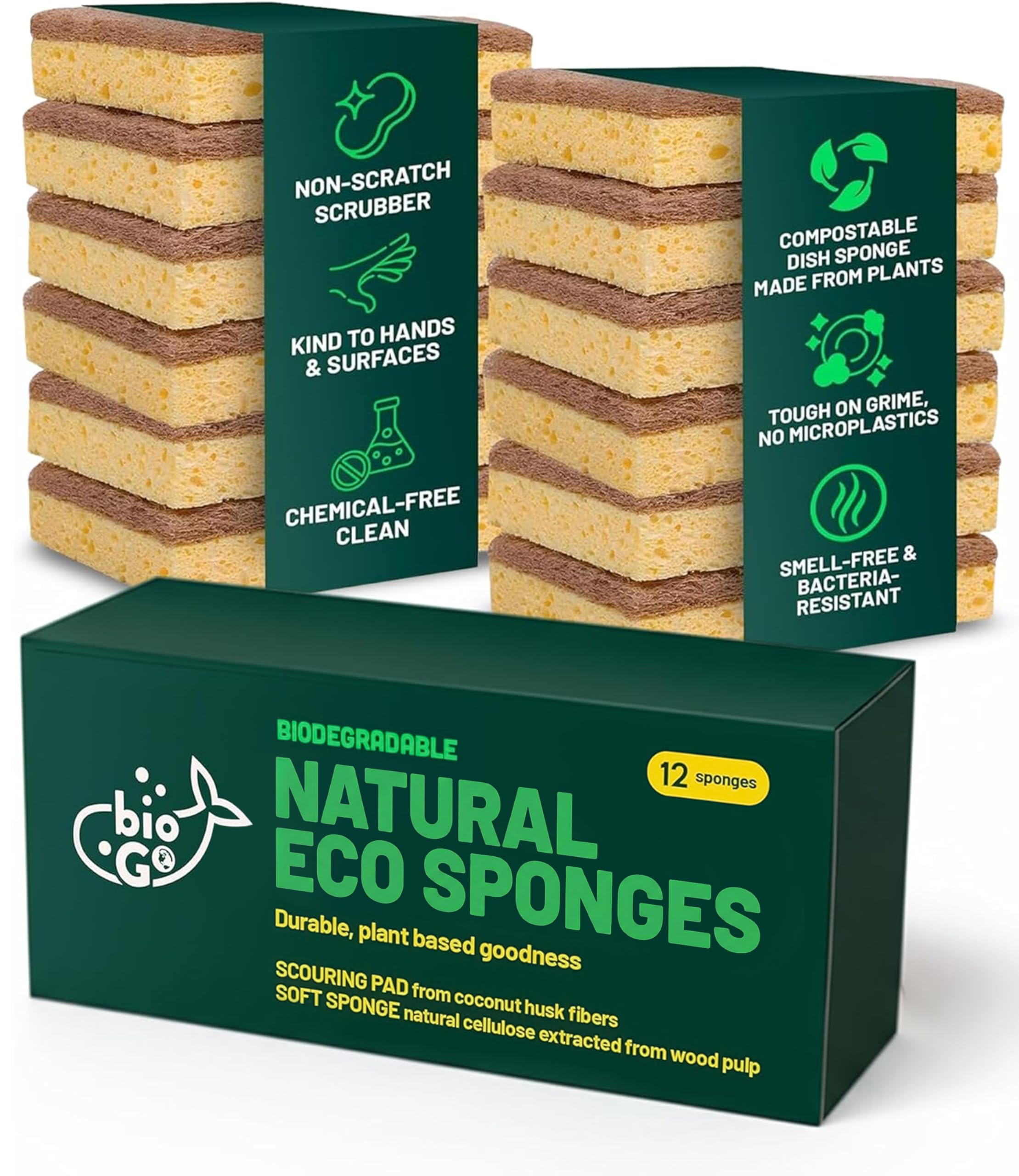
Odor is the reason most people go looking for an eco sponge in the first place — and this is the pick that leans hardest into that. The bioGo pack is 12 sponges made from wood cellulose and coconut husk. The brand describes them as breathable and porous, and as a result odor-free. The stand-out feature is machine washable: when the sponge starts to feel grubby, into the washer it goes. That is a real-life advantage over a sponge you simply have to bin once it stops smelling fresh.
The scrubbing side does the heavy lifting. Owners describe it as washing without scratching but with power — enough to clear a greasy pan without marring a coated one. The sponge side is soft, and it does not carry the stale smell that makes people replace plastic sponges every few days. On durability the picture splits: a good number of buyers report each sponge lasts a couple of months with daily use, holding water and soap well and cleaning both sides; others find the sponge comes apart on the very first use. Given the volume of ratings here, the happy majority clearly outnumbers the vocal minority.
There is a small caveat worth flagging. The sponge arrives fairly stiff, and some buyers prefer them softer from the start — though that is a matter of preference rather than a fault, and it loosens once it is wet. Considering the material is plant-based, machine washable, and compostable, this is a strong all-rounder. It is rated 4.6 stars across 900+ ratings — the largest review base in this group.
The reasons it stands out
- Machine washable — unlike most eco sponges, this one can be cleaned and reused rather than tossed
- Wood cellulose and coconut husk construction, described as 100% biodegradable
- Two-sided: soft sponge for wiping, coconut husk for scrubbing
- Consistently reported as odor-free — the reason most buyers swap to plant-based in the first place
The trade-offs to know
- Durability is contested — most owners get weeks of use, a minority report early breakdown
- Arrives stiff, which some buyers find takes getting used to
Worth it for: anyone who has given up on plastic sponges because of the smell, and wants one that can be washed and reused.
Think again if: you have had bad luck with sponges breaking down early before, and want to be sure of the durability.
Know the Specs
Cellulose and Coconut Husk
Cellulose is wood pulp pressed into a sponge shape — the same plant fiber used in paper, which is why these sponges are described as biodegradable and compostable. Coconut husk, sometimes called coir or coconut fiber, is the rough outer shell of the coconut used for the scrubber side. A sponge that uses both has a soft wiping face and a tough scrubbing face in one tool. The upside is that the scrubber tackles cooked-on food without steel wool, and the material breaks down instead of sitting in a landfill for years.
Compressed vs Standard Sponges
Some eco sponges ship compressed — flat and thin so they take up almost no storage space, then they thicken into a normal sponge when they get wet. Others ship at full size. Compressed sponges are the packable choice: they stack neatly in a drawer, an RV cabinet, or a gym bag, and you do not sacrifice anything at the sink because they reach full thickness the moment they meet water. The trade-off is that the size on arrival tells you nothing about the size you will actually use.
Scrubber Sides and Scratch Resistance
A scrubber side is the coarse face that loosens stuck-on food. That face is meant to be non-scratch on the surfaces most people own — glass, stainless steel, ceramic, and coated nonstick pans. Without it you end up reaching for steel wool, which scratches nonstick.
Biodegradable and Compostable
Biodegradable means the material breaks down over time rather than persisting like plastic foam. Compostable goes a step further — it can be added to a compost system at the end of its working life. For a dual-sided sponge, the cellulose half is the part described as compostable; the coconut scrubber half is often separated and disposed of differently. Always check the maker’s disposal instructions, because the two halves can be handled separately.
Common Questions
Do compressed cellulose sponges really expand to full size once they get wet?
Will a coconut scrubber side scratch my nonstick pans?
Do plant-based sponges actually smell better than plastic ones?
Can I put an eco sponge in the dishwasher or washing machine?
How long does a compostable kitchen sponge last?
What is the difference between biodegradable and compostable?
Are these sponges safe to use on glass cooktops and stainless steel?
Are cotton fiber kitchen sponges the same as cellulose ones?
How should I store eco sponges between uses?
Do I need the scrubber side, or is a plain soft sponge enough?
The Bottom Line
For most kitchens, the best eco-friendly sponges are the 36 Pk Pop-Up Compressed Cellulose Kitchen Sponges — 36 sponges in a compact box, made from 100% natural cellulose, that puff up to full size once wet. If scrubbing power is what you are after, the Natural Sponges for Dishes 12 Pack gives you a coconut husk scrubber you can separate and compost. And if odor is the enemy in your sink, the bioGo 12 Pack is the one that can go in the washing machine. Any of the five will get you off plastic — pick the one that matches how you actually wash dishes.
How we choose
We do not accept paid placement. Every pick is matched to a real buyer and a real use-case; we do not hands-on test units.
Sources
Specifications: manufacturer listings and product documentation. Review insights: verified customer reviews, as of October 2026. Pricing: not shown on this page (it changes often); check the current price via the retailer link.
As an Amazon Associate, Aappliancez earns from qualifying purchases. This does not affect which products we feature.