Disclosure: Some links in this post are affiliate links. As an Amazon Associate I earn from qualifying purchases, at no extra cost to you. Learn more
Specs are compiled from manufacturer listings and verified buyer reviews and can change over time — please confirm the key details on the product page before buying.
PETG is the filament that punishes a bad first layer. It grabs too hard on bare glass, warps on a cold plate, and tears chunks out of the surface when you pry a finished part loose. The fix is not a printer upgrade but the surface you print on, plus the right adhesive when the surface alone is not enough.
This guide is built by comparing the manufacturers’ published specifications and the patterns across verified customer reviews, so you get each pick’s real strengths and trade-offs instead of marketing spin.
You will see two kinds of products here: flexible steel plates that grip PETG while hot and release it once cool, and liquid bed adhesives that add grip to whatever plate you already own. Both routes work, and the right choice depends on whether your problem is a worn surface or a filament that simply will not stay down. This breakdown of the build plate for petg covers what actually holds a print and what lets it go.
Top Picks

How To Choose The Best Build Plate for PETG
Two things ruin PETG prints: a first layer that will not stick, and a finished part that will not come off. Your job is to pick a surface that solves both, because a plate that grips perfectly but welds your model to the bed is just as useless as one that lets corners curl.
Plate size and printer fit come first
Most of the plates here are 257 x 257 mm, which is the standard bed size for the Bambu Lab X1, X1C, X1E, P1P, P1S, P2S and A1 family. If your printer is not on that list, measure your bed before you buy anything — a plate a few millimeters off will not seat against the alignment stops. Several Bambu machines also run a build plate detection scan, and the fix is usually to switch that detection off in the slicer before you select the plate type.
PETG wants heat, but not much of it
PETG prints well on a bed that is warm rather than scorching. The makers here publish PETG bed temperatures between 50°C and 70°C, and some cold-print plates hold PETG at room temperature with no heat at all. Lower bed heat means less power draw and less waiting, so a plate that grips PETG at a cooler setting is doing you two favors at once.
The release trick is the whole point
Every flexible steel plate in this roundup works the same way: PETG locks on while the bed is hot, then lets go once everything cools. That cooling step is not optional. Flexing a plate while it is still warm is how people tear coatings and bend finished parts.
Side-by-Side Comparison
| Model | Best For | Type | PETG Bed Temp | Plate Size | Amazon |
|---|---|---|---|---|---|
| 3D Printer Bed Adhesive by ENOMAKER★ Best Overall | Adding grip to any plate you already own | Liquid adhesive | — | — | Amazon |
| Magigoo All-in-One MO2016Best Value | One bottle across many filament types | Liquid adhesive | — | — | Amazon |
| GOMENL Holographic Smooth PEI Plate | Decorative pattern on the underside of prints | Spring steel plate | Not published | 257 x 257 mm | Amazon |
| AIYANQI Double Sided Smooth PEI Plate PF-257 | Clean smooth bottom finish on PETG | Spring steel plate | 50-70°C | 257 x 257 mm | Amazon |
| BIQU CryoGrip Pro Glacier | Cooler printing with no glue at all | Spring steel plate | 60-70°C | 257 x 257 mm | Amazon |
Detailed Reviews
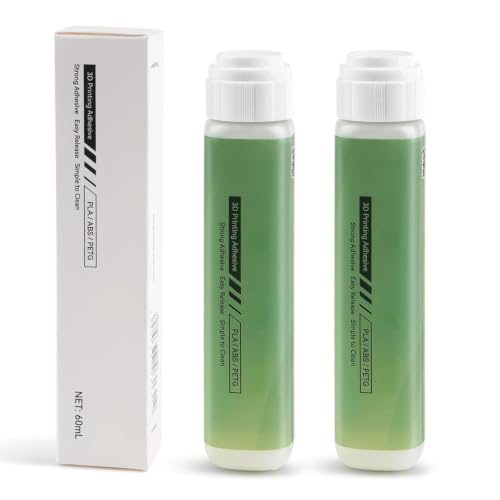
1. ENOMAKER Liquid 3D Printer Bed Adhesive, 2-Pack
Our pick — over 4.5★ from 300+ verified ratings; the strongest balance of quality and price.
The two-bottle liquid goo that fixes whatever plate your PETG is currently failing on.
If your PETG keeps curling because the plate underneath it is worn, glassy, or just plain wrong, you do not have to replace the plate. You can pour on grip instead. This ENOMAKER set gives you two 60 ml bottles of low-viscosity liquid adhesive, and it is rated 4.8 stars from over 300 owners, the strongest owner feedback in this roundup. It handles PETG, PET, PLA, ABS, ASA and TPU, and it adheres to low-temperature and high-temperature surfaces alike, including textured and smooth build plates, glass, PEI, PEO and aluminum.
The application is where it earns the praise. You press the applicator head onto the bed to open the valve, then spread the liquid evenly across the print area. Because it is a liquid rather than a solid glue stick for a hot bed, it spreads more uniformly and covers more ground per pass, and it sinks into the pores of the plate surface instead of sitting on top as a lumpy film. Once the print finishes and cools, the part releases cleanly. Anything left behind rinses away with water or a wet rag, off the plate and off the bottom of your model.
On the numbers that matter for comparison, this pack ships two pieces — twice the count of the single-bottle Magigoo. It is a stronger choice than a glue stick is for PETG specifically, because a stick drags and leaves ridges that show up in your bottom layer, while this liquid dries to a thin even coat in a minute or two. The trade-off is in the accounting: the same buyers who call it the best adhesive they have used after years of printing also split on whether the price is fair, so this is a buy-once-a-year product rather than a cheap throwaway. A small squeeze per print is all it takes, and the water-cleanup routine is what keeps it from being a mess.
Where it pulls ahead
- Two 60 ml bottles in one box, so your backup is already on the shelf
- Water-soluble by design — warm water lifts the residue off plate and model alike
- Thin low-viscosity liquid spreads evenly, unlike a drag-and-ridge glue stick
- Odor-free and harmless for a printer in a spare room
The honest catch
- You still have to reapply between printing sessions to keep the grip consistent
- It adds a liquid step to every job instead of a peel-and-print plate
- Value is the one point owners disagree on, so it is a considered purchase
Reach for this if: your plate is fine but PETG will not hold a corner, or you print PETG on glass and want a release layer in between.
Think twice if: you want to slice, start, and walk away — a flex-to-release steel plate removes this extra step entirely.
2. Magigoo All-in-One MO2016 Bed Adhesive, 50mL
One small bottle that covers PETG, ABS, HIPS and TPU on almost any surface you own.
Magigoo built its name on a single claim: sticks hot, releases cold. The MO2016 goes on thin and holds PETG through the print, then lets go once the bed drops. Owners running three months of near-continuous PLA, PLA+ and PETG printing report it holds up throughout. It fits Flex Plate, Glass, PEI, Buildtak and Kapton surfaces, and the same bottle covers PLA, ABS, HIPS, TPU and TPU Flex filament, so you do not need a separate adhesive for each material.
The application sequence is shake, press, apply to the area you are actually printing on. That last part matters, because this is a spot touch-up product, not a full-bed-coverage product. Put down a light coat, add a second coat perpendicular to the first for stubborn PETG, and let the bed cool to roughly 40°C before you try to remove the part. If a print is welded tight, the freezer trick comes straight from the review pages: a few minutes in the freezer and the part drops off the plate instead of fighting you.
Compared with the ENOMAKER two-pack, this is a single bottle rather than a pair — half the piece count in the box. What you get in return is a wider surface list and a formula that runs cooler than PLA alone on some setups. The one recurring gripe is the applicator itself: the stick-style dispenser does not lay down an even line, so you end up spreading it by hand anyway. The other quirk is that newer PLA formulations can stick harder than expected at room temperature, which is exactly why the freezer exists as a release step. Neither of those is a deal-breaker for PETG, where the grip is the point.
What wins people over: a light coat holds a delicate first layer with no brim, no raft, and nothing to babysit. The reusable coat means you can run a handful of prints off one application before you touch it again.
Keep in mind: the finish it leaves behind shows you where you applied it, so spread evenly and keep fingerprints off the surface — skin oil kills adhesion fast.
The shortcut pick: one bottle, every filament you own, and no second product to buy when you switch materials.
Not the one for you if: you want a plate that does the gripping by itself — this is an additive you have to apply each session.
3. GOMENL Holographic Smooth PEI Build Plate, 257x257mm
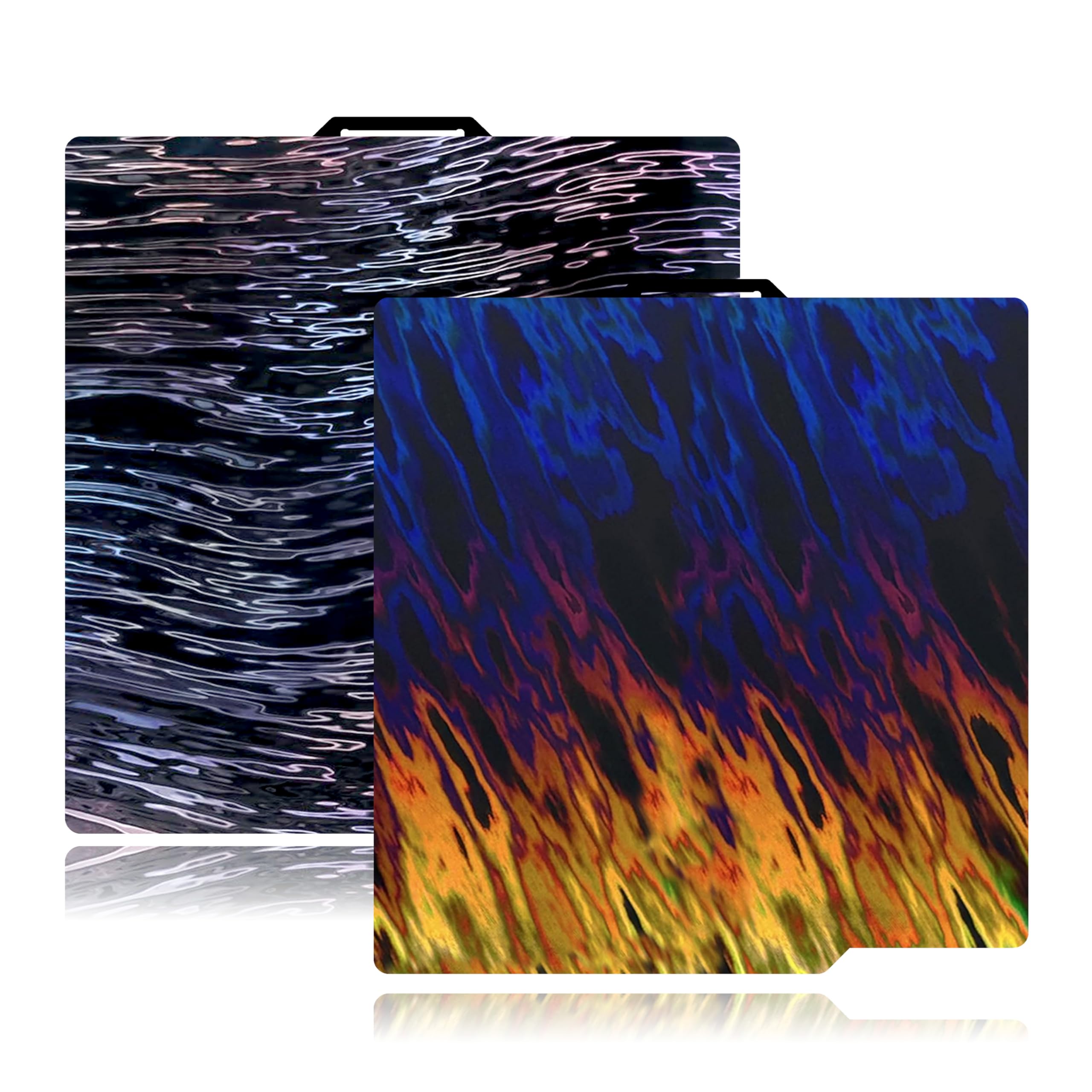
A wood-grain and ice-and-fire plate that stamps a finish on the bottom of every print.
Most PETG plates are judged on grip and release alone. This one is judged on what it leaves behind. The dual-pattern surface imprints a wood grain or an ice-and-fire design into the underside of your models, and the holographic effect shifts as you turn the part in your hand, which means PETG pieces come off the bed already looking finished instead of needing sanding and buffing later.
Underneath the decoration, it is a flexible spring steel sheet like the others. Bend the plate and the print pops free once it has cooled. The PER surface sheet covers PLA, PETG, ABS and TPU and takes bed temperatures up to 180°C, and it fits the 257 x 257 mm beds of the Bambu Lab X1, X1C, P1P, P1S, P2S and A1. In the slicer you select the Smooth PEI Plate / High Temp option, and on an X1, X1C or X1E you switch off build plate position detection before you dial in that plate type.
The setup step is the part buyers mention first — it takes a little fiddling in the software before the plate is recognized — and once it prints, the workflow settles down. You should also know there are two protective films to peel, not one, and the second one hides if you rush. The finish itself is a matter of taste: the holograms read subtler in real life than they look in the listing, especially on black PLA, and the texture behind that pattern did not come out as textured as one owner expected on the wood-grain side. If you want a smooth glass-like bottom, the AIYANQI below is the cleaner route.
Why it earns a spot
- Prints come off with a decorative bottom layer already applied, no post-processing
- Handles PETG along with PLA, TPU and ABS on the same sheet
- Bends free once cool, so removal is a flex rather than a fight
- Fits the whole 257 x 257 mm Bambu Lab range
Before you commit
- Two protective films sit on the sheet, and missing one leaves you printing on plastic
- Hologram brightness runs subtler than the product photos suggest
- The surface needs regular cleaning to keep adhesion honest
Pick it for the look: good if you sell printed parts or display them, where a custom bottom face is worth the slicer setup time.
Look elsewhere if: you want a flat, plain bottom layer with zero decorative variation between parts.
4. AIYANQI Double Sided Smooth PEI Build Plate, PF-257
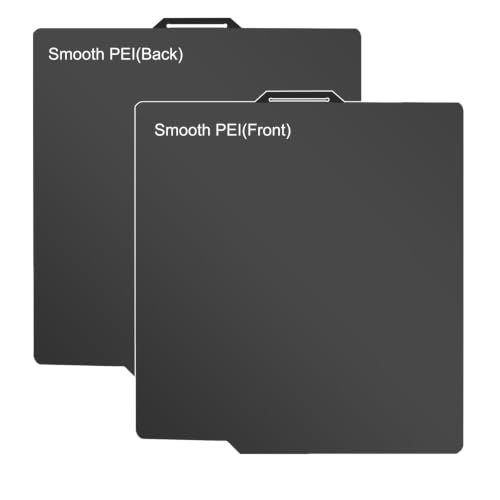
Two smooth PEI faces, one flat bottom layer, and a published PETG window to match.
Here is the plate to buy if your PETG parts need a clean glass-like underside. AIYANQI uses a black smooth PEI face on both sides of the sheet, and that smooth surface transfers a flat finish to the bottom of whatever you print. The published temperature guidance is PETG at 50-70°C and PLA at 40-55°C, so you have a real starting point instead of trial and error. It fits 257 x 257 mm beds across the Bambu Lab X2D, X1C, X1, X1E, P1P, P1S, A1 and P2S, and the higher-temperature face tops out at 100°C.
Owners who run it hard report roughly a hundred prints with excellent adhesion, parts releasing on a flex and no tape or glue. One thing to know about the hardware: this sheet ships without a detection code, so your printer will either skip the check or throw a prompt you can dismiss or switch off. That is a one-time setting, not an ongoing annoyance.
Maintenance is the thing that decides whether this plate stays good. Dust and grease cut adhesion, so a regular wash with detergent and clean water keeps the surface working, and the manufacturer specifically warns against acetone because it destroys the PEI. Stubborn small parts like earrings can stick so well that they resist removal even after cooling, which tells you the grip is not the weak point. The trade-off is stiffness: this sheet is more flexible than a factory Bambu plate, which is fine for PLA and PETG but means a tall ASA or ABS print can pull a corner of the plate up off the magnet. If you print only PETG and PLA, that stiffness question never comes up.
The real-world payoff: a smooth bottom face is the difference between a part you sand and a part you hand over as-is, and the double-sided build means you get two surfaces before you buy a replacement.
Watch the edges: the spring steel is cut sharp, so handle it by the flats when you flex it and keep it away from your fingers on the corners.
Best for: PETG and PLA printing where a smooth, untextured bottom finish is the whole reason you are buying a plate.
Not the one if: you regularly print tall ABS or ASA parts, where a stiffer plate holds the bed down better.
5. BIQU CryoGrip Pro Glacier Build Plate, 257x257mm

Grips PETG at a fraction of the heat, with no glue, no brim, and no waiting to swap plates.
This is the plate for the printer that runs all day. The coating is seven layers of cobalt oxide — base plate, base coat, intermediate coating and top coat — rated to resist impact, corrosion and repeated bending without peeling. The practical result is an ultra-fine textured surface that sits between smooth and rough, giving the bottom of a part a finished look rather than a glassy sheen or a deep orange-peel pattern.
The published PETG window is 60-70°C, and the plate only warms slightly even on a 100°C bed thanks to its hollow handle. Because it stays cool to the touch, you can pull the finished plate out the moment a print ends and drop a spare in to keep the machine running, instead of waiting for the bed to come down. The substrate is highly magnetic, which holds the sheet flat and fights the stress warping that lifts corners on PETG.
The one exception to the no-glue rule is ABS printed in an open enclosure, which still warped and failed. The plate also carries its own AR code that the X1 locating scan reads, so you avoid the missing-QR-code error on high-temp material. The catch worth knowing: the maker states plainly that the Glacier grips less aggressively than its own Frostbite surface does on PLA and PETG, so if maximum bite is your priority, that is the sibling to look at.
What owners keep coming back to: the freezer trick — ten minutes in the freezer and a stubborn part pops straight off the plate, no prying required.
Care rules that matter: never use acetone on it, and wash with dish soap rather than harsh solvents to protect the coating.
ideal if your printer runs long jobs back to back and you want to swap plates and start the next print immediately.
Know what you are buying: the maker itself rates this surface below its Frostbite sibling for PETG grab, so pick it for convenience and finish rather than the hardest possible hold.
Know the Specs
Bed temperature for PETG
This is the number the maker publishes for the surface you are printing on, and it tells you how much heat the plate needs before PETG will hold. The plates here run 50-70°C for PETG, and the cooler end is the better one to aim for: less heat means less power drawn and less time waiting for the bed to reach temperature. Pick a plate with a published PETG window and treat it as a starting point, then adjust in small steps.
Plate thickness and stiffness
Thickness is not just a build-quality number. A thinner spring steel sheet flexes more, which makes parts easier to pop off, but it also lifts more easily off the magnet when a warping filament like ABS or ASA pulls on it. Thicker sheets hold the bed flatter under stress. If PETG and PLA are your main materials, flexibility is a benefit; if you print warp-prone materials, stiffness matters more.
Viscosity of a liquid bed adhesive
Low viscosity means the adhesive flows thin and spreads evenly instead of sitting in ridges the way a solid glue stick does. A thin coat dries faster, shows less on the finished bottom layer, and rinses away with water because the formula is water-soluble. Thicker adhesive grips harder on some surfaces but is harder to clean. Match the viscosity to how much you care about the look of your first layer.
Surface type and the finish it leaves
A smooth plate gives you a flat, glass-like bottom face. A textured plate leaves a patterned finish that can hide small imperfections. A patterned or holographic plate imprints a design. The surface type also changes release behavior: textured faces generally let go with less grip than smooth ones, so parts on smooth PEI can stick firmly enough to need flexing even after they cool.
Common Questions
Will a 257x257mm plate fit my Bambu Lab printer?
Why does PETG stick so hard to a smooth PEI plate?
Do I need glue with a CryoGrip or PEI plate?
How long does one bottle of liquid bed adhesive last?
Can I clean a PEI build plate with acetone?
What bed temperature should I run for PETG?
Why did my printer show a build plate detection error?
Is a liquid adhesive better than a glue stick for PETG?
Will a flexible plate hold a tall PETG print without lifting?
What is the freezer trick for removing stuck prints?
Does the plate surface change the bottom finish of my part?
The Bottom Line
If your PETG is failing on the plate you already own, the ENOMAKER liquid bed adhesive is the cheapest path to a working first layer — two 60 ml bottles, water cleanup, and the strongest owner feedback in this roundup. If you would rather buy a surface and skip the liquid step entirely, the BIQU CryoGrip Pro Glacier is the one to reach for: it holds PETG at 60-70°C, releases on a flex, and lets you swap plates the second a print ends. And if a perfectly flat, glass-like bottom face is what you are after, the AIYANQI PF-257 delivers the smoothest finish of the group. One nudge before you go: whichever route you pick, buy the spare now. Plates wear and bottles run dry mid-project, and a second surface on the shelf turns a stalled print into a ten-second swap.
How we choose
We do not accept paid placement. Every pick is matched to a real buyer and a real use-case; we do not hands-on test units.
Sources
Specifications: manufacturer listings and product documentation. Review insights: verified customer reviews, as of October 2026. Pricing: not shown on this page (it changes often); check the current price via the retailer link.
As an Amazon Associate, Aappliancez earns from qualifying purchases. This does not affect which products we feature.