Disclosure: Some links in this post are affiliate links. As an Amazon Associate I earn from qualifying purchases, at no extra cost to you. Learn more
Specs are compiled from manufacturer listings and verified buyer reviews and can change over time — please confirm the key details on the product page before buying.
If one room in your house never feels right no matter what you set the thermostat to, the problem usually isn’t your furnace — it’s that the air never makes it down that last stretch of duct. An air duct booster fan sits in or on that duct and pushes the air the rest of the way. The picks below cover the whole range, from a register-mounted unit you drop into a floor vent to an 807 CFM inline blower that moves serious volume.
This guide is built by comparing the manufacturers’ published specifications and the patterns across verified customer reviews, so you get each pick’s real strengths and trade-offs instead of marketing spin.
Before you buy, know that these fans split into two families: register boosters that drop into an existing floor or wall vent, and inline fans that splice into the duct run itself. Size, noise, and airflow rating decide everything else, and the guide below walks through all three so you can pick the right one for your house — the full breakdown of the best air duct booster fan.
Top Picks

How To Choose The Best Air Duct Booster Fan
The single biggest mistake buyers make here is buying a fan before measuring the hole it has to fit. Booster fans are named by duct size, not by the vent cover you see on the floor or wall, and the two numbers are almost never the same. Get that measurement right first and everything else gets easier.
Register Booster Or Inline Blower
A register booster is the simple route. It sits in an existing floor or wall register, plugs into a normal outlet, and pushes more air out of that one vent. There is no ductwork to cut and no wiring to run, which is why it suits renters and anyone who wants a fix in an afternoon.
An inline fan is the heavier-duty route. It splices into the duct run itself, often in an attic, crawl space, or basement, and can feed a whole branch of ductwork rather than one vent. These move far more air, but they need power where there may not be an outlet and they are sized to match your duct diameter — usually 4, 6, or 8 inches.
Match The Airflow To The Job
Airflow is measured in CFM, or cubic feet per minute — how much air the fan moves each minute. A register booster for a bedroom might work at 120 CFM, while an inline blower handling a long duct run can be rated at several hundred CFM. More is not automatically better: a fan rated far above what your duct can carry just adds noise and wastes energy.
Decide How Much Noise You Can Live With
Noise is measured in dBA, a decibel scale weighted for how human ears actually hear. A fan rated in the low 30s is roughly library-quiet; one running near 40 dBA is closer to a soft conversation. Almost every booster fan in this category gets louder as you raise the speed, so the honest question is not “is it quiet” but “is it quiet at the speed I’ll actually use.”
Check The Power And Control Setup
Every unit here needs a plug-in outlet or a wired connection — none of them run on batteries. Some switch on automatically when they sense the HVAC system running, and some come with a remote or an app. Think about where the outlet is before you commit, because a 12-foot cord reaches further than you’d expect but not through a wall.
Side-by-Side Comparison
| Model | Best For | Airflow (CFM) | Type | Noise Rating | Amazon |
|---|---|---|---|---|---|
| VIVOSUN AeroZesh G4 4″ Inline Fan★ Best Overall | Grow tents and workshops | 195 CFM | Inline, 4 in | 28 dB | Amazon |
| iPower 6 Inch Ventilation Booster FanTop Performer | Basements and attics | 300 CFM | Inline, 6 in | 31 dB | Amazon |
| VELLEE Register Booster Fan | Cold bedrooms, plug-in setup | 120 CFM | Register, 4×10 | 18 dBA | Amazon |
| Suncourt Register Booster Fan (HC600) | Floor vents in awkward sizes | 200 CFM | Register, 6×12 and smaller | 8 speeds | Amazon |
| VEVOR 8-Inch Inline Duct Fan | Large rooms and grow rooms | 807 CFM | Inline, 8 in | 39 dB | Amazon |
| Tjernlund M-4 Inline Booster Fan | Long duct runs, bathroom venting | 200 CFM | Inline, 4 in | — | Amazon |
| Tjernlund M-8 In-Line Duct Booster | Whole-floor duct branches | 670 CFM | Inline, 8 in | — | Amazon |
Detailed Reviews
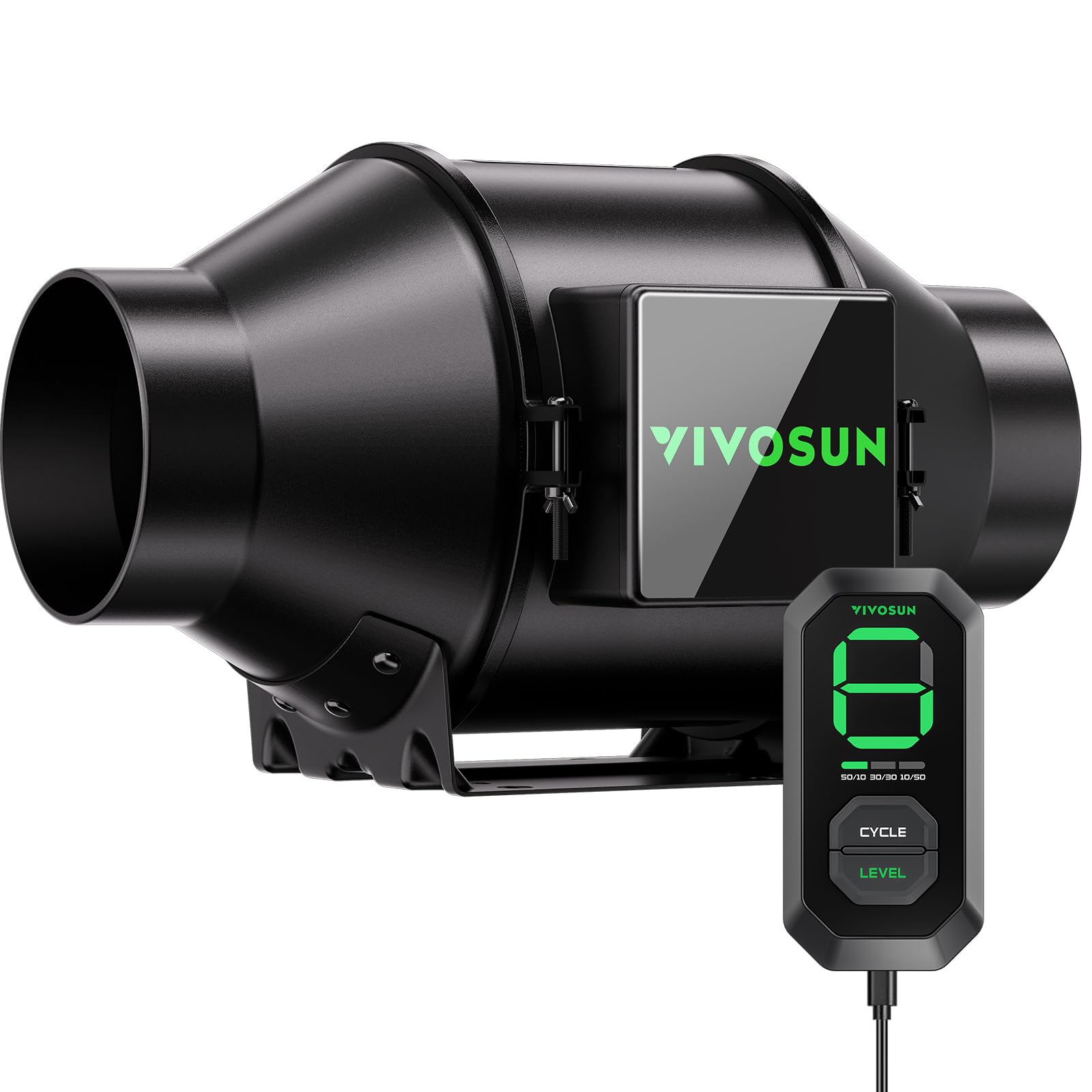
1. VIVOSUN G4 4″ Inline Fan
Our pick — over 4.5★ from 250+ verified ratings; the strongest balance of quality and price.
The inline fan that runs a ten-speed dial down to a whisper and remembers where you left it
If you are venting a grow tent, a 3D printer enclosure, or a laser cutter, the number that decides this pick is 195 CFM — cubic feet per minute, the volume of air it pushes each minute. That is enough to clear a small to mid-size space without ripping a hole in your heating bill, and because it is an EC motor (an electronically controlled motor that uses less power than a standard AC fan motor) it draws far less current than the older blowers it tends to replace.
The control side is where this one separates itself from the cheaper inline fans. You get ten fan speeds through a PWM controller (pulse-width modulation, which switches the motor on and off very fast to set an exact speed rather than just high or low), backed-up memory that restores your last setting after a power cut, and three on/off cycle modes so the fan can run on a rhythm instead of constantly. It sits at 28 dB while running, which is about the level of a quiet bedroom at night.
What wins people over is the build. The housing is reinforced plastic over a corrosion-resistant metal base, and it is the single most-praised thing about this fan — owners beat it up in workshops and tents for years. Airflow and speed control come next in the praise. The honest catch is noise at the top end: drop it to full speed and it does become audible, and there is a durability question mark, since one long-time buyer of an 8-inch version in the same line reports the motor seizing after about a year. At 7.86″D x 11.91″W x 7.07″H it is a compact unit, and its 11.91-inch width is far narrower than the VELLEE register booster’s 11.54-inch face — the two sit in completely different spots in a system, so pick by where the fan has to live.
Cycle mode control
- 195 CFM of airflow with an EC motor that sips electricity compared with older fans
- Ten speeds from the PWM controller, plus backup memory so it returns to your last setting
- 28 dB operation — quiet enough to leave running while you work nearby
- Three on/off cycle modes and an upgrade path to the E42A multi-device and GrowHub app control
Bulky install space
- Full speed is noticeably louder than the idle rating suggests
- Runs on a standard AC plug, so you need a free outlet near the mounting point
- Long-term motor life is the one open question owners raise
Grow room ready: you are venting a tent, printer enclosure, or workshop and want adjustable speed plus app-ready control without paying flagship money.
Small closet only: you need to boost a small floor register in a bedroom — a plug-in register unit is the right tool there.
2. iPower 6 Inch Ventilation Booster Fan
A 6-inch inline workhorse rated to move nearly twice the air of a small register booster
For a basement, attic, or garage that smells stale no matter what, the headline here is simple: this is a 6-inch inline fan rated at 300 CFM with a fan speed of 2350 RPM (revolutions per minute, how fast the blades spin). Against the VELLEE register booster’s 120 CFM, that is a 2.5x gap in rated airflow — this one is built to move air through a duct run, not just out of a single vent.
Two things explain why people keep buying it. First, the deflector inside concentrates the airflow and cuts the turbulence, which is how iPower gets the claimed running sound down to 31 dB. Second, and this is the real selling point, it is light and compact with flanges on both the intake and exhaust ends, so it slots into a short duct run without a contractor. A 60W motor running on standard 120V household power at 60Hz keeps the electrical side simple, and the grounded cord means one less thing to think about.
The airflow number is where you should keep your expectations honest. Buyers use these to ventilate crawl spaces and under-house voids and report they hold up well, but the CFM claim is contested: one reviewer bluntly reports that two of these move at best 200 CFM, not the 300 on the label. So treat it as a solid mid-volume fan rather than a true 300 CFM unit. The other recurring note is volume — one buyer found it a touch too loud to live with, and another called it a little loud while praising how much air it moves. The plastic housing is also worth handling carefully, since it is not the rubberized kind that shrugs off a drop. At 6.5″D x 7.4″W x 7.87″H it fits where a bigger blower simply will not go.
Booster airflow boost: the 6-inch flanges on both ends mean you can drop this into a short run and clamp it in — no custom adapter needed. Its 7.4-inch body width is the tightest on this list, so it squeezes into spaces the 8-inch blowers cannot reach.
Ground wire fuss: the label says 300 CFM and the real-world number may sit closer to 200, so size it for a mid-size job and not a whole-house one.
Long duct runs: you have a 6-inch duct run to a basement, attic, or under-floor void and want real airflow without a premium spend.
Short straight runs: you expect a full 300 CFM at the vent, or you need it silent in a bedroom.
3. VELLEE Register Booster Fan 4″ x 10″
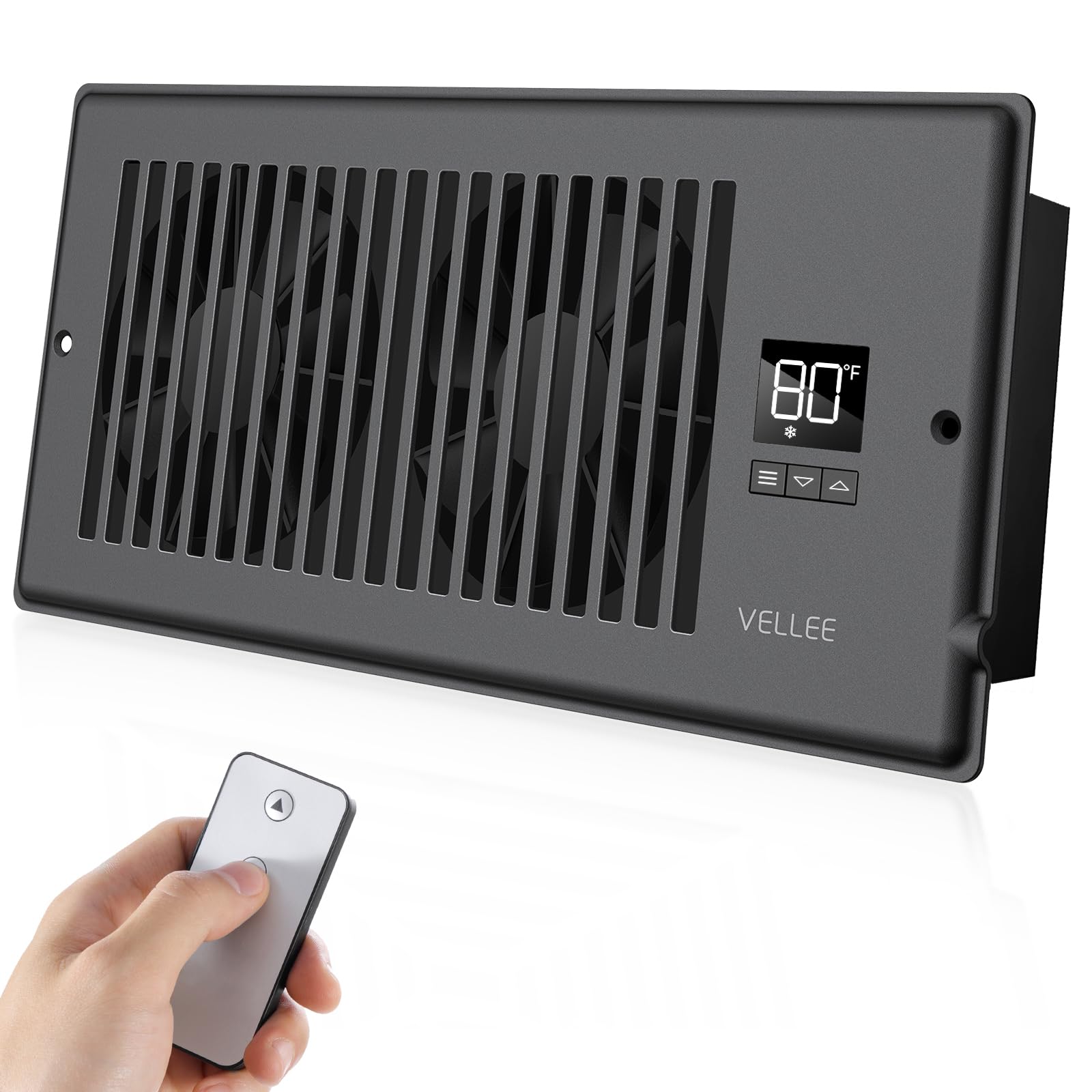
The plug-in register fan for the bedroom that never warms up, no tools and no app required
If your problem is one stubborn room rather than a whole duct branch, start here. This is a register booster — a fan that drops into the vent opening itself — rated at 120 CFM and designed for a 4″ x 10″ duct opening. It plugs into a wall outlet rather than hard-wiring, and it ships with the wall adapter and 12 ft cord, so you genuinely do not need to run new wiring or call anyone in.
The quiet story is this unit’s best card. VELLEE rates it as low as 18 dBA (a decibel scale weighted to how human ears hear), which is quieter than the 28 dB of the VIVOSUN inline fan above and well below the 31 dB of the iPower. That low figure relies on the high-static-pressure PWM motor — a motor built to keep pressure in the duct without shouting. It has ten adjustable speed levels and a dedicated temperature sensor with a smart chip that starts and stops the fan for you, so you set a target and forget it. There is no app to pair, which VELLEE frames as one less thing on your phone.
Sizing is the part that trips people up, so read this twice. The 4″ x 10″ refers to the duct opening, not the vent cover on your floor. Before ordering, pull the old cover and measure the hole — the neck that fits inside is 9.72″ x 3.93″ with a 1.96″ insertion depth, and the face that covers the hole measures 11.54″ x 5.51″. If your duct has a steep inward taper, the neck will not seat. Airflow is the most-praised thing here, with the fan doing well at redistributing cool air toward a warm upper floor. Be honest with yourself about the noise, though: some owners find it whisper-quiet while others report a rattle developing after the first night, and clicking or sticking has come up on one of several units. An occasional noisy unit is the recurring gripe, not a pattern — and one owner who hit a problem reported the manufacturer replaced the set generously. One more thing worth knowing: VELLEE is upfront that if your ducts are badly sealed or uninsulated, a register booster may not fix your comfort problem, because it can only move what the system delivers.
Cold floor vents: a renter or homeowner with a single cold bedroom, a spare 4″ x 10″ vent, and an outlet within 12 feet.
Wall vent setup: your vent is a different size or your ducts are unsealed — measure the opening and check the ductwork before you buy.
4. Suncourt Register Booster Fan HC600
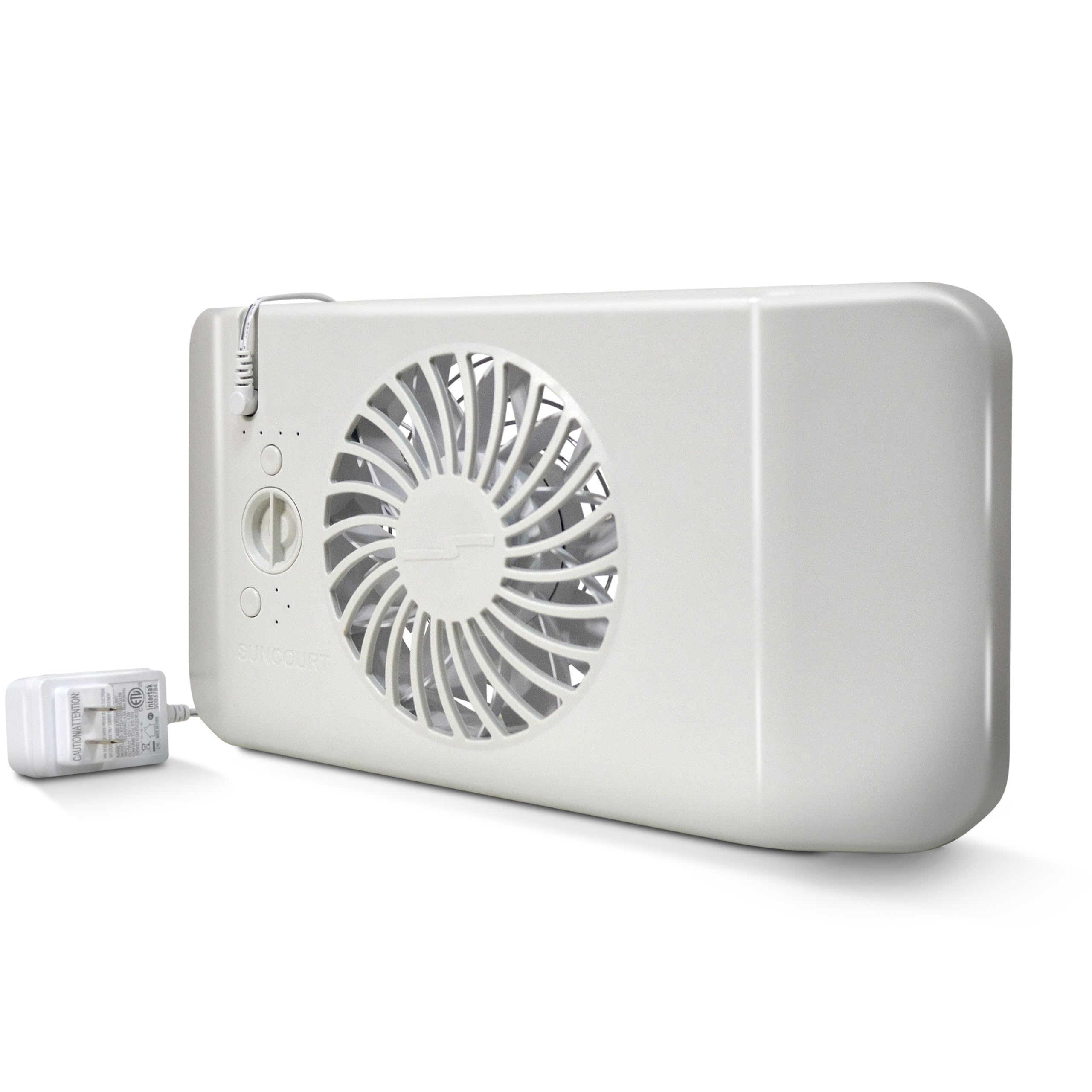
The floor-vent booster that fits a dozen odd register sizes and switches itself on when the heat kicks in
Here is the pitch in one line: this drops into floor vents 6×12 and smaller — including 2×10, 2×12, 3×10, 3×12, 4×10, 4×12, 6×10, and 6×12 registers — and delivers up to 200 CFM. That flexibility is the whole point. The VELLEE above locks you into one 4″ x 10″ opening; this one covers the awkward sizes people give up on, and owners hunting for a 2×12 solution say this was the only option they could find.
Two features make it feel smarter than a plain fan. The patented smart sensing turns the unit on automatically when your HVAC heats or cools, so there is no switch to flip between seasons and no thermostat wiring. And you get 8 fan speeds to dial in just how much push the room needs, rather than a simple on/off. Cords and installation are similarly simple: set it in the register and plug into a standard outlet with the 6-ft cord. It is made in the USA since 1988, uses flame-retardant, thermally protected materials, and carries a 3-year warranty.
Functionality is what owners value most, followed closely by cooling performance, and the room-temperature difference is real — buyers commonly report their problem room landing 3-4 degrees cooler, with one split-level owner noting an upstairs room that once ran warmer now sometimes ends up cooler than the rest of the house. The controls are the fair warning here. Auto mode takes 15-25 seconds to trigger, and the highest speed is loud enough that owners compare it to a window air conditioner. If you need peace and quiet, run it lower. It is also worth remembering that a single booster helps one room, so a second floor may still need more than one unit.
Quiet floor vent: covering 2-inch through 6-inch register widths means you are not guessing at a single opening — measure the inside of the duct, not the cover, and match it to the list.
Sizing check first: the top speed is genuinely loud, so treat the 8 speeds as a range from near-silent to window-AC territory.
Bedroom floor vent: your floor register is an odd size like 2×12 or you want automatic on/off without touching a thermostat.
Large room needs: you need quiet above all — pick a fan you can run at low speed instead.
5. VEVOR Inline Duct Fan 8-Inch

An 807 CFM blower that reads its own temperature and humidity and sets the speed for you
When the job is a large grow room, a big basement, or a workshop full of fumes, the number that matters here is 807 CFM — over four times the rated airflow of the VIVOSUN at 195 CFM. This is an 8-inch inline fan, so it moves serious volume, and the included temperature-and-humidity sensor lets the variable speed controller pick the airflow setting automatically instead of you fiddling with a dial.
The motor is an EC design running up to 3000 RPM, which VEVOR says saves 30% on energy consumption versus a comparable older motor and pushes service life longer. It runs at 39 dB — louder than the 28 dB VIVOSUN, but that is the trade for a fan this size. Setup is meant to be easy: the fan arrives with non-vibration rubber mats and straps, and you can either hang it or mount it on a wall. Build materials are ABS and PP plastic over a cold-rolled steel base, and the whole unit weighs 7.6 pounds.
Quality is what owners praise above everything else, with airflow a close second. Buyers use these to boost weak HVAC flow, to pull heat and humidity out of rooms, and one even built a bed-cooling rig around it to stop waking up hot. The controls are rated easy to navigate, and the temperature control earns specific praise for keeping a room steady through the evening. The caveats are noise and sensors. At higher settings it gets fairly loud, and the sensor side is not universally loved — one greenhouse owner reported the sensors failing after about three weeks of use and felt let down by the unfinished-feeling support. Instructions are also on the thin side, so plan a little extra time for setup. If you are not chasing huge airflow, the 4-inch options above will be quieter and simpler.
Big grow rooms: a large, hot, or humid space where you want the fan to manage its own speed off temperature and humidity.
Tight duct space: your duct is only 4 or 6 inches, or you want quiet operation in a living space.
6. Tjernlund M-4 Inline Duct Booster Fan

A metal-bodied 4-inch booster for long duct runs, the kind that outlasts a cheap inline fan
A 4-inch duct run with a weak register at the end is exactly what this fan is for. It is rated at 200 CFM, pulls 100 Watts at 120 VAC, and has a 4-inch inlet and outlet, so it splices in with minimal fuss. It comes with a mounting bracket and cord in the box. If you have tried a cheap inline fan and felt nothing at the vent, this is the class of unit that actually pushes air down a long run.
The metal rotor is the defining trait. This is a heavy-duty, well-balanced turbine rather than a plastic impeller, and it shows up as a balanced operation with minimal vibration — owners describe running it on a bench without it moving. The mounting bracket is sturdy, which matters when the fan lives in an attic. It also draws praise for holding up in punishing heat, with one owner specifically noting it stands up to Las Vegas attic temperatures.
Value is what gets mentioned most here, and it is earned. What is interesting is how much stronger it performs than the rating suggests: an owner replacing a 240 CFM inline fan with this unit reported 5-8x more actual airflow despite the CFM figures being close. That reality is why this fan earns its keep on long runs where weaker units stall. Two practical notes. A piece of cardboard is wedged into the intake side for shipping and is not mentioned in the instructions — just pull it out before you install. And the intake is smaller than the outlet, so plan your duct splice accordingly. Long-term, a few owners have noticed delayed or failed starts after around two years, pointing to the start capacitor. That is a small share of buyers on a fan this popular, but worth knowing before you commit it to a hard-to-reach spot.
Metal housing build: a heavy-duty metal rotor and sturdy mounting bracket, so it stays balanced and quiet when mounted well away from the register.
Mounting prep work: remove the hidden cardboard collar from the intake before you switch it on — it is easy to miss.
Long metal ducts: you have a long 4-inch duct run with a weak vent at the end and want a metal-bodied fan that holds up in heat.
Plastic duct runs: you need to reach the fan easily for any future service, or your duct is 6 or 8 inches.
7. M-8 In-Line Duct Booster 8″ Metal, 670 CFM
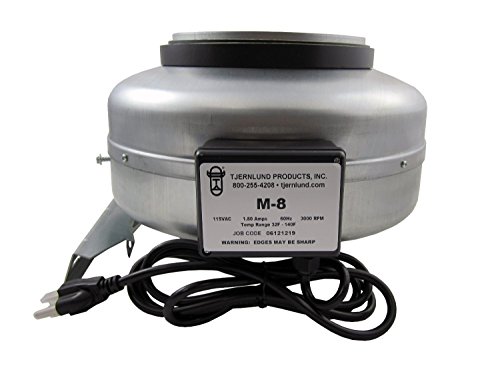
A 670 CFM metal turbine for feeding a whole floor of ductwork, not just one vent
This is the biggest hammer in the lineup. At 670 CFM with 8-inch inlet and outlet, it is built for a full branch of ductwork — the kind of job the VIVOSUN at 195 CFM could never take on. If you have one room at the far end of a long run that never gets air, this pushes enough volume to reach it, and it is a metal-bodied, tubular unit made in the United States.
What separates it from its 4-inch M-4 sibling above is not just size. The turbine in this unit is heavy-duty and well-balanced, and owners describe it running with no mechanical noise at all — only the sound of moving air, and inaudible from a floor away. It also runs with zero vibration, holding still on a bench through a full test. The sturdy bracket and included power pigtail make install straightforward, and it will work across 100+ feet of 8-inch duct, so long runs are exactly its zone.
Owners have found it strong enough to blow napkins off a table when run straight into one register, and the recommended fix is to split the output with a wye into two registers rather than feeding one. Mount it far from the register and the noise disappears. On the durability side, a small number of long-term owners have reported delayed starts after a couple of years, likely the start capacitor — the same pattern seen on the M-4 — but the overwhelming response has been to rebuy rather than switch brands. Pair it with a duct switch or timer if you want it to run only when the system calls for air.
Large duct runs: a whole-floor duct branch or a very long run where a smaller inline fan cannot push air to the far end.
Small duct runs: you only need to boost one register — this is far more air than a single vent needs.
Know the Specs
CFM (Cubic Feet Per Minute)
CFM tells you how much air a fan moves each minute. A register booster might be rated at 120 CFM; an 8-inch inline blower can be rated in the hundreds. Bigger is not automatically better — a fan rated well above what your duct can carry adds noise without adding comfort, so match the rating to the size of the duct and the length of the run.
dBA (Decibel Level, Ear-Weighted)
Noise is rated in dBA, a decibel scale adjusted for how people actually hear. A fan in the low 30s is roughly library-quiet; a fan near 40 dBA is closer to soft conversation. Two things to remember: most fans get louder as you raise the speed, and a fan mounted far from the register will sound quieter in the room than its rating suggests.
Duct Diameter And Register Size
Inline fans are named by duct diameter — 4, 6, or 8 inches — while register boosters are named by the vent opening, such as 4″ x 10″. Register sizes are measured across the hole in your floor or wall, not the cover you see. Measure the opening before ordering, since a fan that does not seat properly will not move air the way it should.
Motor Type And Power
An EC motor (electronically controlled) is more energy-efficient than a standard AC fan motor and often runs quieter. Standard AC fans are rated in watts and volts, like a 100W unit at 120V. Every booster fan needs a plug-in outlet or a wired connection — none run on battery, so check where your power is before you commit.
Common Questions
Will a booster fan actually make my coldest room warmer?
How do I measure my duct opening for a register booster?
Is a register booster or an inline duct fan the better choice?
Will a booster fan work with a heat pump or a standard air conditioner?
How loud is a duct booster fan at night?
What CFM do I need for a bedroom versus a whole floor?
Do duct booster fans run on batteries or need an outlet?
Will a bigger CFM fan always move more air?
How long should a duct booster fan last?
Do I need to remove my existing vent cover to install one?
The Bottom Line
For most homes, the air duct booster fan that solves the widest range of problems is the VIVOSUN AeroZesh G4, because its ten-speed control, backup memory, and 28 dB operation give you both the airflow and the control to match it to any space you point it at. If your problem is one stubborn bedroom and you want zero installation work, the VELLEE Register Booster drops into the vent and plugs in. For a long duct run that a small fan cannot reach, the metal-bodied Tjernlund M-4 is the one that actually pushes air to the far end.
How we choose
We do not accept paid placement. Every pick is matched to a real buyer and a real use-case; we do not hands-on test units.
Sources
Specifications: manufacturer listings and product documentation. Review insights: verified customer reviews, as of October 2026. Pricing: not shown on this page (it changes often); check the current price via the retailer link.
As an Amazon Associate, Aappliancez earns from qualifying purchases. This does not affect which products we feature.