Disclosure: Some links in this post are affiliate links. As an Amazon Associate I earn from qualifying purchases, at no extra cost to you. Learn more
Specs are compiled from manufacturer listings and verified buyer reviews and can change over time — please confirm the key details on the product page before buying.
If your legs feel heavy and puffy by mid-afternoon, the fix is not another pair of ordinary yoga pants — it is graduated compression that squeezes hardest at the ankle and eases up as it climbs. The picks below range from a 20-30 mmHg compression tight to a flat-knit medical legging, and each one earns its place for a different reason: real squeeze, all-day comfort, or value. Start with the IUGA Compression Leggings — the crowd favorite at 4.4 stars across 13,000+ ratings — if you want tummy control and pockets first.
This guide is built by comparing the manufacturers’ published specifications and the patterns across verified customer reviews, so you get each pick’s real strengths and trade-offs instead of marketing spin.
You will see why mmHg ratings, waistband construction, and footless versus footed cuts decide whether a pair actually helps. The right pair of lymphatic drainage leggings should feel snug at the ankle and easy everywhere else.
Top Picks

How To Choose The Best Lymphatic Drainage Leggings
Buying compression leggings is a sizing problem wrapped in a medical-ratings puzzle. Get both wrong and you end up with a pair that rolls down, pinches your calves, or barely squeezes at all. The good news: once you understand three things — the compression rating, the knit style, and the cut — you can pick the right pair in minutes instead of returning three.
Start with the mmHg number, not the label
The compression level is written in mmHg, short for millimeters of mercury — the same unit your blood pressure is measured in. A 20-30 mmHg tight is firm graduated squeeze — the tier worn for swelling, varicose veins, and post-surgical recovery. A lighter 18-21 mmHg pair feels closer to a snug legging you can wear all day. If the mmHg number is not printed on the listing, treat it as a lifestyle legging, not a medical one.
Flat knit versus circular knit
Circular knit is the soft, stretchy tube most people know from running tights — it gives uniform squeeze and feels smooth. Flat knit is a denser, seam-shaped fabric built to follow the contour of each leg, so it grips harder where you need it and stays put at the knee and thigh. Flat knit usually costs more and feels stiffer at first, then softens to your body.
Waist height and the footless question
A high waist that reaches the bra line spreads pressure across your abdomen instead of pinching at the hip — useful if you want tummy control or lumbar support. Footless cuts win for everyday wear because you can pair them with any shoe. Table the decision: if you need ankle compression, choose a footed style; if you want a legging you can wear anywhere, go footless.
Side-by-Side Comparison
| Model | Best For | Compression | Cut | Key Feature | Amazon |
|---|---|---|---|---|---|
| IUGA Compression Leggings with Pockets★ Best Overall | Everyday wear with pockets and tummy control | Sandwich Waistband support (mmHg not stated) | Full length with pockets | Sandwich Waistband | Amazon |
| 20-30mmHg Compression PantyhoseBest Value | Swelling and varicose vein support | 20-30 mmHg | Footless, high waist | Opaque finish, S-2XL | Amazon |
| 2 Pairs Medical Compression Pantyhose | Swelling relief with a spare pair on hand | 20-30 mmHg | Footless, high waist | 2 pairs per pack | Amazon |
| Ingrid & Isabel Basics Postpartum Leggings | Postpartum and C-section recovery | Compression leggings (mmHg not stated) | Full length | Easy access nursing design | Amazon |
| Anti Cellulite Slimming Leggings (Fuseaux) + Silver | Massage-knit daily leggings with lumbar support | Extremely elastic compressed fabric | Full length | Continuous micromassage knit | Amazon |
| Bioflect Capri Compression Leggings | Lipedema and lymphedema leg support | Moderate compression | Capri with raised knit | Raised 3D massaging knit | Amazon |
| CzSalus Flat Knit K2 Leggings | Higher-stage lipedema and lymphedema | K2 = 25-30 mmHg | Full length, mid-foot | Flat knit, made in Italy | Amazon |
Detailed Reviews
1. IUGA Compression Leggings
Our pick — over 4★ from 13,500+ verified ratings; the strongest balance of quality and price.
The everyday pair that holds your middle without rolling down.
The IUGA is what most shoppers actually mean by a drainage legging: firm squeeze, soft touch, and a cut you can wear to the gym, the office, or the school run. The PowerTight Collection uses a sandwich waistband — two layers of fabric that fold over your middle — for tummy control, so the squeeze sits high on your waist instead of digging into your hip. Customers describe the fabric as buttery and thick, and the smooth surface stays put through a full day instead of sliding. It also comes in at 4.4 stars across 13,000+ ratings, the most-reviewed pick in this lineup by a wide margin.
What keeps it clean is opacity — the material blocks light so you are not clocking the floor tiles through the seat, and the side pockets hold a phone without a bulge. Sizing runs on the snug side, so measure your hip and waist before ordering rather than assuming your usual legging size. The waistband sits high enough to smooth your middle, and the leg hits right at the ankle.
The one trade-off: because the IUGA is built around a sandwich waistband rather than a graduated mmHg rating, it is a support legging, not a medical-grade compression garment. If your legs swell from lymph buildup after surgery or you wear compression by prescription, pick the flat-knit picks down the page instead. The IUGA is best for daily wear you actually want to put on.
What wins people over
- Sandwich waistband gives tummy control without digging in
- Soft, thick fabric that customers say feels like butter and does not roll down
- Side pockets hold a phone without a bulge
- Opaque enough to wear without a cover-up
Where it asks a little of you
- Sizing runs small for some — check the fit guide first
- No mmHg rating, so it is not a substitute for medical compression
Reach for this if: you want one pair that works for yoga, errands, and long days on your feet.
Look elsewhere if: you need a clinically measured 20-30 mmHg squeeze for swelling after surgery.
2. 20-30mmHg Compression Pantyhose
The firmest squeeze in this lineup for anyone fighting afternoon leg swelling.
That “20-30mmHg” on the box is the whole point: graduated squeeze from ankle to thigh, graded so the tightest part sits at the ankle and the fabric eases off as it climbs toward your waist. That graduated pressure is what eases swelling, varicose veins, and the puffy-leg feeling after a long flight. This pair delivers it footless and opaque — no separate layer, no shine-through, and it goes under trousers or a skirt without looking like hosiery. S-2XL sizing covers the average range, and the high waist smooths your middle as it works.
The honest trade-off with anything in this compression range is getting them on. This pair is a tight, graduated sock-level squeeze at the ankle, and the pull-on struggle is real — expect a few minutes of rolling them up your leg and working out wrinkles. Once they are on, they stay.
Compared with the IUGA above, this is the more serious compression piece: a full 20-30 mmHg rating versus the IUGA’s waistband support. If you have been told by a clinician to wear 20-30 mmHg, this is the tier of pair to buy.
Straight talk on the fit: the mmHg rating is where the money goes, and the compression is what buyers report works. The complaint loop is comfort and putting them on — plan to spend five minutes on your first few attempts.
Pick this if: you want real graduated squeeze at a budget-tier price.
skip it if: you want a legging you can pull on in ten seconds without effort.
3. 2 Pairs Medical Compression Pantyhose

Two graduated pairs in one pack, so laundry day never leaves you without squeeze.
Two pairs is the practical play here. Compression tights are a daily-wear item, and having a second pair means you can wash one while you wear the other — no gap in your routine. The rating matches the standard 20-30 mmHg range you would need for swelling, and the cut is footless and high-waisted, so they sit smooth under clothes. The maker is Lakicool, listed under the CPT2BS model, and the design leans on shaping plus comfort with a compressive footless leg. This one earns its place mostly through convenience: buy once, wear twice as long between washes.
What owners mention lines up with the spec — strong support that does not feel restrictive, comfortable enough to wear through the day, and effective at easing leg swelling. Two identical pairs also means no guesswork about sizing between styles; if one fits, they both fit. The high waist and elasticity keep the pair anchored, and the footless leg opens up shoe choices from slippers to heels.
Set against the Bioflect further down, this is the firmer-rated, more affordable option; the Bioflect is where you go if you specifically want a raised massaging knit and a capri cut. If you need the compression and the daily rotation, this pair is the value.
Why the count matters: the price-to-pair math is where the two-pack wins — you get double the wear days and half the laundry problem.
One thing to know: firm 20-30 mmHg needs a tape measure. Guessing your size wastes the second pair.
Good match for: daily wearers who want a spare pair on the shelf without paying twice.
Not the fit for: anyone who wants a single ultra-fine pair for a one-off event.
4. Ingrid & Isabel Basics Postpartum Compression Leggings

Built for the weeks after birth, with a nursing-friendly fit and gentle all-over hold.
Postpartum compression is its own thing, and Ingrid & Isabel Basics designs for exactly that stage. The leggings have an easy-access nursing layer built into the waistband, a smooth base layer feel against the skin, and a snug fit that holds everything in place where it counts. Buyers who came through C-section recovery in particular talk about the support, and the material is described as smooth and gentle — the soft touch matters more in the first six weeks than a firm mmHg squeeze.
The honest caveat here is compression strength. Buyers are split — some feel it hugs and supports, others say it is not true compression at all. That split makes sense for a postpartum piece: it prioritizes comfort and access over medical-grade squeeze. Durability is the second thing buyers flag, so wash gently and air-dry to extend the wear life.
For lymph swelling after birth, the footless pair above gives you a firmer 20-30 mmHg squeeze (millimeters of mercury — the same pressure scale used for blood pressure), so it is the stronger pick. This pair is the one to choose if you want a soft legging you can nurse in and live in for the first weeks — the easy-access layer is a feature no other pick in this lineup carries.
Where this fits best
- Easy-access nursing design built into the waistband
- Snug hold that customers note supports the middle and eases movement
- Smooth, gentle material for the early postpartum weeks
What you should weigh
- Compression is light — buyers disagree on whether it counts as true compression
- Durability is the recurring gripe; treat the material kindly
Built for: the recovering mum who wants soft support and easy nursing access.
Not the right fit for: a swelling-driven need for firm 20-30 mmHg squeeze.
5. Anti Cellulite Slimming Leggings (Fuseaux) + Silver
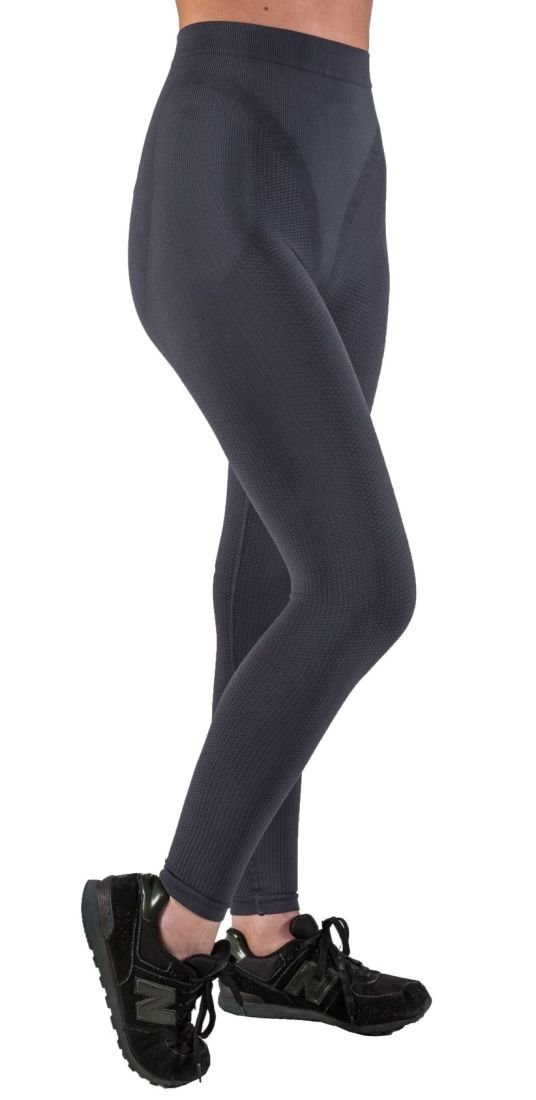
A molded micromassage knit that works while you move, plus real lumbar support.
What sets this Italian-made legging apart is the massage angle. The molded elastic fabric is knitted to pucker along the leg, and every step your body takes presses those points into the skin for a passive micromassage that moves with you. Combined with a built-in lumbar panel for lower back support, this is the pair for the woman who wants a compression effect during her day rather than a medical device. Worn under a uniform or under street clothes, it does its job without asking for a gym session.
The texture is the take-it-or-leave-it. Reviewers point out it snags on rough surfaces and can run long, so choose your size carefully against the size chart — the fit skews loose for many. It wears fine once on, and the compression value is real.
Compared with the Bioflect below, this one leans darker on massage and lumbar help, while the Bioflect leans into lymphedema-specific compression. If your interest is cellulite texture and a lower back that aches after a long day, this is the pair to try first. One owner, a 150 lb, 5’5″ wearer, ran it for a 22-hour day and found no downside — worth knowing if you had durability worries.
Standout: the micromassage knit is the feature everything else in this lineup lacks, and it is the reason to pay for this pair.
Daily-care note: treat rough nails and velcro straps as enemies — the knit will catch and run if you are not careful.
You will like this if: you want passive massage and lumbar support built into a pair of leggings.
Rethink it if: you need a specific mmHg rating for clinical leg swelling.
6. Bioflect Capri Compression Leggings

A raised 3D knit that presses fluid toward your torso with every move.
The Bioflect Capri is the pair built for lymphedema and lipedema legs that need continuous, raised pressure at the calf and thigh. The raised knit weave forms bumps along the inside of the fabric that massage your leg as you move, nudging fluid up toward the torso. The cut is capri (mid-calf), size range runs S/M through 7XL, and the fabric is a bio ceramic blend the maker describes as mold-to-body conforming.
Where buyers rave: comfort and ease relative to traditional compression hose — you can put these on without a fight, and they hold up to cold wash. Where buyers warn: sizing is tight to read, one size larger than expected can be too tight on the calf, and the cut does not suit ankles or feet. Folding the calf resolved it for at least one wearer, and the raised texture should be worn under a garment, never as a stand-alone legging.
This is the pick for the swollen-limb case where fit around an odd-shaped calf matters more than mmHg numbers. The 25-30 mmHg CzSalus below is firmer by specification, but the Bioflect wins on the raised-knit construction and on range of sizes — from S/M all the way up through 7XL.
Why it earns the premium tier
- Raised 3D knit massages the calf and thigh as you move, pushing fluid toward the torso
- Unusually wide size range, S/M through 7XL
- No chemical smell reported by sensitive wearers
- Holds up to cold wash and hang dry
Where the fit asks more of you
- Sizing is the recurring gripe — one size larger can still feel tight at the calf
- Crotch fit is inconsistent; some report the leg creeping down when sitting
- Undergarment only — the raised texture shows under tight clothing
Best-fit buyer: someone managing lipedema or lymphedema who needs a massaging knit and a capri length.
Better served elsewhere if: you need compression that reaches the ankle or foot.
7. CzSalus Flat Knit K2 Compression Leggings

Flat-knit Italian compression with a 25-30 mmHg rating for higher-stage needs.
CzSalus K2 is the top-compression pick. The K2 rating means 25-30 mmHg — the firmest class in this lineup, and the pair built for higher-stage lipedema or lymphedema where lighter tights are not enough. It is flat knit rather than circular, so the fabric is shaped to the contour of each leg rather than cut from a tube. The build is 80% polyamide microfiber plus 20% elastan, knitted in Italy, and the high waist runs from the bra line down to mid-foot for full-length graduated squeeze.
The bonuses: a lumbar compression panel for lower-back relief, a fabric treated to limit odor and sweat, and a reinforced structure meant to hold shape through long days of wear. As owners put it: “true to size, soft, thick, run-resistant, cool, easy on, knee/thigh fit, many colors” — one reviewer noted wearing it for a 22-hour stretch with no complaint. For POTS and lipedema wearers seeking light-pressure comfort, the lighter 18-21 mmHg sibling works; for firm squeeze, the K2 is the one.
Sizing is tight to read. The rule of thumb from the maker’s fit chart runs to short-limbed buyers, so measure your calf and knee circumference before ordering and expect the first try-on to feel firm. This is a medical-grade garment — you will feel it.
Spec that matters: the 25-30 mmHg K2 rating is the firmest in this lineup, and the flat-knit construction means the squeeze holds shape at the knee and thigh rather than sagging.
Worth knowing: because it is flat knit and Italian-made, fit is unforgiving of wrong sizing — order with a tape measure, not by habit.
This is the pick if: your legs need the firmest squeeze a legging can give.
Not the right call if: you want a soft, casual pull-on or you are not ready for a tape-measure sizing step.
Know the Specs
What mmHg Actually Means On a Legging
mmHg stands for millimeters of mercury, the same scale used for blood pressure. On a compression legging, it tells you how much pressure the fabric pushes against your leg. The scale usually climbs through three tiers: light (often around 15-20 mmHg), moderate (often around 20-30 mmHg), and firm (often 30 mmHg and above). Higher numbers mean a firmer squeeze, so the legging is harder to pull on and firmer to wear. Match the tier to your need, not to habit — a 20-30 mmHg pair worn by someone who only wants gentle support will feel exhausting, while a soft fashion pair will not do the job for a swollen leg.
Graduated Versus Uniform Compression
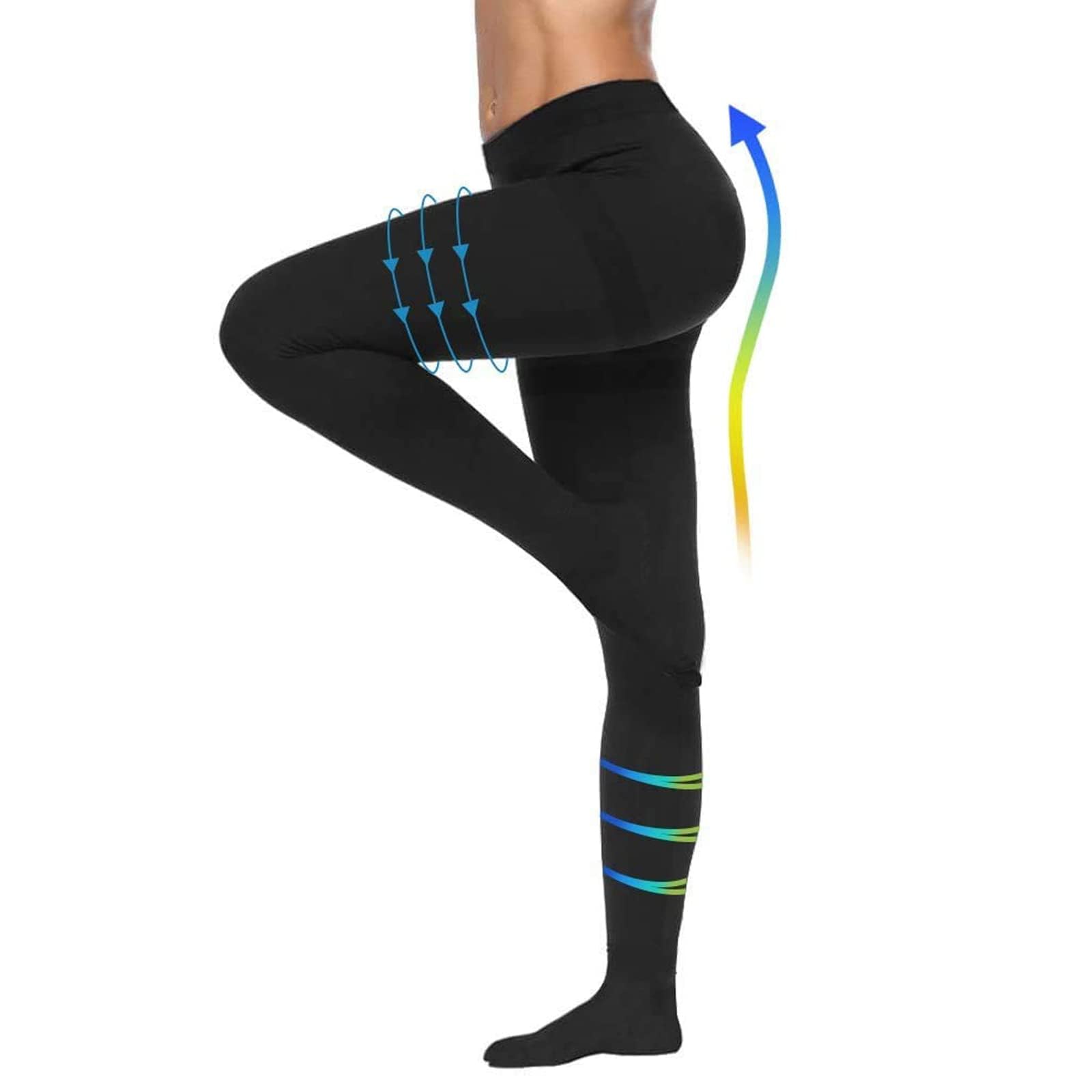
Graduated compression runs highest at the ankle and lowest near the thigh, giving your vein valves an assist as they push fluid upward. Uniform compression gives the same squeeze everywhere, which feels smoother but does not push fluid up. A graduated pair such as the 20-30 mmHg tights is the right choice when swelling is the concern. A uniform pair such as the IUGA sandwich waistband legging is the right choice when you want support and tummy control without a medical rating. Read the listing for the word “graduated” or a mmHg number before assuming the pair is doing more than it looks.
Common Questions
What does the mmHg number on compression leggings actually mean?
How do I know which compression level is right for me?
Are lymphatic drainage leggings the same as ordinary compression tights?
Should I pick footless or full-foot compression leggings?
How long should I wear lymphatic drainage leggings each day?
Will a compression legging last through daily wear?
Do these leggings help with swelling after surgery or pregnancy?
How do I stop compression leggings from rolling down at the waist?
Can I wear compression leggings to the gym or under clothes?
The Bottom Line
For most people shopping for the best lymphatic drainage leggings, the IUGA Compression Leggings with Pockets is the smart first pick — the sandwich waistband and soft, opaque material make it the pair you will actually wear, and it holds the highest rating across this lineup by far. If real graduated squeeze is what your legs need, the 20-30mmHg Compression Pantyhose gives you a firm 20-30 mmHg squeeze at a budget-tier price, and if you want two pairs on rotation, the 2 Pairs Medical Compression Pantyhose is the value play. For higher-stage lipedema or lymphedema, the firm 25-30 mmHg CzSalus K2 is the top performer — just order it with a tape measure, not with habit. Whichever you pick, check the mmHg number against your leg’s need before adding to cart.
How we choose
We do not accept paid placement. Every pick is matched to a real buyer and a real use-case; we do not hands-on test units.
Sources
Specifications: manufacturer listings and product documentation. Review insights: verified customer reviews, as of October 2026. Pricing: not shown on this page (it changes often); check the current price via the retailer link.
As an Amazon Associate, Aappliancez earns from qualifying purchases. This does not affect which products we feature.