Disclosure: Some links in this post are affiliate links. As an Amazon Associate I earn from qualifying purchases, at no extra cost to you. Learn more
Specs are compiled from manufacturer listings and verified buyer reviews and can change over time — please confirm the key details on the product page before buying.
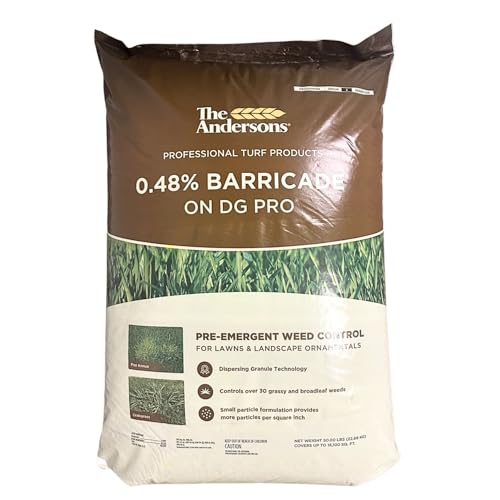
If you want fewer winter weeds in your Bermuda lawn next spring, the key is timing: put down your fall pre-emergent before soil temperatures drop and winter weeds wake up. The Andersons Barricade 50 lb Bag leads this list because it holds the highest owner satisfaction among the picks here and covers 14,200 square feet in a single bag, so it handles a real Bermuda lawn without you re-ordering mid-season.
This guide is built by comparing the manufacturers’ published specifications and the patterns across verified customer reviews, so you get each pick’s real strengths and trade-offs instead of marketing spin.
The picks below cover granular and liquid formats so you can match the product to your spreader, your budget, and your lawn size. A proper fall pre emergent for bermuda grass program keeps your turf thick instead of patchy.
Top Picks

How To Choose The Best Fall Pre Emergent for Bermuda Grass
Bermuda grass is a warm-season grass that goes dormant and browns out after the first hard frost, which is exactly when winter annuals like poa annua and henbit move into the bare spots. Your fall application has to go down before that germination window opens, not after you spot the first green intruder.
Timing beats everything else
Pre-emergent chemistry only works on seeds that have not yet sprouted, so the label window on a product you can actually apply in fall is the first thing to check. Some pre-emergents are labeled for early spring only, and using one of those in October means you are watering a barrier that does nothing. Read the label section on application timing before you buy, not after it arrives.
Match the coverage number to your lawn
Coverage is listed in square feet, and a bag that treats 5,000 square feet will not finish a half-acre Bermuda yard in a single pass. Measure your turf area first, then pick a bag that covers it with a little margin so you are not short on the last strip along the fence line. Concentrates work differently — their coverage depends on the rate you mix, so the label math matters more than the bottle size.
Granule or spray, which fits your setup
Granular products drop through a broadcast or drop spreader and then need watering in so the particles dissolve into the soil. Liquid concentrates mix in a pump sprayer and let you dial in the rate per gallon, which suits flower beds and ornamentals better than a spreader. Neither format wins outright — the spreader you already own usually decides this one for you.
Read the label on what it will not do
Pre-emergents prevent weeds from germinating; they do not kill weeds that are already growing. If your Bermuda is already overrun, you need a post-emergent step first and a pre-emergent laid down afterward to keep the next wave from coming through. Confusing the two is the single most common reason a fall application appears to fail.
Side-by-Side Comparison
| Model | Best For | Active Ingredient | Coverage | Form | Amazon |
|---|---|---|---|---|---|
| The Andersons Barricade 50 lb Bag★ Best Overall | Best Overall | prodiamine 0.48% | 14,200 square feet | Granule | Amazon |
| Hi-Yield (33030) Turf & Ornamental Weed & Grass StopperBest Value | Flexible Timing | Oryzalin | 5,000 sq. feet | Granule | Amazon |
| Barricade 4FL Herbicide Concentrate | Bed And Border Spraying | prodiamine | Label rate dependent | Spray | Amazon |
| The Andersons 18-0-4 Barricade Fertilizer with Pre Emergent | Feed and Prevent | Prodiamine 0.426% | 5,000 sq ft | Granule | Amazon |
| Agrisel Sulfentrazone 4F Weed Killer | Nutsedge And Tough Weeds | Sulfentrazone | Approx. 2,500 sq ft | Spray | Amazon |
| Prodiamine 65 Wdg 5lbs (Generic Barricade) | Largest Lawn Value | Prodiamine 65% | Rate dependent, pro scale | Granule | Amazon |
| Dimension Granular Pre-Emergent Herbicide 50 LB | Early Crabgrass Knockdown | Dithiopyr 0.25% | 10,000 to 14,000 sq ft | Granule | Amazon |
Detailed Reviews
1. The Andersons Barricade 50 lb Bag
Our pick — over 4.5★ from 950+ verified ratings; the strongest balance of quality and price.
One bag of professional-grade prodiamine that carries a whole Bermuda lawn through winter.
If your Bermuda covers a real yard rather than a courtyard patch, this is where most people should start. The 50 lb bag spreads 14,200 square feet of coverage — that is the largest single-bag footprint in this lineup — at 0.48% prodiamine, the active ingredient that blocks weed seeds from sprouting in the first place. You apply it in early spring and fall, exactly the two windows a warm-season lawn needs.
The DG Pro formulation is the quiet technical edge here. It packs more particles into every square inch of treated ground, which translates to a more even barrier across your turf instead of thin spots where a spreader pass overlapped. It is labeled to prevent over 30 grass and broadleaf weeds, and it is designed to stop weeds without harming the desirable plants already in your lawn. Pair it with a post-emergent for anything already up, and you have a full seasonal plan.
The honest catch is coverage honesty against your spreader. Buyers report that on the recommended setting the bag covered only about half its claimed area, and the printed directions assume a professional-grade spreader rather than a basic homeowner drop model. This is the hardest-working pick in this list for a big lawn — it outcarries the Hi-Yield bag several times over on square footage — but budget for a second bag if your turf is closer to a half-acre and you want a full barrier.
Where it pulls ahead
- 14,200 square feet of coverage from a single 50 lb bag — the biggest reach here
- 0.48% prodiamine, the same active ingredient turf-care professionals use for fall prevention
- DG Pro granule sizing spreads an even barrier rather than clumping in one strip
- Labeled to prevent over 30 grass and broadleaf weeds, including the winter annuals that invade dormant Bermuda
Where it asks more of you
- Real-world coverage can fall short of the printed figure on a basic homeowner spreader
- Directions are written for professional equipment, so read them closely before you load the hopper
- Won’t touch weeds already growing — that step comes first
Buy this if: you have a large Bermuda lawn and want one professional-strength bag to cover it for the fall window.
Think twice if: you are working with a small patch or a flimsy spreader — the rate here rewards even, calibrated application.
2. Hi-Yield Turf & Ornamental Weed & Grass Stopper, 12 lbs
The bag that forgives a late start — apply it up to four weeks after the others have closed.
Timing is the hardest part of any fall pre-emergent program, and this is the pick that bends the rule. You can apply this oryzalin granule up to four weeks later than other pre-emergent crabgrass products, which matters when a warm autumn keeps pushing your application window back. A 12 lb bag treats up to 5,000 square feet, so it fits a standard suburban Bermuda lawn without waste.
It is intended for ornamental landscape areas, established lawns, and ornamental turf, and the label directs you to apply within a few days of mowing for the best coverage. Effective weed prevention is what earns this bag its spot — the thing that wins people over is how reliably it holds crabgrass back in the early spring window, and buyers back that up: “I applied this twice after the growing season and watered it in well and it got rid of everything.”
Plan on consistency rather than a single hit. Timing really does carry this product, and the results you see across a problem yard tend to build over roughly two seasons of spring-and-fall applications rather than one. That is not a flaw so much as the nature of oryzalin (a pre-emergent herbicide that stops weed seeds from sprouting) — but know it going in, because a lawn that has been fighting henbit and goosegrass for years will need a spring follow-up to finish the job.
The timing advantage: That four-week grace period is a genuine differentiator when the rest of the picks on this list are already locked to their spring windows.
The coverage trade-off: At 5,000 square feet, this bag covers roughly a third of what the Andersons 50 lb bag handles in a single pass — fine for a standard yard, tight for acreage.
Reach for this if: your fall window slipped and you still need a granular that will take.
Look elsewhere if: your Bermuda runs past 5,000 square feet or you want a single application to carry two seasons.
3. Barricade 4FL Herbicide Concentrate, 4 Fl Oz
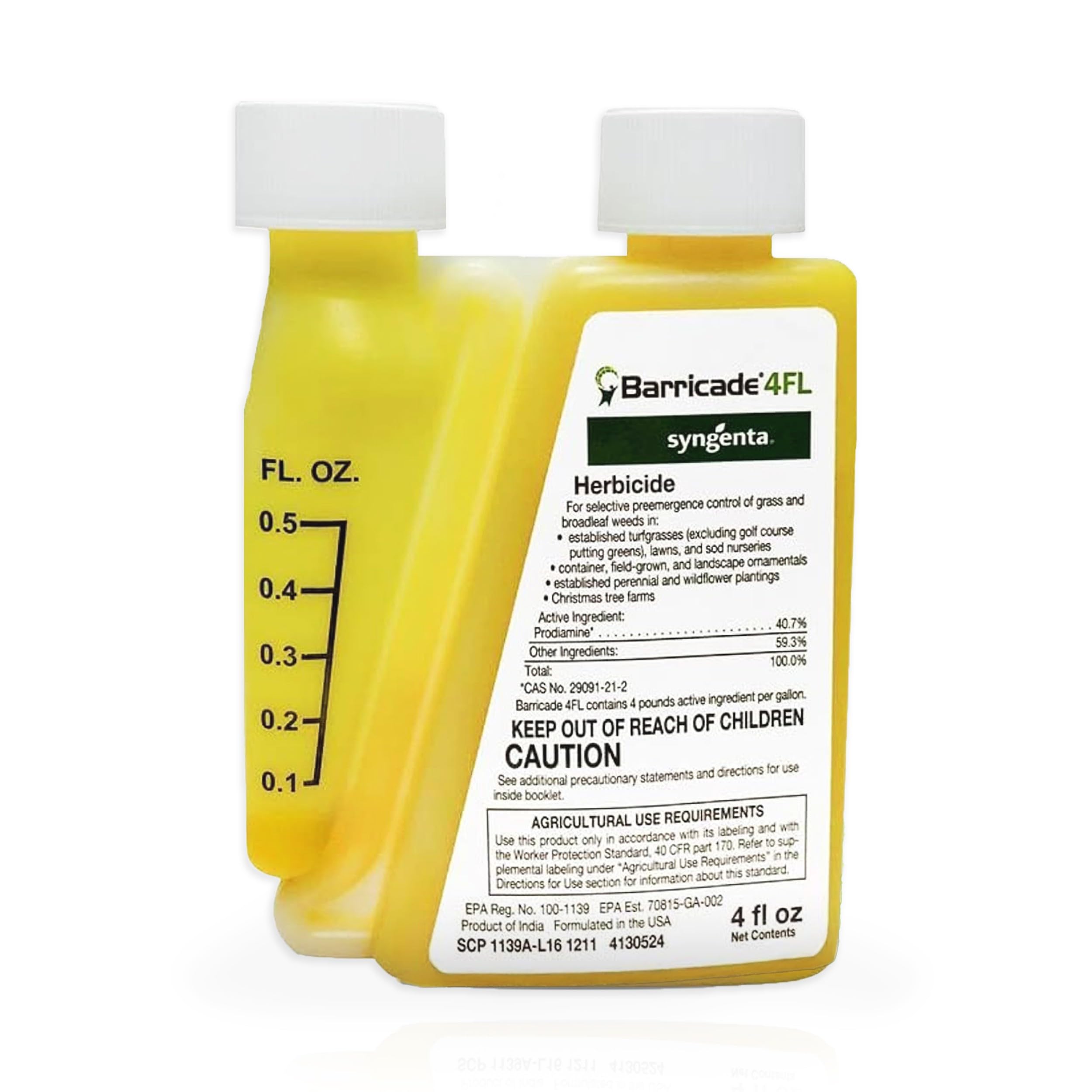
The bottle that turns a sprayer into a season-long weed barrier around beds and borders.
Where a spreader cannot reach — flower beds, mulch borders, the tight strip along a driveway — this prodiamine concentrate does the work. It mixes in a pump sprayer and controls weed growth before germination, which is the same principle as the granular picks but with sprayer-level precision on the rate per gallon. Applied at the label rate, one bottle carries a bed through the full season, and it can go down months ahead of germination.
This is the go-to for landscaped plantings. It handles up to 30 species of turf weeds including both summer and winter annuals, and it works across container, field-grown, and landscape ornamentals as well as established turf. A turf manager spraying beds in late March found the treated areas “still weed free” five months later, with no raking or watering-in step to distribute the product.
Two realities to weigh. The 4 fl oz bottle is a concentrated format, and the label rate drives how far it stretches, so you have to do the mixing math before you spray. And it is formulated only for prevention — Barricade will not control weeds after they have germinated, so any green already showing needs a different product first.
Where it earns its keep: Beds and ornamentals, where a spreader would scuff mulch and scatter granules onto foliage you want to protect.
Where it costs you attention: Small bottle, label-driven mixing, and a strict pre-germination window. Get the concentration wrong and you either waste product or under-treat the bed.
The right pick for: anyone treating mulch beds, foundation plantings, and ornamental borders alongside their Bermuda turf.
The wrong pick for: broad open-lawn coverage — a sprayer simply cannot match a bag’s reach on a half-acre.
4. The Andersons 18-0-4 Barricade Fertilizer, 18 lbs
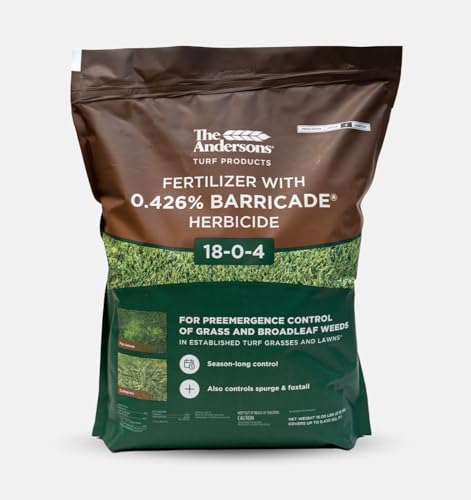
One pass of the spreader that weeds and feeds in the same trip — a two-in-one for a warm-season lawn.
This is the bag for the homeowner who wants to do one job, not two. It carries the same prodiamine pre-emergent chemistry — 0.426% — that prevents weeds, and it adds an 18-0-4 fertilizer to feed the turf simultaneously. The nitrogen-leaning ratio is designed to build a lush, thick lawn, which is precisely the defense a Bermuda yard needs against next season’s weed pressure.
Like the other Andersons pick, it uses DG Technology, a dispersible granule that dissolves rapidly when you water it in and pushes the active ingredient down into the soil. The particles are small, which means more coverage per square inch and fewer bare strips where weeds can slip through. It is labeled to prevent 30 grass and broadleaf weeds, including crabgrass, poa annua, goosegrass, and henbit, and it is made in the USA.
The one honest note owners file: it can read as overpriced for what you get compared to buying the fertilizer and pre-emergent separately. If you already have a fertilizer schedule dialed in, a standalone pre-emergent is cheaper — this pick earns its place when you value the time saved by one application instead of two.
Standout feature: 18-0-4 coverage means the same pass greens your Bermuda and blocks the next round of weeds — the kind of job you would otherwise do with two separate bags and two spreader loads.
Reach for this if: you want one product, one application, and a thicker lawn going into fall.
Skip the double-duty if: you already run a separate fertilizer schedule — this is convenience paid for at the register.
5. Agrisel Sulfentrazone 4F Weed Killer, 8 Ounces
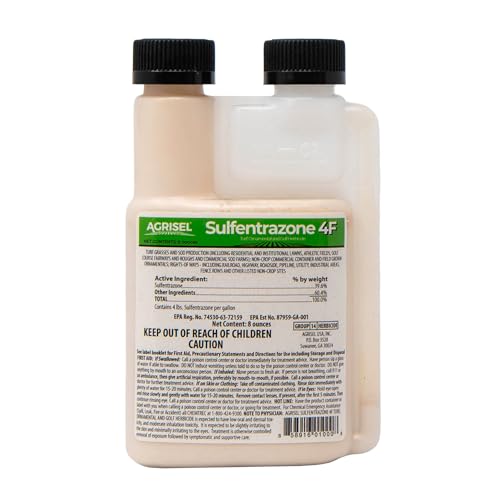
For the yard where standard pre-emergents leave nutsedge and wild onions standing.
Sulfentrazone goes after the weeds that ordinary pre-emergent chemistry ignores. This is a pre-emergent and post-emergent herbicide that targets weed seeds as they germinate and also reaches the tough perennials — the pick if your Bermuda has been losing ground to nutsedge, wild onions, or dove weed. The 8-ounce Tip and Pour bottle covers approximately 2,500 square feet, and the squeeze-side measuring design lets you pour an accurate dose into the cap without a funnel.
Nutsedge and wild onions are where this earns its reputation. The concentrated formula gets mixed at roughly 1.5 teaspoons per gallon with a sticker, and Buyers describe wild onions browning by day two and thistle turning black overnight. Dove weed, which most homeowner products miss, goes down in days, and buyers reorder a second bottle. It is labeled for use on residential lawns, golf courses, roadside areas, and pre-planting crop spaces.
The caveat is a genuine one and worth flagging honestly: sulfentrazone is a strong active, and one fescue owner treating clover reported killing some of the grass along with it. Approach this as a targeted weapon rather than a blanket broadcast, and spot-treat where weeds are worst. The 8-ounce bottle is also a small starting size — you will want to scale up if the whole lawn is the target.
what separates it
- Pre- and post-emergent action in one bottle — reaches weeds after they have already shown
- Labeled to stop nutsedge, wild onions, and dove weed, the hard cases that defeat granular pre-emergents
- Tip and Pour squeeze-side design makes precise measuring simple
- Roughly 2,500 square feet of coverage from 8 ounces at the recommended rate
What to respect about it
- Strong enough to damage cool-season turf if you broadcast over the whole lawn — spot-treat instead
- Safety is not universal — some grasses tolerate it, others do not
- Small bottle is a starter size if you are covering a lot of ground
The targeted pick for: lawns where nutsedge, wild onions, or dove weed have resisted everything you have tried.
The cautious pick for: cool-season grass or a lawn you are not willing to test on a small patch first.
6. Prodiamine 65 Wdg 5lbs Pre-emergent (Generic Barricade)
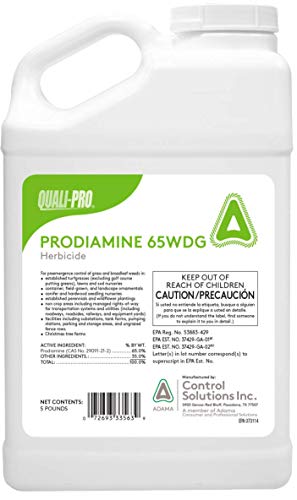
The professional-strength five-pounder that turns a big yard into a season-long project instead of a monthly one.
Sixty-five percent prodiamine is a very different animal from the 0.48% granule up top — this is the concentrated powder form that turf managers measure out by the ounce per thousand square feet. At the listed rate of 0.185 to 0.55 ounces per 1,000 square feet, one 5 lb jug covers acres of ground, and the same can be said of the label formula: 0.5 to 2.30 lbs per acre. Higher upfront cost here, yes, but the per-application cost works out well below bagged product over a full season.
This is the pick for a genuinely large property or for the lawn owner willing to spray and dial in rates. It best suits a spring and late-fall pre-emergent program, and rotating the active ingredient between seasons keeps weeds from building resistance. Spray it and water it in shortly after, and avoid applying when heavy rain is forecast — otherwise the barrier runs off with the runoff. Nutsedge and other tough grassy problems respond well when the rate is right.
The one note to respect: 65% prodiamine is potent and gets spread across acres, so this is not a consumer product you sprinkle by eye. Rotating it between seasons is the maintenance pattern owners suggest, and overapplication is the primary risk to your turf. It also leaves a yellow dye that will stain whatever it touches, so keep it off sidewalks and off your hands.
Right fit for: multi-acre lawns, large properties, and anyone doing their own pro-grade program.
Wrong fit for: a half-acre suburban yard — the jug would last years and the rate math is overkill.
7. Dimension Granular Pre-Emergent Herbicide, 50 LB Bag
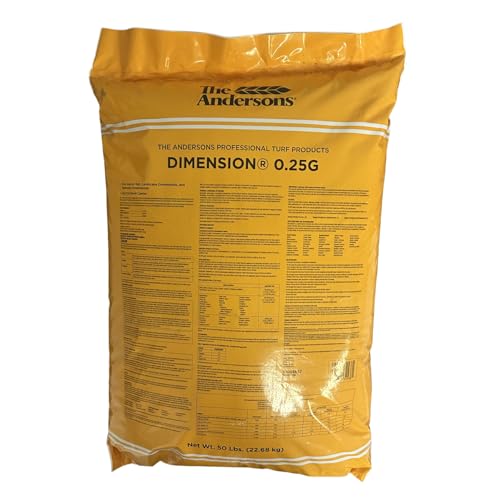
A big-bag budget option with a different active ingredient — dithiopyr can take crabgrass earlier than prodiamine alone.
Dimension is your alt-active play. It uses dithiopyr at 0.25%, which controls early crabgrass on immature plants and is labeled to prevent over 40 grass and broadleaf weeds — a longer list than most of the prodiamine picks on this page. A single 50 lb bag treats between 10,000 and 14,000 square feet, so the coverage math lands right next to the Andersons bag up top. That makes it genuinely interesting if you want to rotate a different chemistry into your fall program or are simply looking for value on a large yard.
The weed list is specific and long: barnyardgrass, bluegrass, poa annua, chickweed, crabgrass, dandelion, goosegrass, henbit, oxalis, ryegrass, spurge, and others. It is a DG Pro granular like its Andersons cousin — a dispersible granule that dissolves quickly after watering to push the active into the soil — and the label asks for correct timing to work. That timing factor is real: get it down before the crabgrass would germinate and it does its job; miss the window and the results reflect the delay, not the product.
Where this one carries an asterisk is the granular format itself. Spread coverage depends on your spreader calibration, so plan to measure. As a budget-friendly bag with premium coverage and a different active ingredient, though, it makes a smart pairing if you want to swap away from prodiamine for one season.
The dithiopyr edge: Over 40 labeled weeds at 0.25% dithiopyr gives you a different active rotation for fall, and early crabgrass control on immature plants that prodiamine-only products skip.
The spreader note: DG Pro granules dissolve fast, but actual coverage depends on your hopper calibration — measure before you assume you have 14,000 square feet in the bag.
Reach for this if: you want to rotate a different chemistry into your fall application or need the biggest weed list on the page.
Look elsewhere if: you have already found success on prodiamine and prefer to stay with a single, known active ingredient.
Know the Specs
Active ingredient: prodiamine, dithiopyr, oryzalin, sulfentrazone
This is the chemical that actually blocks weed seeds from sprouting. Prodiamine (the ingredient in Barricade) is the most common in warm-season programs, dithiopyr (in Dimension) is another option that handles early crabgrass, oryzalin (in Hi-Yield) behaves similarly to prodiamine, and sulfentrazone is the one that also works post-emergent against nutsedge and wild onions. Rotating between them across seasons keeps weeds from adapting to any single barrier.
Coverage area in square feet
Coverage tells you how far the product stretches, and it is the number most buyers overlook. A 5,000 square foot bag handles a typical suburban front and back, while a 14,000 square foot bag or a pro-scale concentrate handles acreage. For liquids, the coverage figure depends entirely on your mixing rate, so the label math matters more than the bottle size alone.
Granule versus spray
Granular products drop through a spreader and need watering in so the particles dissolve into the soil, which suits open lawns and broadcast coverage. Liquid concentrates mix in a pump sprayer and let you dial in the rate per gallon, which fits beds, borders, and precise coverage areas. Neither is inherently better — the spreader or sprayer you already own usually decides it.
Pre-emergent versus post-emergent
A pre-emergent stops seeds before they sprout. A post-emergent kills weeds that are already growing. The trap most buyers fall into is expecting a pre-emergent to kill the weeds they can already see in the yard — it will not. Clear existing weeds with a post-emergent step first, then lay down your pre-emergent barrier to keep the next round from coming through.
Common Questions
When should I apply fall pre-emergent to Bermuda grass?
Will pre-emergent hurt my Bermuda grass?
Can I overseed Bermuda grass after applying pre-emergent?
Which is better for Bermuda, prodiamine or dithiopyr?
How long does fall pre-emergent last in the soil?
Does pre-emergent need to be watered in after applying?
Can I use pre-emergent on a mixed Bermuda and fescue lawn?
Will fall pre-emergent kill weeds that are already growing?
How much pre-emergent do I need for a one-acre Bermuda lawn?
Is a combined fertilizer and pre-emergent as good as applying them separately?
The Bottom Line
For most Bermuda owners, the right pick in this fall pre emergent for bermuda grass lineup is the The Andersons Barricade 50 lb Bag — 14,200 square feet of pro-grade prodiamine from a single bag, which is the strongest all-around match for a real warm-season lawn. If you need a product that forgives a late start, the Hi-Yield Weed & Grass Stopper gives you four extra weeks of application window on a 5,000 square foot bag. And for the beds and borders a spreader cannot reach, the Barricade 4FL Herbicide Concentrate turns a pump sprayer into your season-long barrier. Whichever you choose, apply before the weeds rise — the timing is what separates a working fall application from a wasted one.
How we choose
We do not accept paid placement. Every pick is matched to a real buyer and a real use-case; we do not hands-on test units.
Sources
Specifications: manufacturer listings and product documentation. Review insights: verified customer reviews, as of October 2026. Pricing: not shown on this page (it changes often); check the current price via the retailer link.
As an Amazon Associate, Aappliancez earns from qualifying purchases. This does not affect which products we feature.