Disclosure: Some links in this post are affiliate links. As an Amazon Associate I earn from qualifying purchases, at no extra cost to you. Learn more
Specs are compiled from manufacturer listings and verified buyer reviews and can change over time — please confirm the key details on the product page before buying.
If you want to know what your oxygen level does while you sleep, you need a device that records all night instead of beeping once and quitting. That is the whole job of a continuous oxygen monitor. It clips to your finger or slips onto your wrist, samples your blood oxygen and pulse minute after minute, and hands you a report in the morning you can print or email. The picks below are the ones worth your money right now, sorted so you can see the real differences fast.
This guide is built by comparing the manufacturers’ published specifications and the patterns across verified customer reviews, so you get each pick’s real strengths and trade-offs instead of marketing spin.
Some of these devices store a full night on their own memory, and some need your phone nearby to sync. Most are built for sports and aviation use rather than medical diagnosis, which changes how you should read the numbers. Here is what separates a keeper from a return when you shop for the continuous oxygen monitor that actually fits your night.
Top Picks

How To Choose The Best Continuous Oxygen Monitor
One quick fingertip reading can miss the oxygen dip that happens at 3 a.m. A regular fingertip oximeter gives you a single number for a few seconds. A continuous oxygen monitor records your blood oxygen saturation (SpO2 — the percentage of oxygen your red blood cells are carrying) again and again across hours, so you see dips, trends, and events you would completely miss with one quick reading. Before you buy, decide how long you actually need it to run and where it will sit on your body, because those two choices drive everything else.
Sensor placement decides comfort and staying power
Where the sensor sits on your body decides how well it stays put overnight. A fingertip clip is the easiest thing to put on and take off, but the clip can loosen as the night goes on. A soft silicone ring wraps the finger and tends to hold its position better for long sessions. A wrist unit moves the recorder off your hand entirely, which some people find far less annoying in bed. There is no single winner here — it depends on how you sleep and whether you move your hands around.
Battery hours and built-in memory set the real limit
Battery life is the number that decides whether a monitor makes it to morning. Short sessions need far less, but if you want a full overnight recording plus a bit of buffer, longer runtime is the safer bet. Built-in memory matters just as much, because it lets the device keep recording even when your phone is across the room or Bluetooth drops out mid-sleep. Look for a monitor that stores multiple sessions on the device itself, then syncs later.
Alerts, reports, and what you do with the data
A vibration or audio reminder tells you in the moment when your oxygen or pulse crosses a threshold you set, which is useful if you want to wake up or reposition. The reporting side is where the real value sits. A graphic report you can export as a PDF or share with a doctor turns a vague feeling into something concrete you can actually discuss. Check whether the app or PC software is free, since some platforms charge for the features that matter most.
Side-by-Side Comparison
| Model | Best For | Battery Life | Sensor Type | Measured Range | Amazon |
|---|---|---|---|---|---|
| EMAY SleepO2 Pro★ Best Overall | Overnight sleep and flow tracking | 15 hours | Wrist unit with finger sensor | 70-100% | Amazon |
| Vibeat WearO2Most Portable | Long daily tracking with vibration alerts | 12 hours | Optical ring | — | Amazon |
| HealthTree JKS50FBest Value | Households sharing one device | 18 hours | Fingertip clip | SpO2: 70-100%; HR: 0 bpm and up | Amazon |
| Vibeat OxyRing | Discreet all-day wear | Up to 12-16 hours | Optical ring | 70% – 100% SpO2 | Amazon |
| LOOKEE Ring-Pro | All-day tracking around the clock | Up to 16 hours | Optical ring | — | Amazon |
| Wellue O2Ring-S | High-resolution overnight recording | 24 hours | Optical ring | — | Amazon |
| CMI Health CH-100 | Handheld multi-sensor monitoring | 1440 hours | Handheld with paired sensors | 70% – 100% SpO2 | Amazon |
| Wellue Wrist Pulse Oximeter | Multi-night recording on one charge | 100 hours | Wrist unit with finger sensor | — | Amazon |
| Nonin TruO2 OTC 3250 | Spot checks across skin tones and low circulation | Up to 2,200 spot checks | Optical fingertip clip | — | Amazon |
Detailed Reviews
1. EMAY SleepO2 Pro
Our pick — over 4★ from 150+ verified ratings; the strongest balance of quality and price.
The only pick here that records your airflow alongside your oxygen, which is what actually separates a real apnea night from a quiet one.
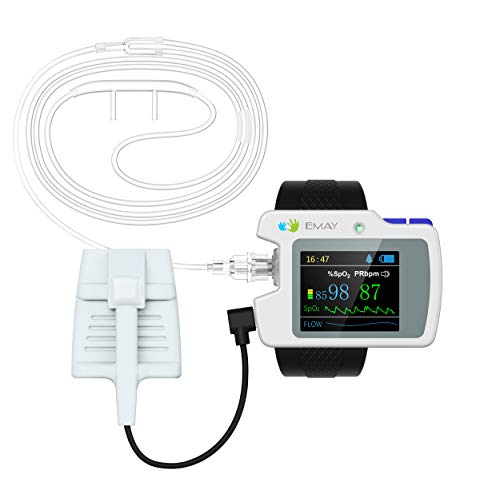
If you have ever felt tired after eight hours in bed and wanted proof of why, this is the device built for that exact question. It pairs a wrist recorder with a soft silicone finger sensor that stays put all night, plus nasal tubes that measure your breathing flow. The gentle tube design is made to tolerate longer wear without turning uncomfortable. You set it to record, go to sleep, and download the whole night to a PC in the morning.
Battery life is 15 hours, which comfortably covers a full night even if you start the recording early. That outlasts the 12 hours the Vibeat WearO2 below runs, and the extra margin is exactly what you want when a session drags past sunrise. Where this pick pulls ahead is depth — a 70-100% measuring range, minute-by-minute detail, and a report that automatically flags apnea, hypopnea, and desaturation events. Buyers report the recording regularly runs longer than a night: as owners put it, it “Records 20hrs, downloads to PC for analysis/report.”
The free PC software is where the real work gets done. It generates an AHI and ODI report you can export as a PDF and hand straight to a physician. What wins people over most is accuracy, and the data depth behind it. The trade-off is that the disposable sensors are the weak link — the reusable probe is the reliable one, and a few owners needed a strip of medical tape to keep a sensor seated. The two-button interface also takes a few nights to learn.
What earns it the top spot
- Flow tracking catches apnea events that a pure oxygen reading would miss
- 15-hour battery covers a full night with margin to spare
- Free PC software exports a shareable AHI and ODI PDF report
- Silicone finger sensor stays on without slipping
Where it asks a bit more of you
- No Wi-Fi or Bluetooth — you sync over USB, and files are proprietary
- Disposable sensors are less dependable than the reusable one
- The software is technical and takes patience to learn
Grab this one if: you want airflow plus oxygen recorded together and a report you can print for a doctor.
Think twice if: you would rather glance at your phone than sit down at a PC to see your night.
2. Vibeat WearO2 Pulse Oximeter
A soft silicone ring that tracks your oxygen for hours, nudges you when levels dip, and weighs barely anything on your finger.
The WearO2 is aimed at people who want long recordings without a wrist box strapped to their arm. Its patented soft silicone ring sensor slips over a finger and is shaped to avoid the sore, numb feeling that stiffer clips create. Real-time readings show on the device screen and in the free ViHealth app, which works on both Android and iOS and integrates with Apple Health. If you ever want a quick check, the screen handles that too.
Battery life is 12 hours, and the model name promises continuous tracking across that window. That is shorter than the 15 hours the EMAY above delivers, so if your nights run long, plan your charging around it. The built-in memory stores 4 sessions of up to 10 hours each and overwrites the oldest once full, so you can leave your phone in another room and sync later. You can set a vibration threshold and adjust the intensity, so the ring buzzes when your oxygen drops below your chosen number.
It is honest about what it is — a device marked for sports and aviation use, not medical diagnosis. A couple of owners have had one that would not power on after charging, and some question the readings against a fingertip meter. Fit is the other wild card, since the ring-band can stretch with heavy use.
What it nails: the ring format plus a free app that exports PDF reports per session makes it easy to compare nights.
One thing to know: treat it as a wellness tracker, not a diagnostic tool, and keep an eye on the band tightness over time.
Best fit for: someone who wants a lightweight finger ring and app-based history without lugging a wrist unit.
Look elsewhere if: you need readings long enough to replace a full diagnostic sleep study.
3. HealthTree JKS50F Pulse Oximeter
A rechargeable fingertip monitor that lets ten different people keep their own records on the same device.
This is the pick for a household where more than one person wants to track their oxygen. It runs 10-user mode, so each person gets their own slot and can store up to 300 sets of data with date and time stamps. It reads fast — results in as little as 5 seconds. Battery life is 18 hours, the longest among the clip-style monitors here, and it recharges instead of eating disposable batteries.
The alerts are genuinely useful. When your SpO2 drops below 90 or your heart rate falls below 50, the device sounds an alarm and flashes the reading until you press the button to silence it. It has two record modes, point test and trend test, so you can take a one-off reading or run a continuous log. Bluetooth pairing to your phone lets you print or share the data. Stated accuracy is +/-2%, with a 70-100% SpO2 measuring range.
One caution: during the night, a single device has limits. A few owners mention units that quit working after a couple of weeks, and the buttons take some getting used to. The screen is not the brightest, either, so cleaning the fingertip before a session matters for a clean reading.
The household angle: 10-user mode plus 300 stored records per person is a genuine convenience no ring-style monitor here offers.
What to watch: because a single reader sits on your finger, a long overnight log depends on it staying put — check fit before bed.
Choose this if: several people in your home want their own tracked readings from one shared oximeter.
Step up if: you mainly want unattended all-night recording — a ring sensor stays put more reliably.
4. Vibeat OxyRing
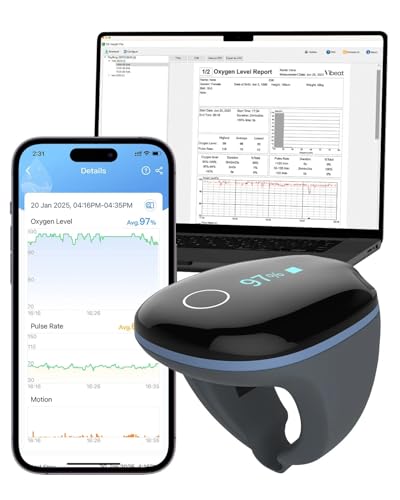
Raise your hand to wake the screen — a ring that runs automatically and hides in plain sight while you wear it.
Wear this and it starts recording on its own. There is no button to remember, and the display stays off until you lift your hand to check a reading. It tracks blood oxygen, heart rate, and body motion continuously for up to 12-16 hours after a full charge, then syncs everything to the free PC software and app. It fits finger circumferences of 2 to 3.2 inches, which covers most adult fingers. The soft silicone ring is built for all-day wear without drawing attention.
The reporting side is thorough for the size. You get unlimited downloading and sharing of PDF, CSV, and binary records, including an O2 score plus max, minimum, and average oxygen and pulse rate. It also integrates with Apple Health. You can set your own thresholds, and if your level crosses them, the ring vibrates while the app beeps. Because the ring stores 4 groups of 10-hour data on board, a night away from your phone is not a problem — it uploads automatically the next time you connect.
Two honest notes. The battery is rated for 2 years but is sealed in, so the ring has a finite life. And it can read on the low side, so treat its numbers as a trend, not a diagnosis. The patent ring sensor keeps it comfortable either way.
The win: automatic recording means no missed nights, and a full set of PDF and CSV exports comes free with the app.
Know before you buy: the sealed 2-year battery cannot be swapped, so plan for the ring’s useful life rather than a lifetime.
Pick this if: you want a shape-discreet ring that logs all day without you thinking about it.
skip it if: you expect the same runtime as the longer-lasting wrist monitor further down this list.
5. LOOKEE Ring-Pro Wearable Oxygen Monitor
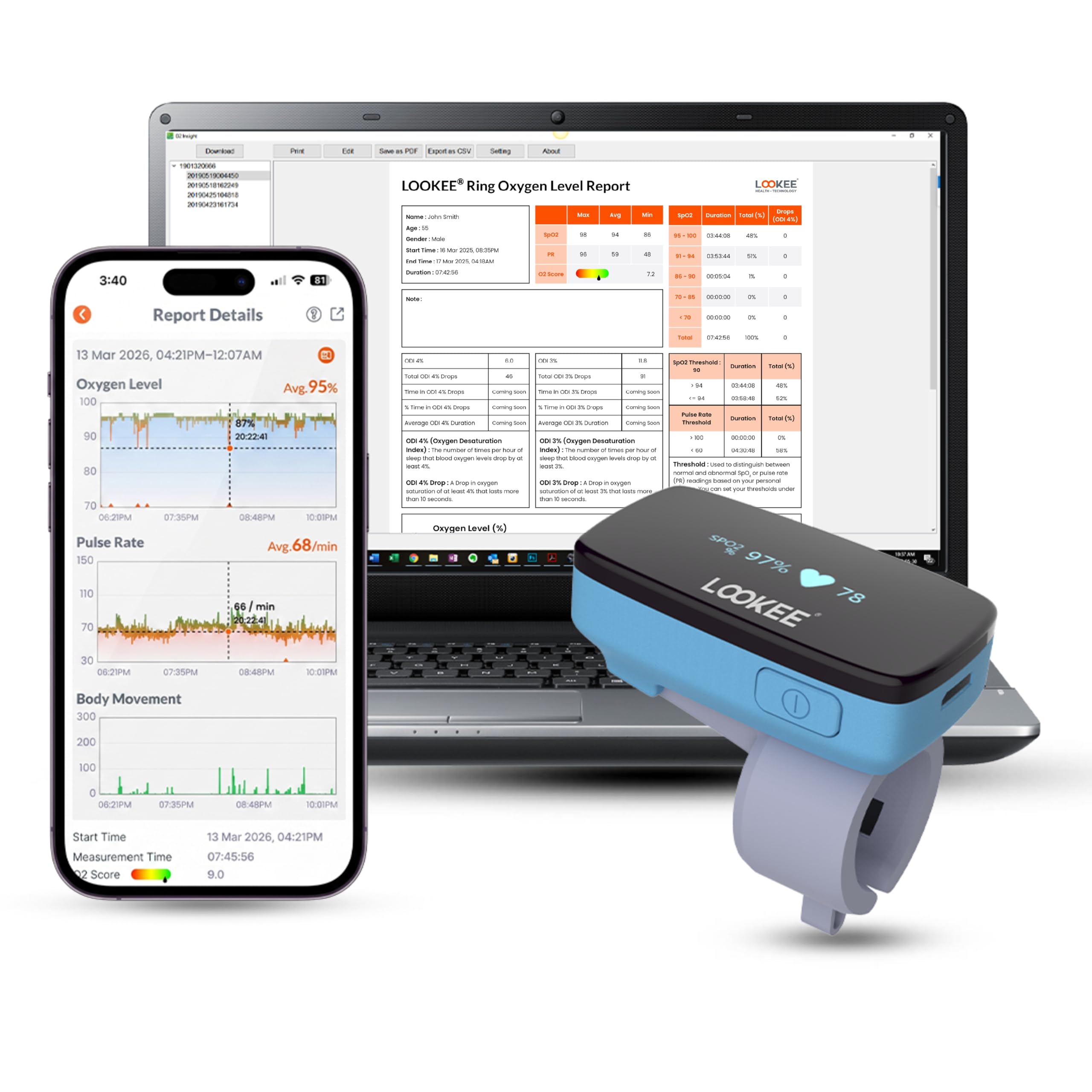
A soft sensor ring built for round-the-clock tracking, with a gentle buzz that taps your finger when oxygen dips.
The Ring-Pro is set up for all-day use, tracking oxygen, pulse rate, and body motion continuously for up to 16 hours per charge. That is the longest single-charge window among the finger-ring models here. The patented soft silicon sensor ring is designed to be light and comfortable enough to forget you are wearing it. This is the pick that goes beyond a bed-side tool — it is built for tracking across your whole day, not just overnight.
The vibration reminder is the centerpiece. When your oxygen falls below the threshold you set, the ring buzzes directly on your finger, so you do not have to be watching a screen. The free mobile app and PC software give you graphic oxygen and pulse reports, and you can export unlimited PDF and CSV files to share. On the compatibility side, the app works with iOS 9.0 or above on iPhone 4s and iPad 3 or newer, and Android 5.0 or above. Built-in memory holds up to four sets of 10-hour data and uploads automatically when you connect.
It has been on the market since July 3, 2019, and one owner has stayed with the same line across four replacements over ten years. Reliability is the honest caveat: some units have turned themselves off mid-session, and a shorter wearer may notice it stops recording after about 10 hours unless a longer session is set. Read the setup carefully before your first full night.
The draw: 16 hours per charge plus on-finger vibration alerts make it a true all-day tracker, not just a sleeper.
The honest catch: it depends on snug ring fit to be accurate, and a loose or oversized finger can wobble the reading.
The right buyer: someone who wants continuous tracking through the day with a tap-on-the-finger low-oxygen nudge.
Prefer another pick if: you want the highest sample resolution — the ring with 200Hz sampling later on records more granular detail.
6. Wellue O2Ring-S

The overnight-resolution leader — a ring that samples faster and runs longer than almost anything else in this lineup.
This is the pick for someone who wants the finest detail their ring can capture. An upgraded chip samples data at 200Hz, which the maker says translates to up to 36,000 sampling points per report. The point of all that resolution is simple — you see the small dips and quick recoveries a coarser sensor would smooth over. The ring fits a finger perimeter of 2.17″ to 3.15″ (55-80mm), and the compact design keeps it portable. Wear it and it starts measuring automatically.
Battery life is 24 hours, the longest of any ring here and double the 12 hours the Vibeat WearO2 offers. That full day of runtime means you can record an overnight session and still have charge left for the next night without a mid-day top-up. It stores 4 sets of 10-hour data on board and syncs them to the ViHealth app and O2 Insight Pro software automatically. You can set a SpO2 and heart-rate threshold, and the ring vibrates and flags the event in the report when you cross it. Reports export as PDF or CSV.
On the downside, the charging cable is proprietary rather than a standard USB-C, so a lost cable means a replacement order. The one-size ring fit runs loose on some fingers and snug on others, and a periodic sync hiccup has frustrated a few users. Still, for raw recording quality, the monitoring and data-display side is what owners call out — it captures more detail per night than most rivals.
Why it leads on data
- 24-hour battery — the longest runtime of any ring in this guide
- 200Hz sampling yields dense overnight detail
- Vibration reminder tripped by your own oxygen and heart-rate thresholds
- Free app and PC software with PDF and CSV exports
What to expect going in
- Proprietary charging cable, not a standard USB-C
- One-size ring can sit loose or tight depending on your finger
- Wireless sync occasionally needs a restart
The clear choice for: anyone who wants the most detailed overnight oxygen record and a full day of battery.
Aware of: the custom cable — keep it somewhere you will not lose it.
7. CMI Health CH-100 Handheld Pulse Oximeter
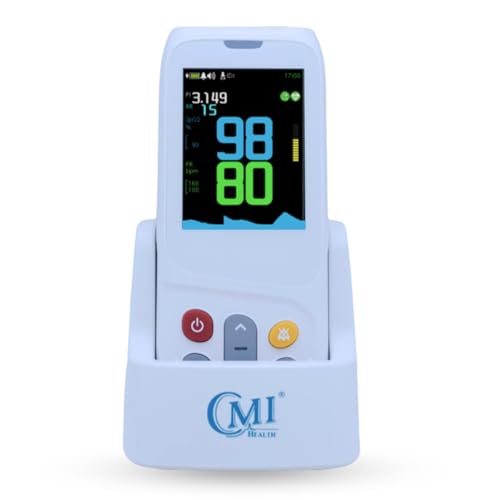
A handheld base station that pairs with five different sensor types, so you can monitor oxygen, pulse, and breathing rate your way.
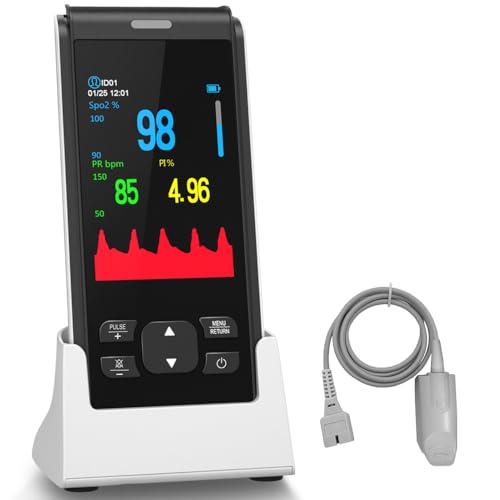
Swap the sensor instead of buying a whole new monitor — the CH-100 pairs with 5 different sensors, including Nellcor forehead and earlobe options. Most monitors in this guide lock you into one sensor. It reads SpO2 (blood oxygen saturation), respiration rate, pulse rate, and perfusion index. Perfusion index tells you how strong the pulse signal is at the sensor, which is useful when circulation is weak. That flexibility is why it earns the most-versatile label here. The 3.2″ touchscreen is bright and easy to read.
You can record for months without erasing anything — 1440 hours of continuous oximetry storage, so you can record and recall data across a very long stretch without wiping it. For raw documentation volume, no ring in this guide comes close. Its sensors are built to read low perfusion (weak blood flow at the sensor) and to hold accuracy across skin tones. Anti-motion features reduce the effect of movement during a reading. A carry case and charging station are included, and free PC software lets you manage and share your data.
The honest catch is the sensor ecosystem. The included sensor is not built for overnight monitoring, and a compatible overnight sensor has been hard for some buyers to source on the usual channels. A few customers note units that stopped charging after a few months, and customer support has been slow to answer for some. Screen size and touch controls are still a clear plus for daily spot checks.
The flexibility story: five sensor options plus 1440 hours of storage give you more monitoring shapes than any single-format device here.
Do your homework first: confirm the exact sensor you want for overnight use is in stock before you buy, because the included one is aimed at spot checks.
For you if: you want to swap sensor types and keep a long continuous record from one handheld unit.
Cross it off if: you want a simple, self-contained overnight recorder with no accessory hunting.
8. Wellue Wrist Pulse Oximeter
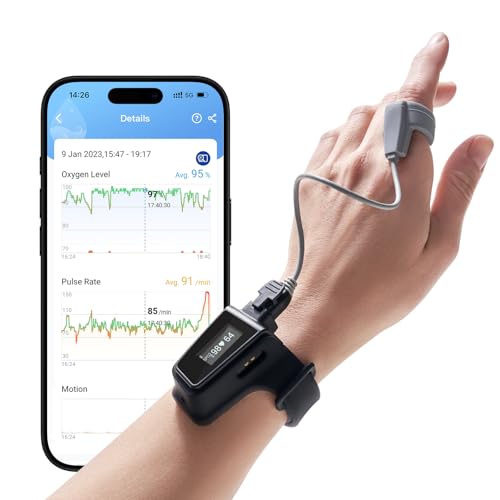
A wrist monitor with the longest battery in this whole guide — a full charge lasts up to 100 hours of continuous use.
If charging something every night sounds like a chore, this is the pick. A 2-hour charge buys up to 100 hours of continuous use, which dwarfs every other monitor here. That is more than four times the runtime of the 24-hour Wellue O2Ring-S above, and it means one charge can carry several nights. The wrist-worn design keeps the recorder off your hand, and the display is built to be easy to read at a glance. It stores up to 4 full 12-hour sessions on the device itself.
Alerts come two ways — the monitor vibrates and beeps when your oxygen or pulse rate falls below your preset level, and you can adjust both the vibration and sound intensity. Reports cover SpO2, pulse rate, and motion, and you can share them through the free ViHealth app on iOS and Android or the O2 Insight software on Windows and MacOS. The idea is to hand a doctor a real graph rather than describe how you felt. It is marked for sports and aviation use, not medical diagnosis.
Fit is the recurring gripe. The wristband takes effort to put on and secure one-handed, and a few owners found the readings inaccurate or the clasp too loose. The app itself gets steady praise, and the long battery means fewer chances for a mid-session dropout.
Standout spec: up to 100 hours of continuous use per charge is the single longest runtime in this entire lineup.
Fit note: the wristband is fiddly to fasten alone — check it sits firmly before you fall asleep.
Ideal for: multi-night recording where charging every evening is not realistic.
Heads up: the strap takes practice one-handed — not the quickest to slip on solo.
9. Nonin TruO2 OTC Pulse Oximeter 3250

A spot-check oximeter cleared by the FDA for home use, built to read accurately across skin tones and cold fingers.
This one plays a different game from the rings above. It is FDA-cleared for over-the-counter home use, no prescription required. Nonin’s PureSAT technology is built to hold accuracy across skin tones and in low circulation or cold fingers, where cheap oximeters tend to fail. Smart design touches include automatic on/off and a bright, easy-to-read LED display.
Nonin CorrectCheck is a genuinely helpful feature — it instantly alerts you if your finger is not positioned correctly, so you know to adjust before trusting a number. That removes the most common cause of bad readings. You get wireless data sharing through secure Bluetooth to compatible iOS devices, and you can save or email readings with Apple Health or the NoninConnect app. It runs on two included AAA batteries, and the maker says that covers up to 2,200 spot checks. It is made in the USA and carries a 2-year warranty.
Where this differs from everything above: it is a spot-check tool, not an all-night continuous recorder, so do not expect a sleep graph. Owners who value accuracy for health-critical use call it worth it, while some find the plastic body feels less sturdy than expected and note the lack of a lanyard.
The accuracy angle: a device built to read correctly when your fingers are cold or circulation is poor, plus a check that tells you when positioning is off.
Buy it for the right job: this is a spot-check tool, so for a full night’s recording you still want one of the ring or wrist monitors above.
Made for: quick, trusted readings on tricky hands where cheap oximeters give inconsistent numbers.
Not the one for: overnight continuous tracking — that job belongs to the recorders earlier in this list.
Know the Specs
SpO2 and pulse rate
SpO2 is your blood oxygen saturation — the percentage of oxygen your red blood cells carry. These monitors typically read a range of 70-100%, and some list accuracy around +/-2%. Pulse rate is your heartbeats per minute, and most units track it alongside oxygen. When you compare models, look at the measured range and the stated accuracy together, because a wide range with a loose accuracy figure tells you less than a tighter one.
Battery life and built-in memory
Battery life decides how long a monitor can run without a charge, which is the difference between covering one night and covering several. Built-in memory is the safety net — it lets the device keep recording when your phone is out of range, then sync later. Devices here store anywhere from 4 sessions up to 1440 hours of data, so pick based on how often you want to sync.
Sensor type and fit
Sensor type drives comfort and how well a reading holds overnight. A fingertip clip is quick to use but can loosen. A soft silicone ring wraps the finger and tends to stay put, but depends on a snug fit. A wrist unit moves the recorder off the hand entirely. Finger circumference and wristband design both matter, so check the stated size range before you buy.
Alerts and reports
A vibration or audio reminder tells you in the moment when oxygen or pulse crosses a threshold you set. The reporting side is where the data becomes useful — a graphic report you can export as PDF or CSV is what you hand to a doctor. Check whether the app and PC software are free, and whether the platform integrates with Apple Health if that matters to you.
Common Questions
Is a continuous oxygen monitor the same as a fingertip pulse oximeter?
Can I wear a continuous oxygen monitor all night?
How long does the battery last on these monitors?
Will a continuous oxygen monitor work if I have cold fingers or poor circulation?
Do I need my phone nearby to record overnight data?
Are these oxygen monitors medical devices?
Can two people use the same continuous oxygen monitor?
What is AHI and ODI data on an oxygen report?
Can I export my oxygen data to share with a doctor?
Does a ring monitor fit every finger size?
The Bottom Line
If you want to catch the breathing events behind your oxygen dips, the EMAY SleepO2 Pro is the strongest continuous oxygen monitor choice for most people, because it is the only pick here that records your airflow alongside your oxygen, so it can flag the breathing events a plain oxygen reading would miss. If you want the finest overnight detail, the Wellue O2Ring-S is the one to reach for, with its 24-hour battery and 200Hz sampling (200 readings per second). And if simple, accurate spot checks on cold or tricky hands are all you need, the Nonin TruO2 OTC 3250 is the honest choice. Whatever you pick, confirm the size range and battery hours fit your routine before you commit.
How we choose
We do not accept paid placement. Every pick is matched to a real buyer and a real use-case; we do not hands-on test units.
Sources
Specifications: manufacturer listings and product documentation. Review insights: verified customer reviews, as of October 2026. Pricing: not shown on this page (it changes often); check the current price via the retailer link.
As an Amazon Associate, Aappliancez earns from qualifying purchases. This does not affect which products we feature.