Disclosure: Some links in this post are affiliate links. As an Amazon Associate I earn from qualifying purchases, at no extra cost to you. Learn more
Specs are compiled from manufacturer listings and verified buyer reviews and can change over time — please confirm the key details on the product page before buying.
Sticky residue is stubborn, and the wrong remover can dull a finish, lift paint, or leave an oily film behind. What you actually want is a remover that dissolves the glue, leaves the surface looking untouched, and comes in a size that makes sense for how often you reach for it.
This guide is built by comparing the manufacturers’ published specifications and the patterns across verified customer reviews, so you get each pick’s real strengths and trade-offs instead of marketing spin.
Some formulas are built for paper and delicate finishes, others for baked-on tape on metal and vinyl, and a couple are mild enough for skin. This breakdown of the glue adhesive remover options walks through what each one is genuinely good at.
Top Picks

How To Choose The Best Glue Adhesive Remover
Before you buy a bottle, answer two questions. What surface are you cleaning, and how much glue are you dealing with? Those two answers narrow the field faster than any ingredient list.
Match the formula to the surface
A solvent strong enough to chew through baked-on tape can also eat a factory finish if you leave it sitting. A gentle, non-acetone gel is safer on plastics and matte coatings, but it works slower and needs time to soak in before you wipe.
For painted metal, vinyl, and glass, a purpose-built automotive solvent tends to be the safer pick. For paper, card stock, and archival prints, look for a formula described as non-toxic and acid-free, since those are the words that signal it will not yellow the paper over time.
Pick the form that stays where you put it
Liquid removers flow into flat surfaces but run down a vertical one. Gel formulas hold their shape, which is why they work better on corner edges, door frames, and anything you are cleaning while standing up.
Aerosol sprays cover large areas quickly but reach the surface thin, so you often need several passes. If your job is a long flat stretch of tape residue, spray wins. If it is a tight corner or a single drip, a brush cap puts the product exactly where it needs to go.
Think about volume against how often you use it
A large bottle is the better value if you clean often, because refilling small bottles costs more per ounce over time. If you only pull the remover out a few times a year, a smaller bottle stays fresher and takes up less shelf space.
Side-by-Side Comparison
| Model | Best For | Volume | Form | Weight | Amazon |
|---|---|---|---|---|---|
| Un-du 32 Ounce Commercial Framing Adhesive Remover★ Best Overall | Paper, craft and heavy use | 32 fluid ounces | Liquid | — | Amazon |
| 3M Adhesive Remover, 12 oz.Top Performer | Automotive trim and paint | 12 ounces | Aerosol | 12 ounces | Amazon |
| ORANGE-SOL 10022 Contractor Solvent | Silicone, tar and household mess | 12 ounces | Liquid | 3.2 ounces | Amazon |
| Starbond 2 oz. Super Glue Remover | CA glue and tight spots | 2 ounces | Gel | — | Amazon |
| Goo Gone Gunk and Adhesive Remover | Everyday household sticky messes | — | Liquid | 7.83 ounces | Amazon |
Detailed Reviews
1. Un-du 32 Ounce Commercial Framing Adhesive Remover
Our pick — over 4.5★ from 600+ verified ratings; the strongest balance of quality and price.
A 32-ounce acid-free bottle that lifts price tags and mounting tape off paper without marking the stock.
The Un-du Commercial Framing Adhesive Remover is the one to reach for when you are working on something you cannot afford to ruin — vintage posters, photo prints, fabric, leather, and wall art. It holds a 4.8-star rating, the highest score on this list, and that reputation is built on one thing: a patented formula that lifts stickers, tapes, and labels on contact and leaves no residue behind. The 32 fluid ounce bottle is the other headline. You are getting a commercial-size fill in a single pour, which suits anyone who clears labels, price tags, and mounting tape on a regular basis.
The built-in scraper tool is a genuinely useful addition. You lift the edge of a sticker and work it away without hunting for a separate blade, which matters on delicate paper where a hard metal edge would cut straight through. What wins people over most is the adhesive removal itself — the bottle earns its reputation on clearing residue from delicate and painted items, and papercrafters lean on it specifically because it does not damage the surface beneath. The acid-free, non-toxic formula is the part that matters if you frame art or handle archival paper. Amazon’s own review summary even names it a must-have for papercrafters, which tracks with the bottle’s intended job.
The catch is the scent. The formula is alcohol-based, and some buyers find the smell strong enough that you want ventilation while you work. That is the honest trade-off for the speed and gentleness, and it is worth knowing before you pour it onto a big job indoors.
What It Does Well
- Lifts stickers, tape, and mounting adhesive on contact with no residue left behind.
- Acid-free and non-toxic, so it is safe on archival paper and card stock.
- 32 fluid ounce bottle lasts far longer than standard countertop-size bottles.
- Built-in scraper lifts sticker edges without a separate tool.
What To Know First
- The alcohol-based scent is noticeable — work near an open window.
- No precision dispenser tip; the wide bottle can pour faster than you want.
- Best suited to paper, fabric, and craft work rather than heavy automotive tar.
Buy it for: Anyone clearing labels and mounting tape off paper, frames, or fabric who needs a big bottle that lasts.
Hold off if: You want a spray for large flat metal or vinyl jobs where an aerosol reaches the surface better.
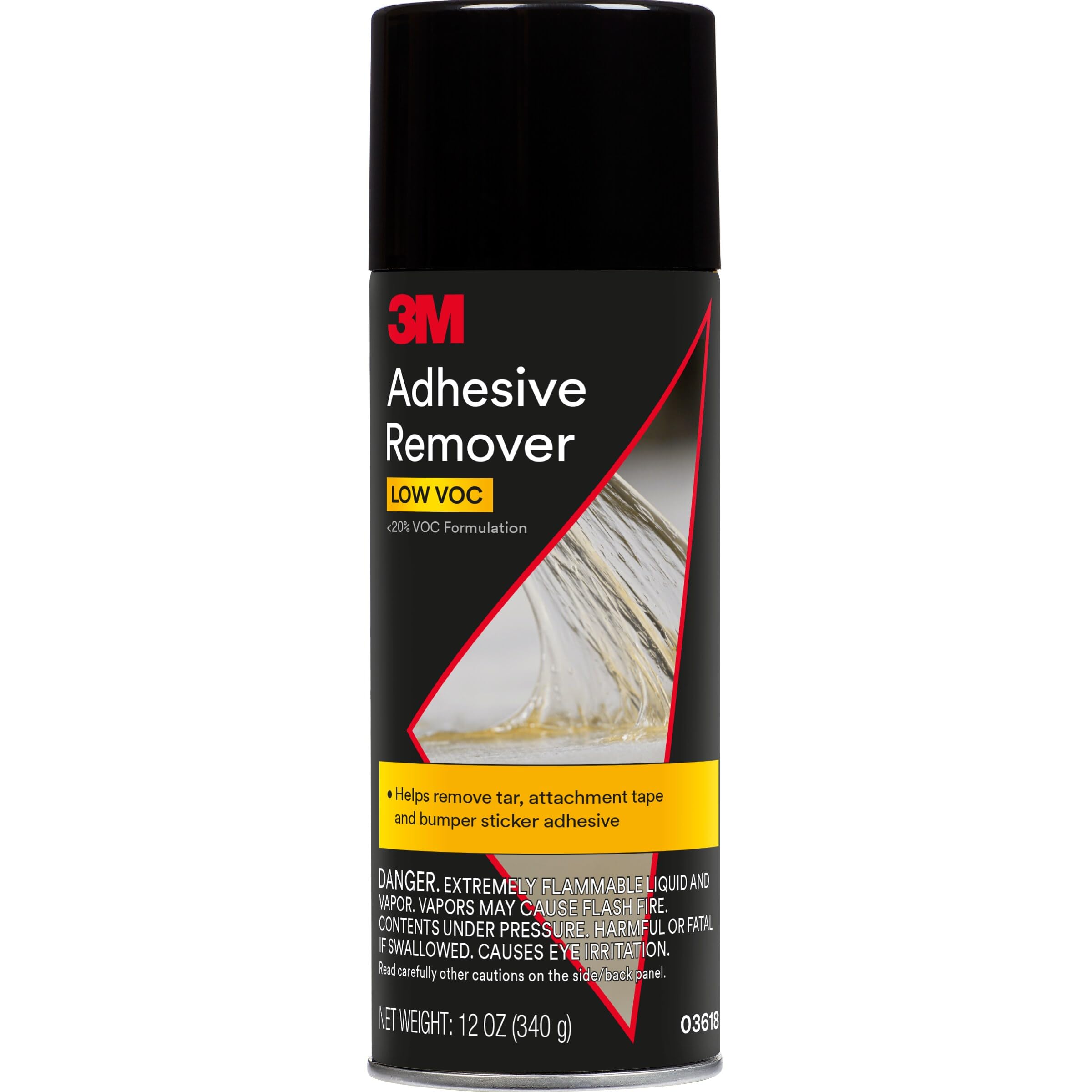
2. 3M Adhesive Remover, 12 oz.
An aerosol that dissolves sun-baked duct tape adhesive off cured car paint in one firm pass.
If your mess is baked-on tape on a car door, a magnetic screen frame, or a boat hull, this is the bottle that does the heavy lifting. The 3M Adhesive Remover blends non-abrasive solvents that dissolve adhesive residue without harming cured paint, and it is rated safe for nearly all cured automotive paints and works on glass and vinyl too. It is a full 12 ounces in an aerosol can, and it is one of the bigger physical packages here — noticeably taller and wider than the ORANGE-SOL 12 ounce bottle, which measures 0.3 x 5.3 x 9 inches.
Owners are clear on what it beats. It handles old sun-baked adhesive that generic citrus cleaners have failed on, and it does it fast — one firm case describes wiping old duct tape residue off a car as easily as dry-erase marker. Another arc says it removed all residue from two doors in about an hour using a plastic scraper, with the note to use plastic rather than metal on vinyl frames so you avoid scratches. On the strength front, it tends to outwork the citrus-type competitors on dried gunk, though it is also pricier per can than the citrus options.
Two things to know before you spray. Some surfaces need more than one application to fully clear, so budget for a second pass on old residue. And because the spray reaches the surface light unless you hold it close, vertical jobs tend to work better than soaking a flat puddle. The low VOC formula is a plus if you work indoors.
Under the hood: An aerosol blend of non-abrasive solvents that dissolves adhesive without damaging cured paint — which is why it is the safe bet on car paint, glass, and vinyl.
What you trade off: It costs more per ounce than the citrus formulas, and it needs a second application on stubborn old residue.
Pick it for: Auto trim, boat hulls, and any cured-paint surface where you need the strongest fast-acting spray.
Choose something gentler if: Your target is a powder-coated or plastic trim piece — stronger is not always safer there.
3. ORANGE-SOL 10022 Contractor Solvent, 12 oz.

A non-corrosive citrus solvent for silicone, tar, and spray foam on skin, clothing, and aluminum siding.
The ORANGE-SOL 10022 Contractor Solvent earns its place because it is non-hazardous and non-corrosive, and it is safe to use on a variety of surfaces including skin and hair. That is a rare combination — it means you can tackle silicone, oil paint, spray foam, tar, bugs, and asphalt sealant off skin, clothing, and aluminum siding without fear. At just 3.2 ounces it is the lightest bottle here, and at 0.3 x 5.3 x 9 inches it is a slim, tall container that takes up little shelf space.
The citrus-based formula is slow but paint-safe, which is the key difference from the 3M bottle in this list. As one buyer testing it against a powder-coated metal surface put it, the more aggressive options will eat the coating while Orange-Sol takes longer but leaves it intact — and for silicone on aluminum RV panels it works without harming the paint. The proven method is to heat the seam, spray, wait about 15 seconds, then scrape with a plastic tool.
There are two things to watch. If you use it on brick or porous stone, buyers report it can darken the surface and require a scrubbing-and-rinsing pass to restore the color — so spot-test anything porous first. And the spray bottle itself tends to leak and drip over time, so store it upright and handle it carefully.
Where it wins: Its non-corrosive, non-hazardous makeup lets you spray it on silicone, tar, and bug residue without the finish risk that comes with harsher solvents.
Where it asks patience: It works slower than the 3M formula, needs a wait time before you scrape, and the bottle is prone to dripping.
Reach for this if: You are stripping silicone off an RV, cleaning tar off skin, or tackling a mix of messy jobs where a paint-safe formula matters.
Look elsewhere if: You want the fastest possible result on baked-on adhesive or a bottle that will not drip on the shelf.
4. Starbond 2 oz. Super Glue Remover

A brush-cap gel that puts a single drop of CA glue debonder exactly where the glue sits.
The Starbond Super Glue Remover is built for one job: undoing CA glue (cyanoacrylate — the fast-curing stuff in most super glue bottles). The gel formula stays put instead of running or dripping, and the built-in brush cap lets you reach corners, edges, and gaps with a targeted drop. That matters because a runny debonder will spread the glue you are trying to remove across a wider area, and that problem shows up in the owner reports.
Where it shines is on hard, non-porous surfaces. Owners mention clean wins on metal, ceramic, plastic, wood, and — in one notable case — textured car dashboard plastic that came away without melting, stripping, or discoloring the matte finish. Another use case that stands out is faux wood laminate: a single drop restored a hazy white super-glue mark on a desk back to new. The gel also holds its position on eyeglass lenses, and one owner reported restoring clarity there.
The honest limit is what the gel will not do. It is a mild, non-acetone formula, so it is less harsh and damaging than the acetones — which also means it does not give instant results. You apply it, walk away for roughly 10 to 15 minutes, then wipe the softened glue off. Porous materials like synthetic leather can soak it up and leave the glue lump in place, which is why you should spot-test before committing. Fingernails and skin are a documented strong suit; furniture foam and clothing are not.
Gel over thin liquid: Because the product holds its shape rather than running, you can treat a single drip on a vertical surface without it spreading to the surrounding finish.
Patience required: The mild non-acetone formula needs a soak window before it works — expect to leave it in place roughly a quarter of an hour, not seconds.
Ideal for the model builder or repairer: Someone who needs surgical control on metal, plastic, glass, or laminate and wants to protect the surface around the glue.
Not the tool for porous fabric or foam: The gel can soak in and fail to release dried glue from those materials.
5. Goo Gone Gunk and Adhesive Remover
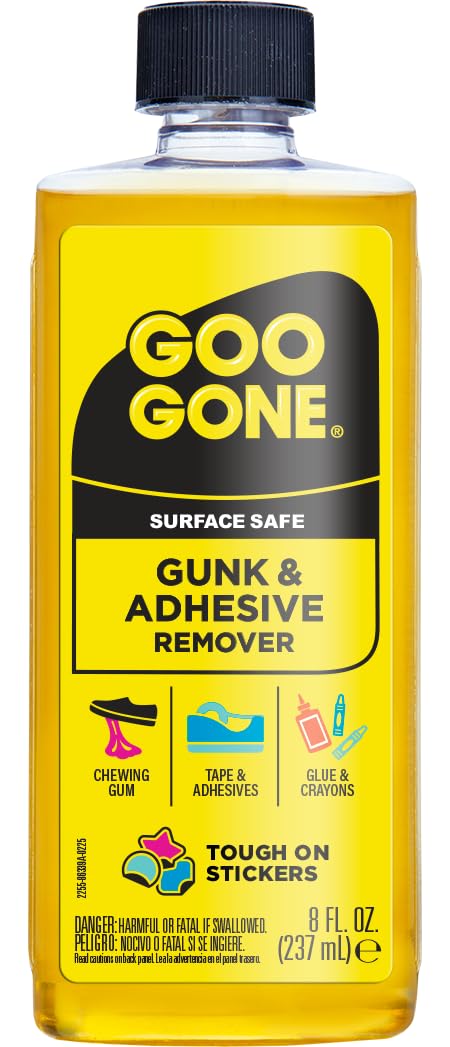
A citrus liquid that lifts rug-pad glue off hardwood in under five minutes.
Goo Gone Gunk and Adhesive Remover is the recognisable name for everyday sticky jobs, and it earns its spot on versatility. The citrus cleaning agents dissolve gunk, adhesive, chewing gum, tape, stickers, glue, crayons, markers, scuff marks, candle wax, labels, and decals, and the manufacturer lists it as safe on carpets, fabrics, hard surfaces, dinnerware, tables, cars, wine glasses, drinking glasses, and clothing. That is a long list of surfaces for one bottle, and it is why it lands on so many shelves.
What wins people over is speed on real household messes. The signature owner story is a rug that was stuck to hardwood with a grip pad — the glue would not come up with anything else, and the Goo Gone lifted it in under five minutes without ruining the floor. The brand also has a documented win on iron-on adhesive remnants on a nylon bag, where the residue came away immediately after everything else had failed. Apply it to the spot, let it sit a few minutes, then wipe with a cloth or paper towel.
On the trade-off side: this formula is not for every surface. The brand does not flag it as safe on painted or varnished wood, so it pays to test a hidden corner first. It is also not the bottle to reach for if you specifically need a debonder for cured CA glue in a tight corner — that is a job for the gel-type formula in this list.
Why it stays in the rotation: A citrus formula versatile enough to handle carpet, fabric, hard surfaces, dinnerware, cars, and clothing from one bottle.
Know before you pour: It is not positioned as safe on painted or varnished wood, and it is not designed for cured CA glue — spot-test and use the right tool for the job.
Best fit for the generalist: Anyone who wants one bottle in the cupboard that handles stickers, gum, tape, crayon, markers, and everyday sticky residue.
Wrong tool if: You are specifically undoing cured super glue in a tight spot or cleaning a delicate paper surface.
Know the Specs
Why Volume Matters
A larger bottle costs less per ounce over time, so the 32 fluid ounce Un-du makes sense if you clean often. If you only reach for a remover a few times a year, a smaller bottle stays fresher and takes less shelf space. Match the volume to how frequently you actually use the product.
Form: Gel vs Liquid vs Aerosol
Liquid flows into flat messes but runs on vertical surfaces. Gel stays put, which is why it works for corners and edges. Aerosol covers large flat areas quickly but reaches the surface thin and often needs a second pass. Pick the form based on whether your target is flat, vertical, or a tight spot.
Solvent Strength and Surface Safety
Stronger solvents dissolve glue faster but carry more risk to paint, plastic, and powder coat. A product labeled non-acetone or low VOC is a gentler option that works slower. The key question is not which is strongest — it is which is strong enough for your glue while safe for your surface.
Applicator Design
A built-in scraper, a fine brush cap, or a targeted spray nozzle each changes how much product you waste. A brush cap puts a precise drop exactly where the glue sits; a scraper lifts sticker edges without a separate blade. The applicator decides how controlled your cleanup will be.
Common Questions
Will adhesive remover damage car paint or a clear coat?
Is adhesive remover safe to use on skin?
How long should I let the remover sit before wiping?
Can adhesive remover be used on glass and vinyl?
Why does my adhesive remover smell so strong?
Does adhesive remover work on dried super glue?
Can I use adhesive remover on paper and photos?
What is the difference between a liquid remover and a gel remover?
Will adhesive remover leave an oily residue behind?
The Bottom Line
For most people, the glue adhesive remover winner is the Un-du 32 Ounce Commercial Framing Adhesive Remover, because its acid-free, non-toxic formula lifts stickers and tape off paper, fabric, and frames without leaving a mark, and the commercial-size bottle lasts far longer than a countertop one. If you want the fastest, strongest action on cured automotive paint or vinyl trim, grab the 3M Adhesive Remover. And for undoing cured super glue in a tight corner, the Starbond 2 oz. Super Glue Remover is the one to reach for. Match the bottle to the surface, spot-test a hidden corner first, and any of these will do the job.
How we choose
We do not accept paid placement. Every pick is matched to a real buyer and a real use-case; we do not hands-on test units.
Sources
Specifications: manufacturer listings and product documentation. Review insights: verified customer reviews, as of October 2026. Pricing: not shown on this page (it changes often); check the current price via the retailer link.
As an Amazon Associate, Aappliancez earns from qualifying purchases. This does not affect which products we feature.