Disclosure: Some links in this post are affiliate links. As an Amazon Associate I earn from qualifying purchases, at no extra cost to you. Learn more
Specs are compiled from manufacturer listings and verified buyer reviews and can change over time — please confirm the key details on the product page before buying.
Buy the fan that still moves air when you drop the speed low. Most fans that keep you up are not loud at top speed — they are loud at the speed you actually need overnight. A fan rated down around 27 dB (decibels, the unit used to measure how loud a sound is) can run beside your bed without drowning out your own breathing. A fan with a weak low setting pushes you up to a speed that keeps you awake. That low-speed quiet matters more than brand or price tier.
This guide is built by comparing the manufacturers’ published specifications and the patterns across verified customer reviews, so you get each pick’s real strengths and trade-offs instead of marketing spin.
The picks below cover bladeless towers, compact desk circulators, and full-height floor fans, all chosen for how quietly they move air. Read on for the specs that actually predict nighttime quiet, plus the air-flow and oscillation figures that tell you whether a silent fan will still cool the room. If quiet is your whole reason for shopping, this breakdown of the quietest fans starts with the number that matters most.
Top Picks


How To Choose The Quietest Fan
Every fan gets louder as you raise the speed. So the real question is not “is it quiet?” but “is it quiet at the setting I will actually use?” A fan that whispers on its lowest two speeds and turns into a small hurricane up top is doing exactly what it should. A fan that is only tolerable at its lowest setting has nowhere left to go on a hot night.
Start with the decibel floor, not the decibel ceiling
A decibel figure printed in the specs is usually the quietest the fan gets, measured in dB — the unit for sound level, where lower means softer. A fan that starts at 18 dB sits near the sound of rustling leaves. One that starts at 27 dB is still a soft hum you can talk over. What you want is a fan whose quiet floor is low enough that you can leave it running all night on speed one or two and still get a breeze.
Then check the airflow the quiet setting can deliver
Airflow is measured in cfm (cubic feet per minute — how much air the fan moves each minute). Two fans can both whisper, but one moves far more air while doing it. A high cfm number with a low dB floor is the real prize, because it means the quiet setting still reaches your bed. If the airflow figure is modest, look at oscillation and head-tilt instead: aiming a smaller breeze straight at you usually beats flooding the whole room.
Match the shape to the room
A tall tower fan stands on the floor and throws air across a room at chest and bed height. A compact circulator sits on a desk or nightstand and tilts to aim. If your bed is tall or your room is open-plan, a full-height tower earns its footprint. If you want to cool just your face at your desk, a small tiltable unit keeps the sound close but the air closer. Also weigh the low-speed mode: a night setting that dims the display and steps the speed down quietly is worth more than an extra top speed you will never touch.
Side-by-Side Comparison
Every column below is the same measurement across every row, so you can scan quiet floor, airflow, and oscillation side by side.
| Model | Best For | Quiet Floor (dB) | Airflow (cfm) | Oscillation | Amazon |
|---|---|---|---|---|---|
| GoveeLife 42 in. Tower Fan★ Best Overall | Smart whole-room cooling | 27 dB | 1515 cfm | 30°–150° | Amazon |
| Windmill Smart FanSilent Bedside Pick | Bedside and desk | 18 dB | 388 cfm | — | Amazon |
| DREO Tower Fan 307 | Bedroom value | — | 1158 cfm | 90° | Amazon |
| OmniBreeze 36 Inch Tower | Living room on a budget | — | 540 m3/min | Wide-angle | Amazon |
| Honeywell QuietSet HYF290B | Medium to large rooms | — | — | Oscillating | Amazon |
| Lasko Wind Curve T42951 | Tall bedroom tower | — | 262 cfm | 60° | Amazon |
| Shark TurboBlade TF202S | Hot sleepers, multi-room | — | 85 cfm | 180° | Amazon |
Detailed Reviews
1. GoveeLife 42 in. Tower Fan
Our pick — 4.5+★ from 950+ verified ratings; the strongest balance of quality and price.
The 42-inch tower that whisper-cools at 27 dB and still floods a room with 1515 cfm.
Here is the number that decides this pick: 1515 cfm of airflow — cubic feet per minute, meaning it moves more than fourteen hundred cubic feet of air every sixty seconds. The Windmill below pushes 388 cfm. That is a 3.9x gap, and it is why this GoveeLife is the one to buy if your room is large or your summers are brutal. It stands 42 inches high on a 12.9-inch square footprint, so it takes roughly the space of a dinner plate on the floor while throwing air at bed height instead of your ankles.
The quiet side holds up too. The brushless DC motor (a motor with no carbon brushes rubbing inside, which is where a lot of fan hum comes from) lets it run down to 27 dB — a soft, brushy hum you can talk over. Speeds one through three are the ones you will sleep on, and the twelve-speed range means you can creep up gradually as the night warms rather than jumping from whisper to gale. A 30° to 150° oscillation sweep (the adjustable arc it pans through) lets you park the breeze on your side of the bed instead of the wall.
Buyers report it cools across a room, not just directly in front of the tower. The app earns its place too: scheduling, voice control through Alexa, Google, and Siri, and an ambient light in adjustable colors. The catch is honest and worth naming: the bladeless design tops out in the low-20s on noise when pushed, and a portion of long-term owners have seen units stop working after a couple of months. The ETL certification (an independent electrical-safety stamp) and five-minute assembly are small bonuses on top.
Why it takes the top spot
- 1515 cfm gives it whole-room reach — nearly four times the airflow of the Windmill
- 27 dB quiet floor keeps speed one through three genuinely sleep-friendly
- Twelve speeds and five modes (including a thermostat-linked auto setting) stay in step with the room
- App, voice, and touch control with adjustable-color ambient light
- Removable grill and impeller make cleaning straightforward, plus an aromatherapy box
The honest trade-offs
- Noise climbs noticeably as you push past the mid speeds
- Occasional reports of units shutting down after a few months — weigh the warranty
- Does not support 5G Wi-Fi, so check your network band before buying
Reach for this if: you have a bedroom or living room bigger than a closet and you want one fan to move serious air quietly.
Look elsewhere if: you need the absolute lowest decibel at arm’s reach — the Windmill’s 18 dB floor beats it for bedside duty.
2. Windmill Smart Fan Ultra-Quiet 2-in-1 Air Circulator
An 18 dB whisperer that slips onto a nightstand and tilts the breeze right at your face.
If the only number you care about is decibels, this is the quietest fan on the list. Eighteen dB is close to the sound of a quiet library — about as hushed as a moving-air machine gets without going silent. The five-speed range is split with intent: Whisper, Low, and Medium work as a cooling desk fan, while High and Boost switch it into an air circulator that pushes 388 cfm. That is the honest counterweight to the GoveeLife above — you get one-tenth the airflow, but the floor is nearly ten decibels lower.
The size is the whole appeal for nightstands. At 10.71 inches tall and two and a half pounds, it disappears onto a small table and tilts to aim. The weighted base holds firm, which is the sort of thing that matters when you knock a table reaching for water at 3 a.m. Control is flexible: app, soft-touch buttons, remote, and voice commands, and it remembers your last setting so you do not fiddle with it every night. As one happy buyer put it: “Love these. Small and sufficiently powerful.”
Quiet is the headline here — owners rate the hush above everything else. The catch: the quiet fades at speeds four and five, and with no oscillation the breeze stays where you point it. Think of it as a personal cooler rather than a room-wide fan. For a sleeper who wants a breeze on the pillow and nothing else, that trade-off is a fair bargain.
The bedside argument: it runs at 18 dB at its lowest setting (about as soft as a whisper), so it can sit close to your head without waking you. The two-and-a-half-pound body fits a nightstand, and the head tilts to put the airflow where you want it. That makes it the quietest option here for a fan parked right by the bed.
What it will not do: with 388 cfm and no oscillation, it cools a person or a small room, not a whole living space. Above the halfway speed, the whisper turns into a normal fan hum.
Best fit: a light sleeper who wants the hush of a library and a personal breeze, not room-wide circulation.
Not for you if: you need a fan to cool a large bedroom from across the room — its airflow is aimed, not broadcast.
3. DREO Tower Fan for Bedroom, 28ft/s Velocity

A DC-motor tower that throws air 34 feet and still hushes down for sleep mode.
The DREO’s quiet trick is the same one the GoveeLife uses: a brushless DC motor (no brushes rubbing, so less mechanical hum) combined with an impeller shaped to cut turbulence. The result is a fan that runs near-silent until you push past speed three or four, then finally starts to let you hear it. Eight speeds and four modes — Normal, Natural, Sleep, and Auto — give you room to step the airflow up gradually instead of snapping from off to loud. The reach is generous for the footprint: airflow tops out at 28 feet per second and projects 34 feet, so a bed across the room stays in the stream.
Where this one earns its spot for a lot of people is maintenance and long-haul value. The rear grille and impeller come off so you can actually clear the dust that quietly chokes a fan’s airflow over months. A 90° oscillation sweep spreads the air, and the safety package — a pinch-proof grille, fused plug, and ETL certification — is reassuring in a house with kids or pets. Speeds reset to four after a power blip, which is a smarter default than starting back at full blast.
The realistic caveat: in a genuinely large room you will be working the higher speeds, and that is where the quiet gives way to ordinary fan noise. It is best suited to a bedroom or a modest living space where the mid speeds do the job. For the money, the combo of a quiet DC motor, washable grille, and real reach is hard to argue with.
Where it shines: a DC motor for quiet running, 8 speeds and 4 modes for fine control, and a removable grille and impeller that let you clean it instead of replacing it. The 90° sweep and 34-foot reach cover a standard bedroom easily.
The trade-off to know: the hush is real on the low and mid settings but fades as you climb, so a very large room may push it into audible territory.
Pick this for: a bedroom or home office where you want quiet DC-motor running and a fan you can actually clean.
Pass on it if: your space is big enough that you will live on the top speeds — that’s where the quiet advantage narrows.
4. OmniBreeze 36 Inch Digital Tower Fan

A 36-inch tower with a mute button and a display you can switch off for the night.
For a fan that lives in the living room and has to behave at night, the OmniBreeze leans on the small stuff. There is a mute function (silences the button beeps) and a display-off function (kills the panel light) — two things that quietly ruin sleep on otherwise fine fans. The 36-inch height puts the airflow at seated and sofa height, and the wide-angle oscillation spreads it across the room rather than drilling one spot. Four modes — Normal, Natural (blended speeds that mimic an outdoor breeze), Sleep (gradually steps down), and Auto (adjusts to room temperature) — give you a range from steady to hands-off.
Setup is genuinely quick: you take the body, mount the two base halves with the lock nut, and you are done. Owners time it at about five minutes, and the listing calls assembly a 30-second job. The remote reaches out to 20 feet, so you can change the fan from the sofa without getting up. Two things sit on the honest side of the ledger, though. Owners say the quiet holds nicely on the low settings but steps up to a tolerable rumble higher in the range, so it is not the hushed pick for a silent bedroom. And the base has a wobble that several owners notice — it does not rattle, but the tower is not perfectly planted.
If your priority is a slim, budget-friendly tower that keeps a living room moving without a light show or a beep every time you touch it, this fits. It will not win a decibel contest at the top speeds, and the wobble is worth knowing about — but the trade-off is fair for a fan that does a lot of everyday jobs.
The practical wins: mute and display-off functions, four modes including a temperature-driven Auto setting, a 20-foot remote reach, and a five-minute setup — all details that make a tower fan liveable day to day.
Size it honestly: the quiet is real at low speeds but gives way to audible fan noise higher up, and the base has a wobble that some owners notice.
Good match for: a living room or family space where the fan runs during the day and needs a dark, silent control panel at night.
Think twice if: your only goal is a silent bedside fan — the noise climbs once you leave the low settings.
5. Honeywell QuietSet Whole Room Tower Fan HYF290B

The known name with eight speeds and a remote that stores neatly in the back.
Honeywell has been making room fans long enough that the QuietSet’s appeal is partly about familiarity. You get eight speed settings to dial in the exact breeze, and a slim 40-inch tower that fits a medium to large room without claiming floor space. The remote nests right into the back of the housing, so it does not vanish under the couch. A fused safety plug adds a layer of electrical confidence, and the fan is built to cool a living room or bedroom while easing the load on your air conditioner.
Noise is where the real-world reports split. On the lowest two or three settings, many find it genuinely hushed — one owner describes it as quiet enough to run overnight, and multiple owners mention five-plus years of service. Push to setting four and above, and it becomes audible. The honest frame is that it is not the quietest fan on this list at the top of its range, and not the loudest either — it sits where a well-built mid-tier fan lands. That is fine for a living room and workable for a bedroom if you stay low.
There are small annoyances worth flagging. The timer is fiddly (you tap through multiple steps to set it), and one owner had to reseat a loose housing before the airflow came up to full strength. If you buy it and the breeze feels weak on high, check that casing fit first. The remote’s line-of-sight requirement and lack of on-remote speed display are minor once you learn the buttons. For a dependable, easy-to-assemble tower from a name that has been making fans for a long time, this one is a sensible middle path.
What works: eight speed settings for fine tuning, a store-in-the-back remote, a fused plug, and a slim 40-inch footprint that suits medium-to-large rooms. Assembly is tool-light and quick.
What to expect: quiet on the low settings but plainly audible higher up, a clunky timer, and a remote that needs a clear line of sight. No app or voice control.
Suits you if: you want a trusted-name tower with many speeds and a remote that stores in the housing, for a living room or a big bedroom.
Skip if: you want app control or a truly silent top end — both go to the smarter, hushed picks above.
6. Lasko Oscillating Tower Fan with Remote, 42″ T42951
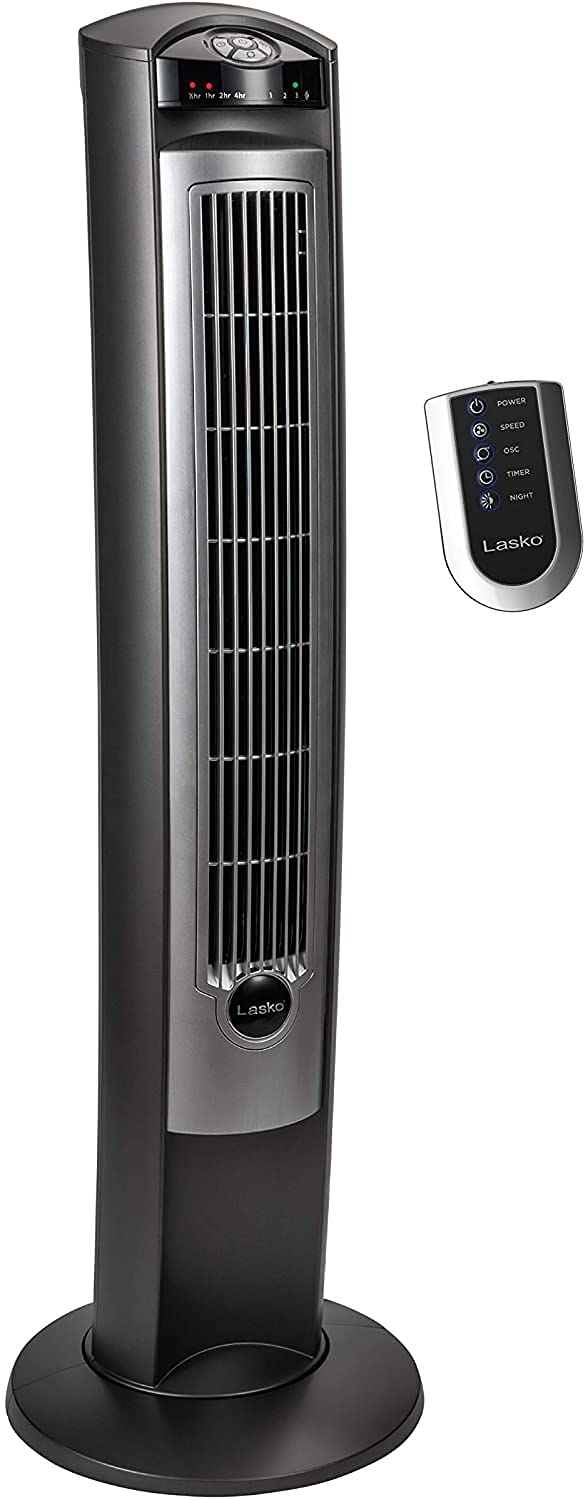
A 42-inch tower built to run for years, with a night mode that dims the panel.
Lasko’s quiet pitch rests on a night setting that dims the LED controls and steps the fan speed down — a simple, effective touch for a bedroom. At three speeds, this 42-inch tower reaches a decent small-to-medium room, and low speed runs close to a whisper of white noise. What separates it from the field is longevity stories: customers note units running near-daily for seven and even ten years without rattle or creak. A 7.5-hour programmable timer and a remote that handles power, speed, oscillation, and the night mode from the bed round out the package.
The catch with the Lasko is that its airflow is modest — at 262 cfm (cubic feet per minute, the volume of air it pushes in a minute) it is the smallest bladed tower here. So it is best at aiming air at one or two people rather than flooding a large living space. On high it is powerful for a bedroom but will not match the OmniBreeze or the DREO for raw reach. The timer is also clumsy, cycling through combinations instead of simple steps. None of that stopped buyers from treating it as a long-haul purchase.
Build-wise it is plastic and slightly light, but the base stays put while oscillating and the fan does not rattle. If you want a quiet, dependable tower that you can aim at your side of the bed and forget about for years, the Lasko is a sensible choice. If you need to cool an open-plan space, look to the higher-airflow picks above.
The long-haul case: a night mode that dims and slows the fan, 60° oscillation, a 7.5-hour timer, and a remote that reaches across the room — plus years-of-service records that few fans here can match.
The honest limit: 262 cfm is the smallest airflow among the bladed towers, so it is a bedroom and personal-space fan, not a whole-room blower. The timer is also awkward to set.
Choose it for: a bedroom where you want a quiet, tall tower you’ll keep for years and aim at the bed.
Look higher up if: you need to move a lot of air across an open room — the airflow here is modest by design.
7. Shark TurboBlade Bladeless Tower Fan TF202S

The bladeless tower that pivots flat into an Air Blanket mode and sweeps 180°.
Shark’s TurboBlade is the most adjustable fan on the list, and that adjustability has a real cooling payoff. Pivot it vertically for a focused tower stream or drop it horizontal for Air Blanket mode, a spread of airflow that washes over a whole bed rather than one strip of it. Twist the vents to aim two ways, oscillate across 180°, and you can point cooling at two rooms from one corner. Ten speeds span from quiet, gentle cooling to a turbo-jet hum on the top end, and the bladeless, wipe-clean design plus a Dust Defense element make it far easier to keep clean than a bladed tower.
The quiet story is a low-speed one. Below about level five, owners describe it as very quiet — a low airplane hum — which is exactly the range you sleep in. Above that, the sound ramps up to a strong white noise that some hot sleepers actually want. This is where the Shark and the GoveeLife split: the GoveeLife moves far more air (1515 cfm against the Shark’s 85 cfm), but the Shark is the one that can re-aim itself on the fly. The magnetically held remote sits on top so it does not get lost, and the tool-free assembly takes minutes.
Two caveats stand out. First, this is a substantial machine — 44.84 inches tall and 14.3 pounds, and it grows wide when dropped into horizontal mode, so it wants space. For a hot sleeper who wants to re-aim a quiet breeze over the bed without moving the fan, that versatility is worth it.
The versatility payoff: you can pivot between tower and Air Blanket modes, twist the vents to cool two directions, sweep 180°, and dial through 10 speeds and 10 noise levels. That makes it the most configurable fan here, and the bladeless design makes it easy to clean.
The catch: it’s a big machine (44.84 inches, 14.3 pounds) that spreads wide horizontally, and the 85 cfm airflow is far smaller than the top pick’s — you’re paying for flexibility, not raw volume.
Ideal for: a hot sleeper or multi-room user who wants to re-aim a quiet breeze over the bed and redirect it without moving the fan.
Not the pick if: you want the most air for the footprint — the higher-cfm towers above cool a big room faster.
Know the Specs
Decibels (dB): the quiet floor
A decibel is the unit for how loud a sound is, and lower numbers mean less noise. A fan’s spec sheet usually lists the lowest dB it can reach, so read it as the quietest the fan gets — not a promise it stays that soft. A floor of 18 dB, like the Windmill, sits near a quiet library. A 27 dB floor, like the GoveeLife, is a soft hum you can talk over. The number that actually matters is whether that floor is quiet enough for you to sleep on while the fan still moves air; if you have to raise the speed for a breeze, the noise rises with it.
Airflow (cfm) and what a quiet fan can move
Airflow in cfm — cubic feet per minute — measures the volume of air pushed in a minute, so a bigger number means more air and faster cooling across a room. The trap is comparing a quiet fan to a loud one by sound alone. A fan that whispers but pushes 85 cfm (the Shark) will not cool a big room the way one pushing 1515 cfm (the GoveeLife) can. The balance point is finding the quietest fan whose mid-speed airflow still reaches your bed. Add in oscillation (the arc the fan pans through, from 60° to 180°) and a tilt or pivot, and you can aim a smaller, quieter stream exactly where you need it.
Common Questions
How quiet is actually quiet for a bedroom fan?
Will a quieter fan still cool my whole bedroom?
Is a bladeless fan quieter than a bladed tower fan?
Do these quiet fans get louder as you raise the speed?
What does oscillation add to a quiet fan?
Can I clean these quiet fans, or will dust make them louder?
Do I need the app, or does the remote do everything?
Which quiet fan is best for the smallest room or a nightstand?
How tall should a quiet tower fan be for a bedroom?
Do the smart quiet fans need a specific Wi-Fi network?
The Bottom Line
For most buyers, the quietest fans winner is the GoveeLife 42 in. Tower Fan, because it pairs a 27 dB quiet floor with 1515 cfm of airflow — the rare fan that is hushed enough to sleep beside and powerful enough to cool a large room. It also holds 4.5+ stars across 900+ ratings, and the app control and adjustable-color light make it an easy all-rounder.
If quiet at close range matters most, the Windmill Smart Fan drops to an 18 dB floor on a nightstand and tilts the breeze at you. For a tall tower you can trust for years, the Lasko T42951 with its dimming night mode is the steady pick. And if you want to aim one quiet fan around a whole room, the Shark TurboBlade pivots and sweeps 180° to cover two spaces at once.
How we choose
We do not accept paid placement. Every pick is matched to a real buyer and a real use-case; we do not hands-on test units.
Sources
Specifications: manufacturer listings and product documentation. Review insights: verified customer reviews, as of October 2026. Pricing: not shown on this page (it changes often); check the current price via the retailer link.
As an Amazon Associate, Aappliancez earns from qualifying purchases. This does not affect which products we feature.