Disclosure: Some links in this post are affiliate links. As an Amazon Associate I earn from qualifying purchases, at no extra cost to you. Learn more
Specs are compiled from manufacturer listings and verified buyer reviews and can change over time — please confirm the key details on the product page before buying.
If your legs or arms swell and ache, the right compression garment can change your whole day — and the wrong one ends up in a drawer by week two. The hard part is that lipedema swelling is not shaped like a standard limb, so a garment that fits a friend or a size chart perfectly can dig, roll, or slide on you. This guide breaks down seven options that real buyers with lipedema and lymphedema keep reaching for, from arm sleeves to adjustable wraps to high-waist leggings, so you can match the fit to your body instead of guessing.
This guide is built by comparing the manufacturers’ published specifications and the patterns across verified customer reviews, so you get each pick’s real strengths and trade-offs instead of marketing spin.
Compression only works when you actually wear it, so comfort and staying-put matter as much as the pressure level. Below you’ll find the exact numbers, the fit quirks, and the honest limits of each pick so you can choose the best compression garments for lipedema with confidence.
Top Picks


How To Choose The Best Compression Garments for Lipedema
The biggest reason compression garments get abandoned is not pressure — it is fit. Lipedema affects both legs, the arms, or the torso, and it can change size as swelling shifts, so a garment has to be measured against your actual limb, not your dress size. Get the compression level and the body shape right, and you will wear it every day.
Match the mmHg to your stage
Compression is measured in mmHg, which is the amount of gentle squeeze the fabric puts on your limb all day. A 20-30 mmHg garment gives a firm, medical-level squeeze for moderate swelling. Stronger levels like 30-50 mmHg press harder and are used for more stubborn fluid. Too little and you feel no support; too much and you cannot get it on or it digs in. Your clinician sets the target — your job is to buy the garment whose listed mmHg matches it.
Measure the limb, then pick the shape
Lipedema often means wider thighs, a narrower ankle, or an arm that thickens through the upper section. That is why adjustable wraps and knit leggings built for odd-shaped limbs tend to work better than a plain tube sock. Measure at the widest and narrowest points of the swollen area and compare both to the seller’s own chart. A garment that is one size too tight across the calf will roll, and one too loose at the ankle will slide down.
Decide between pull-on and adjustable
Pull-on leggings and sleeves give consistent pressure and disappear under clothing, but they can be hard to wrestle on over sore, swollen tissue. Adjustable wraps open flat like a wrap, so you lay it on and close the straps — much easier on a bad day. Many people keep a pull-on garment for good days and an adjustable wrap for mornings when swelling is worst.
Side-by-Side Comparison
| Model | Best For | Compression | Body Area | Style | Amazon |
|---|---|---|---|---|---|
| Juzo Soft 2001 Arm Sleeve★ Best Overall | Arm and hand swelling | 20-30 mmHg | Arm sleeve | Pull-on, soft knit | Amazon |
| Bioflect Capri Compression LeggingsBest Value | Groin to calf support | Moderate compression | Legs and abdomen | Pull-on leggings | Amazon |
| JOBST Relief Waist High Stockings | Full-leg everyday wear | 20-30 mmHg | Waist to toe | Pull-on, open toe | Amazon |
| CircAid Juxtalite HD Wrap | Adjustable daily swelling | 20-30, 30-40, or 40-50 mmHg | Lower leg | Velcro wrap | Amazon |
| CzSalus K2 Compression Leggings | Higher-stage lipedema | K2 = 25-30 mmHg | Waist to mid-foot | Pull-on flat knit | Amazon |
| Extremit-Ease Lower Leg Wrap | Post-op and long sitting | 30-50 mmHg | Lower leg | Adjustable wrap | Amazon |
| MARENA SFBHM2 High-Back Girdle | Post-surgical torso support | Stage 2 post-surgical | Torso, thigh, calf | Pull-on girdle | Amazon |
Detailed Reviews
1. Juzo Soft 2001 Arm Sleeve Compression 20-30 mmHg, Max, Long
Our pick — over 4★ from 300+ verified ratings; the strongest balance of quality and price.
The soft knit arm sleeve people keep buying after mastectomy swelling
If your swelling sits in your arm rather than your legs, this is the one to start with. The Juzo Soft 2001 is a 20-30 mmHg arm sleeve — that mmHg number is the squeeze the fabric applies all day, and 20-30 is the firm, medical range for moderate arm swelling after node removal or surgery. The “Max” in the name means the longer length, so it covers more of your arm from wrist up. It is built for the arm, which is exactly what lipedema and lymphedema of the arm call for.
What wins people over is the compression itself, followed by how little it bothers them to wear — two things that matter more than any number on the box. Buyers describe it as soft and comfortable on the arm, and the sleeve stays put without slipping. One detail buyers specifically value after a mastectomy: the sleeve “helped with swelling” and they would “buy again”. The color is close to natural skin, so it disappears under everyday clothing rather than announcing itself.
Here is the honest catch. The sleeve is sold as a single piece, not a pair, and it lands in the same territory as a full pair of leg compression — so buying for both arms doubles up fast. Sizing is also tricky if your arm is not a standard shape, and a few buyers found the stretchy fabric fragile. Those are real fit-and-care notes, not dealbreakers, since comfort and compression are the clear winners here.
The strengths that keep buyers coming back
- Firm 20-30 mmHg squeeze in the medical range for moderate arm swelling
- Soft knit that buyers call comfortable to wear all day
- Stays in place on the arm without slipping
- Washes well and dries quickly, per buyers
Worth knowing before you buy
- Sold as a single sleeve, not a pair
- Care needed on non-standard arm shapes for sizing
- A few buyers call the stretchy fabric fragile
Reach for this if: your swelling is in one or both arms and you want a soft, firm 20-30 mmHg sleeve that stays put under clothing.
Look at a leg garment instead if: your swelling sits below the waist — this arm sleeve has no leg version.
2. Bioflect Capri Compression Leggings
The capri that molds to odd-shaped limbs and reaches the bra line
For groin, abdominal, and leg swelling at once, these capri leggings do something a plain stocking cannot. Instead of a flat tube, the fabric uses a raised massaging knit — a bumpy, 3D weave that presses varied points along the skin instead of squeezing evenly. That design is why it conforms to the uneven, thicker-through-the-thigh shape lipedema often creates. The knit runs from a high waist down to mid-calf, so it covers the belly, groin, and lower leg in one garment.
You get a gentler squeeze than a 20-30 mmHg medical stocking (mmHg measures the pressure a garment puts on your limb). The maker calls the fibers bioactive and says the moderate level helps because discomfort is the main reason people stop wearing compression at all. Buyers report the stretchy micro-fiber fabric goes on more easily than traditional compression hose and does not snag or split at the seams. The high waist reaches the bra line and does not roll down for most wearers. One buyer facing leg and abdominal swelling said simply, “the best compression leggings I have ever bought.”
The trade-off is sizing and length. The fit is the most-discussed topic on these leggings, and while many find it phenomenal, some report that even one size larger runs tight — so measure carefully and expect a period of adjusting. A few taller wearers found the capri cut climbs toward the ankle rather than stopping at mid-calf. And because it is a moderate level, not a firm medical stocking, it suits everyday swelling rather than the strongest compression needs.
Quick read: The raised knit that adapts to uneven leg shape is the standout here, pressing varied points rather than squeezing evenly from a flat tube.
The fit caveat: sizing runs tight enough that even a size up can feel snug, so treat the chart as your starting point and be ready to swap.
The pick for: groin-to-calf swelling where you want the leg, belly, and groin covered at once in an easier-on fabric.
Skip the guessing: measure twice — sizing runs tight, so verify against the chart before committing.
3. JOBST Relief 20-30 mmHg Waist High Compression Stockings

Full waist-to-toe support built for people on their feet all shift
If you stand or walk for a living and your swelling runs the full length of the leg, a waist-high stocking covers more than any wrap. These JOBST Relief stockings deliver a 20-30 mmHg squeeze from the waist down to the foot, and the open-toe design leaves your toes free. That open toe is a small thing with a real payoff: buyers use it to adjust the heel into place and to wear sandals or flip-flops in warm weather. The thick, textured fabric stays opaque rather than sheer.
Buyers praise comfort most, and the context is telling — nurses in long shifts say their legs feel great by the end of the day, and people who wear support hose for circulation issues call the firm squeeze a relief from leg ache rather than a chore. The stockings hold up through repeated hand washes, and owners mention there is no underwear show-through if that matters to you. A medium fits a range of heights and builds, from a shorter, lighter frame up to a taller 180 lb wearer.
The recurring gripe is not comfort but fit down the leg — several wearers find these run down and bunch behind the knee over a long day. Durability is the other mixed point: some stockings last through many washes, while an occasional one develops a run or tear early. Treat the fabric gently, wash in a bag, and hang dry to protect the knit. None of that undercuts how good the compression and comfort are — it is why they are still a top pick for full-leg daily wear.
Best choice when: your swelling runs the whole leg and you need dependable 20-30 mmHg support for long days on your feet.
Not ideal if: you want a garment that will not shift at all — the open toe and knit can warm up and slide slightly on a long shift.
4. CircAid Juxtalite HD Adjustable Lower Leg Compression Wrap
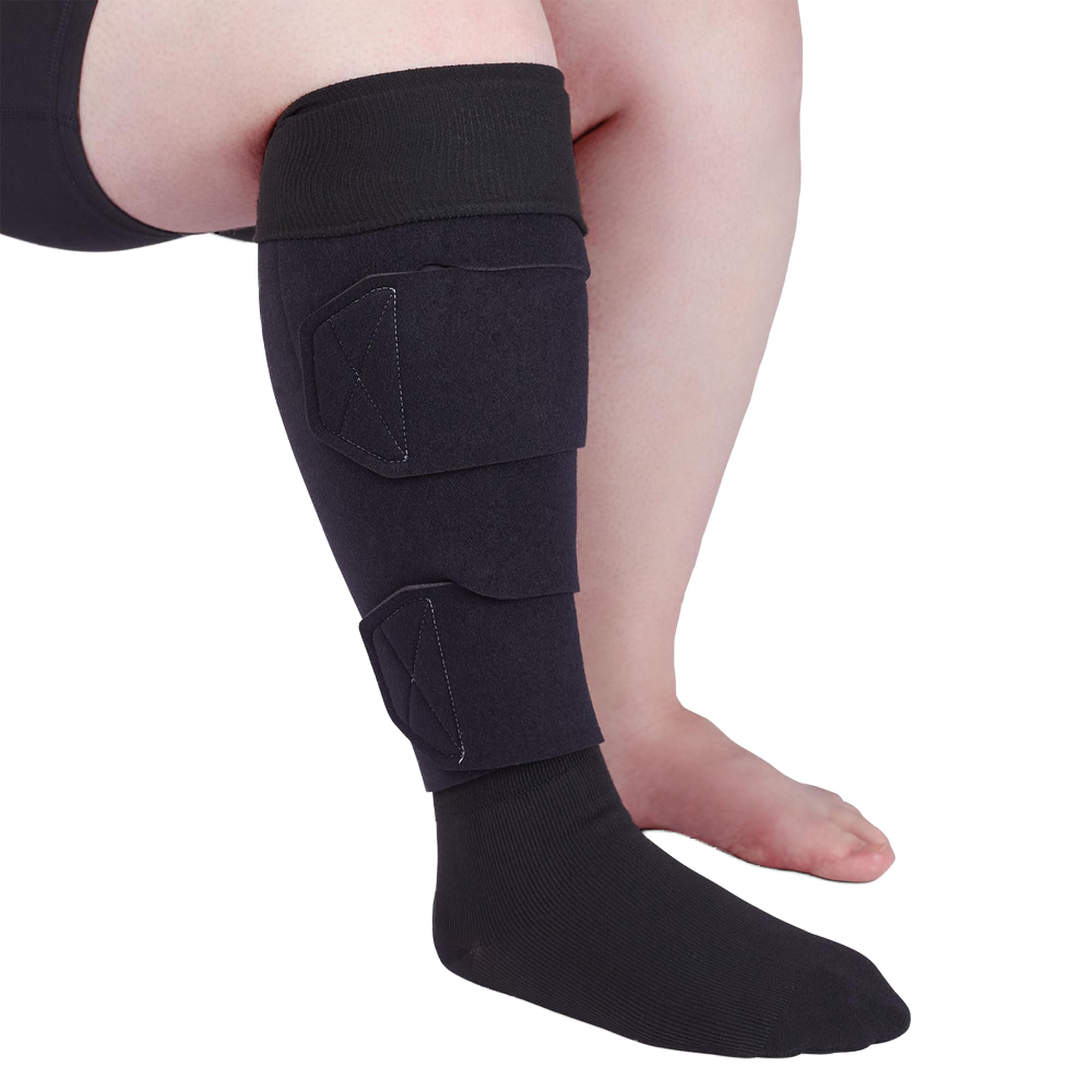
A wrap that opens flat and lets you dial the squeeze up or down
When swelling changes day to day, a fixed stocking cannot follow it — an adjustable wrap can. The CircAid Juxtalite HD is a Velcro lower-leg wrap that opens all the way, so you lay it against the leg and close the straps instead of wrestling a tight tube over swollen tissue. It carries three adjustable compression levels — 20-30, 30-40, or 40-50 mmHg — set using the built-in pressure system, which lets your clinician pin a target you can repeat at home. That range is the key advantage over a single-level stocking like the JOBST above.
The HD tag means higher containment than the original, built for stronger fluid control. It comes in two lengths, 28cm and 33cm, and circumference sizes from Small to XXL with three full-calf options — helpful when one calf is noticeably bigger than the other. Each kit includes the lower-leg garment, two compression undersocks, and a measurement card. The Breathe-O-Prene material is described as cool and lightweight, and buyers who wear it all day under jeans say they forget it is there.
The honest trade-off is cost and the closure. This is a premium-tier wrap, and some buyers feel the price is steep. The Velcro closures take two hands to line up, and a few wearers found the wrap slides down and folds at the ankle — usually easy to fix by re-positioning. Sizing errors are the other risk, since an incorrect size looks and feels wrong.
Why it earns its spot: three selectable pressure levels (20-30, 30-40, or 40-50 mmHg) mean your garment can match your swelling instead of the other way around.
Budget note: this is top-tier pricing, so weigh the adjustability against a simpler fixed stocking if your swelling is stable.
Choose this if: your swelling shifts daily and you want a wrap you can re-tension yourself without help.
Think twice if: you prefer a pull-on you never have to position — the Velcro straps need a moment to line up.
5. CzSalus Flat Knit K2 Compression Leggins

Italian flat-knit leggings for later-stage lipedema that reach the mid-foot
For higher-stage lipedema, pull-on leggings made specifically for the condition beat a general stocking. These CzSalus leggings carry a K2 rating, which is 25-30 mmHg — a firmer level than a standard 20-30 stocking — and they are cut to run from a high waist down to mid-foot. They are made in Italy of a non-allergenic fabric that is breathable, soft, and elastic, with a composition of 80% polyamide microfiber and 20% elastan. The reinforced flat-knit structure is built to handle the demands of higher-stage swelling.
Buyers with experience of the condition speak to the quality and the pressure. One owner wrote that these were recommended by an lymphedema therapist and are “a pain to get on and off, but while on they are a dream.” The design also uses a passive massaging effect and lumbar compression that wearers find supportive. Because the knit runs to the mid-foot, it covers the ankle and foot edge that a capri cut leaves exposed — a real difference from the mid-calf Bioflect leggings above.
The honest limit is getting them on and off. A tight 25-30 mmHg flat knit is genuinely hard to pull over a swollen leg, and for people with stage 3 or 4 cuffing at the ankle, ace bandages first or a helper make it far easier. Sizing must be measured precisely, because a garment this firm does not forgive a wrong size. Shipping can also run slow. If you can manage the donning, the support is hard to match.
What higher-stage wearers value
- Firmer 25-30 mmHg K2 compression for later-stage swelling
- Flat knit covering from high waist to mid-foot
- Made in Italy; 80% polyamide microfiber and 20% elastan
- Supportive, comfortable enough that buyers sleep in them
Where it asks patience
- Hard to pull on and off over swollen legs
- Sizing must be measured exactly — no room for error
- Shipping can take several weeks
The one to pick if: you are managing higher-stage lipedema and want firm 25-30 mmHg flat-knit coverage down to the mid-foot.
Prepare for this: donning is the hard part — plan on ace bandages or a helper if you have ankle cuffing.
6. Compression Garment 30-50 mmHg Lower Leg Compression Wrap
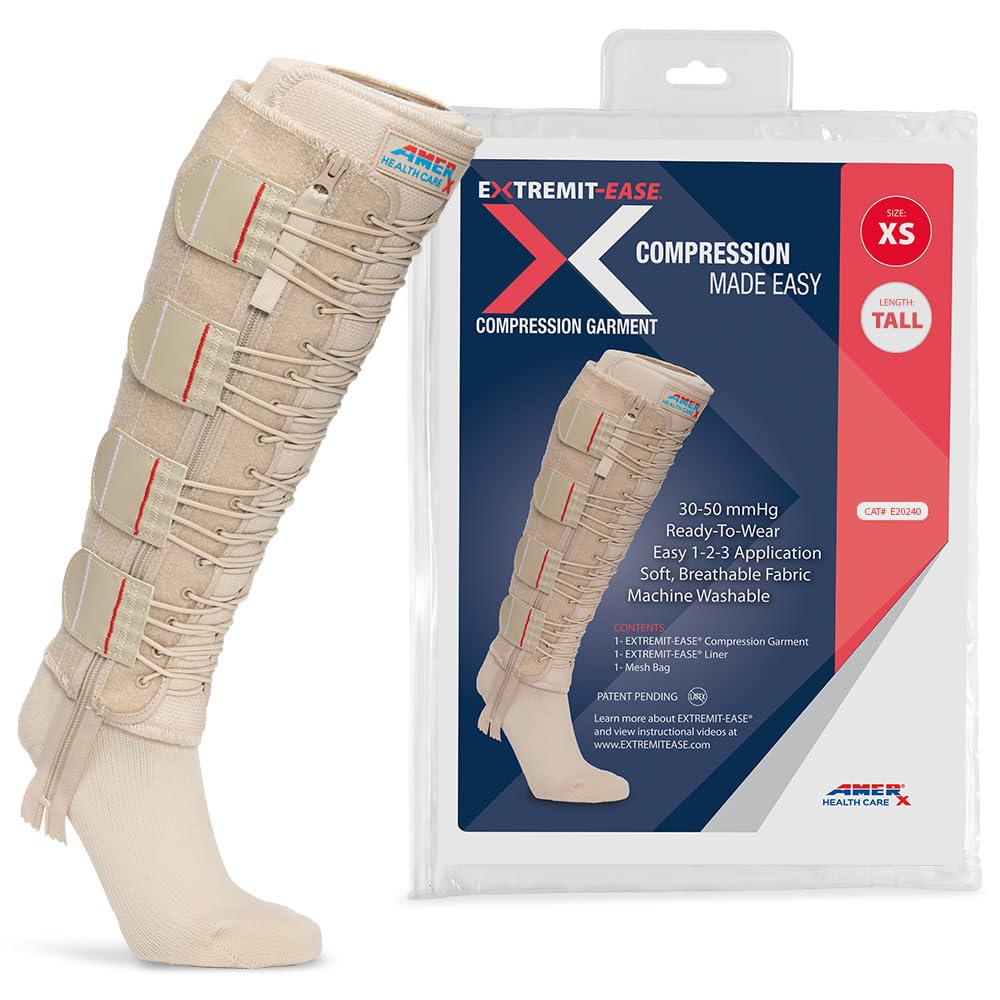
A strong 30-50 mmHg wrap that lays on rather than pulls up
When the swelling needs the strongest squeeze in this roundup, this lower-leg wrap delivers it. It runs at 30-50 mmHg — the highest level here — and is aimed at mild to moderate lymphedema (swelling from lymph fluid buildup), venous insufficiency (poor blood flow back up the leg), and post-op edema (swelling after surgery). Unlike a stocking you drag up over the calf, this one uses bungee straps that let you position it on the leg and then tighten, and customers note that design makes it much easier to apply than the pull-on alternatives. It comes from AMERX Health Care Corp.
People who struggle with stiff stockings tend to like this best. One owner who had used older VA Velcro wraps said those slid down the leg while these are much better quality, and another with long periods of sitting appreciated the open toe. The straps wrapped around the leg adjust the fit to your calf rather than forcing you into a fixed tube, so a swollen leg that changes through the day is easier to manage.
Be clear-eyed about one thing: this garment works with a compression sock underneath, and it is not a stand-alone sock-free wrap. A buyer who expected to skip the sock entirely found the included sock a hassle to put on. The other recurring note is price — several buyers feel it is high for anyone paying out of pocket without Medicare. It is a smaller seller with a modest track record of reviews, so treat it as a targeted pick rather than a crowd favorite.
Where it wins: at 30-50 mmHg with bungee straps, it applies easily onto a swollen calf instead of being dragged up over it.
The catch: it relies on a compression sock underneath, so factor in that extra step if you wanted a sock-free wrap.
Good fit for: post-op or long-sitting swelling where you want the strongest 30-50 mmHg pull and an easy-to-place strap system.
Be ready for: wearing a compression sock beneath it — those expecting a sock-free wrap will be surprised.
7. MARENA SFBHM2 Stage 2 Compression Girdle

A high-back post-surgical girdle that supports without pressing the ribs
If you are recovering from liposuction, a tummy tuck, or a thigh lift, this girdle is built for the torso rather than the limbs. The MARENA SFBHM2 is a Stage 2 post-surgical compression girdle — Stage 2 means the firmer phase of recovery compression — with a high back that rises up the spine and a cut that runs to mid-calf over the thighs. It is a pull-on design with no zippers or hooks, so there is nothing hard pressing into your skin while you heal.
Compression is what buyers single out here, and the high-back cut is why. A garment that stops low can ride up and press the ribs and back — buyers recovering from a tummy tuck and liposuction describe earlier doctor-issued garments pulling to the ribcage and causing rib and back pain, while this one provides strong compression without that pressure. The crotch opening is notably wide, which reviewers point out makes bathroom trips far easier than the tiny openings on other recovery garments. The high-quality elastic material holds its shape over several days of wear, and adjustable straps let you tune the torso length.
Fit is the variable to manage. Some wearers find it great, while others find it runs several inches long for a shorter torso. It can also be hard to pull on in the early, most-swollen days, and some find the straps fiddly. Size against the chart and your height — buyers ranging from 5’0″ to 5’9″ found it comfortable when sized right, and a few later sized down as swelling fell.
Made for: post-surgical recovery — tummy tuck, lipo, or thigh lift — where you need high-back torso compression with an easy restroom opening.
Watch the length: if you are on the shorter side, confirm the cut against your height, since some wearers find it runs long.
Know the Specs
What mmHg really means for you
mmHg is the unit that tells you how hard the fabric squeezes your limb. A garment rated 20-30 mmHg applies a firm, medical-level pressure. A higher number presses more — 30-50 mmHg sits at the strong end, and the CircAid wrap even lets you switch among 20-30, 30-40, and 40-50 mmHg. Your clinician sets the target level for your condition; the garment you buy just has to match it, so always check the number before ordering.
Pull-on vs adjustable wrap, in plain terms
A pull-on garment is a fixed tube you slide over your arm or leg — consistent pressure, but harder to don over sore, swollen tissue. A wrap opens flat and closes with straps, so you place it and tighten, which is gentler on a bad morning. Both are legitimate; many people keep a pull-on for everyday wear and a wrap for strong-swelling days. Neither type is better in every case — it depends on how your swelling behaves and how easy you need the garment to be to put on.
Common Questions
What mmHg compression do I need for lipedema?
Should I choose leggings or a compression wrap?
How do I measure my leg for a lipedema garment?
How long does a compression garment usually last?
Can I wear compression garments all day and night?
Is a flat knit better than a round knit for lipedema?
What if my arm is swollen but my leg is not?
Do compression wraps need a sock underneath?
Will a post-surgical girdle help with lipedema swelling?
Why do some compression garments run small or large?
The Bottom Line
For most people managing arm or limb swelling, the compression garments for lipedema winner is the Juzo Soft 2001 Arm Sleeve because it delivers a firm 20-30 mmHg squeeze in a soft knit that stays in place and washes well — and it is a proven daily go-to for arm lymphedema. If you need legs and groin covered together, grab the Bioflect Capri Leggings, whose raised knit adapts to uneven limb shapes. For higher-stage swelling you can re-tension yourself, reach for the adjustable CircAid Juxtalite HD Wrap.
How we choose
We do not accept paid placement. Every pick is matched to a real buyer and a real use-case; we do not hands-on test units.
Sources
Specifications: manufacturer listings and product documentation. Review insights: verified customer reviews, as of October 2026. Pricing: not shown on this page (it changes often); check the current price via the retailer link.
As an Amazon Associate, Aappliancez earns from qualifying purchases. This does not affect which products we feature.