Disclosure: Some links in this post are affiliate links. As an Amazon Associate I earn from qualifying purchases, at no extra cost to you. Learn more
Specs are compiled from manufacturer listings and verified buyer reviews and can change over time — please confirm the key details on the product page before buying.
You set out a mineral site, wait, and the deer walk right past it — that is money and weekends gone. The fix depends on three things: the right mineral form, the right salt level, and matching the product to what you actually want — antler growth, herd health, or just more deer on camera. This guide walks through eleven mineral and salt picks so you can choose with confidence instead of guessing.
This guide is built by comparing the manufacturers’ published specifications and the patterns across verified customer reviews, so you get each pick’s real strengths and trade-offs instead of marketing spin.
A mineral site is only as good as the mineral in it, which is why the details below matter more than any single brand promise. From chelated granular blends to simple Himalayan salt chunks, each option on this list earns its place by how deer actually respond to it — and you can find the right mineral for deer here.
Top Picks

How To Choose The Best Mineral for Deer
Deer seek minerals for a reason — sodium drives thirst and browsing, calcium and phosphorus build antler bone, and trace minerals like zinc, copper, and selenium support overall herd condition. What separates a mineral site that gets hammered from one that sits untouched usually depends on form, texture, salt level, and how you place it. Before you buy, work through the four checks below.
Match the form to your property
A hard block (a pressed brick of salt and minerals) resists rain and lasts through weather, but it dispenses slowly and concentrates deer in one tight spot. Granules and powders (loose mineral you rake into the soil) spread wider and let a whole herd share the site at once. Loose forms often suit larger properties and food plots, while blocks suit small yards and camera setups where you want a single, easy-to-monitor lick.
Read the mineral percentages, not just the name
Serious buyers check what is actually in the mix — calcium and phosphorus levels, whether trace minerals are chelated (bound to amino acids so the animal absorbs more of them), and whether the product is mostly salt dressed up as a mineral. A high salt percentage attracts deer fast but does less for antler growth; a lower-salt, mineral-forward blend does more for the herd but may take longer to build a following.
Check your local game laws first
Mineral sites attract deer, and in some states that counts as baiting. Several products on this list carry an explicit note to check local baiting regulations before you place a site. Confirm the rules for your state and season before you put anything on the ground — a great mineral you cannot legally use is no mineral at all.
Plan the season you need it for
Antler growth happens in spring and summer, when a buck’s body pulls heavily on calcium and phosphorus. Doe lactation and fawn development follow the same calendar. Some products are built specifically for that window, others work year-round. If your goal is bigger antlers, get the mineral down early and keep it topped up through the growing months.
Side-by-Side Comparison
| Model | Best For | Form | Primary Mineral Focus | Weight | Amazon |
|---|---|---|---|---|---|
| Antler King Trophy Deer Mineral★ Best Overall | Year-round herd nutrition | Granule | 27 minerals, vitamins, amino acids | 20 lb | Amazon |
| Licking Salt for Horse (Himalayan Pink Chunks)Best Value | Multi-species livestock and wildlife | Solid block | Naturally occurring trace minerals and electrolytes | 6 lb | Amazon |
| Whitetail Institute 30-06 Mineral and Vitamin SupplementTop Performer | Spring and summer antler-building season | Pellet | 10% protein boost, vitamins, minerals | 20 lb | Amazon |
| Terra Products Co. AX Deer Mineral – Antler Xcelerator | Concentrated low-intake mineral site | Powder | Balanced calcium-to-phosphorus, trace minerals | 8 lb | Amazon |
| Antler Power Deer Mineral, 5 lb | Wide-spread mineral sites on larger land | Powder | Calcium 13-15%, phosphorus, zinc, copper, selenium | 5 lb | Amazon |
| KALMBACH Feeds Vitamin and Mineral Goat Supplement Block | Goats and small-pen livestock | Block | Balanced salt-mineral blend | 25 lb | Amazon |
| Big Tine Fortified Deer Block, 20 Lb | Winter feeding and camera attraction | Chunk | Corn, sunflower seed, milo blend | 20 lb | Amazon |
| Trophy Rock Four65 Granular Deer Mineral Attractant | Trail-camera scouting and herd mineral | Granule | 60+ balanced trace minerals | 30 lb | Amazon |
| 40LB Big Tine Deer Feed | Backyard and suburban deer feeding | Feed blend | Corn, milo, sunflower seeds | 40 lb | Amazon |
| Himalayan Pink Salt Lick Pack of 3 (6lbs Each) | Hanging barn and stall salt licks | Block on rope | 98% sodium chloride, 84 trace minerals | 6 lb each | Amazon |
| Pure Whitetail Full Throttle Cherry Scented Mineral Lick, 3-Pack | Spring and summer antler growth | Powder | Vitamins A and D3, phosphorus, calcium (35% salt) | 5 lb each | Amazon |
Detailed Reviews
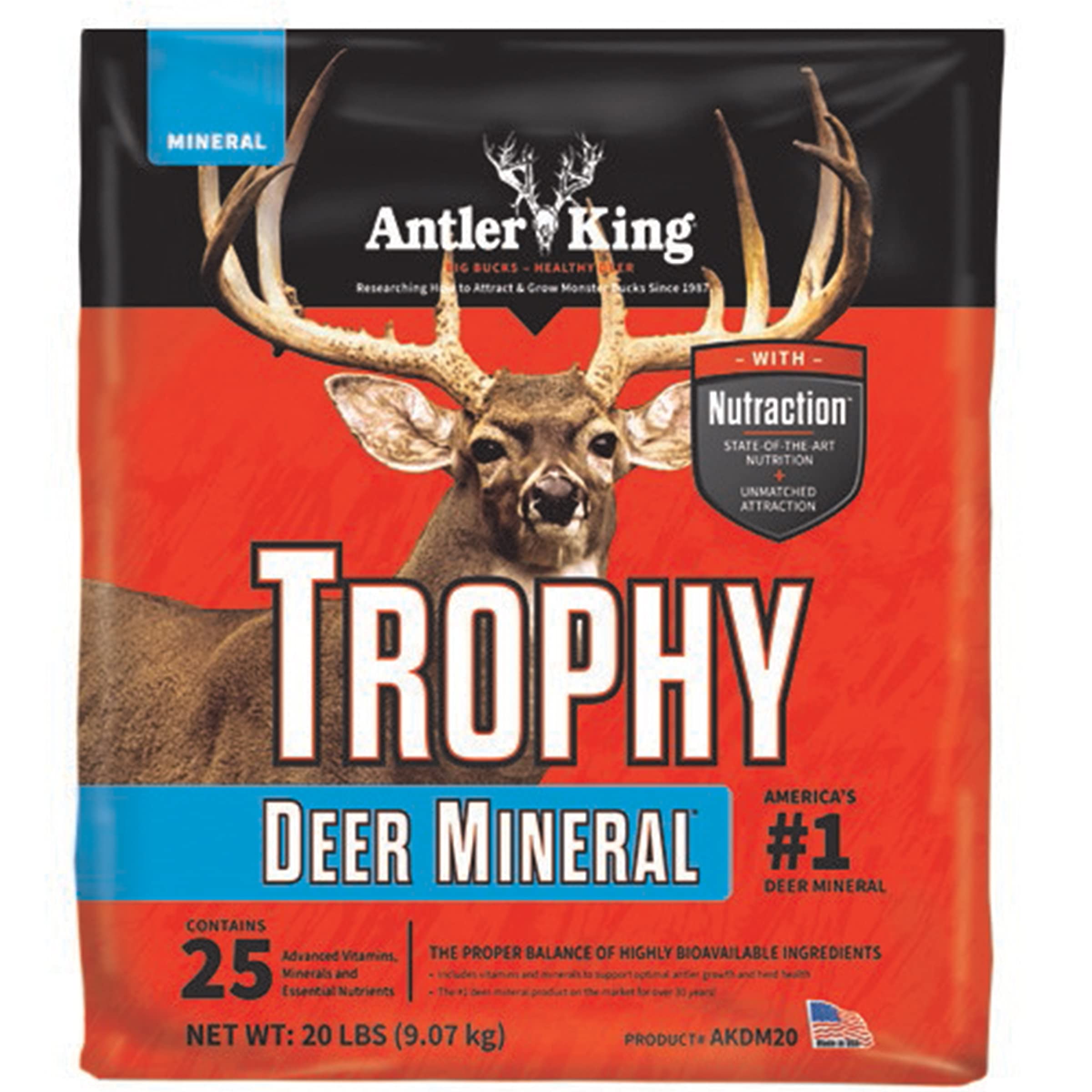
1. Antler King Trophy Deer Mineral
Our pick — over 4.5★ from 400+ verified ratings; the strongest balance of quality and price.
A 20-pound granular blend with 27 chelated minerals, vitamins, amino acids, and a yeast culture.
This is the pick that earned the top spot, and the thing that wins people over is how hard deer work a site that gets this put down. It packs 27 different antler-building minerals, trace minerals, vitamins, amino acids, and additives into a single granule, all meant to be absorbed more easily because they are chelated. It also brings a yeast culture, which helps a deer digest what it eats more efficiently. Deer enjoyment is what owners rave about most, and it is the aspect that shows up again and again in the feedback.
That is not the only reason it holds the top spot — the crowd factor matters too, with 4.6 stars across 400+ ratings. One owner laid it out clean: “Ordered 8; deer love them. One misdelivered order refunded by Antler King. Deer rejected a competitor’s block. Current herd: two does, two young fawns.” That is a real-world read on both the appeal and the fact that the company stood behind a shipping problem. Enough buyers hit the same result that it reads as the norm rather than a lucky weekend.
The honest catch is value — the value-for-money feedback is genuinely mixed, with some owners saying the 20 lbs should be closer to 50 lbs for what it costs. It also disappears fast in heavy-traffic areas, and raccoons or javelinas will help themselves when you are not watching, so protect the site if you have other wildlife around. One buyer summed the appeal up simply: “Great deer attractant.” If you want the mineral that most consistently gets deer on their feet and coming back, this is the strongest overall pick.
What It Brings To The Table
- 27 minerals plus vitamins, amino acids, and additives in one blend
- Chelated minerals designed for easier absorption
- Added yeast culture for better digestion of the food it eats
- A proven attractant most buyers report deer return to
What To Weigh Before Buying
- Value is genuinely debated — some want more volume for the money
- 20 lbs goes fast in high-traffic areas
- Raccoons and javelinas will share the site if left unguarded
Grab It If: You want the mineral most deer seem to convert into regular visits and a healthier herd.
Look Elsewhere If: You need your site to hold up against heavy raccoon or javelina pressure without a tray or guard.
2. Licking Salt for Horse, 6 LBS, Pack of 2
Two 6-pound Himalayan pink salt chunks that work as both a horse lick and a deer salt site.
If your acreage plays host to horses and deer both, this pack does double duty in a way a single-species mineral cannot. These are chunks of pure Himalayan pink salt mined from ancient deposits, holding naturally occurring trace minerals and electrolytes, not an additive list. The blocks are built to resist rain and biting, so a site in the open survives weather that would degrade a loose powder overnight. The owner feedback centers on one thing above all — how eagerly horses work a block they like.
The 6-pound size keeps this light on the truck and easy to drop in the barn or a stall, and unlike the 20-pound granules above, you can haul it one-handed. Deer respond to it as well — one owner wrote, “We use these blocks for wild deer. The deer seem to love them. We love our wildlife…….” A separate long-time user on this same product put it more plainly: “My horses love this stuff. They lick it faster than regular salt block. Don’t sit it in dirt, because they eat it so fast. Keep it in a tray or tub.”
The honest limit is what it is: this is a rock salt block, not a mineral-forward antler supplement. If your goal is antler growth from calcium and phosphorus, you would want a product with a real mineral matrix. And even the maker warns of the rain resistance up front, so a block in a low spot will still want a tray or tub under it to stay clean. For straight salt appeal and a barn-friendly size, it is the sort of quiet budget workhorse that just keeps earning its spot.
Straight from the data: A rain-resistant 6-pound Himalayan chunk that doubles as a horse salt lick and a deer attractant, for anyone whose property runs both.
Test it with: A tray or tub under the block — the feedback leans that way for a reason.
Go This Route: For barns and multi-species properties that want one salt block horses and deer both use.
Pass On It If: Antler growth is your endgame and you want a calcium-and-phosphorus mineral matrix instead of straight salt.
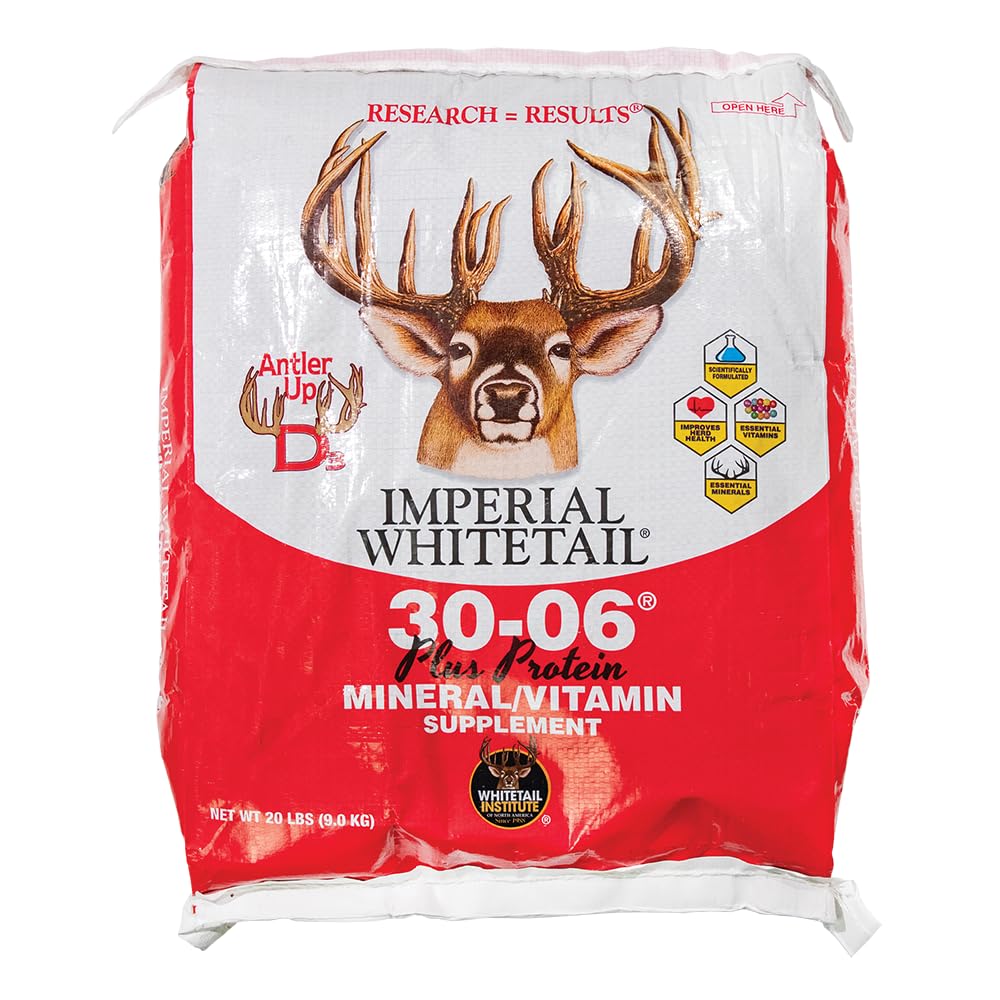
3. Whitetail Institute 30-06 Mineral and Vitamin Supplement, 20 lbs
A 20-pound pellet formulated for spring and summer, with a 10% protein boost for antler growth and lactation.
This one targets a specific calendar. It is formulated for the needs of deer in spring and summer, with a 10 percent protein boost on top of the mineral package, and it carries specific minerals in the forms and ratios the maker says matter for antler growth, pregnancy, and lactation. Deer preference is the aspect that owners praise most here, and it shows in how fast a fresh site gets torn up. The texture is a pellet, not a powder, so it behaves differently underfoot than the granular picks on this list.
Setup is straightforward for a food-plot approach: rake or shovel a patch 2 to 3 feet across and mix it into the soil. That suits an in-ground site rather than a hanging block. Owner reports back the seasonal pitch up — one reviewer noted deer are on it within 30 to 45 minutes of putting it down. The attraction feedback is genuinely mixed, though: plenty of owners mention their deer hit it hard, and a few report the opposite with deer walking past.
The honest trade-off is that a mixed attraction signal means placement and local herd habits matter more here than with a straight salt block. If you already have a deer trail running past a good spot, the pellet form mixed into soil should take. If you are trying to pull deer into a spot they never visit, this is the riskier bet. Mix it one season and watch the trail camera, because the spring-and-summer window is short and you want the timing right.
Where it wins: A 20-pound pellet built for the spring-summer antler window, with a real protein boost and an in-ground mixing method that suits food plots.
Where it needs a hand: The mixed attraction reports mean placement on an active trail does a lot of the work.
Reach For This If: You run a food plot and want a seasonal mineral with a protein bump going into the growing months.
Think Twice If: You need a sure thing on a property where deer have never fed in that spot before.
4. Terra Products Co. AX Deer Mineral
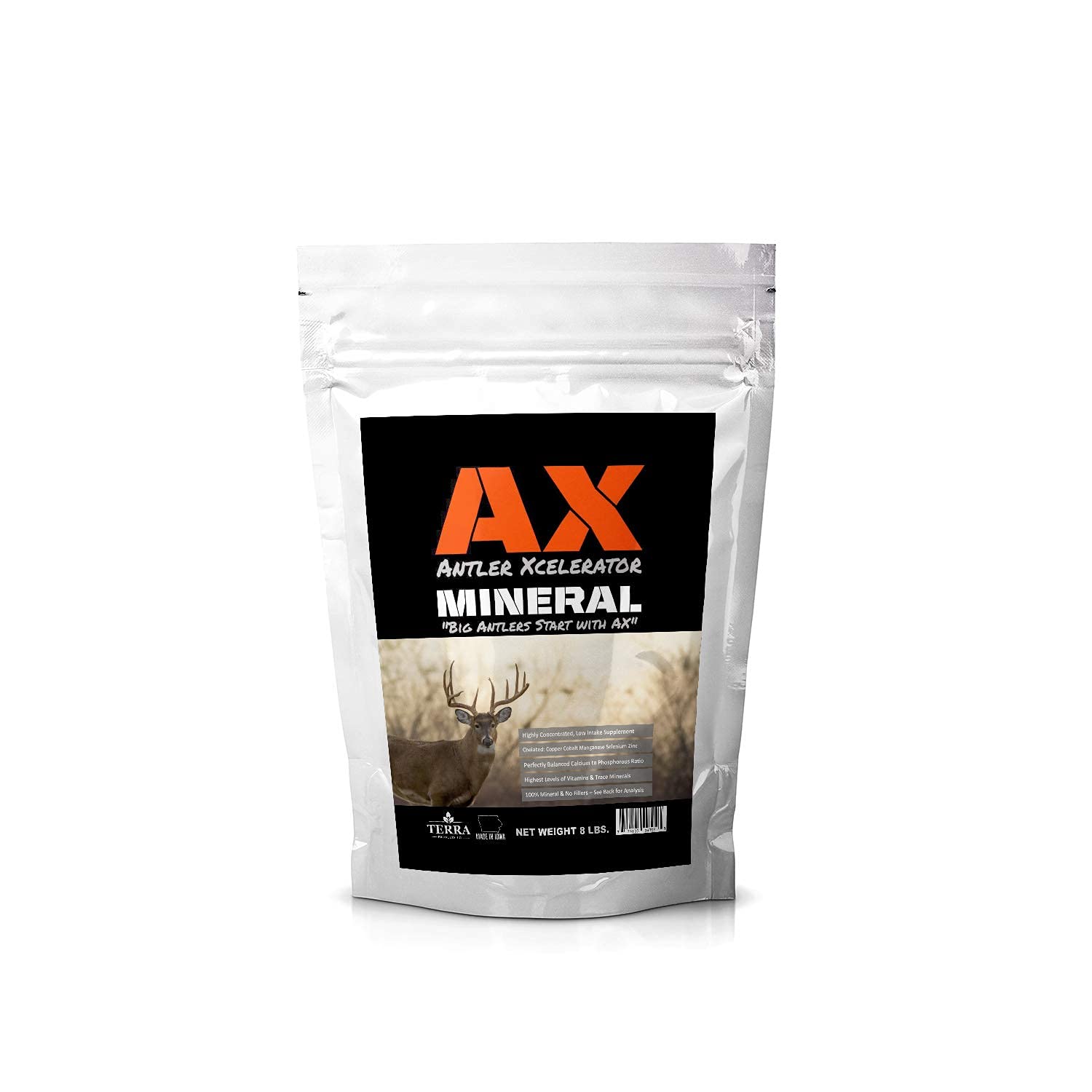
An 8-pound filler-free powder with a balanced calcium-to-phosphorus ratio for a low-intake mineral site.
This is the pick for a hunter who wants a concentrated, low-intake mineral site and does not want to haul a heavy bag out to the timber. The label pitches a perfectly balanced calcium-to-phosphorus ratio, the highest levels of vitamins and trace minerals the brand offers, and a 100 percent mineral formula with no fillers. It comes as a powder in an 8-pound bag, so it weighs less than most of the granular options on this list while still treating a mineral site.
Customers note the site-building works. One described deer finding it quickly and returning daily, and noted the powder is weather-resistant and dissolves slowly, which keeps a site alive between visits. Another, comparing it to other minerals on the market, called it a solid performer on antler growth and herd health and passed it along as a straightforward recommendation for hunters and wildlife watchers. Another simply wrote, “Deer really love this mineral combination,” and reported an increase in the number of deer on the property.
The honest caveat comes from the property itself — a small number of reviewers point out deer that never take to it at all. One wrote it sat out for 30 days with no interest, noting that mineral needs differ by area. Treat that as a site quirk rather than a formula flaw; if your herd already hits a mineral site, this concentrated powder should find the same audience. The 8-pound bag is the other thing to know — you are buying concentration, not volume, so plan on a smaller, well-placed site rather than blanketing acres.
What works: A filler-free 8-pound powder built for a concentrated, low-intake mineral site and a haul that does not wreck your back.
What to expect: It treats a small, carefully placed site — this is not a broadcast-the-acres product.
The Right Call For: Hunters building a compact, high-concentration mineral site deep on the property.
Not The One For: Anyone trying to cover wide acreage on a single bag, or a herd that has never touched a mineral site.
5. Antler Power Deer Mineral, 5 lb

A 5-pound chelated powder with 13-15% calcium that treats 10 to 30 acres per bag.
Here is the pick for a food-plot or acreage hunter who wants a mineral deer instinctively seek, spread across as much ground as possible. The formula runs calcium at 13 to 15 percent and phosphorus at 6 percent, with zinc, copper, selenium, and vitamins A, D3, and E. Those minerals are chelated, meaning they are bound so a deer’s system absorbs more of them, and the blend is built with a proprietary aromatic whitetail attractant. One 5-pound bag treats 10 to 30 acres when you pour it into a 2-foot circle.
Shoppers say the spread works. One 20-year mineral-site veteran described deer consuming the product down to the dirt and fighting and breaking trees over the site — using a bag a week on a large property, and calling it great but on the expensive side for that pace. Another, on 14 acres in south Jersey, sprinkles it over cracked corn and reported a ton of deer on the property within two days. That is a fast response for a food-plot supplement.
The honest limit is the size. Five pounds of powder goes fast if you are running a large property and refreshing every 3 to 4 weeks, so a serious manager may find themselves buying a bag every week in season. One owner openly wondered if the pouch really was five pounds at all, given how light it feels in hand. If you run a small-to-mid property that wants wide spread from a small bag, this is the one that does exactly that — just plan on replenishing.
What it delivers: A chelated, aromatic 5-pound powder with 13-15% calcium and 6% phosphorus, covering up to 30 acres per bag.
What to budget for: It runs dry fast on heavy properties — expect to restock often in season.
Best Match For: Hunters with 10 to 30 acres of food plot or timber who want a wide mineral spread from a light, resealable bag.
Skip This If: You want a single bag to last a whole season on a large property, or you dislike the pace of monthly refills.
6. KALMBACH Feeds Vitamin and Mineral Goat Supplement, 25-LB Block

A 25-pound balanced salt-mineral block that goat buyers report lasts a year for a small herd.
This one is worth flagging for the multi-species property, because the goats and the deer often share a mineral site. It is a 25-pound vitamin-and-mineral block and the one descriptor that recurs in the feedback is balance — owners describe it as the most balanced salt-mineral block they have tried for goats, and the herd picks it over plain salt. For a mixed operation, that balance and palatability matter as much as raw mineral content.
The size is the tell here. Twenty-five pounds of solid block in a 9 x 9 x 5-inch footprint sits out for a long time before it needs replacing — one owner running three Nigerian goats reported it lasted a full year. Owners do flag the weather angle, though: they recommend a covered spot under a roof, since rain breaks a block down faster than dry ground. Placed in a plastic bucket under cover, owners mention less mineral waste than loose mineral feeders deliver.
The honest note is that this is a goat supplement, not a deer-antler formula — the mineral pitch is a general salt-mineral blend; goat owners get more value out of it than a whitetail-focused hunter will. If your operation includes livestock and you want a long-lasting block, that one-year report is worth thinking about. If you are chasing antler growth on a whitetail property specifically, the deer-focused options above will serve that goal better.
What stands out: A long-lasting 25-pound balanced salt-mineral block — one goat owner got a year out of it for three animals.
What to know: It is a livestock block, so keep it under cover and treat it as a general supplement, not an antler-growth formula.
Natural Fit For: Properties with goats or small livestock that also want a long-lasting block on the ground.
Look Past It If: Deer antler development is the whole point and you want a whitetail-specific mineral matrix.
7. Big Tine Fortified Deer Block, 20 Lb

A 20-pound winter block with 13% protein, corn, black oil sunflower, milo, and a Cherry Rush scent.
Here is the pick that crosses over from mineral to outright feed, and for cold-weather attraction it earns its spot. This one is loaded with corn, black oil sunflower seeds, and milo, with an exclusive Cherry Rush scent and flavoring designed to pull deer in from longer range. The nutritional balance runs protein at 13 percent, fat at 5 percent, and fiber at 10 percent, and it can be fed year-round — though winter is where owners lean on it.
The response from deer is very fast. One owner feeding a herd through deep snow reported 8 to 10 deer finishing the block off in a week, though the local turkeys helped. Another buyer, who only puts it out on the coldest weeks of winter to supplement the lack of grass, reported that deer like it enough that the block lasts only a day or two. That is a lot of draw packed into a 20-pound chunk with a scent that carries.
The honest trade-off is exactly that speed — it goes quick. There is also a legality note worth flagging: one owner feeding an urban herd quietly noted that feeding deer is not legal in their town. Check your local rules before you use a pure feed block on a suburban property. For attracting deer to a specific spot in winter, though, this one delivers.
Why it draws deer: A 20-pound chunk with 13% protein and a long-range cherry scent that pulls deer through the snow.
What to know: It disappears fast in a real winter — plan on replenishing, and check local feeding laws first.
Pick It Up If: You want to attract or supplement deer through the hardest weeks of winter and want a feed block with a strong scent trail.
Look Elsewhere If: You want one product to last a whole season, or you are setting on property where feeding deer is restricted.
8. Trophy Rock Four65
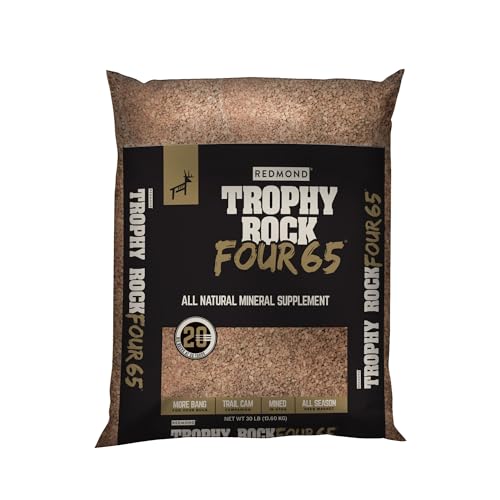
A 30-pound bag of crushed Utah-mined rock carrying 60-plus trace minerals for a camera-friendly lick.
This is a scouting tool as much as a supplement. It is the crushed form of the same Redmond Trophy Rock product — a granule you pour on the ground to build a nutrient-dense mineral lick, rather than a solid block to haul and set. It delivers 60-plus balanced minerals, and it is mined in Utah, USA, for anyone who wants their purchase to stay domestic. The natural trace minerals are pitched as what a deer needs to reach full growth potential, and the format lets you spread the site easily around a camera.
Customers note strong returns on the site. One buyer who has run Trophy Rock and other minerals for a decade reported more deer coming to this than to any other mineral attractant used in that span. Another described deer returning daily to a mineral combo, with a visible increase in the number of deer on the property. The 30-pound bag also means each scoop goes a long way — you get 30 pounds of coverage out of a single purchase.
The honest note is more practical than product-level: as a granule, it behaves like the other loose forms on this list — it wants a site that holds up to weather and repeat visits, and it will not last like a solid block. If you are building a camera-friendly mineral site and want a large bag of crushed trace-mineral rock in one go, this is the strongest scouting-oriented pick here. Just be ready to refresh the site regularly and keep it out of standing water.
What it does best: Pours a 60-plus mineral crushed-rock site that one ten-year Trophy Rock user compared favorably to every other mineral attractant tried.
What to plan for: Loose granule form, so refresh it regularly and keep it above standing water.
Great Choice For: Hunters building a trail-camera-friendly mineral lick and wanting a large, domestic-mined bag of crushed trace-mineral rock.
Less Ideal For: Anyone who wants a set-and-forget block that survives rain and a full season without refreshing.
9. 40LB Big Tine Deer Feed

A 40-pound feed bag for the backyard herd you want to keep close.
This is the pick for the suburban or backyard deer watcher — not a hunter running a mineral site, but someone who lives near deer and wants to keep them coming. It is a 40-pound feed blend of corn, milo, and sunflower seeds, packaged for a home feeder or a spread pile. It is a straightforward feeding product rather than a concentrated mineral, and the size reflects that approach.
Reviewers point out the draw is real. One described it attracting a doe herd of five with two fawns plus a bachelor herd of three bucks over six months — effective enough that the deer ventured off the trail and into neighboring yards, which got the neighbors talking. Another reported success luring a whitetail family within 20 feet of the house, nearly every day and night, with the brand’s block also working well alongside it. One buyer mentioned it works great for new mama deer and babies in the backyard.
The honest note is that a feeding product draws deer to a yard fast enough that it can create exactly the kind of neighborhood tension one owner describes. It is food, so expect it to go through quickly with a real herd on it, and it will not do the antler-focused mineral job a chelated mineral blend does. If you run a suburban property and want more deer on the trail camera in the backyard, this is a genuinely effective pick for that goal — just be mindful of the neighbors.
What it does: A 40-pound corn, milo, and sunflower feed that shoppers say drawing a herd of five plus a bachelor group over six months.
Worth knowing: This is a feeding product, so it goes fast and it draws deer to yards — check your local rules and your neighbors’ patience.
Best For: Backyard and suburban deer watchers who want to keep a local herd coming through and visible.
Not The Pick For: Hunters chasing antler growth, since this is feed, not a mineral site formula.
10. Himalayan Pink Salt Lick Pack of 3

Three roped Himalayan blocks only a barn wall or stall door away from a lick.
For a stall or paddock setup, this is the pick that does the job without needing a holder. You get three 6-pound Himalayan pink salt blocks, each pre-threaded with a rope, mined in the Himalayan Mountains and rated at 98 percent sodium chloride with no artificial fillers. The blocks carry 84 naturally occurring minerals and are cut to a thicker profile to resist breakage and last longer when hung. That rope design is what separates it from the plain chunks on this list — no tray, no tub, just a hook.
Owners like that convenience. One wrote, “The rope is good quality and doesn’t fray,” and described pulling the rope out to hang the block easily, adding that the horses love them. Another buyer hangs them inside the barn and appreciates not having to worry about the blocks melting in the rain. The thicker cut and the high salt content also mean each block holds up over repeated licking rather than crumbling away in a week.
The honest note is that this is a straight salt lick, not an antler-growth formula — 98 percent sodium chloride means the draw is salt and electrolytes, and the mineral content is what occurs naturally in the rock. That is fine for hydrating horses and giving deer a salt site, but it is not what you buy if calcium and phosphorus for antlers is the goal. There is also a slight size note from the maker — actual block weight can vary between 5.5 and 6.6 pounds — so sizing is good but not exact. For hanging and forgetting, this is the one.
What works: Three pre-roped Himalayan blocks that hang straight from a stall or fence — one owner reported the rope is good quality and does not fray.
What to know: Straight 98% sodium chloride salt, so it is a hydration and salt-attraction product, not an antler mineral formula.
Ideal For: Horse owners and barn setups that want a no-tray hanging salt block and value the three-pack.
Not The Move If: Your deer property needs a mineral-forward supplement for antler development rather than straight rock salt.
11. Pure Whitetail Full Throttle Cherry Scented Mineral Lick – 5 lb Bag, 3-Pack
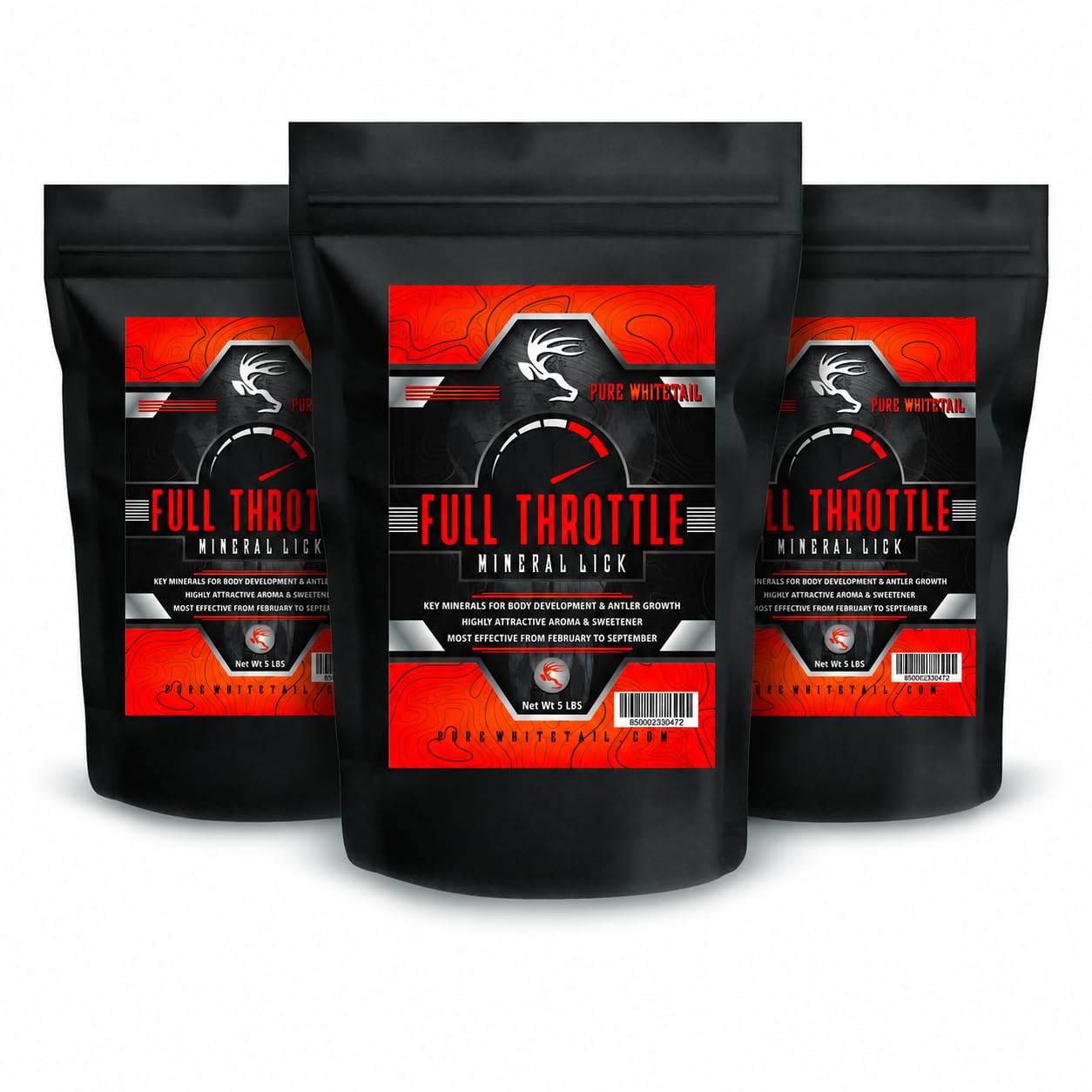
A cherry-scented, low-salt powder that pitches mineral over straight salt.
Here is the one for the hunter who wants a real mineral site rather than a salt lick, and it makes that pitch explicit. The formula is only 35 percent salt, and it carries vitamins A and D3 plus phosphorus and calcium for antler growth and body development — the brand’s whole angle is “create a mineral lick, not a salt lick.” It arrives as a 3-pack of 5-pound bags with a cherry aroma and sweetener, and it is pitched hardest for the February through September window when antler growth does its work.
Buyers report the draw comes quickly. One buyer had bucks in within two days of putting it out, and another had deer eating on the mineral the same day it went down — noting that other brands never drew this much attention. A third, a month into a stump site, reported deer tearing the stump apart. This is the only pick in this lineup that names a specific antler-growth window, and buyer reports line up with that spring-and-summer push.
The honest caveat is that a low-salt mineral is a slower build than a salt block, and one owner who put it out fair and square said the deer and bear mostly walked past it while a salt lick 29 yards away got more interest. That is a fair read of what a 35-percent-salt formula does — it does not smack deer in the face like a pure salt block. If you want maximum antler nutrition over pure attraction, and you are willing to place the site in a spot deer already travel, this is the pick to build a mineral lick around.
Why it wins antler-minded buyers: Only 35% salt, with vitamins A and D3, phosphorus, and calcium aimed at the February-to-September antler-growth window.
What to accept: Low salt means slower attraction than a rock block — it rewards placement on a site deer already use.
Own This If: You want a genuine mineral lick for antler growth and will put it where deer already travel during the spring and summer push.
Give It A Pass If: You want the fastest possible salt attraction and are willing to trade some mineral content for it.
Know the Specs
Mineral Form: Block vs. Granule vs. Powder
Blocks — pressed bricks of salt and minerals — resist rain and last through weather, but they dispense slowly and concentrate deer into one tight spot. Granules and powders are loose minerals you pour or rake into the soil, spread wider across a site, and let a whole herd share the lick at once. Loose forms can absorb into the ground and hold deer to the spot longer; blocks suit a camera setup or a small yard with a well-drained site. Match the form to the property and to how much acreage you want to cover.
Chelated vs. Plain Minerals
Chelated minerals are bound to amino acids so an animal’s body absorbs more of them than it would from a plain salt or rock form. That is why chelated blends — like those found in a chelated calcium, phosphorus, and trace-mineral matrix — are usually a better bet for herd nutrition than straight rock salt. Salt content is the flip side: a formula that is mostly salt draws deer fast, while a lower-salt, mineral-forward blend does more for antler development but may take longer to build a following. Read both numbers before you decide.
The Calcium-to-Phosphorus Ratio
Calcium and phosphorus are the two minerals that build antler bone. Serious buyers check the ratio — a properly balanced calcium-to-phosphorus mix is what supports antler growth, doe lactation, and fawn development through the growing season. A formula running calcium in the 13-15 percent range with phosphorus at 6 percent is the sort of mineral matrix you would look for if antler development is the goal. Products that are mostly sodium chloride — 98 percent, for example — are hydration tools, not antler supplements.
Weight, Coverage, and Refresh Rate
The weight on the bag tells you how long the site lasts and how far it spreads. A 5-pound bag of powdered mineral covers a smaller, more concentrated site than a 30-pound bag of granules, and a heavy 25-pound block can sit for months on end. Loose mineral usually needs a refresh every 3 to4 weeks in active season, while solid blocks go longer between visits. That is the trade-off between convenience and coverage — a big block trades a slower response for far less labor, and a light powder trades shelf life for a wide, fast-growing mineral site.
Common Questions
What is the difference between deer mineral and plain salt for deer?
Is a granular mineral better than a hard mineral block?
When should I put deer mineral out for antler growth?
How much ground does one bag of deer mineral cover?
Will deer share a mineral site with horses or goats?
Does the flavor or scent of a deer mineral matter?
How long does a deer mineral site last before I need to refill it?
Is it legal to put out mineral for deer in my state?
Can a deer mineral attract other wildlife too?
Should I mix deer mineral into the soil or pour it on top?
The Bottom Line
If you want one dependable pick, the mineral for deer winner is the Antler King Trophy Deer Mineral because it packs 27 minerals, vitamins, amino acids, and a yeast culture into a granule deer seek out and return to — and it holds 4.6 stars across 400+ ratings. If you want a mineral-forward, low-salt formula aimed straight at spring and summer antler growth, grab the Pure Whitetail Full Throttle. And for hanging a lick in a barn or stall with nothing but a rope needed, the Himalayan Pink Salt Lick 3-Pack is the one to reach for. Whichever you choose, the rule is the same: read the salt percentage, match the form to your property, and get the site down before the antler-growing season runs out.
How we choose
We do not accept paid placement. Every pick is matched to a real buyer and a real use-case; we do not hands-on test units.
Sources
Specifications: manufacturer listings and product documentation. Review insights: verified customer reviews, as of October 2026. Pricing: not shown on this page (it changes often); check the current price via the retailer link.
As an Amazon Associate, Aappliancez earns from qualifying purchases. This does not affect which products we feature.