Disclosure: Some links in this post are affiliate links. As an Amazon Associate I earn from qualifying purchases, at no extra cost to you. Learn more
Specs are compiled from manufacturer listings and verified buyer reviews and can change over time — please confirm the key details on the product page before buying.
If your big toe has started leaning into its neighbor, the fix is not a tighter shoe or a stiffer splint — it is a spacer that gives the joint room to spread again. A good bunion corrector does one job: it gently pushes the big toe back toward a natural line and cushions the spot where the two toes rub. Get the shape and the fit right and a gel loop can stay on through a workday, while a knob splint suits overnight wear. Get it wrong and the spacer pinches the joint, slips off your toe, or ends up in a drawer. This guide walks you through five picks — two gel spacers, a thick tube spacer, and two knob splints — and who each one suits.
This guide is built by comparing the manufacturers’ published specifications and the patterns across verified customer reviews, so you get each pick’s real strengths and trade-offs instead of marketing spin.
Toe spacers, gel loops, and knob-adjusted splints all attack the same problem from different angles, so the right pick depends on how much correction you want and when you plan to wear it. Below you will find honest breakdowns of the best bunion correctors for daily wear, sleep, and walking around the house, with spacer thickness and wear-time guidance for each.
Top Picks

How To Choose The Best Bunion Correctors
Every product on this list does the same basic thing — it holds your big toe away from the second toe and cushions the joint in between — but they differ in spacer thickness, how they stay on, and when you can wear them. What separates them is how much space they create, how they stay on your foot, and whether you can keep them on while walking, sleeping, or wearing shoes. Decide those three things first — how much space you want, how it stays on, and when you will wear it — and the choice gets simple fast.
Spacer Thickness Sets Your Shoe Situation
A thicker spacer pushes your toes further apart, which gives a stronger stretch but eats up room inside the shoe. Povihome’s spacer sits at roughly six-tenths of an inch thick, and the owner feedback is blunt about what that means: to wear it all day you may need to go up a shoe size. Thinner gel loops sit flush enough to slide into most everyday shoes without a sizing change.
Gel Loop, Toe Sleeve, or Knob Splint
A gel loop slips over your second toe and rests a soft pad between the toes — the least fussy option, and the easiest to leave on for hours. A toe sleeve wraps the toe in a soft tube, holding more firmly but feeling tighter around the joint. A knob-adjusted splint is the most aggressive design, using a rotating dial to dial in a correction angle at the big-toe joint. That control is also the trade-off: it is the design most likely to feel harsh if your bunion is sensitive.
Wear Time Has To Ramp Up
Nobody starts at eight hours. The standard advice across these products is to begin with short sessions and add time as your toes adjust. A common starting point is thirty minutes a day, building toward one to three hours before you try sleeping in it. If the spacer slides off in bed, it is usually too loose — not a sign the product is wrong for you.
Side-by-Side Comparison
| Model | Best For | Spacing Method | Correction Control | Package Weight | Amazon |
|---|---|---|---|---|---|
| APEX Adjustable Toe Separators★ Best Overall | Awkward toe pain and Morton’s Neuroma relief | Adjustable inserts, gel-like silicone | Swappable inserts | 3.84 ounces | Amazon |
| ZenToes Gel Toe SpacersBest Budget Pick | Slipping a soft pad into everyday shoes | Single-loop gel over second toe | Fixed | 0.63 ounces | Amazon |
| Povihome 6 Pack Gel Toe Spacer Separators | All-day wear and post-surgery cushioning | Toe tube ring, 0.6” thick spacer | Fixed | 2.4 ounces | Amazon |
| Pwithze Adjustable Knob Bunion Corrector | Home use with a dialed-in correction angle | Knob at the big-toe joint with silicone pad | 180° rotating knob | 0.07 kg | Amazon |
| HEMEXS Adjustable Big Toe Straightener | Day and night support with two splint lengths | Two interchangeable big-toe splints | Independent adjustment knob | — | Amazon |
Detailed Reviews
1. APEX Adjustable Toe Separators 2 Pairs
Our pick — over 4★ from 650+ verified ratings; the strongest balance of quality and price.
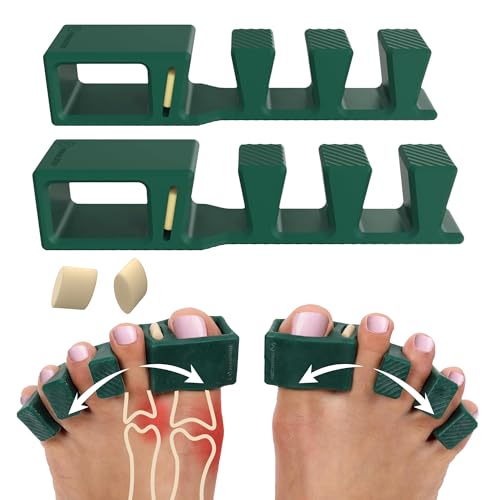
Two pairs, two inserts, and a flat base that lets you walk around the house while your toes stretch.
This is the pick for someone whose toes need a real stretch — not just a soft pad between them. APEX builds it from gel-like silicone that the maker describes as over 50% thicker and more durable, and it ships with adjustable inserts so you decide how aggressive the splay gets. Switch to the larger insert when you want a strong stretch, and drop to S/M when your feet are tired. The two sizes cover women’s 6–9 and men’s 7–9 in S/M, with size L built for anyone at 10 and up.
What wins people over is simple comfort — it is the quality buyers single out more than any other, followed closely by how much toe flexibility it restores. As owners put it: “The best toe separators I’ve tried.” That is the shape of the feedback: people who had cycled through loop-style silicone and found it restrictive say this firmer design holds its stretch instead of collapsing. The flat bottom is the detail that matters day to day, because you can walk in them at home rather than sitting with your feet up. At 3.84 ounces for the set, this is also the heaviest of the pack — notably heavier than the ZenToes spacers at 0.63 ounces — which is the price of a rigid base that stays put.
Here is the honest limit: these are not a shoes-on product. The feedback is consistent that you wear them barefoot or with loose socks, not inside your normal shoes. Beginners should also expect to start small — buyers report “only 30-60 min before discomfort” at first, which is normal for an aggressive splay. A few narrower feet note the smallest toes can slip out of the gaps, so if you have particularly slim toe spacing, size down or expect a looser fit on the outer toes.
Where this one earns its keep
- Two insert sizes let you dial the splay up or down instead of accepting one fixed shape
- Flat-bottom base means you can walk in them at home, not just sit
- Firmer, less stretchy silicone holds its shape instead of collapsing like loop-style spacers
- BPA and latex-free, and easy to put on
What to know before you buy
- Not wearable inside regular shoes — barefoot or loose socks only
- Expect a short adjustment window before longer sessions feel comfortable
- On narrower feet, the smallest toes can work their way out of the gaps
Reach for this if: you want an adjustable, walk-around-the-house stretcher for toes that hurt or overlap, and you are happy to use it barefoot.
Think twice if: your day does not allow time without shoes, because this design is built for home use rather than inside footwear.
2. ZenToes Gel Toe Spacers 4 Count
The slip-on gel loop that turns an ordinary shoe into a comfortable one for the price of a coffee.
If you want the least intrusive version of this whole category, this is it. You slip the loop over your second toe, rest the soft gel cushion between your toes, and that is the entire setup. Four spacers come in the pack, in one size meant to fit most, and the gel is latex-free and washable. At 6.5 x 4.02 x 1.1 inches for the package it takes up barely any drawer space.
Comfort is the whole story here, and the cushioning between the toes is what earns the devotion — the softness is the thing people notice first, followed by how well the padding separates and protects the smaller toes from the big one. Two buyers capture the range of it perfectly: someone wearing them around the clock in socks and even in bed, and a size 7 wearer who finds they “fits 2nd toe well initially but slips toward toe tops sometimes.” That second note is the recurring gripe worth knowing about. The spacers do not lock into place, so they need a nudge back down now and then.
This is also the lightest thing on the list by a wide margin — 0.63 ounces against the APEX set at 3.84 ounces — and every gram of that lightness is why it disappears into a shoe. It sits under bunion pads well too, so you can layer it with a wider cushion if you want more coverage. Just know what you are buying: a pressure-relieving buffer, not a corrective splint.
Layered, not locked: you can wear this alone or underneath bunion pads for extra padding, and it washes clean and comes back for another round.
The fit variable: because it is one size for most foot sizes, how snugly it stays depends on your toe spacing — the fix is pushing it back into position rather than a different product.
Good match: daily-wear shoppers who want soft cushioning inside normal shoes at the friendliest entry point on this list.
Look elsewhere if: you want a firm, corrective stretch — this one cushions and separates, it does not push hard.
3. Povihome 6 Pack Gel Toe Spacer Separators

A thick, tube-style spacer meant to hold a wide gap between the big toe and the second toe all day.
Where the ZenToes loop pads and separates, this one deliberately pushes. Povihome sizes the spacer at roughly six-tenths of an inch thick and describes it as creating about that much distance between the big toe and the second toe. The tube-ring design wraps the toe so it stays put, which is why people wear it in boots as well as around the house. Six come in the pack, and it can go on the second toe or the big toe, whichever sits more comfortably for you.
The count that matters most here is quality — that is what buyers praise first, with effectiveness right behind it. The durability story is genuinely good: rinse it nightly and the maker-side guidance from long-term wearers is to replace it every two to three months. One detail that separates it from the APEX pick above is how it handles shoes — you do not have to go barefoot. Owners mention wearing it all day, though that thick six-tenths-of-an-inch spacer often means going up a shoe size to make room. As customers note: “Worn all day; required going up a shoe size.”
Now the caveat, and it is a real one. Fit is the single most contentious issue in the feedback — some find the sleeve perfect, others find it grips the big toe too tightly, and circulation comes up as a mixed point. That tension is baked into a thick tube design: it holds firmly or it feels tight, depending on your toe. Narrow feet in particular report it running small. The post-surgery note cuts both ways too — one wearer found it ideal for recovery, another found it too thick once the surgery was done.
Built to last: soft gel that handles nightly rinsing and multiple months of daily wear before it loosens up.
Thickness cuts both ways: that six-tenths-of-an-inch spacer is exactly why it holds a wide gap, and exactly why it may need a bigger shoe — and why tighter feet should size down their expectations.
Best for: all-day wearers and anyone cushioning a toe after surgery who wants a firm, wide gap rather than a soft nudge.
Not ideal for: sensitive or narrow toes — the tube grip that keeps it on is the same grip that can feel too tight.
4. Pwithze Bunion Corrector Big Toe
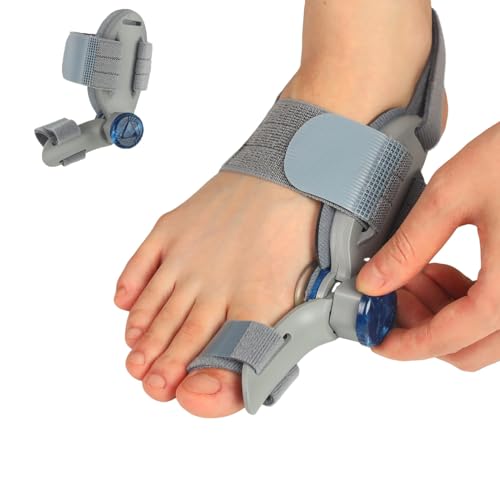
A dial on the big-toe joint that lets you set exactly how much correction you want, one turn at a time.
This is the pick for someone who wants to control the angle rather than accept a fixed shape. A knob sits at the big-toe joint and rotates 180°, so you turn it to increase or ease the correction as your toe tolerates it. Straps at the toes, sole, and heel hold the whole thing onto your foot using Velcro, so it stays put while you walk. It ships with two toe splints, one long and one short, to suit different toe lengths, and a large silicone pad sits inside to cushion the joint.
Adjustability is the quality that stands out most in owner feedback and the top positive note for this product. The design is meant for home life — lounging, reading, watching TV, sleeping — rather than striding around town. The maker’s own guidance is to start at thirty minutes a day and build toward a one-to-three-hour session, then try wearing it to sleep once it feels comfortable. Give it one to two weeks to get used to the pressure.
Be honest about the trade-off before you commit. The rigid knob, which is the entire point of this design, is also the part that shows up in the mixed feedback — sensitive or mildly affected feet sometimes find the mechanism too harsh, and a few note the fit runs small. Construction quality and comfort come through as genuinely mixed, so this is one to buy only if a firm, dialed correction is what you actually want. The lightweight build does help: at 0.07 kg it stays unobtrusive inside loose shoes.
The case for the knob
- 180° rotating dial lets you set the exact correction angle instead of guessing
- Two splint lengths — one long, one short — accommodate different toe sizes
- Velcro straps at toes, sole, and heel hold it on during walking
Who should hold back
- The firm knob mechanism is the part that draws mixed feedback on comfort
- Fit readings are mixed, with some finding it runs small
- Wants a gradual wear-time build-up of one to two weeks before it settles in
Pick this one when: you want active control over your correction angle and plan to wear it at home while relaxing or sleeping.
Give it a miss when: your bunion is sensitive — the firm dial that provides the control is exactly what some wearers find uncomfortable.
5. HEMEXS Bunion Corrector 1 Pack
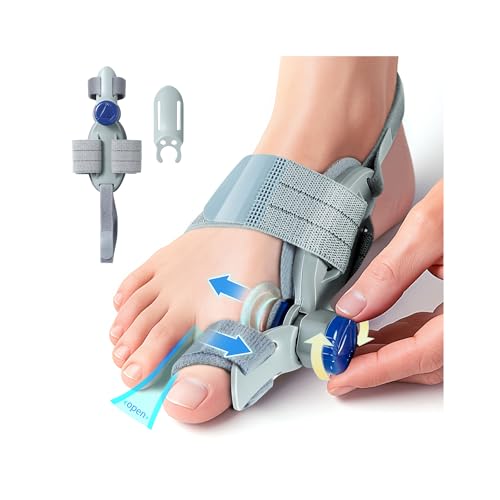
A soft, breathable brace with an independent knob and two splint lengths built for day-and-night rotation.
For a foot that needs support on a daily schedule — relaxing, working from home, sleeping — this brace keeps it simple. It uses an independent adjustment knob to ease the angle and pressure to taste, and includes two interchangeable splints at different lengths so you can match your own toe size. The universal design goes on either the left or right foot, and the straps are built to hold everything comfortably in place.
The comfort and adjustability seal it for most wearers: the tension mechanism is easy to dial and the brace sits gently once it is set. It is a compact, unobtrusive thing — 7.87 x 3.15 x 1.18 inches — that slips on while you are kicked back on the couch. Wear-time guidance is the same patient approach the rest of the category uses: start short, build up based on how it feels. One wearer sums it up cleanly: “10/10 works great and is exactly as described! Great price for the product! Stays in place and fits perfectly after the proper adjustment with easy instructions.”
Two things to weigh. First, this is a sit-and-relax brace, not a walking shoe insert — wearers report it is hard to walk in with it on, so plan your daytime sessions around being stationary. Second, a small number find the pressure unpleasant and experience foot discomfort after long constant use. That is not the common experience, but it is the pattern to watch if you tend to over-tighten. For anything beyond gentle support, keep your sessions short and consistent.
Two splints, one brace: swapping between the long and short splint lets you find the fit that matches your toe length rather than settling for a one-size compromise.
Built for stillness: the same softness that makes it comfortable overnight makes it awkward for walking, so schedule daytime wear for seated sessions.
Best fit for: someone who wants a comfortable, adjustable brace for relaxing, working at a desk, or sleeping with gentle toe support.
skip it if: you need to stay on your feet while wearing it — this design is built for seated and overnight use.
Know the Specs
Spacer Thickness and Toe Splay
Thickness is the number that decides how much room your toes get and how much space they take up. A thicker spacer, such as the six-tenths-of-an-inch design on the Povihome, creates a wider gap between the big toe and the second toe — but it also fills the front of your shoe, which is why going up a shoe size becomes the trade. Thinner loop-style gel, like the ZenToes spacers, slips into ordinary footwear without a sizing change because it takes up almost no room.
Gel Loop, Toe Sleeve, and Knob Splint
The shape decides when you can wear it. A gel loop is the easiest to leave on for hours and the least likely to pinch, but it does not lock in place. A toe sleeve wraps and holds the toe firmly, which suits all-day wear but can feel tight on the joint. A knob splint gives you active control over the correction angle — the most aggressive option, and the one to skip if your bunion is sensitive. Match the shape to when you will actually wear it, and any of these can work.
Common Questions
Can I wear a bunion corrector inside my regular shoes?
How long should I wear a bunion corrector each day?
Will a toe spacer actually straighten my toe over time?
Which bunion corrector is best for post-surgery recovery?
Do bunion correctors help with overlapping toes or corn pain?
Is it fine to wear a toe separator while sleeping?
How often should I replace a gel toe spacer?
Will a thick bunion spacer make my feet hurt?
Should I choose a knob-style bunion splint or a simple gel spacer?
The Bottom Line
If you want one pick that does the most for the most people, the APEX Adjustable Toe Separators earns the top spot because its swappable inserts let you choose your own splay, and the flat base lets you walk around the house while your toes stretch. If affordability and slipping a spacer into normal shoes is the priority, the ZenToes Gel Toe Spacers deliver soft cushioning for the least money. And for anyone who wants to physically dial in a correction angle at home or overnight, the HEMEXS Adjustable Big Toe Straightener gives you two splint lengths and an independent knob to match your foot. Whichever shape you pick, start with short sessions — consistency beats force every time.
How we choose
We do not accept paid placement. Every pick is matched to a real buyer and a real use-case; we do not hands-on test units.
Sources
Specifications: manufacturer listings and product documentation. Review insights: verified customer reviews, as of October 2026. Pricing: not shown on this page (it changes often); check the current price via the retailer link.
As an Amazon Associate, Aappliancez earns from qualifying purchases. This does not affect which products we feature.