Disclosure: Some links in this post are affiliate links. As an Amazon Associate I earn from qualifying purchases, at no extra cost to you. Learn more
Specs are compiled from manufacturer listings and verified buyer reviews and can change over time — please confirm the key details on the product page before buying.
If your vision turns cloudy in the morning and clears as the day goes on, you already know the drill: Fuchs dystrophy lets fluid build up in the clear front layer of your eye overnight, and a hypertonic drop is the tool that pulls that fluid back out. The two things that actually matter are the sodium chloride strength and whether the product is a drop or a thicker ointment.
This guide is built by comparing the manufacturers’ published specifications and the patterns across verified customer reviews, so you get each pick’s real strengths and trade-offs instead of marketing spin.
Fuchs dystrophy care splits into two jobs: a daytime drop you can use as often as your routine allows, and a thicker ointment that sits on the eye through the night. This guide covers the eye drops for Fuchs dystrophy that handle each job, with the exact sodium chloride percentage and format spelled out for every pick so you can match the bottle to your eye doctor’s instructions.
Top Picks

How To Choose The Best Eye Drops For Fuchs Dystrophy
Start with one question: is the product doing the pulling, or just the wetting? A hypertonic sodium chloride drop draws fluid out of a swollen cornea. A plain lubricating tear adds moisture but does not pull anything. For Fuchs dystrophy, the first type is the one your eye doctor is usually steering you toward.
Match the format to the clock
Drops suit daytime use, and because they are thin they clear quickly. An ointment is thicker and sits on the eye longer, which is why it tends to be the choice for overnight use when your eyes are closed for hours.
Read the sodium chloride percentage first
A 5% sodium chloride formula is the standard hypertonic strength you will see across this category. Compare that number across every option before anything else.
Check what the formula leaves out
Look for alcohol-free labeling. Look for preservative-free labeling too, especially if you are instilling drops several times a day.
Count what you actually get
A three-pack of bottles and a box of 60 single-use vials solve the same problem in different ways. Bottles are cheaper to run. Single-use vials keep every dose sterile and travel well.
Side-by-Side Comparison
| Model | Best For | Sodium Chloride | Format | Preservative-Free | Amazon |
|---|---|---|---|---|---|
| REFRESH OPTIVE Artificial Tears★ Best Overall | Daytime dryness and post-surgery use | — | Single-use vials (60) | Yes | Amazon |
| Rugby Sodium Chloride 5% SolutionBest Value | Daytime corneal edema support | 5% | Solution (3-pack) | — | Amazon |
| Muro 128 5% Ointment | Keeping eyes moist overnight | 5% | Ointment | — | Amazon |
| Bion Tears Lubricant Eye Drops | Severe dryness and sensitive eyes | — | Single-use vials (56) | Yes | Amazon |
| Visine Original Redness Relief | Redness from screen time or missed sleep | — | Bottles (4-pack) | — | Amazon |
Detailed Reviews
1. REFRESH OPTIVE Eye Drops
Our pick — over 4.5★ from 12,000+ verified ratings; the strongest balance of quality and price.
Sixty sterile vials that live in a pocket and never need a preservative
For the daytime half of a Fuchs dystrophy routine, this is the pick that does the most work with the fewest compromises. Every dose comes in its own 0.4 mL vial, so there is no preservative in the formula at all — and no bottle cap to touch after you have washed your hands.
If you are instilling drops several times a day, you will burn through vials quickly, so buying the larger box keeps you from rationing. As buyers report about the format itself, the self-contained single-use vials are easier than squeeze bottles, especially for itchy, burning dry eyes that have worsened with age.
What wins people over is simple: it hydrates without the sting some drops carry. That said, a portion of users do get some irritation from it — reviewers put “eye irritation” as a mixed point — so if your eyes are reactive, it is worth testing a few vials before committing to the whole box. The manufacturer also lists post-LASIK dryness as a use, which you should run past your eye doctor first.
Preservative-free vial tears
- Completely preservative-free, so there is nothing extra in the vial to aggravate already-irritated eyes
- 60 single-use containers means every dose is sterile and there is no bottle to keep clean
- Small enough to drop in a pocket or purse, so relief travels with you
Pricey per dose
- A portion of users report mild irritation, so it is not universally sting-free
- Relief is described as brief, so frequent daytime users go through vials fast
Daily dry eye: your routine is daytime-focused and you want a preservative-free option you can use freely without worrying about cumulative irritation.
Budget buyers: your eyes have reacted badly to drops before — get a small quantity in hand before buying the full box.
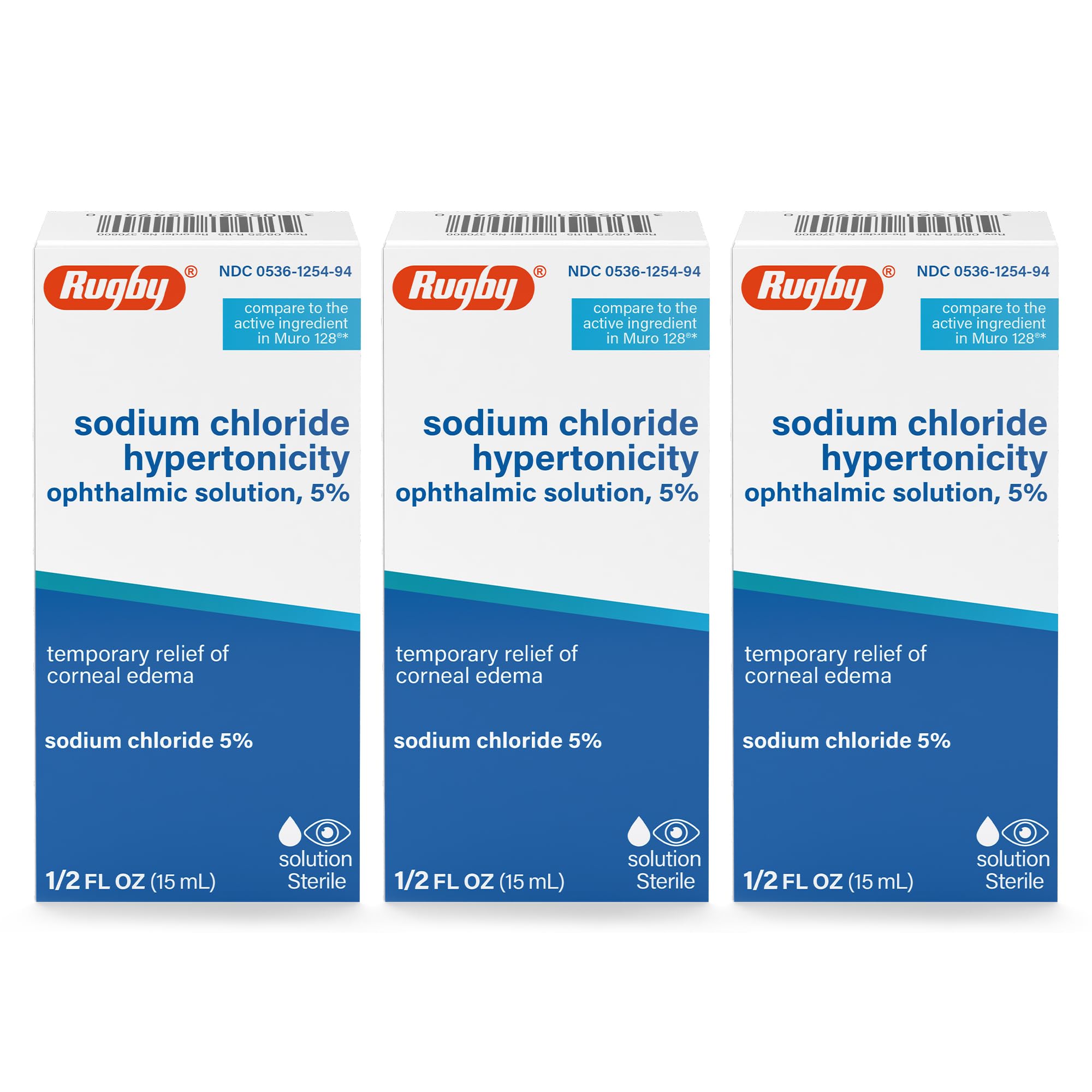
2. Rugby Sodium Chloride Eye Solution 5%
The hypertonic workhorse that behaves like the brand-name bottle for less
Here is the product that actually does the pulling. At 5% sodium chloride, this is a hypertonic solution — meaning it is saltier than your tears, which is the whole mechanism for drawing fluid out of a swollen cornea. For Fuchs dystrophy, that is the job that matters, and you get it without paying brand-name prices.
It is alcohol-free and free of soy, sugar, latex, gluten, and peanuts, which narrows the list of things that could set off a sensitive eye. Users consistently find it effective — “effectiveness” is the aspect most-discussed in the review pool — and a recurring theme is that it holds up next to the expensive branded version.
One reality check worth knowing before your first drop: it stings. Owners describe the burning as brief, often fading within a few seconds, and it tends to be worse on the first drop of the day. That is expected with a 5% hypertonic formula, not a defect. The label says to stop use if the condition persists beyond 72 hours, so treat that as your signal to call your eye doctor.
Saline hypertonic solution: The honest trade The 3-pack structure is the real win here — the review pages frame it as a multi-month supply rather than a single bottle you have to keep reordering, which cuts down on the scramble when you are near the end of your last bottle.
Stings on entry: Where to set expectations Temporary burning on instillation is the standard experience, not a reason to return it. Plan your drops around it and the sting becomes a non-issue.
Mild swelling if the clinical goal is daytime corneal edema support and you want the 5% strength without a branded price tag.
Open sores if you cannot tolerate any burning sensation at all — the saltiness is the point, and it comes with a sting.
3. Muro 128 Ophthalmic Ointment
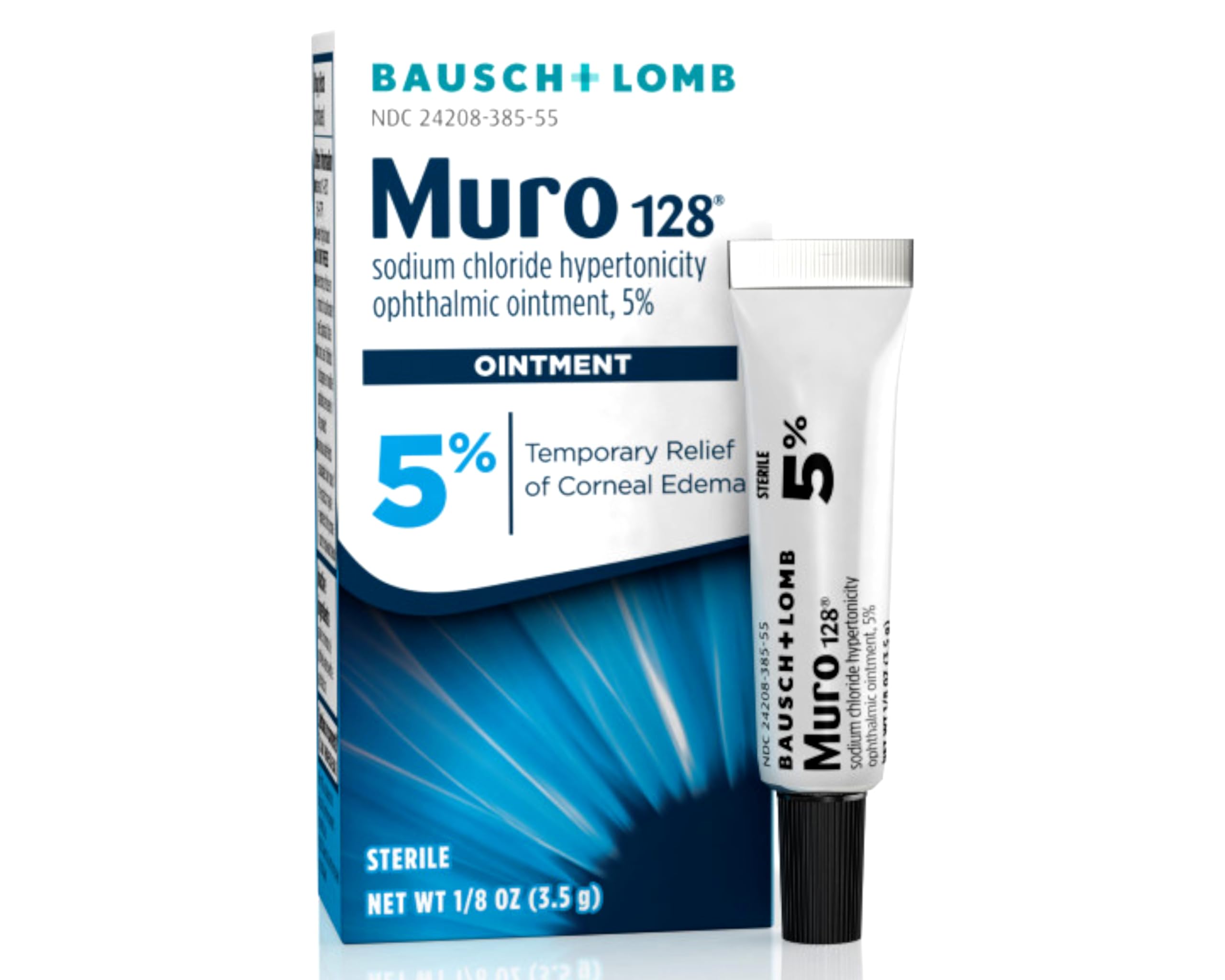
The overnight fix for the foggy morning that opens every day
Muro 128 weighs almost nothing — the tube lands at 0.12 ounces compared with the 7.04 ounces of the Bion Tears box — but the format difference is the real story. This is an ointment, not a drop, and it is built for the hours when your eyes are closed and cannot be topped up.
A drop runs off and clears. An ointment sits. That is why this is the pick for the overnight half of a routine: apply it before bed, and it stays on the eye while you sleep. The label allows application every 3 to 4 hours, or as your doctor directs, so you are not locked into a single bedtime dose. It uses the same 5% sodium chloride strength as the Rugby solution, just delivered as a thick, slow-release layer.
What the review pages praise most is effectiveness, followed closely by moisture. Overnight users describe waking up with eyes that stayed wet rather than gritty. The honest catch is the price-to-amount ratio — value-for-money is the one mixed note across reviews, since a small tube goes quickly if you are using it more than once a night. Make sure you know your own application frequency before you decide. It comes from Bausch + Lomb, the maker of Muro’s broader eye care range.
Overnight ointment relief: Why the format wins The eye cannot be re-wetted while you are asleep, so a product designed to stay put overnight solves a problem a daytime drop simply cannot reach.
Blurry morning vision: The catch worth sizing It is a small tube. If your doctor has you applying it more than once each night, you will replace it faster than you would a bottle of drops.
Bedtime corneal edema: reach for this if your mornings are the hard part and you want something working while you are not awake to apply drops.
Daytime users: your routine is strictly daytime — a thin 5% solution like the Rugby bottle does that job without the heavy texture.
4. Lubricant Eye Drops – 0.015 oz, 28 ct Single Use Vials, 2 pk
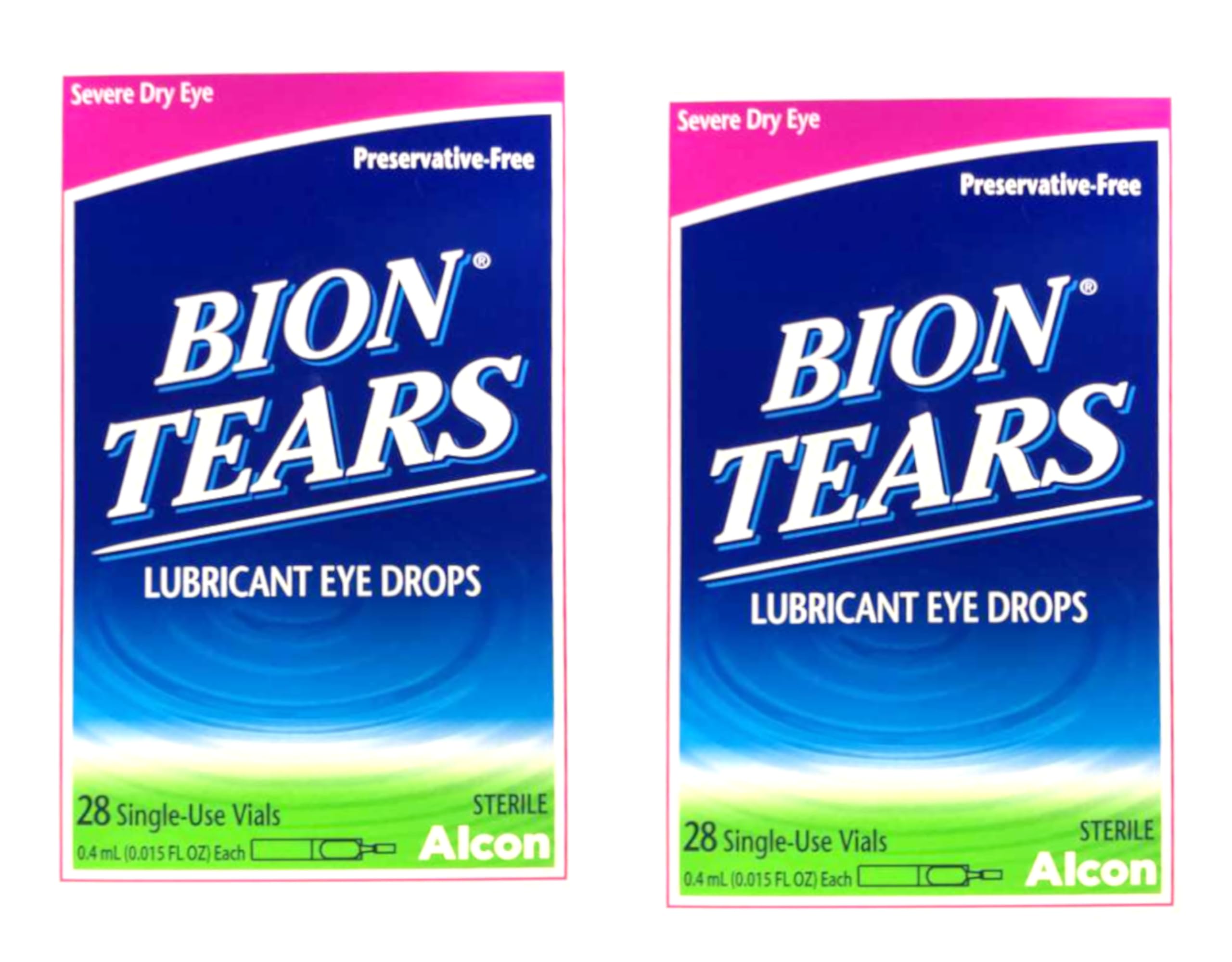
The vial format for eyes so sensitive that a preservative is one thing too many
If a preservative is what makes your eyes sting, the answer is a formula with none in it at all — and this pick is sterile and completely free of added preservatives. Each 0.015 oz vial is sealed until the moment of use, so nothing has been sitting open and collecting contaminants between doses.
The brand is Bion Tears, and it has a following that runs deep. Users who found it years ago describe it as superior to everything else they tried, and there is a real thread of frustration in the reviews about how hard it became to find — a local pharmacy stopped stocking it, and people had to hunt it down again. Reviewers rate it on effectiveness and eye health above all else, which is a telling order: this is about the long game on a sensitive eye, not just fast relief.
The trade-off is honest and simple — a portion of buyers find it a bit pricey. The Bion Tears box is smaller in physical footprint than some competitors, but that compact size is exactly what makes it easy to carry. If both the vials and the visual relief matter to you, this is the one that people stay loyal to.
Single-use sterile vials: The loyalty signal Reviews where people mention using the same drop for decades are rare in this category. It shows up here.
Twenty-eight vial limit: The monetary note Some reviewers consider it a little expensive. It is a smaller box than the REFRESH OPTIVE 60-count, so calculate your usage before deciding which is better value for you.
Sensitive eyes: this is the pick if you have tried other drops without luck and want a preservative-free, sterile formulation that users stay loyal to for years.
Heavy daily use: the box carries fewer vials than the REFRESH OPTIVE option above, so if volume-per-dollar matters most, compare the counts side by side first.
5. Visine Original Eye Drops Pack of 4

Four pocket bottles for taking the red out of tired eyes fast
Important distinction first: this is a redness reliever, not a hypertonic sodium chloride product, so it does not pull fluid out of a swollen cornea and it is not a substitute for the 5% options above. What it does is narrow the blood vessels that make your eyes look red, using 0.05% tetrahydrozoline hydrochloride as the active ingredient — a formula the label says starts working in 60 seconds.
For the everyday redness that comes from smoke, a bad night’s sleep, or a long stretch in front of a screen, that speed is the selling point. The bottle is small enough for a pocket or a bag, and the four-pack means you can keep one at home, one at work, and one in the car without constant reordering.
The label caps it at one to two drops in the affected eye up to four times daily. This is a product for occasional redness, and if your eyes are red every single day from a chronic condition, that is a conversation for your eye doctor rather than a reason to keep reaching for the bottle. It comes from Visine, and reviewers who like it tend to stay loyal to the original formula.
Occasional redness: someone who wants a fast redness fix for occasional tired or irritated eyes and likes keeping a small bottle within reach.
Daily users: anyone dealing with corneal edema symptoms — you need a 5% sodium chloride product like the Rugby solution or the Muro 128 ointment, not a redness reliever.
Know the Specs
Sodium Chloride Percentage
This is the number that decides whether a product can do the hypertonic job at all. A 5% sodium chloride formula is saltier than your natural tears, which is what lets it draw fluid out of a swollen cornea. A plain lubricating drop has no sodium chloride listed because it works by adding moisture, not by pulling fluid. If your goal is managing corneal edema symptoms, scan for that 5% figure before anything else on the label.
Drop vs. Ointment Format
Drops are thin and clear off the eye quickly, which suits daytime use when you can reapply every few hours. Ointments are thick and stay on the surface much longer, which is why they fit overnight routines where the eye is closed. Neither format is better overall — the format has to match when you can actually apply it.
Preservative-Free vs. Preserved
Preservatives help a multi-dose bottle stay clean, but for eyes that are already irritated, repeated exposure can become its own problem. Single-use vials sidestep this because the formula needs no preservative at all — every dose is sealed and sterile. If you are instilling drops many times a day, that distinction is worth paying attention to.
Package Count and Running Cost
A 3-pack of solution, a box of 60 single-use vials, and a 2-pack of 28 count vials solve the same problem at very different consumption rates. If you use drops four times a day, the count determines how often you reorder. Match the quantity to your actual daily frequency, not to the lowest number on the label.
Common Questions
Can I use regular lubricating eye drops for Fuchs dystrophy?
What percentage of sodium chloride should I look for?
Should I use drops or an ointment overnight?
Why do hypertonic eye drops sting when I put them in?
Are preservative-free eye drops better for sensitive eyes?
How many doses are in each bottle or box?
Can I use these products after LASIK surgery?
Is Visine the same as a hypertonic sodium chloride drop?
What does alcohol-free mean on a hypertonic eye drop?
How often can I use a 5% sodium chloride drop safely?
The Bottom Line
For the daytime half of a Fuchs dystrophy routine, the winner among these eye drops for fuchs dystrophy picks is the REFRESH OPTIVE Preservative-Free Artificial Tears, because it hydrates a sensitive eye without a preservative and comes in 60 single-use vials that travel wherever you go. If you need the actual hypertonic pull — a 5% sodium chloride formula working during the day — grab the Rugby Sodium Chloride 5% Solution, which delivers that strength in a three-pack without the branded markup and stays alcohol-free. And for the mornings that start foggy, the Muro 128 5% Ointment is the one to reach for, because an ointment sits on the eye through the night in a way no drop can. Buy your hypertonic product from the Rugby or Muro 128 aisle, add the REFRESH OPTIVE vials for daytime comfort, and confirm your drop schedule with your eye doctor before you change anything.
How we choose
We do not accept paid placement. Every pick is matched to a real buyer and a real use-case; we do not hands-on test units.
Sources
Specifications: manufacturer listings and product documentation. Review insights: verified customer reviews, as of October 2026. Pricing: not shown on this page (it changes often); check the current price via the retailer link.
As an Amazon Associate, Aappliancez earns from qualifying purchases. This does not affect which products we feature.