Disclosure: Some links in this post are affiliate links. As an Amazon Associate I earn from qualifying purchases, at no extra cost to you. Learn more
Specs are compiled from manufacturer listings and verified buyer reviews and can change over time — please confirm the key details on the product page before buying.
If you have ever watched a strawberry go into the sink dusty and come out still dusty, you already know the problem. Plain rinsing only moves what is loose. The machines worth buying use ozone gas or charged water ions to break down residue and grit, so your produce actually comes clean. This guide covers six of them, from pick-up-and-go battery units to wall-mounted ozone boxes that trace their roots to commercial food treatment. The crowd favorite — the VTAR 500mg/h unit — sits at 4.0+ stars across 450+ ratings.
This guide is built by comparing the manufacturers’ published specifications and the patterns across verified customer reviews, so you get each pick’s real strengths and trade-offs instead of marketing spin.
You will see three approaches here. Portable battery purifiers travel to any sink. Wall-mounted ozone generators (units that release ozone gas into water or air) stay put and treat a fixed basin. And one unit runs both electrolysis and ultrasonic modes. Each fits a different kitchen. The rest of this page breaks down which one fits yours, including what fruit cleaner machine specs matter most when you shop.
Top Picks


How To Choose The Best Fruit Cleaner Machine
Every unit here cleans with water and electricity. But the “how” splits into three families. The family you need tells you more than any single spec on the box.
Ozone Output In mg/h Is The First Number To Check
Ozone machines release gas into the water. The strength is written as mg/h, or milligrams per hour — how much ozone gas the unit pushes out in an hour. A 500mg/h unit treats a standard bowl of vegetables in a few minutes. A 1000mg/h unit moves twice the gas. That matters for bigger batches, larger water volumes, or if you want the cycle to end sooner. The trade-off: more ozone means more gas in the room unless your kitchen is well aired. So run stronger models with a window open or a vent on.
Ion Purifiers Trade The Gas Smell For A Quieter Ride
Ion machines skip the ozone gas. They use electricity to split water into charged particles called OH-ions (charged water particles that lift dirt off the surface). You get none of the sharp ozone smell that some users dislike. The units also tend to be smaller because there is no diffuser stone (a porous stone that bubbles the gas into the water). The catch: ion purifiers need the food submerged and often need a longer soak. Results also vary more from one model to another.
Battery, Cord, And Mounting Decide Where You Can Use It
Cordless units with a built-in rechargeable battery go from kitchen bowl to picnic cooler without a plug nearby. Wall-mounted or countertop ozone generators need an outlet. In return they free up cabinet space and get pointed straight into a large basin or even bath water. Measure your biggest mixing bowl before you buy, because nearly every unit here wants 3-5L of water (liters, so roughly a large mixing bowl).
Side-by-Side Comparison
| Model | Best For | Cleaning Method | Ozone Output | Power Source | Amazon |
|---|---|---|---|---|---|
| VTAR Ozone Machine 500mg/h (Silver)★ Best Overall | All-round home fruit and water cleaner | Ozone gas via diffuser stone | 500mg/h | Corded, wall-mount or countertop | Amazon |
| Fabenix Fruit & Vegetable Cleaning Machine (White)Best Value | Cordless cleaning for sinks and travel | OH-ion purification | — | 4800mAh rechargeable battery | Amazon |
| IMENE Upgraded 2-in-1 Washing Machine | Two cleaning modes in one unit | OH-ion + ultrasonic | — | IPX7 waterproof host, corded | Amazon |
| ICARE Ozone Machine Generator, 1000mg/h | Faster treatment for bigger loads | Ozone gas via diffuser stone | 1000mg/h | Corded, wall-mount or countertop | Amazon |
| Ozone Machine Generator, 500mg/h with 5-Speed Timer | Preset timing across multiple tasks | Ozone gas via diffuser stone | 500mg/h | Corded, wall-mount or countertop | Amazon |
| VTAR Ozone Machine 1000mg/h (Dark Gray) | Larger rooms, kitchens and offices | Ozone gas via diffuser stone | 1000mg/h | Corded, wall-mount or countertop | Amazon |
Detailed Reviews
1. VTAR Ozone Machine 500mg/h
Our pick — 4.0+★ from 450+ verified ratings; the strongest balance of quality and price.
One box that treats the produce bowl, the kitchen air, and the toothbrush cup
This unit takes the top spot because owners praise its build quality more than any other aspect, and it refuses to do only one job. Drop the diffuser stone (the porous stone that bubbles ozone into the water) into a bowl with your greens. Tap the power button. The touch panel reads 00, and you tap the up or down timing key in 5-minute steps up to a maximum of 60 minutes. Same machine, same hose, then handles a room to clear cooking smells, a pet area, or aquarium water. It runs on a cord and has a wall-mount option, so it stays off the counter between uses.
The output is 500mg/h — milligrams per hour, or how much ozone gas it pushes out in an hour. That is half the strength of VTAR’s own 1000mg/h model, so a family bowl of vegetables works fine but a big sink of greens takes longer. The body is rated 2.2 pounds and 2.8 x 6.7 x 9.5 inches, small enough to tuck under a cabinet or ride on a wall. It ships with 1 detachable tube and 2 grey diffuser stones, so you can rotate one stone into the water while the other dries.
Owner feedback reads consistently across the review pages: it cleans, it is easy to use, and the price sits in value territory. Ozone output is the one honest caution — some buyers report units that produced little or no ozone. The odor and noise split buyers too, with some loving the “fresh air” smell and others finding it unpleasant. That is not a defect pattern, it is an ozone-device reality: how strong it smells and how loud it sounds depends on the room and the owner. Run it near an open window, do not expect a silent soak, and this stays a steady performer for weekly produce cleaning and long-term food preservation.
What owners keep coming back to
- Build quality is the standout across owner feedback — this is the aspect praised most often
- Easy three-tap operation: power, then up/down timing in 5-minute increments up to 60 minutes
- Wall-mount or countertop placement, so it stays out of the way between uses
- Ships with 1 detachable tube and 2 grey diffuser stones
- Doubles as an air and water purifier for rooms, toilets and pet odors
Where it asks for patience
- 500mg/h takes longer than the 1000mg/h models in this list for a large basin
- Ozone output draws mixed results — some owners mention weak or no gas production
- The ozone smell and running noise split opinion
- Tiny low-contrast vertical labels and a 1.2m cord make placement a planning exercise
Buy it if: you want one box that handles produce, kitchen odors, and water in a single machine and you have a window or vent nearby.
Look elsewhere if: you need to treat big sink loads fast — step up to a 1000mg/h unit instead.
2. Fruit and Vegetable Cleaning Machine
The cordless puck that turns your sink basin into a purifier
No hose, no wall mount, no stone — this is the only unit in the list that runs on a 4800mAh rechargeable battery, and that battery is why it wins on portability. It is a small round disc that drops into 3-5L of water (liters, so roughly a large mixing bowl or your kitchen sink) and starts bubbling. The bubbles carry OH-ions, which are charged particles made from plain water that lift residue off the food surface. Press the power button, walk away, come back 10 minutes later.
The maker rates one charge at roughly 30 cleaning cycles. So you can take it camping, to the RV, or just to the second sink without hunting for an outlet. The base doubles as the charger, which keeps the unit sitting right when it is not in use. There is no chemical addition and no heat, so nothing cooks or wilts.
What wins people over is how fast the routine gets. Instead of multiple bowls, soaks and scrubs, the food goes in the water, the puck goes in, and time does the rest. One reviewer summed it up on the review pages: “just let it go come back in 30 minutes and all the dirt is off the strawberries.” The honest caveat is upkeep — customers note you must take it apart, rinse it, and dry it right after each use, or the two halves bond from buildup over time. Skepticism exists too: one user ran a half-and-half berry test and saw no visible difference. It is not a scrubber, so caked-on soil still wants a pre-rinse — unlike the VTAR Silver, it will not also clear your kitchen air.
Where it earns its spot: the 4800mAh battery turning a 10-minute soak into a cordless routine is the whole pitch. That is what makes this the easiest pick in the group for anyone without a free outlet near the sink.
The one habit you should build: disassemble, rinse and dry after every cycle. Owners link buildup and corrosion to skipping that step, not to the design.
Reach for this if: you want cordless, packable cleaning that goes from kitchen sink to campsite without a plug.
Pass if: you want the machine to do the scrubbing — dirt that is stuck on still needs your hands.
3. IMENE Upgraded 2-in-1 Fruit and Vegetable Washing Machine

Two cleaning engines in one host, and a waterproof body that can take abuse
Every other unit in this article gives you one cleaning method. This one hands you two. Drop the host into 3-5L of water (liters, so a large mixing bowl or picnic basin), press the controller, and choose electrolysis mode, cleaning mode, or enhance mode — three settings that layer OH-ion purification on top of ultrasonic vibration (high-frequency sound waves that shake residue loose). The ions do the chemical-lite work; the sound waves do the physical agitation. The maker claims the two modes together remove over 99% of residue from food surfaces. The maker also lists rice, meat, seafood, and tableware.
The build detail worth flagging is the IPX7 waterproof rating on the host — a rating that means the body is designed to be submerged in up to a meter of water for a short time. So getting it fully wet in a full sink is not a mistake. Cycle time is 10 minutes, and the unit fits whatever container you already own.
Owner feedback here splits buyers more than its siblings do. One owner reported grapes tasting noticeably cleaner after the cycle. Others aren’t sold — one reviewer noted it was loud and the water didn’t look different after the run, and another said they ran it six times in plain water and felt the result was worse, not better. Those are real experiences, not a pattern of failures. But they do suggest a machine that rewards patience and a pre-rinse. Judge it on which mode you use and how dirty the food started. The maker also offers a 90-day refund window.
Why two modes matter: the OH-ion + ultrasonic combination gives you a dial for how aggressive your cycle is — a light 10-minute pass for grapes, an enhanced pass for meat or tableware.
What to expect honestly: the review page shows real divergence. The IPX7 body and 3-5L bowl flexibility are consistent strengths; the cycle results are the variable.
Suits you if: you want one portable machine that can switch between light produce washing and heavier food or tableware cleaning.
Think twice if: you want quiet operation — running noise shows up as a recurring objection.
4. Ozone Machine Generator 1000mg/h
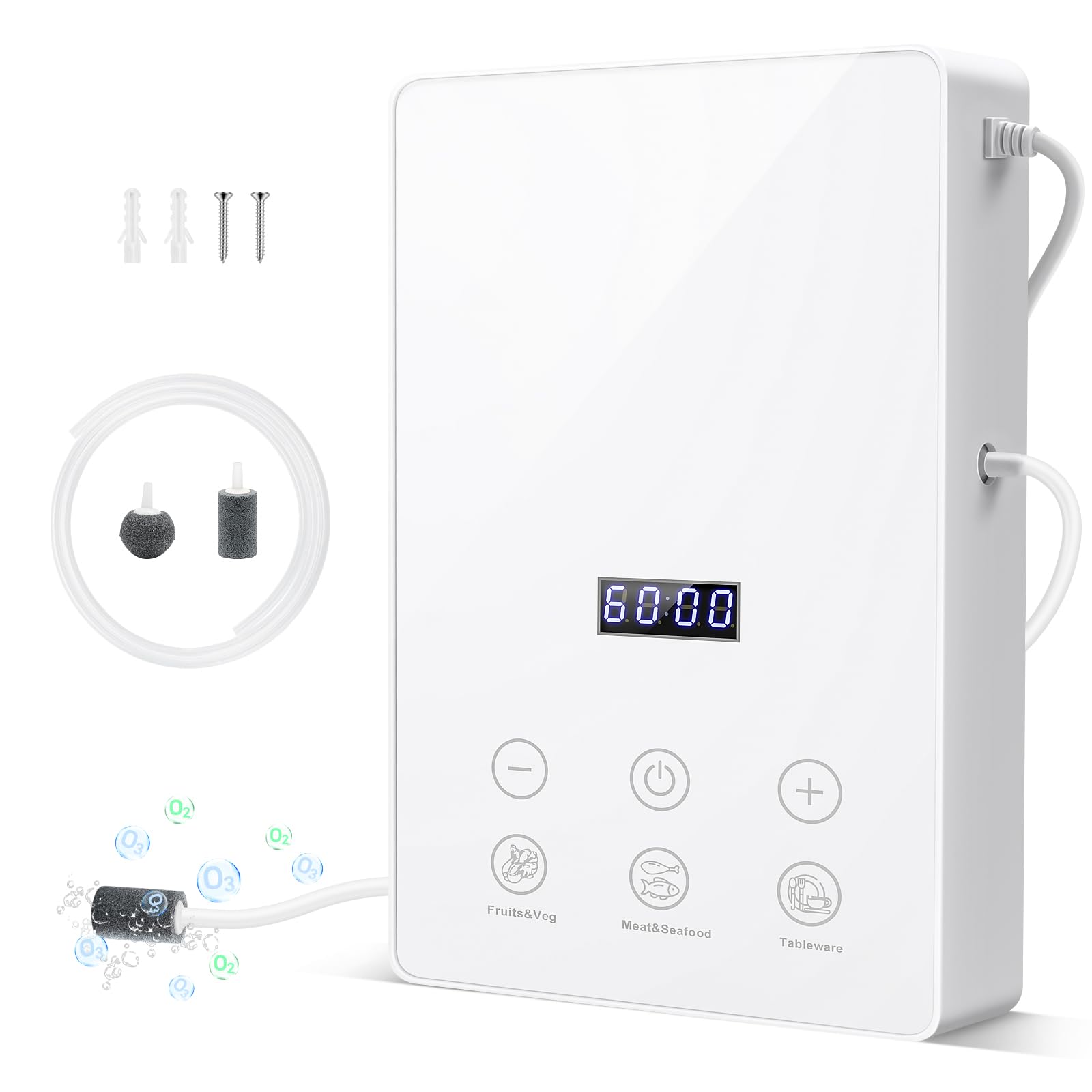
Double the ozone output, and a smart touch panel you can actually see in a dark kitchen
A 1000mg/h output puts this unit in a different performance class from the VTAR Silver, which pushes 500mg/h — that is a 2.0x gap by the manufacturer’s own numbers. More ozone per hour translates to a shorter treatment time on the same water volume. That pays off when you clean a full salad spinner of greens rather than a single bowl, or process a batch before you leave for work.
Timing is the second reason this pick sits high in the group. The control panel is a touchscreen with adjustable timing from 0-60 minutes, so you dial in the exact soak length instead of stepping through presets. The controls are large and illuminated — one buyer’s note called them “large illuminated controls, presets, quick time addition.” It also ships with 2 sets of PVC tubing, diffuser stones, and mounting screws, so wall-mount or countertop is your call. The maker positions it for apartments, kitchens, RVs, and family use, with the ozone water applied to drinking water treatment, produce washing, kitchen cleaning, and even bathtub or small-pool water.
The body is compact and light — the spec lists 2.34 pounds and 7.48 x 1.97 x 1.97 inches, so it stores easily. Two honest buyer notes worth keeping in mind: the instructions are thin (one buyer mentioned poor documentation with no warranty card), and the ozone smell is real — “you can really smell the ozone when in use” is how one buyer put it. Ozone is a lung irritant at room concentration, so run this near an open window or vent, not in a closed bedroom. Quiet operation on most surfaces is a plus; a cloth underneath cancels the vibration noise that a few buyers mention.
Where it pulls away: the 1000mg/h output and 0-60 minute touchscreen timer combine to give you the fastest, most controllable cycle in this list for a standard kitchen bowl.
The trade-off to plan for: documentation is minimal and the ozone smell is unmistakable — budget for a ventilated spot and a quick internet search for setup if the manual leaves you cold.
Pick this one if: you process larger loads and want the cycle to end sooner, plus a touchscreen timer you set rather than a preset you settle for.
Skip if: you need walk-through instructions in the box — this unit assumes you already know the routine.
5. Ozone Machine Generator 500mg/h

Preset timing designed around real tasks, not just one dial setting
A five-speed timer is what separates this machine from the other ozone units here. The presets map to how you actually use it: 5 minutes, 10 minutes, 15 minutes, 30 minutes, and 60 minutes. Short cycles treat drinking water and small bowls of berries; longer ones handle meat, seafood, tableware, or a soak for softening and cleaning hands and face. The 500mg/h output (milligrams per hour of ozone gas) matches the VTAR Silver, which costs you a longer cycle on a big basin. But you press a preset instead of tapping your way through every cycle, and the screen is large enough to read the working status from across the kitchen or bathroom.
This is also the ozone pick most owners use for air, not just water. Ozone’s oxidizing action breaks down cooking odors, bathroom smells, and stale room air. One buyer set it up in a DIY tote bin as a small ozone station to clear odor from old fabric and paper. Performance and effectiveness are the two aspects mentioned most in the review pages, followed by versatility. It reaches full strength fast, and it is small enough to store in the same tote or cabinet you use the rest of the time.
Setup is package-simple: the wall-mount design keeps it out of the way when not in use, and the box includes 1 silicone tube plus 2 diffuser stones. Use those to add more bubble surface area and dissolve more ozone into the water. The honest caveats are the same as any ozone unit. The smell is what sends some buyers to the porch for a cycle, and the ozone reduction window back to oxygen is listed at 30-60 minutes, so a treated room needs airing before you sit in it. Ease of use earns mixed notes across the crowd. Run it with a window cracked and it turns out to be a reliable, task-specific cleaner with the widest timer range in the group.
The standout: a 5-minute-to-60-minute preset range is the single most useful control on any ozone unit, because different jobs genuinely want different cycle lengths.
Do not skip: the 30-60 minute re-oxygenation window. Treat the cycle end as the start of your ventilation clock, not the finish line.
Good fit for: households that want one machine for kitchen water, produce, and room odors with a preset for each job.
Think about the room: if you cannot ventilate during and after cycles, the ozone smell will linger longer than you want.
6. VTAR Ozone Machine 1000mg/h
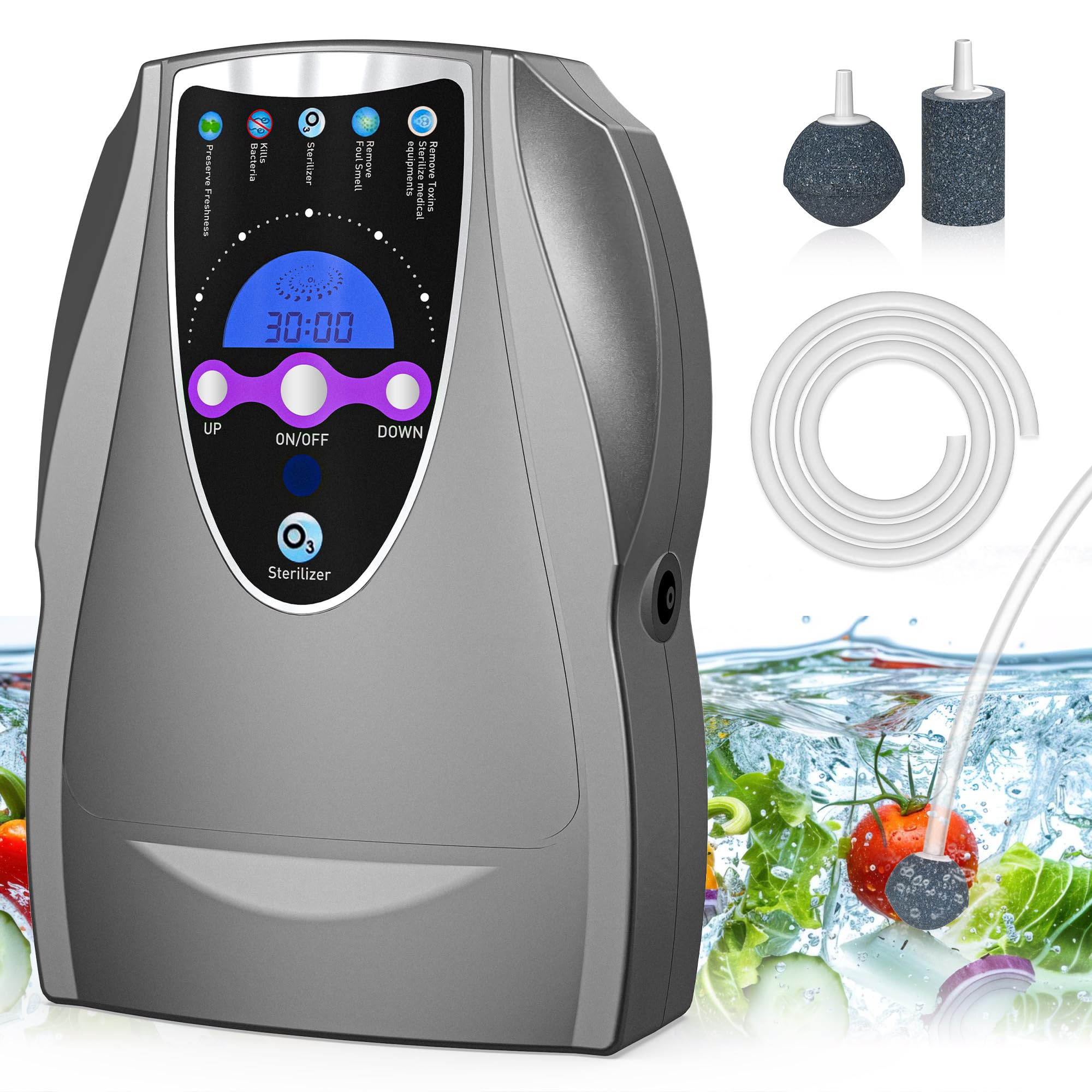
Same trusted VTAR body, now pushing 1000mg/h to cover bigger jobs
Take the VTAR Silver’s identical body — 2.8 x 6.7 x 9.5 inches, 2.2 pounds — and double the output to 1000mg/h (milligrams per hour of ozone gas). The maker bills that as the ideal for bigger rooms, kitchens and offices. The same package carries over: 1 detachable tube, 2 grey diffuser stones, wall-mount option, and the “00” display with tap-tap timing in 5-minute steps up to a maximum of 60 minutes.
Owners who want the full capability of a VTAR get exactly that. Strong airflow from the diffuser stone, effective odor work on kitchen and bathroom air, and a body that cleans produce and water the way the smaller model does. Against the 500mg/h VTAR Silver, this one runs the same tasks on the same bowl but reaches a stronger ozone concentration on a thinner schedule. That is the real reason to pay more within the same design language.
Two honest notes from the review pages. First, ozone output gets mixed signals just as it does on the VTAR Silver — some buyers find it exceptionally strong, and some report little or none, so contact the maker rather than living with it if yours seems weak. Second, the sound and smell are both a matter of room and taste: a fish-tank-level hum and a beep when the cycle ends, plus an ozone odor that some love (“smells like fresh air”) and others do not. The pump runs for 30 seconds after the cycle for cooling, which is normal and intended. Owners have flagged tiny low-contrast vertical labels, a 1.2m cord, and no feet on the base — so plan on the wall-mount or a small mat if you want it sturdy on a counter.
The upgrade logic: you are buying the same proven VTAR form factor with 2x the ozone output for the same bowl size — the fastest VTAR cycle for produce and the strongest one for rooms.
What to plan for: the cord is 1.2m, the labels are small, and the smell is once again the dividing line between five-star and three-star experiences.
Made for: someone who wants the room-freshening and produce-cleaning power of a 1000mg/h ozone unit in the familiar, proven VTAR layout.
Not for: anyone who needs a long cord or a unit that sits flat without mounting — you get 1.2m and a wall-mount challenge.
Know the Specs
Ozone Output In mg/h
This is the first number to compare between machines. It tells you how many milligrams of ozone the unit can push into the water or air in an hour. A 1000mg/h machine produces twice the ozone of a 500mg/h model, so you can treat a larger volume of water in the same time or run a shorter cycle on the same bowl. For produce washing, 500mg/h handles a standard family bowl fine. Step up to 1000mg/h if you process bigger loads, bathe water, or want the cycle to end sooner. Remember the trade-off: more ozone means more gas in the room, so plan ventilation around your output choice, not just around the size of your sink.
Water Volume And Bowl Size
Nearly every machine here wants 3-5L of water for a cycle — liters, so a large mixing bowl, a pasta pot, or a typical kitchen sink filled a few inches. Not a full sink to the brim. Too little water and the ozone or ions concentrate too high; too much and the machine cannot saturate it in the cycle window. Worth measuring your biggest bowl before you buy. A cordless unit like the Fabenix puck fits the same 3-5L range and travels with you, which is handy if your kitchen and your camping setup use different containers. Wall-mounted ozone units usually feed a fixed basin via a diffuser hose, so pick the placement to match the container you will keep using.
Common Questions
Will a fruit cleaner machine work on grapes and berries?
Do I have to rinse the fruit after the cycle?
Will these units clean meat and seafood, or just produce?
Do I need to ventilate while an ozone machine runs?
Why does one machine need to be plugged in and another uses a rechargeable battery?
How loud are these machines in a real kitchen?
Is a 1000mg/h unit overkill for one household?
What do I do if my ozone unit produces little or no ozone?
Can I use one of these for tap water I plan to drink?
Should I buy two units, one for produce and one for the room?
The Bottom Line
For most kitchens, the fruit cleaner machine winner is the VTAR Ozone Machine 500mg/h (Silver). It handles produce, water, and room odors in one unit, ships with two diffuser stones, and carries the owner build-quality ratings that back it up. If you want to treat bigger loads faster, grab the ICARE 1000mg/h Ozone Machine for double the ozone output and a touchscreen timer. And for cordless, packable cleaning that goes anywhere, the Fabenix USB Wireless Food Purifier is the one to reach for — a quick soak-and-go rather than a fixed installation.
How we choose
We do not accept paid placement. Every pick is matched to a real buyer and a real use-case; we do not hands-on test units.
Sources
Specifications: manufacturer listings and product documentation. Review insights: verified customer reviews, as of October 2026. Pricing: not shown on this page (it changes often); check the current price via the retailer link.
As an Amazon Associate, Aappliancez earns from qualifying purchases. This does not affect which products we feature.