Disclosure: Some links in this post are affiliate links. As an Amazon Associate I earn from qualifying purchases, at no extra cost to you. Learn more
Specs are compiled from manufacturer listings and verified buyer reviews and can change over time — please confirm the key details on the product page before buying.
If your upstairs bedroom turns into an oven every July, a 16,000 BTU portable air conditioner can fix it. BTU stands for British thermal units, the standard measure of how much heat a unit can pull out of a room. This guide compares six of them on what actually decides your comfort: real cooling reach, how loud they run at night, and whether you have to babysit a water bucket every day. The short answer: the ZAFRO Smart Inverter is the strongest all-rounder for most people, the HUMHOLD and DOMANKI are the quiet-night picks, and the value-tier units at the bottom are best for a single bedroom.
This guide is built by comparing the manufacturers’ published specifications and the patterns across verified customer reviews, so you get each pick’s real strengths and trade-offs instead of marketing spin.
Below you’ll find a plain-English breakdown of BTU ratings, dual-hose versus single-hose design, drainage, and noise in decibels, followed by six honest picks. Choosing the best 16000 BTU portable air conditioner depends on matching real SACC cooling and airflow to your room size and how quietly you need it to run at night.
Top Picks
How To Choose The Best 16000 BTU Portable Air Conditioner
Buying a portable air conditioner is less about brand names and more about three physical truths: how much real cooling the unit delivers, how it pushes hot air out of your window, and how much water you’ll have to deal with.
ASHRAE BTU versus SACC BTU
Almost every unit in this category advertises 16,000 BTU, but that number is an ASHRAE rating — a lab measurement taken with no real-world window losses. The DOE SACC number (the US Department of Energy’s adjusted rating) is the number that reflects what you actually feel. The ZAFRO and the HUMHOLD both list their SACC rating of 12,000 BTU alongside the 16,000 BTU ASHRAE figure, which is the honest way to do it. When a listing shows only one BTU number, assume it’s the ASHRAE figure, not the SACC one.
Dual Hose versus Single Hose
A dual-hose unit runs two ducts to the window — one pulling outside air in to be cooled, one pushing hot exhaust out. That keeps the unit from depressurizing your room and dragging hot air back in through door gaps. A single-hose unit is cheaper and easier to install, but it uses the cooled air already in your room to run the exhaust, so it fights itself. If your room is above 300 square feet or you live somewhere brutally hot, dual hose is worth it.
Side-by-Side Comparison
| Model | Best For | Cooling Power | Hose / Airflow | Noise | Amazon |
|---|---|---|---|---|---|
| ZAFRO Smart Inverter 16000 BTU★ Best Overall | Most people, most rooms | 16,000 BTU (12,000 BTU SACC) | Dual hose, 500 m³/h | 42 dB | Amazon |
| KoolSiln 16,000 BTU InverterBest for Small Rooms | Small/medium rooms on a mid budget | 16,000 BTU | Single hose | Under 40 dB | Amazon |
| Augsmile Portable AC 16,000 BTU | Renters who need it to move with them | 16,000 BTU | Single hose, 450 m³/h | 40 dB | Amazon |
| SNOCOD 16,000 BTU Portable AC | Simple, low-fuss single-room use | 16,000 BTU | Single hose | — | Amazon |
| HUMHOLD Inverter 16000 BTU | Bedrooms in dry heat | 16,000 BTU (12,000 BTU SACC) | Dual hose | 42 dB | Amazon |
| DOMANKI Inverter 16000 BTU | Open-plan rooms and offices | 16,000 BTU (12,000 BTU SACC) | Dual hose, 470 m³/h | 42 dB | Amazon |
Detailed Reviews
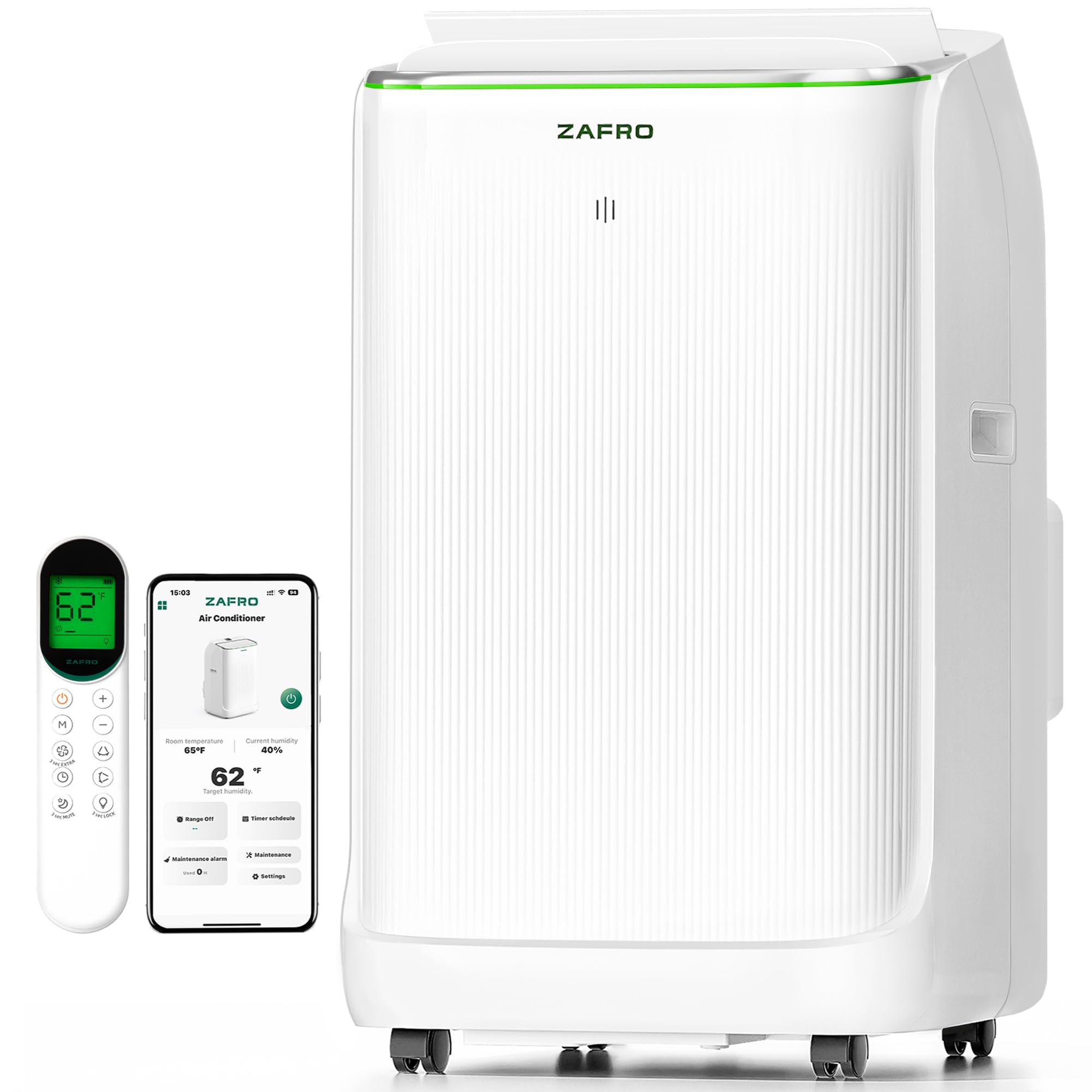
1. ZAFRO Smart Inverter Portable Air Conditioners 16000 BTU
Our pick — 4.0+★ from 400+ verified ratings; the strongest balance of quality and price.
The dual-hose inverter that moves 500 cubic meters of air an hour and still whispers at 42dB
If you want one portable air conditioner that handles a real bedroom without you thinking about it, this ZAFRO is the pick. It’s rated at 16,000 BTU ASHRAE and 12,000 BTU SACC, and it uses a dual-hose system — two ducts to the window, one pulling air in and one pushing exhaust out — so it doesn’t steal the cool air it just made. That airflow figure is 500 cubic meters per hour, or roughly the same volume of air a large box fan moves at full tilt, spread evenly rather than blasted at one spot.
What makes it livable day-to-day is the drainage side. The self-evaporating system recycles moisture from the evaporator back over the condenser, so in humidity below 90% it runs drainage-free for up to 72 hours. In other words, you fill your weekend without emptying a bucket. The inverter compressor varies its speed instead of clicking on and off, which is what keeps the noise down to 42dB — quieter than a normal conversation, so you can hold a call in the next room. It also hits a CEER of 12.8, a cooling-efficiency rating that sits well above the 7.83 standard, which is the plain-English way of saying it uses less power for the same cold.
Buyers report the dual hose holds a large bedroom at 70°F easily, with setup around 30 minutes and casters that roll across an apartment. On the ZAFRO app, remote, or the touch panel you get six modes — Cool, Dry, Fan, Sleep, Extra, and Eco — plus a 24-hour timer and four-way oscillation that swings air both up-and-down and side-to-side. Extra Mode locks the temperature at 61°F and runs full power, handy when you walk in from a 98°F afternoon.
Where It Earns Its Keep
- Dual-hose design keeps out hot outside air instead of fighting it
- 42dB sleep mode with automatic compressor and fan adjustments
- 72hrs drainage-free in humidity under 90%, so no daily bucket duty
- Six modes including a 61°F Extra Mode for heat-wave relief
Where It Asks A Little Patience
- The dual-hose exhaust runs hot at the vent, so an insulated hose cover is worth the small extra
- At this capacity it’s a heavy freestanding unit — you’ll want it on its casters before you move it
Bring it home if: you want the best all-round balance of real 12,000 BTU SACC cooling, near-silent nights, and skipping the drain hose for days at a time.
Don’t expect: a lightweight unit you can carry up stairs solo — this is a dual-hose machine built for staying put.
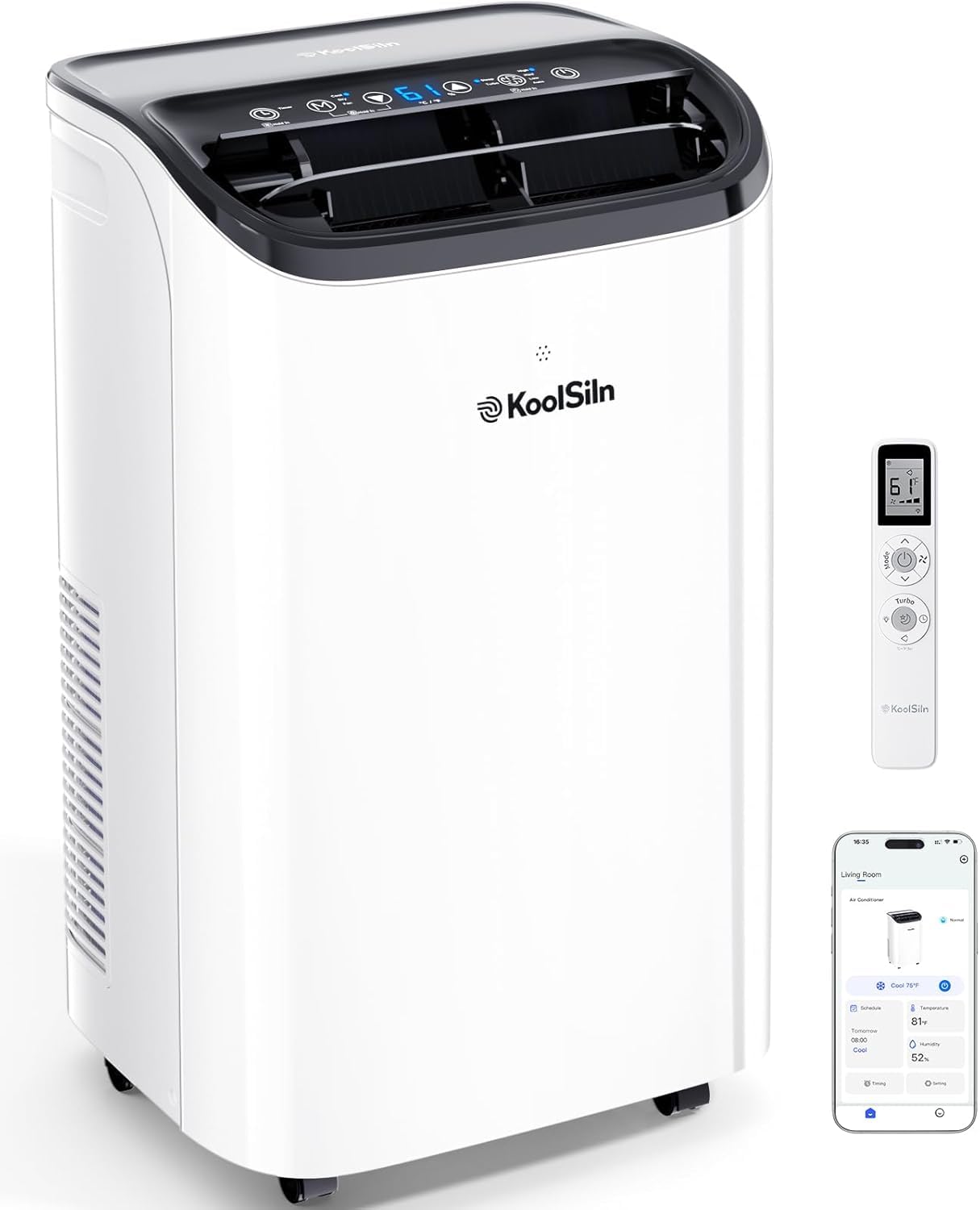
2. KoolSiln 16,000 BTU Inverter Portable Air Conditioner
A sub-40dB sleeper built for one bedroom, not the whole apartment
This KoolSiln is the pick for someone whose problem is a single hot bedroom, not a whole-house heat emergency. Its inverter compressor varies speed instead of cycling on and off, holding noise below 40dB — quieter than a normal conversation. It uses R32 refrigerant and, by the maker’s own claim, drops from 90°F to 61°F quickly.
Where this one differs from the ZAFRO above is on the water and hose side. It uses 360° auto-evaporation to turn about 80% of the collected moisture into exhaust air, so you’re not draining constantly — but it’s driving a single smaller system rather than the 12,000 BTU SACC dual-hose setup of the ZAFRO. There’s an 8-hour sleep timer that dims the display and softens the airflow, plus a plain LED panel and a remote with a 23-foot range. It rolls on 360° wheels with dual handles, and the air filter on the back pops out for cleaning.
The honest catch here is cooling reach. In the real-world accounts this unit handles temperatures in the high 70s to low 80s well, and one buyer is clear that it cools a bedroom nicely but can’t cool a whole apartment. The window panel assembly drew the biggest grumbles — the hose attachment and panel fitting take patience, and the outdoor clasps aren’t usable in a high-rise install. So if your summer runs past 90°F consistently or you have an open-plan space, look at the DOMANKI instead; if you’ve got a normal bedroom and a mid-tier budget, this one earns its spot.
The real draw: sub-40dB operation in Sleep Mode is the quietest claim in this whole lineup, and it arrives with the movable 360° wheels and dual handles that make single-room shuffling easy.
Reach for this if: your hotspot is one normal-sized bedroom and you care more about quiet than square footage.
Look elsewhere if: you live in a high-rise with a recessed window, or you need to cool an open-plan living space in a real heat wave.
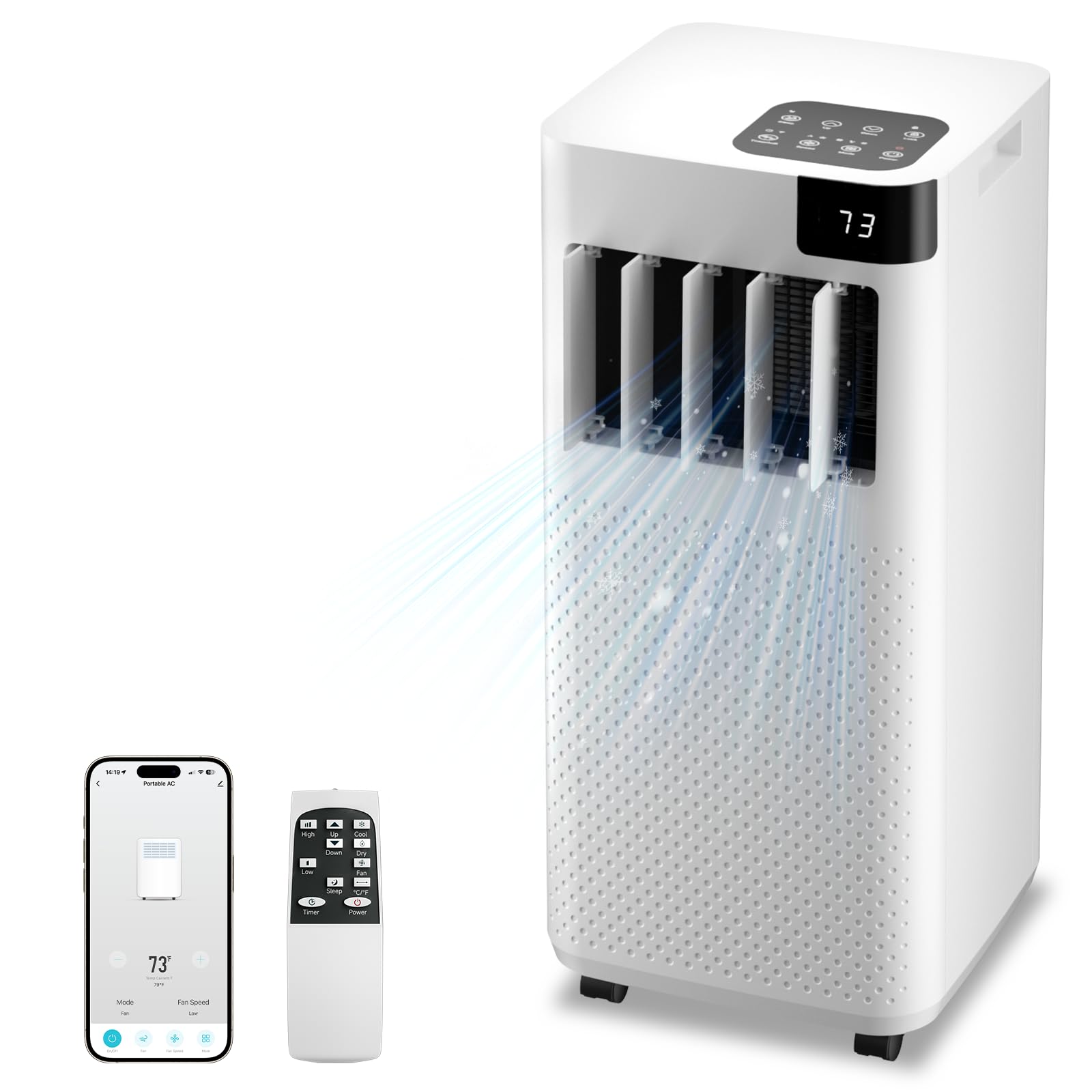
3. Augsmile Portable Air Conditioner 16,000 BTU
The move-out-friendly unit with a tool-free window kit and a genuine dehumidifier mode
Renters have a specific problem: you can’t drill into a window frame, and you can’t leave a permanent hole behind when you move. This Augsmile answers that with a window kit that supports a tool-free, 10-minute setup for 25″–50″ sliding windows — you seat the panels, slot the hose, and you’re done, no landlord call required. It runs the same 16,000 BTU compressor class as the ZAFRO but through a single hose, moving 450 cubic meters per hour for rooms up to 850 square feet by its own rating.
Its party piece is dehumidifying. Alongside 5-in-1 modes (Cool, Fan, Dehumidifier, Sleep, and a 24-hour Timer), the dedicated dry mode gets real attention from renters dealing with damp — reviewers describe it controlling humidity in a portable, rental-friendly way with no permanent modification. WiFi app control lets you cool the room before you get home, and it holds noise at 40dB with a sleep mode that kills the display light. The unit addresses leakage with a stable construction aimed at keeping water where it belongs, and it rolls room-to-room on casters with side handles.
The catch is honest and it lives in the window panel. One user found the install details sparse and had to custom-cut for a window under 26″ — the plastic is tough, so bring a proper blade. There’s also a quirk with the child lock not disabling the WiFi button, so a clever cat can reset the WiFi to factory. And be aware of the ASHRAE-versus-SACC math: one frustrated owner argues the true DOE-rated shoulder of this unit lands well below the headline, which is worth knowing before you buy it for a big open room.
Best match: renters in a damp climate who want real dehumidifier mode and a window kit that comes down clean when the lease ends.
Think twice if: your window is narrower than the 25″ minimum — you’ll be cutting plastic to fit.
4. HUMHOLD Inverter 16000BTU Portable Air Conditioner

Dual hose, 42dB sleep mode, and enough muscle for dry-heat summers
Here’s where the dual-hose and single-hose difference shows up in dollars and comfort. The HUMHOLD matches the ZAFRO on the core numbers — 16,000 BTU cooling, a 12,000 BTU SACC rating, and its own 42dB sleep mode — but it drives the room with an inverter that saves up to 40% energy versus a traditional fixed-speed unit by holding a steady temperature instead of cycling hard on and off. That’s the same inverter argument as the ZAFRO, just delivered on a different chassis. Its Auto Smart mode keeps the room between 73°F-77°F without you adjusting anything.
Where it beats its single-hose rivals is on airflow. The dual-hose design intakes and exhausts outdoor air at the same time, forming balanced circulation that stops outside heat sneaking back through window gaps. You get cooling from 61°F to 86°F, a three-speed fan, a 95-pints-per-day dehumidifier rating, and a 15-75° wide auto-swing that spreads cold air while you sit on the sofa. Sleep mode drops fan speed and quiets the unit under 42dB, and the 0.5-to-24-hour timer lets you set it to shut off after you fall asleep.
The thing that makes owners happy is raw cold. Buyers in Arizona’s dry heat report master bedrooms dropping to about 62°F within a few hours, even above 98°F outside. Durability is the mixed zone here — a few owners mention units that didn’t hold up, so if longevity is your top priority, weigh that against the price-tier value. The water side is situational: the built-in self-evaporation handles normal use with no draining, but in a humid basement or laundry room you’ll drain every 8 hours or set up continuous drainage.
Why It Cools Like It Means It
- Dual hose prevents hot-air seepage and cools the room faster than single-hose models
- Inverter with Auto Smart mode holds 73°F-77°F with claimed 40% energy savings
- 95 pints/day dehumidifier rating and 15-75° wide auto-swing
What To Weigh First
- Durability reports are mixed — some owners had units quit, so factor that in
- In a humid basement it needs an 8-hour drain routine, unlike the lower-humidity ZAFRO behavior
Choose this when: you want the dual-hose cooling power around a mid-tier price and you’ll use it in a dry, hot climate.
Reconsider if: you need proven long-term reliability above all else, or you’re cooling a damp basement where the drain routine gets old.
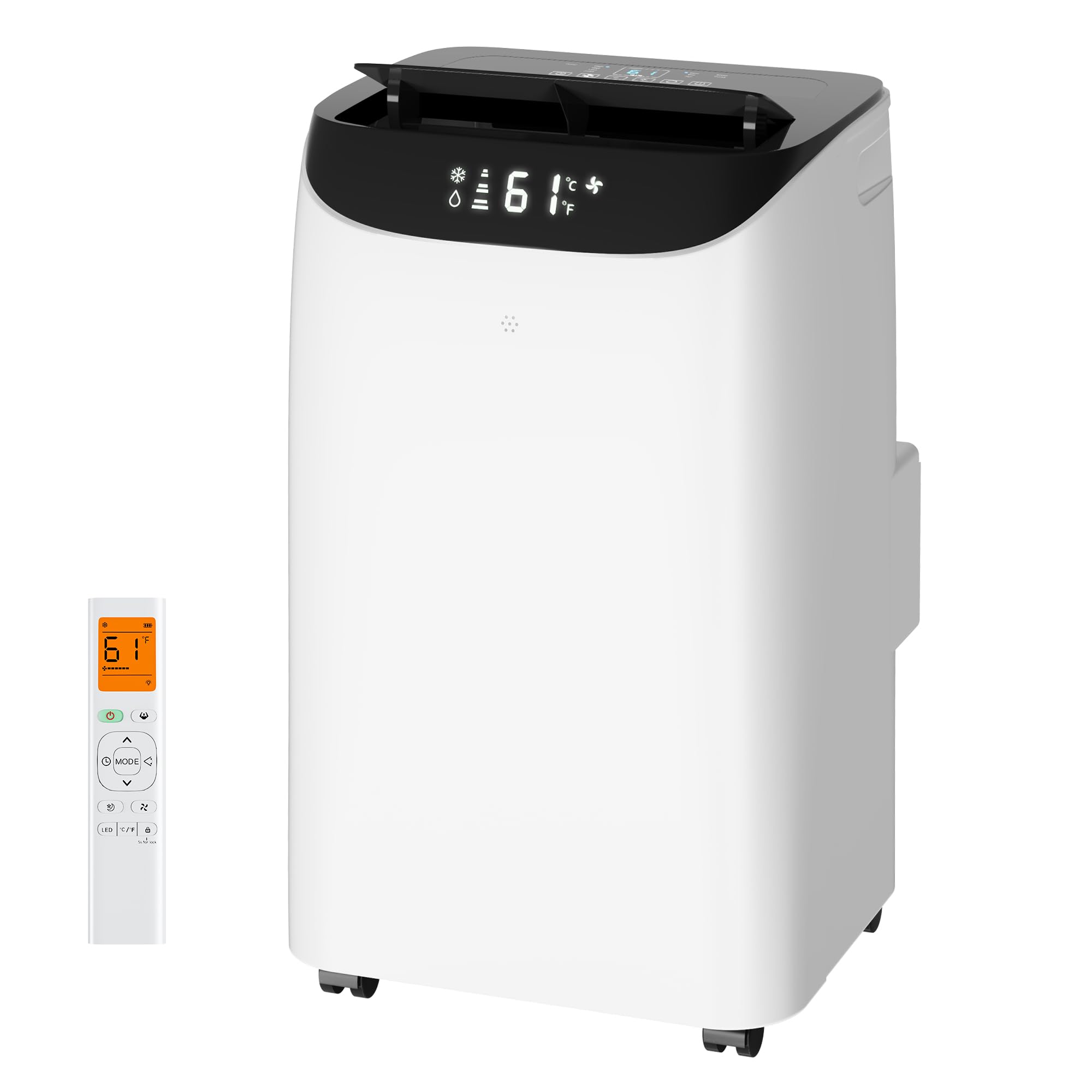
5. DOMANKI Inverter 16000 BTU Portable Air Conditioner
A dual-duct inverter with 470 m³/h of airflow built for big open space
If your “large room” is genuinely large — an open-plan kitchen-living space, a home office, or a whole apartment — this DOMANKI is the one to beat among the mid-tier picks. It’s rated 16,000 BTU ASHRAE and 12,000 BTU SACC with DOE and ETL certification, and it pushes up to 470 cubic meters per hour, moving more air than its single-hose rivals. The dual-duct design pulls fresh air in and exhausts heat out at once, which is the same balanced-circulation trick that keeps the ZAFRO cool — but this chassis is tuned for volume.
It carries four modes (Cool, Dry, Fan, and Auto) plus a 24-hour timer, four fan speeds, a 15-75° auto-swing, child lock, and a turbo function. It has humidity settings too, a feature that matters if you’re using it in a damp basement or a boat. Sleep mode quiets it to 42dB and dims the display, and the remote works up to 25 feet away so you can run it from bed. Build-wise it’s tidy — a 14″ W × 27″ H × 16.5″ D body on 360° casters with a built-in carry handle, and it fits standard windows up to 60 inches wide without any drilling.
The reason open rooms like it is speed: Customers note an open-concept space dropping from 82°F to 72°F in under 25 minutes, with cold air within a couple of minutes. Rolling it between rooms on hardwood and tile is smooth. The one thing that divides opinion is the window seal kit — one user found the included seal a bit flimsy and added foam weatherstripping to stop heat leaking back in, which is a cheap fix but honest to note. For a room under, say, 300 square feet, a cheaper single-hose unit is fine; for real open space, this is the one whose airflow earns the premium.
Built for you if: your cooling zone is a large open-plan room and you want 470 m³/h of airflow plus dual-duct efficiency.
Skip it for: a small bedroom where a cheaper single-hose unit does the same job for less.
6. SNOCOD 16,000 BTU Portable Air Conditioner for Large Rooms
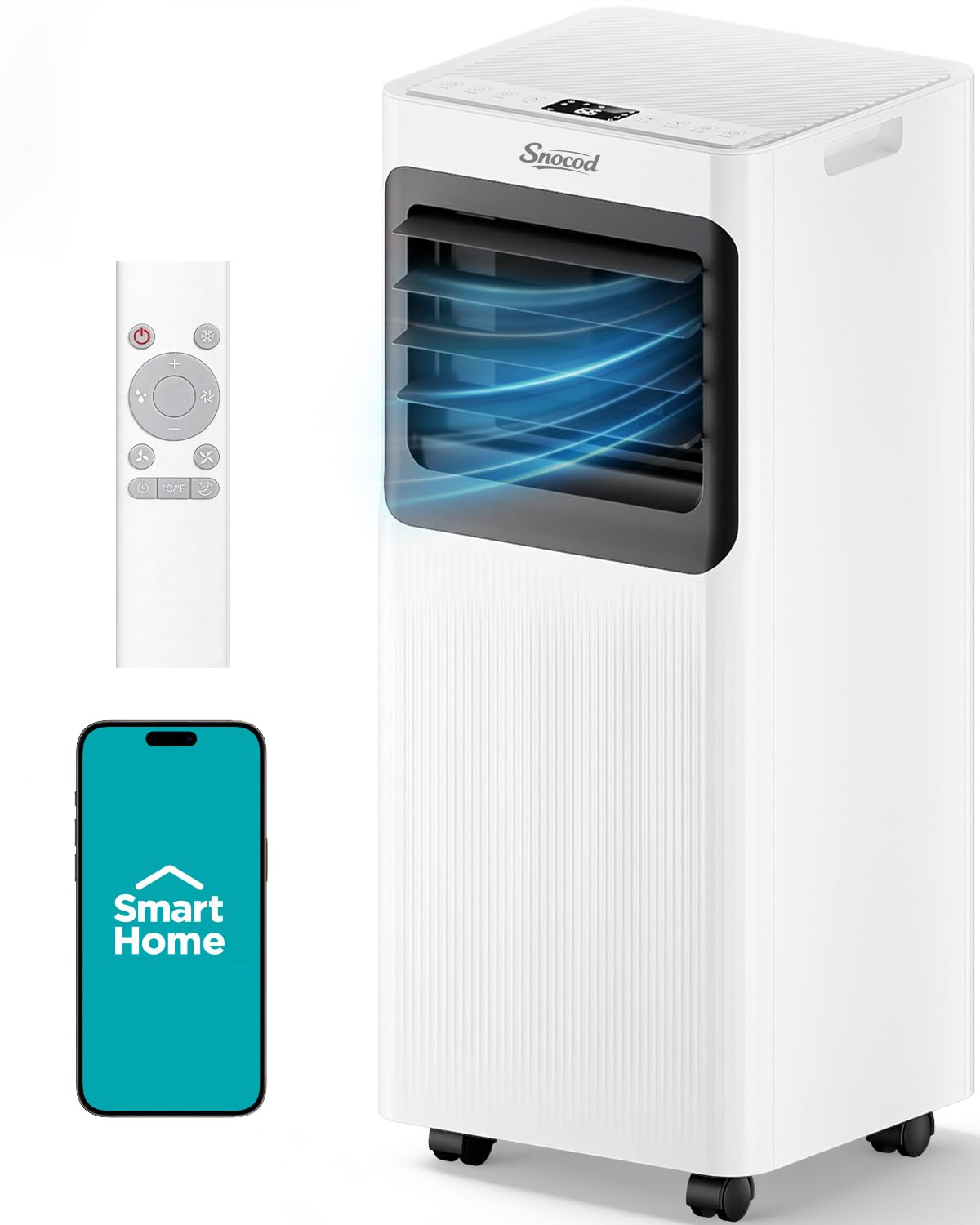
A budget-tier 5-in-1 with a washable filter and a simple setup
This SNOCOD is the entry-level play — a 16,000 BTU single-hose unit rated for rooms up to 750 square feet with a rotary scroll compressor (a smooth-running motor type that keeps vibration low) and a washable filter you rinse instead of replace. It crams cooling, dehumidifier, fan, sleep mode, and a 24-hour timer into one box, and it takes its marching orders from a WiFi app, the included remote, or the LED touch panel.
Where it fits is a small-to-mid bedroom, dorm, or home office where you want one simple machine and don’t need the fastest dual-hose cooling. It has child lock and easy rolling casters with side handles, and it claims quiet sleep mode with a display-off function so the lights don’t keep you up. But the review feedback lands differently here: while people find it easy to set up and appreciate the compact footprint and quiet operation, the cooling performance splits — some say it cools rooms nicely, others report it just doesn’t cool effectively.
That split is the whole story with this pick. If your expectations are a single modest room and you want the lowest-stress entry into 16,000 BTU territory, it can work. If you’re asking it to chill a large living space in a real heat wave, the mixed cooling reports are a fair warning that this is a small-room tool dressed in big-room numbers. At its value-tier position, that’s a reasonable trade — just size it honestly to your space.
Who it’s aimed at: a first portable AC for a single bedroom or dorm, where the washable filter and the app-remote-panel trio of controls make daily use simple.
The honest limit: cooling reviews are genuinely mixed, so treat the 750-square-foot rating as optimistic and expect best results in a smaller room.
Pick it for: a single low-stakes room on a strict budget where simple setup and easy controls matter most.
Don’t count on it for: fast cooling in a big open space during a genuine heat wave — the cooling reports are too inconsistent for that job.
Know the Specs
BTU and SACC
BTU (British thermal units) measures cooling power — the higher the number, the more heat the unit can move. But the headline BTU is usually the ASHRAE figure, measured under ideal lab conditions. The DOE SACC rating is the real-world number, and it’s lower. The ZAFRO, HUMHOLD, and DOMANKI all publish both (12,000 BTU SACC at 16,000 BTU ASHRAE), which is a sign of honest labeling. When a unit only shows one figure, it’s the flattering one.
Decibels (dB)
Noise is rated in decibels, and lower is better. A normal conversation runs around 60dB, so a portable AC running at 42dB is genuinely unobtrusive — you can talk or watch TV over it. Several units here hit 42dB or lower in Sleep Mode. If quiet nights are your priority, a lower dB figure in Sleep Mode is the spec to check first.
Single Hose vs Dual Hose
A single-hose unit uses one duct and is simpler to install, but it draws on your already-cooled room air to run its exhaust, which can pull hot outside air back in through gaps. A dual-hose unit uses two ducts, intaking and exhausting simultaneously, keeping the room pressure balanced and cooling faster. The ZAFRO, HUMHOLD, and DOMANKI all use dual hose; the KoolSiln, Augsmile, and SNOCOD are single hose.
Self-Evaporation and Drainage
When a portable AC cools, it pulls water out of the air. Self-evaporation recycles that water back over the hot condenser coil so it burns off as exhaust instead of pooling in a tank. The ZAFRO stays drainage-free for up to 72 hours in humidity below 90%. The catch: in extreme humidity — above 90%, or in a basement or laundry room — even self-evaporating units need the drain hose and a bucket or floor drain.
Common Questions
Will a 16,000 BTU portable air conditioner cool my whole house?
What does the difference between 16,000 BTU and 12,000 BTU SACC actually mean?
Do I have to empty a water bucket every day?
Is a dual hose unit really worth the extra cost over single hose?
How do I install a portable AC in a sliding window?
How loud is a portable air conditioner at night?
Can a portable air conditioner cool an 850 square foot room?
Why does the exhaust hose get so hot and should I wrap it?
Do I need a window kit for a portable AC and does it come included?
The Bottom Line
For most people, the 16000 btu portable air conditioner winner is the ZAFRO Smart Inverter because it pairs a dual-hose design and 12,000 BTU SACC honest rating with 42dB quiet sleep mode and up to 72hrs of drainage-free running. If you want the strongest open-space airflow in the mid-tier, grab the DOMANKI with its 470 m³/h and dual-duct design. And for a single bedroom in dry heat where cooling muscle comes before everything, the HUMHOLD is the one to reach for. Whichever you pick, match the unit’s real SACC cooling and airflow to the size of the room you’re actually sitting in — that single step separates a satisfying buy from a disappointing one.
How we choose
We do not accept paid placement. Every pick is matched to a real buyer and a real use-case; we do not hands-on test units.
Sources
Specifications: manufacturer listings and product documentation. Review insights: verified customer reviews, as of October 2026. Pricing: not shown on this page (it changes often); check the current price via the retailer link.
As an Amazon Associate, Aappliancez earns from qualifying purchases. This does not affect which products we feature.