Disclosure: Some links in this post are affiliate links. As an Amazon Associate I earn from qualifying purchases, at no extra cost to you. Learn more
Specs are compiled from manufacturer listings and verified buyer reviews and can change over time — please confirm the key details on the product page before buying.
Wrinkled junk journal pages and clogged glue tips usually trace back to three things: how thick the glue is, what kind of tip it has, and how much water it carries. A watery glue soaks paper and makes it buckle; a thick one can blob. Some glues are built to lay precision dots on die cuts (pre-cut paper shapes), while others are made to spread across a whole collage page. The five picks below run from a 100-piece precision tip kit to a 35-yard acid-free tape runner.
This guide is built by comparing the manufacturers’ published specifications and the patterns across verified customer reviews, so you get each pick’s real strengths and trade-offs instead of marketing spin.
Water-based PVA swells thin vintage paper as it dries, while a dry tape runner adds no moisture at all. This breakdown of the glue for junk journals covers tips, dry time, wrinkle control, and how each option behaves.
Top Picks

How To Choose The Best Glue for Junk Journals
Junk journaling is unforgiving on glue in a way most paper crafts are not. You layer torn book pages, washi tape, ticket stubs, fabric scraps and photos, often on thin paper that soaks up moisture fast. Too much water-based glue swells the sheet, bleeds through, and curls corners days later. Three specs decide whether your pages stay flat: applicator type, dry time, and acid-free labeling.
Applicator Type Changes Everything
A precision tip lets you place a controlled dot of glue exactly where you want it — essential when you are attaching a small die cut or a thin strip of lace. A sponge tip or a wide tape runner covers large areas fast, which is the better tool when you are pasting down a full-page background. Many journalers keep both a fine-tip bottle and a tape runner on the desk for this reason.
Dry Time and Wrinkle Risk
Water-based PVA glues go on wet and dry clear, but if you apply too much the paper swells and wrinkles. Glues formulated to resist warping, or tape runners that apply dry adhesive with no moisture at all, sidestep this problem entirely. If you work with very thin vintage paper, a low-moisture or dry-application option is usually the safer bet.
Archival and Acid-Free Formulas
If your journal holds photos, postcards, or anything you want to keep for years, look for an acid-free or archival glue. Acid migration from cheap adhesive can yellow and degrade paper over time. An archival formula and a 1-year shelf life on the label tell you the maker has thought about longevity.
Side-by-Side Comparison
| Model | Best For | Format | Capacity / Count | Key Feature | Amazon |
|---|---|---|---|---|---|
| Bearly Art Precision Craft Glue★ Best Overall | Fine detail work | Liquid, bottle | 4 fl oz, 100 pieces | Multiple precision tips | Amazon |
| tesa 57020 Washable Clear Craft GlueMost Versatile | Multi-surface washable bonding | Gel, bottle | 100 g, 1 piece | Washable contact adhesive | Amazon |
| Mont Marte Signature Clear PVA Glue | High-volume papercraft | Liquid, 3 bottles | 500 g, 3 pieces | Dries clear, water-based | Amazon |
| Scotch Scrapbookers Glue Two-Way | Versatile dual-tip scrapbooking | Liquid, 3 bottles | 1.6 oz each, 3 pieces | Precision + sponge tips | Amazon |
| AdTech Permanent Glue Runner | Fast, flat, permanent bonding | Tape runner, 3 cartridges | 35 yards, 12 pieces | Acid-free permanent bond | Amazon |
Detailed Reviews
1. Bearly Art Precision Craft Glue Original 4 fl oz
Our pick — 4.5+★ from 11,500+ verified ratings; the strongest balance of quality and price.
The tip kit that finally ended the clogging battle for fine paper work.
If you glue tiny die cuts, gems, and thin paper strips onto journal pages, this is the bottle most journalers reach for first. The defining feature is the tip kit: 100 pieces that twist and snap into place, so you can swap between a fine nozzle for dotting and a wider one for covering a larger area. The glue itself dries clear and is formulated to resist wrinkling and clumping, which is exactly what keeps thin junk journal paper flat. Full cure time is 24 hours, so plan on weighting heavier layers overnight.
What wins people over is how cleanly the tip performs during long sessions. Buyers report fine lines, bubble-free application on die cuts (pre-cut paper shapes), and no overnight clogging even when the bottle is stored upside down. As one buyer puts it: “It works great. No issues with it being to thick or any clumping. Love the small precision tip.” It is Made in USA, has a 1-year shelf life, and has been tested to be freeze/thaw stable for 5 freeze/thaw cycles (it survives being frozen and thawed five times) — worth knowing if you stash it in a garage or ship in cold weather.
The honest catch is the cost per bottle. It is a smaller bottle than the bulk 500 g options, so heavy journalers who go through glue fast may find they refill often. Also note that you should be conservative with application if warping worries you — a heavy-handed layer will still dampen paper, no matter how good the formula is.
The reasons it leads the list
- 100 interchangeable tips deliver fine-line accuracy and large-area coverage
- Formulated to resist wrinkling and clumping, keeping thin pages flat
- Freeze/thaw stable for 5 cycles with a 1-year shelf life
- Dries clear with a strong, durable hold on card making and die cuts
Where it asks you to be careful
- Smaller 4 fl oz bottle than most bulk options — frequent refills for high-volume journalers
- 24-hour full cure time means heavy layers need overnight weighting
- Applying too liberally will still dampen and warp thin paper
Your match if: you do intricate, detailed paper work — die cuts, gems, fine lines — and want one bottle that handles it all.
Think twice if: you are gluing full backgrounds on thick books all day and need bigger volumes for cost efficiency.
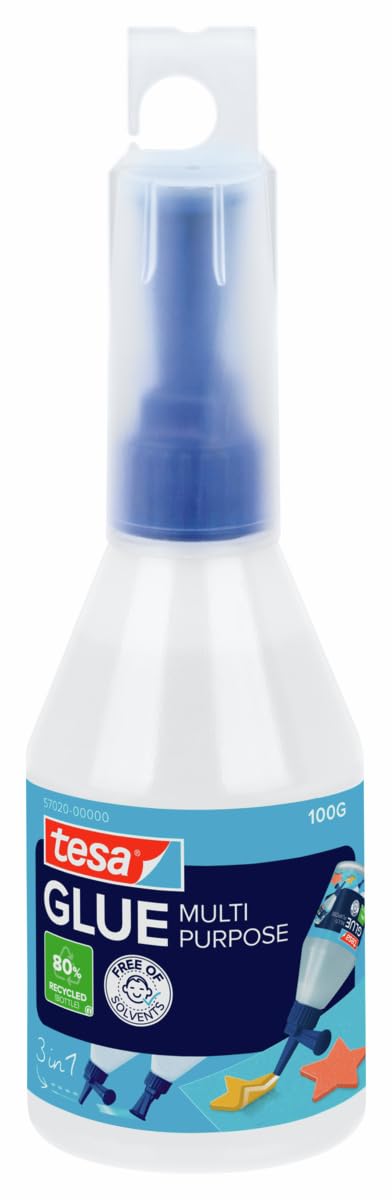
2. tesa 57020 Washable Multi-Purpose Clear Craft Glue 100g
The clear gel that won’t flinch at fabric, leather, or plastic scraps.
Junk journals are not just paper — they are fabric scraps, ribbon, a bit of leather, a plastic embellishment. That’s where this tesa bottle earns its spot. The glue is a gel with contact-adhesive behavior, which means it grips quickly on contact and is compatible with fabric, leather, paper, plastic, and wood, not paper alone. It goes on transparent and stays clear, and the washable property means accidental smudges on a work surface clean up with a damp cloth.
Capacity is 100 g in a single bottle, and at 4.16 ounces it is one of the lighter bottles on this list. For a journaler who mostly works paper but stretches into mixed media, that lighter bottle is actually easier to manipulate than a bulky one. The gel format means less dripping and a more controlled bead than a thin liquid PVA.
Because it is a contact adhesive, you should expect a faster grab than a standard white glue. That is a help when you are positioning a fabric swatch, and a small frustration if you want to slide a piece into place after pressing down. If you attach fabric, leather, or plastic alongside paper, its multi-surface gel grip covers all four.
What actually matters here: the multi-surface compatibility and the washable cleanup. It is the pick that lets you attach fabric and plastic without dragging a second glue into the mix.
Reach for this if: your journal pages include ribbon, fabric, leather, or plastic and you want one clear gel that handles them all.
Look elsewhere if: you want a long open repositioning window — the contact-adhesive grab works fast.
3. Mont Marte Signature Clear PVA Craft Glue 500g 3Pack

Three big bottles of clear-drying PVA — the refill stash for serious journalers.
When you are prepping backgrounds across dozens of pages, you burn through glue fast, and that’s exactly the job this 3-pack is built for. At 500 g per bottle it holds 5 times the capacity of the tesa’s 100 g, in a water-based formula that goes on clear and dries clear for mess-free work from start to finish. It suits porous surfaces including paper, card, and fabric, and cleans up with water while wet.
What wins people over is raw effectiveness on paper craft and card making. Reviewers call it “a rather good glue for card making. I like that it’s clear.” The drying behavior is the swing factor — fine for craft projects, but thick pours can leave a page wavy. Pour a thin, controlled line and let it set before stacking another layer, and it holds well.
The honest caveat: one reviewer noted the formula not drying after four days, and multiple owners mention pages wrinkling when the wrong amount goes down. Water-based PVA is unforgiving on thin vintage paper. For thin vintage sheets, switch to a dry tape runner; keep the 500 g bottles for backgrounds and collage.
Why it’s the volume pick
- 500 g bottles — 5x the capacity of the tesa’s 100 g per bottle
- Water-based, goes on clear and dries clear
- Suits paper, card, and fabric for cross-media work
- Easy cleanup while wet with plain water
The honest side of the bargain
- Thin vintage paper will wrinkle if the glue layer is too heavy
- Not all buyers had a clean dry — one reported the glue never setting
- 3-pack size assumes you will use it, not sample it
Best for: journalers running high-volume paper craft, collages, and school projects who want a big clear-drying stash.
Skip if: you work mainly on fragile, very thin paper where any moisture spells a wrinkle.
4. Scotch Scrapbookers Glue 1.6 Ounce Pack of 3
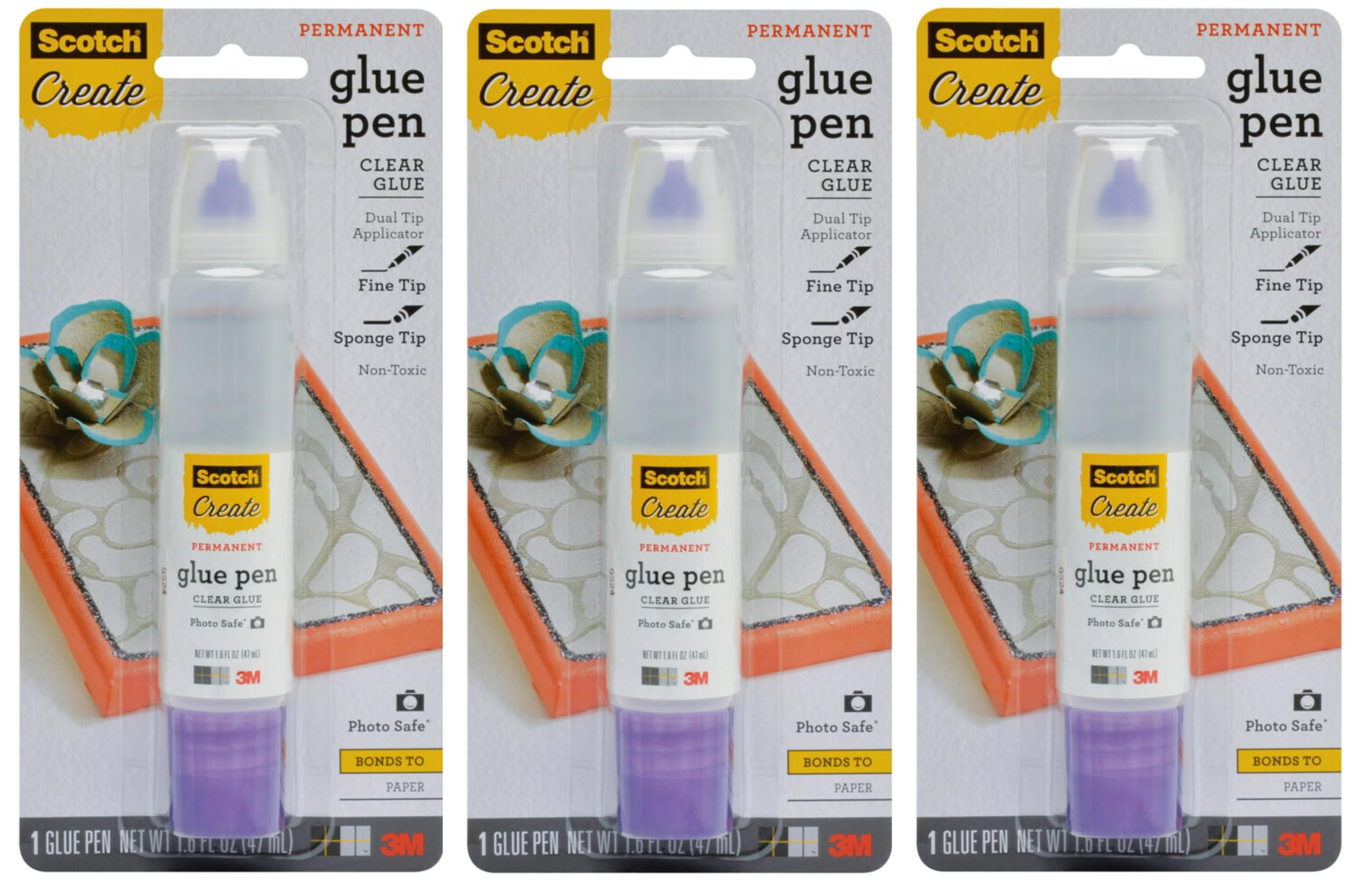
Two tips on one bottle — precision dots at one end, wide coverage at the other.
This is the bottle that does two jobs in one hand. It carries a precision tip for small dots and a sponge tip for large surfaces, both on a 1.6 oz PVA bottle designed for paper and photos. The formula is photo-safe and PVA-based, so it is built to work alongside the prints and ephemera you paste into a journal without the worry that attaches to a cheap unknown adhesive. It comes as a 3-pack, and the full pack weighs 9.6 ounces — more than double the tesa’s 4.16 ounces of glue on the shelf.
What earns the most praise is the strength and speed of the bond. The two-ended design beats a standard glue stick or white school glue for papercraft, and the precision end is ideal for Silhouette-style card work while the sponge end covers a full background fast. The formula is low-odor and the container lasts a long time.
The honest trade-offs are worth knowing before you buy. The precision tip can dispense more product than you want if you squeeze hard, so gentle pressure is essential. And wrinkle resistance is where it lags — if you saturate a page you can wrinkle it. Thin lines from the precision tip bond paper and photos without saturating the sheet.
Two jobs, one tool: the dual-tip design is the real story, letting you switch from dot work to full-page coverage without swapping bottles. That single bottle replaces a fine-tip applicator and a glue stick in your kit.
Pick this for: mixed-media scrapbooking where you move constantly between tiny accents and large background panels.
Not your fit if: you like to squeeze freely — the fine tip needs a light touch to stay precise.
5. AdTech Permanent Glue Runner 35 Yards 3-Pack

Zero moisture, zero wrinkle risk — the tape runner that lays paper dead flat.
If your biggest junk journal headache is wavy pages, the fix is to take liquid out of the equation entirely. This AdTech runner lays down a double-sided adhesive tape — a dry application, so there is no moisture to swell the paper and no drying time. Each cartridge holds 8.75 yards, and the 3-pack gives you 35 yards total, which is a very long runway for pasting down photos, tags, and layered backgrounds. The adhesive is acid-free and sets to a permanent bond, so your scrapbook pages stay put.
The permanent grip is its best feature and its only real caveat. It bonds fast and strong, so once a piece touches down, shifting it means fighting the adhesive. Line it up first, then press. Customers note the adhesive layers paper and collage beautifully and holds across mixed-media work.
The one thing to inspect on arrival is the plastic casing — a couple of the runners in a pack can arrive with a cracked shell or an occasional unclipped cover. It does not affect the tape, but check them before you stash them. The refill-style cartridges also run out faster than you expect if you cover full pages, so keep spares on hand.
Strengths you’ll feel immediately
- Dry tape application means no moisture, no drying, no wrinkling
- 35 yards across 3 cartridges for long uninterrupted runs
- Acid-free and permanent — built for scrapbooks meant to last
- Fast coverage on full-page backgrounds and photo mounting
What to watch
- Permanent bond leaves almost no repositioning room
- Occasional cracked casing on arrival — inspect before storing
- Cartridges run out quickly if you cover full pages
Made for: scrapbookers and journalers who glue fast, hate wrinkles, and want a permanent, acid-free bond without a wet glue mess.
Look past it if: you need to reposition pieces after pressing — this tape is built to stay put permanently.
Know the Specs
Capacity and Container Type
Capacity tells you how much actual adhesive you get, and it usually tracks how much you glue. A 100 g bottle like the tesa is a light-use pick; a 500 g bottle like the Mont Marte gives you 5 times that volume, better for backgrounds and bulk projects. Container type matters too — a bottle with a fine nozzle gives control, while a tape cartridge trades control for speed and a completely dry application.
Dry Time, Full Cure and Shelf Life
Full cure time is how long the glue needs to reach its strongest bond, which is why the Bearly Art lists 24 hours — that’s the wait before a heavy layer is fully set. Shelf life is how long an unopened bottle stays usable, and the Bearly Art carries a 1-year shelf life. A dry tape runner skips both, since it applies no moisture and needs no cure time at all.
Common Questions
Will liquid glue wrinkle my junk journal pages?
Is glue for junk journals safe for photos?
Which is better for junk journals, glue or double-sided tape?
How long does craft glue take to dry?
Can I use a glue runner on fabric and ribbon?
What does archival or acid-free glue actually mean?
Why does my glue tip keep clogging?
Does clear glue really dry clear on paper?
How much glue do I need for a large journal?
Can I store craft glue in a cold garage?
The Bottom Line
For most journalers, the glue for junk journals winner is the Bearly Art Precision Craft Glue, because the 100-piece tip kit and wrinkle-resistant formula handle fine detail work and thin paper better than anything else here. If you need a bulk stash for backgrounds and collages, grab the Mont Marte Signature Clear PVA 3-Pack — 500 g bottles give you far more glue per session. And for wrinkle-free, permanent, acid-free photo mounting, the AdTech Permanent Glue Runner is the one to reach for, with 35 yards at your disposal.
How we choose
We do not accept paid placement. Every pick is matched to a real buyer and a real use-case; we do not hands-on test units.
Sources
Specifications: manufacturer listings and product documentation. Review insights: verified customer reviews, as of October 2026. Pricing: not shown on this page (it changes often); check the current price via the retailer link.
As an Amazon Associate, Aappliancez earns from qualifying purchases. This does not affect which products we feature.