Disclosure: Some links in this post are affiliate links. As an Amazon Associate I earn from qualifying purchases, at no extra cost to you. Learn more
Specs are compiled from manufacturer listings and verified buyer reviews and can change over time — please confirm the key details on the product page before buying.
If you just want a watch that counts your steps and tells the time without dragging a phone and an app along, the pick that fits most people is the ST-CARE Fitness Tracker. It tracks steps, heart rate, and sleep on a bright 1.10-inch AMOLED screen (a sharp, colorful display you can read in daylight), and it manages 10-14 days of regular use per charge. The catch worth knowing up front is that comfort and price are not the hard part here; reliability over the first year is. Some simpler, no-charge, no-app watches cost less to run and never need a cable at all, which is exactly why they are on this list.
This guide is built by comparing the manufacturers’ published specifications and the patterns across verified customer reviews, so you get each pick’s real strengths and trade-offs instead of marketing spin.
You will see how step accuracy, battery style, and water resistance actually differ across five wrist-worn counters, so you can match one to the way you really move. The plainest way to shop a basic pedometer watch is to decide first if you want an app, a charge cable, or neither.
Top Picks


How To Choose The Best Basic Pedometer Watch
The whole point of a basic pedometer watch is doing one job well — counting your steps — without the extras that make a smartwatch fussy. That means the buying decision depends on three things: whether it talks to your phone, how it gets power, and how it survives water. Get those three right and the rest is comfort and screen legibility.
Decide on app connection first
A tracker with Bluetooth and an app mirrors your data to a phone screen, which is handy if you like seeing weekly charts. A standalone pedometer watch skips that entirely: you enter your height and weight on the watch itself and read the numbers on the dial. If you are not tech-savvy, work somewhere phones are banned, or simply do not want your step data in an app, the no-Bluetooth route is the simpler purchase.
Match the battery to your routine
Rechargeable models use a magnetic cable and typically run several days between charges; some rechargeable trackers advertise up to 10-14 days of regular use. Watch-battery models run on a coin cell you replace roughly once a year and never see a cable. Frequent flyers and backpackers tend to prefer the replaceable cell, while anyone happy plugging in weekly gets a bigger screen on the rechargeable side.
Read the water rating carefully
Water ratings are where buyers get tripped up. A 50M or 5 ATM rating means showering, rain, and pool swimming are fine but pressing buttons underwater is not. IP68 covers sweat, handwashing, and rain. A kids’ watch that only claims splash resistance should come off before swimming, no matter how waterproof it looks.
Side-by-Side Comparison
| Model | Best For | Display | Power | Water Rating | Amazon |
|---|---|---|---|---|---|
| ST-CARE Fitness Tracker★ Best Overall | All-day step, heart rate & sleep tracking | 1.10″ AMOLED touchscreen | Rechargeable, 10-14 days per charge | 5 ATM | Amazon |
| Timever Kids Digital WatchBest for Kids | Kids 5-14 who should not have a smartwatch | LED digital with resin dial | USB dial charge, 15+ days | Splash and rain resistant | Amazon |
| Cloudpoem Pedometer Watch | Offline tracking with no phone or app | Screen-based digital | Magnetic charge, 5-7 days use | IP68 | Amazon |
| TIMEURE-2308 | No-charge everyday step counting | Large digital with EL backlight | Coin cell, no charging | 50M | Amazon |
| Hearkent Pedometer Watch | Big readable numbers on a small wrist | Large-number dial with 5-second EL light | Replaceable cell, about 12 months | 30M | Amazon |
Detailed Reviews
1. ST-CARE Fitness Tracker
A 1.10-inch AMOLED touchscreen with 10-14 days per charge — the most smartwatch-like pick here.
Buy this one if you want a pedometer watch that also watches your heart rate, sleep, and body temperature without costing as much as a flagship smartwatch. The star of the show is that 1.10-inch AMOLED HD touch color screen — AMOLED means the display lights each pixel on its own, so colors pop and the time stays readable at a glance. The stainless steel frame takes the daily bumps, and the skin-friendly band adjusts anywhere from 5.0 inches to 9.45 inches, so it fits most adult wrists, men and women alike.
Power is where it earns its spot at the top. Regular use runs 10-14 days per charge with 30 days of standby, and the magnetic fast charging means you just snap the cable on rather than fiddling with a port. The 5 ATM water rating is the highest here — 5 ATM is a pressure rating that covers handwashing, baths, and even diving, so catching it in the rain is a non-event. On the tracking side you get all-day steps, calories burned, workout distance and time, plus real-time heart rate, blood oxygen, and sleep-stage tracking shown in the “Keep Health” app.
What wins people over is the overall quality for what it costs — the tracker gets compared head-to-head with Fitbit and holds its own, and the value and feature set draw steady praise. The honest trade-off is the step count itself: some owners find it spot-on, others find the numbers drift, and the sleep tracking can go quiet after midday. The other thing to weigh is longevity — a slim handful of these stop working about a month in, so register the warranty early and keep the return window in the back of your mind.
What it gets right
- Bright 1.10″ AMOLED touch color screen that stays readable at a glance
- 10-14 days regular use and 30 days standby with magnetic fast charging
- 5 ATM rating handles handwashing, baths, rain, and diving
- Full tracking stack: steps, calories, distance, heart rate, blood oxygen, body temp, sleep
Where it is uneven
- Step accuracy is the most-debated trait — some owners trust it, others do not
- Sleep tracking draws the sharpest complaints and can stall after noon
- A slim minority report the watch quitting around the one-month mark
Reach for this if: you want the most complete everyday tracker on this list — heart rate, sleep, and a screen you enjoy looking at, all in one slim band.
Think twice if: you need rock-solid step numbers for something like insurance or a weight-loss bet, or you have zero patience for an app.
2. Timever Kids Digital Watch
A no-app, no-Bluetooth pedometer for kids 5-14, with two silent vibration alarms.
If the school bans smartwatches and you still want your child counting steps, this is the pick. There is no app to download and no Bluetooth pairing — the watch counts steps, tracks calories and mileage, and shows time, date, and an alarm straight on the dial. The strap is breathable, sweat-resistant silicone, the case is zinc alloy, and the resin dial is high-resolution, which is why parents keep describing it as a watch that looks far more expensive than it is.
The two silent vibration alarms are the feature that quietly does the most work. You set them to nudge your child toward study time, rest, or a water break, and the vibration is soft enough that it will not disrupt a classroom or a library. Charging is unusually simple: the dial has a built-in USB interface, so any phone adapter or computer brings it back to full, and a single charge is rated for over 15 days. Compare that with the ST-CARE tracker above, which needs its own magnetic cable and tops out around two weeks — the kids’ watch is the lower-maintenance of the two.
The thing to plan around is durability. Hardware complaints do surface: a couple of parents describe units that stopped holding a charge or developed dead pixels, and a charging cycle can reset the date and time. Water is the other line to know — hand-washing and rain are fine, but the maker specifically says to take it off for swimming and bathing.
Where the value sits: a full-function kids’ fitness watch with a pedometer, stopwatch, two vibration alarms, and a 15-day battery — all without handing a child a phone connection.
The water ceiling: the improved charging port keeps splashes out, but this is not a swimming watch, and the maker says so plainly.
The right call for: parents who want a real pedometer watch their child can wear to school, with no app and no distraction.
Look elsewhere if: your kid swims daily, or you need a watch that will survive rough sports without the occasional hardware hiccup.
3. Cloudpoem Pedometer Watch — No Bluetooth, No App, No Phone
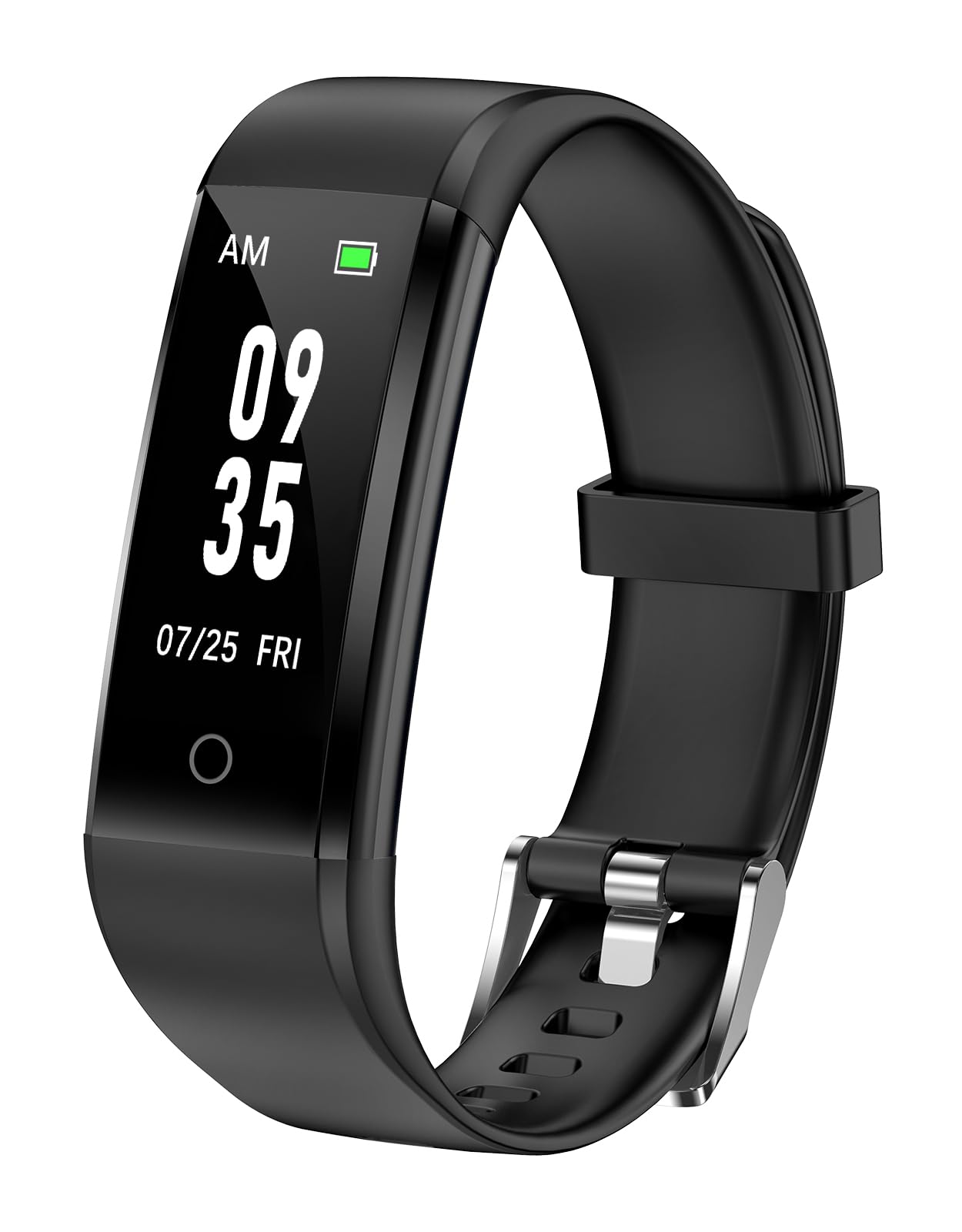
Counts steps, distance, calories, and sleep on the watch itself — no Bluetooth, no app, no account.
This is the one for factory workers, seniors, and anyone who simply does not want their daily mileage living in an app. There is no Bluetooth radio and no pairing step — you enter your height and weight directly on the watch and go. Once you are set, you can see steps, distance, calories burned, and total sleep hours without ever touching a phone or a menu tree built by a software team.
The on-watch sleep switch is the most useful small surprise here. Before bed you flip the sleep mode on manually, and when you wake you flip it off to read your total sleep hours on the screen — no auto-detection, no cloud syncing, no subscription. Charging is a snap-on magnetic cable, and a 1.5-hour charge from empty gets you 5-7 days of regular use, with 20 days of standby. Compared with the rechargeable ST-CARE tracker at the top of this list, this one trades a couple of charging days for total offline simplicity.
Comfort is the recurring theme in positive feedback — owners describe a lightweight, comfortable band with a bright display and enough accuracy for everyday step goals. The honest limitations are real, though. The screen scratches easily, the battery realistically wants a nightly charge for some users rather than the manufacturer’s rating, and the step count lags a beat before catching up. As one owner sums it up, the pedometer does its job at a low price, though you do need to keep the band snug for the count to register.
Why offline matters: the lack of Bluetooth is not just about simplicity — it means your step history lives on the watch and nowhere else.
The honest floor: IP68 covers sweat and rain, but a swimmer who tested it in the pool found the watch quit after a week — the rating is not a diving license.
Pick this one if: you want to count steps and calories over the course of a workday without ever pairing a device.
skip it if: you swim laps, want auto-sleep tracking, or need a scratch-resistant face.
4. TIMEURE-2308 Mens Pedometer Watch for Walking

A 50M water-resistant coin-cell watch with a 5-second EL backlight and no charging cable.
The reason to buy this over the rechargeable picks is simple: it runs on a standard lithium coin cell, not a USB charger. You set your height and weight once and it counts steps, calories, and estimated distance — switchable between miles and kilometers — for as long as the battery holds. The 5-second EL backlight makes the large digital display easy to read in low light, and the full watch functions are all there: time, date, weekday, alarm, hourly chime, stopwatch, and countdown timer.
Fifty-meter water resistance is the second real draw. That rating covers handwashing, rain, cold showers, and even swimming, as long as you do not press the buttons underwater or subject it to hot water, steam, or diving. The stainless steel bezel and soft PU strap adjust from 6.29 to 9.44 inches, which fits most adult wrists. In the small-wrist department, this is one of the more accommodating picks in this article — the Hearkent strap maxes out at 7.6 inches, while this one reaches 9.44.
What stands out in owner feedback is how often this watch gets pressed into unexpected jobs. One owner wore it for refereeing sports, another bought it for a 90-year-old grandfather who wanted a step counter without a smartphone, and another has kept it working through swimming, workouts, and motorcycle rides for over two years. The recurring downside is the step count: some owners say it reads a touch high versus a dedicated pedometer, and the watch has been known to fail a few months in, so a battery that needs replacing early is worth watching for.
Built for forget-and-go use: a coin-cell pedometer watch with a 5-second EL backlight, 50M water resistance, and no charging routine at all.
Where it can sting: the step count runs slightly generous for some users, and a small number of units quit working inside the first year.
Best matched to: an older walker, a busy professional, or anyone who wants a step-counting watch they never have to think about charging.
Consider a different pick if: every last step has to be precise, or you want a unit that will not eventually need a battery swap.
5. Hearkent Pedometer Watch

A large-number dial on a nylon strap that adjusts down to 4.1 inches for small wrists.
Small wrists, meet your match. The Hearkent band adjusts from a minimum of 4.1 inches to a maximum of 7.6 inches, making it the only pick here sized for genuinely narrow wrists — the TIMEURE-2308 sits at 6.29 to 9.44, so a petite wearer would be swimming in that one. The dial is 36mm (about 1.4 inches across), the strap is breathable nylon with a stainless steel snap buckle, and the display uses large numbers so you can check time, weekday, and date without squinting.
Like the TIMEURE, this is a no-charge watch: a replaceable cell runs it for roughly 12 months, so there is no magnetic cable or USB port to keep track of. The 5-second bright EL backlight handles dark mornings, and the 30-meter water rating covers daily life — handwashing, rain, and a splash. The multi-function set rounds it out with a stopwatch, countdown, alarm, and hourly chime, all reachable without Bluetooth or an app.
On the tracking side, the accuracy is honest but limited, and the company says so itself: single continuous movements under 10 seconds are ignored, and counts resume once you pause for more than 1.25 seconds. In practice, that means real walks and hikes read well, but pushing a shopping cart, riding a stair machine, or jogging with a phone in your pocket can throw the numbers off. Owners who need a watch first and a pedometer second tend to be happiest — the display, comfort, and low maintenance win them over, while the step count is the recurring gripe.
What it gets right: a large-number dial, a nylon strap that actually fits a small wrist, a replaceable battery that lasts about a year, and no app to set up.
The honest catch: step accuracy is the weakest link, so treat this as a time-and-date watch that also counts steps, not the other way around.
Made for: anyone with a slim wrist who wants a legible, no-fuss step counter they can rely on for a year without charging.
Not the right fit if: you use a stair machine or push a cart most of the day — the algorithm will undercount those movements.
Know the Specs
Display Type and Legibility
A pedometer watch lives or dies on whether you can read it in one glance. AMOLED displays, like the one on the ST-CARE tracker, light each pixel individually for vivid color and easy daylight reading. Basic digital watches use a segmented LED or LCD panel — less colorful, but often brighter numbers on a larger dial. Look for the dial size (in millimeters) and whether a backlight is included, since both decide how easily you can check the count in a dim room.
Battery Approach
The two battery styles here solve different problems. A rechargeable lithium polymer cell (a built-in battery you refill), charged over a magnetic cable, gives you a bigger screen and richer tracking but wants plugging in every few days. A replaceable coin cell (a small button battery you swap out) runs a basic watch for roughly a year with zero maintenance, which suits hikers, frequent flyers, and anyone who hates hunting for a charger. Neither is better — just match the style to if you want to plug in or forget about it.
Common Questions
Do any pedometer watches work without a phone or app?
How accurate are step counts on a basic pedometer watch?
Can I swim wearing a pedometer watch?
How long does the battery last on a no-charge pedometer watch?
Is a basic pedometer watch better than a smartwatch for walking?
What water rating do I need for handwashing and rain?
Does the Hearkent pedometer watch fit a small wrist?
How easy is it to set up a pedometer watch without an app?
Why does my pedometer watch lag behind my phone’s step count?
Can a pedometer watch track sleep without an app?
The Bottom Line
The strongest all-rounder is the ST-CARE Fitness Tracker, which packs a bright 1.10-inch AMOLED screen, 5 ATM water resistance, and heart-rate, sleep, and body-temperature tracking into a slim band at a fraction of smartwatch prices. If you would rather skip the app and the charging cable entirely, the TIMEURE-2308 counts your steps on a coin cell you swap about once a year, and its 50M rating stands up to a swim. And if a small wrist or a swim-heavy routine is the deciding factor, the Hearkent fits down to 4.1 inches with large numbers you can read from across a room.
How we choose
We do not accept paid placement. Every pick is matched to a real buyer and a real use-case; we do not hands-on test units.
Sources
Specifications: manufacturer listings and product documentation. Review insights: verified customer reviews, as of October 2026. Pricing: not shown on this page (it changes often); check the current price via the retailer link.
As an Amazon Associate, Aappliancez earns from qualifying purchases. This does not affect which products we feature.