Disclosure: Some links in this post are affiliate links. As an Amazon Associate I earn from qualifying purchases, at no extra cost to you. Learn more
Specs are compiled from manufacturer listings and verified buyer reviews and can change over time — please confirm the key details on the product page before buying.
If you sing or play on a stage, the cable dragging across your pedals is the enemy. A wireless IEM system sends your monitor mix to your ears with no cable down your back, so you hear yourself clearly while the room hears the band. This guide breaks down the real differences between wireless monitor systems and wired in-ears that accept a Bluetooth adapter, then points you to the picks that actually hold up under stage conditions.
This guide is built by comparing the manufacturers’ published specifications and the patterns across verified customer reviews, so you get each pick’s real strengths and trade-offs instead of marketing spin.
You will see how range, latency, and battery hours separate a system that survives a full set from one that quits mid-song.
Top Picks

How To Choose The Best Bluetooth IEM
Your first decision is simple: do you want a dedicated wireless system, or a Bluetooth adapter that turns your existing wired in-ears into wireless ones? Both work, but they solve different problems. A stage system sends your monitor mix over its own radio band, while an adapter pairs with your phone or tablet over Bluetooth.
Latency: Why Milliseconds Matter On Stage
Latency is the delay between the sound leaving the source and reaching your ears. Even a short delay makes a vocalist hear their own voice arrive a split second late, which throws off timing. A rated figure near or under 5 milliseconds is generally where live performers want to land, because that gap stays small enough to feel immediate.
Range And Battery For A Full Set
Range tells you how far you can roam from the transmitter before the signal breaks. A club stage is generous with roughly 90 feet, and a large worship platform or theater benefits from more. Battery hours decide how many sets you get per charge, and a rating around 5 hours covers a typical show with room to spare.
Wired In-Ears Plus A Bluetooth Adapter
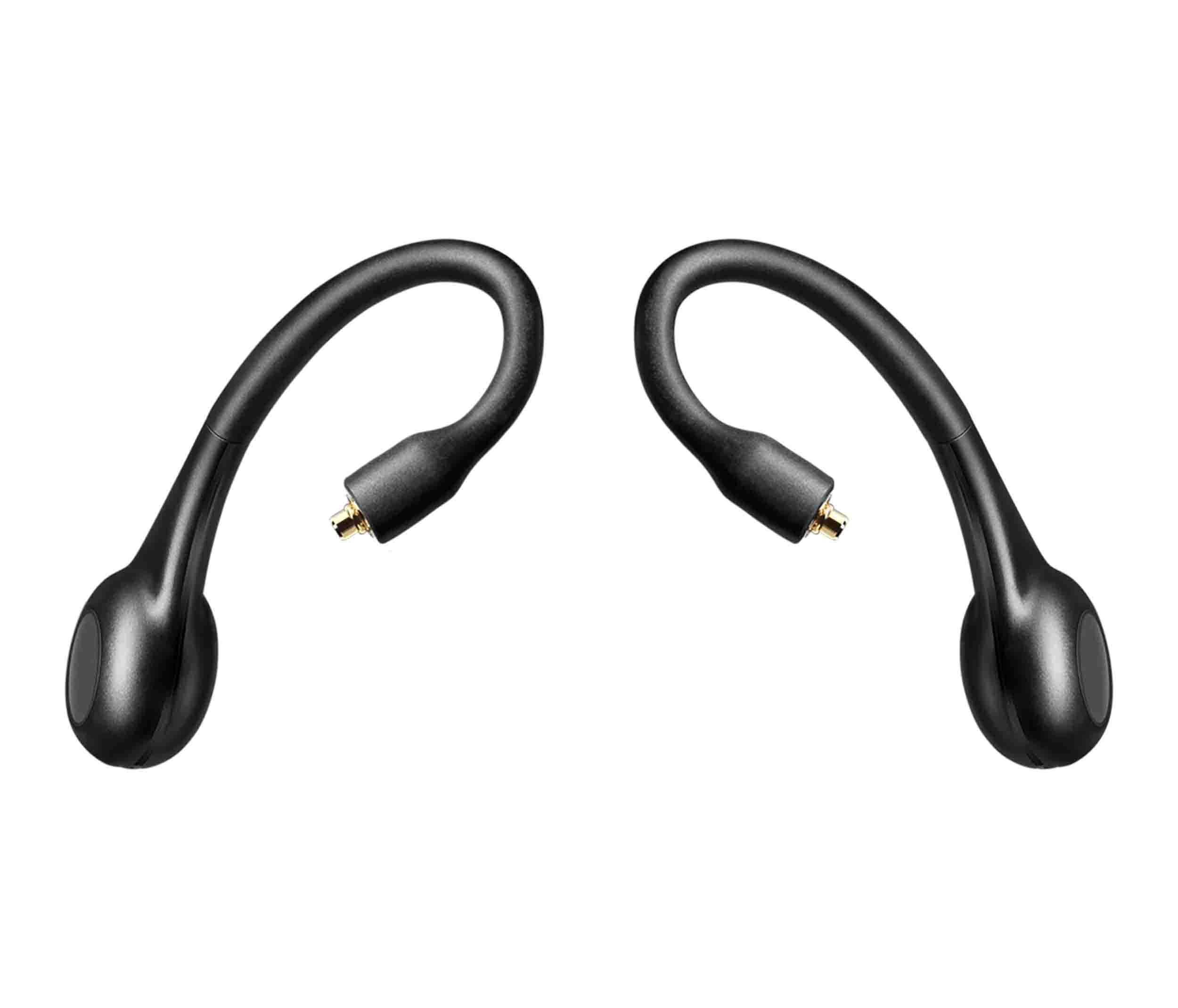
If you already own a favorite set of detachable in-ears, an adapter that clips on over the ear keeps your preferred sound signature while removing the cable. Look for a secure over-ear hook, an environment mode for hearing the room, and a charging case that stacks extra charges on top of the per-charge runtime.
Side-by-Side Comparison
| Model | Best For | Battery Life | Wireless Range | Connection Type | Amazon |
|---|---|---|---|---|---|
| Xvive U4 Wireless in-Ear Monitor System Set★ Best Overall | Gigging musicians on a budget | Up to 5 hours | Over 90 feet | 2.4GHz wireless | Amazon |
| Shure RMCE-TW2 True Wireless AdapterBest Battery | Upgrading owned Shure earphones | 32 hours total | 10 meters | Bluetooth 5 | Amazon |
| Fosi Audio IM4 Open-Back IEM | Long studio listening sessions | — | — | Wired 3.5 mm | Amazon |
| Sennheiser Pro Audio IE 100 Pro Wireless | Wired or wireless on one pair | 10 hours | 10 meters | Bluetooth 4 | Amazon |
| Phenyx Pro Compact UHF Stereo IEM PDP-M | Mono or stereo stage monitoring | Up to 4 hours | 160-200 feet | UHF 900MHz | Amazon |
| Linsoul ZiiGaat x Hangout Odyssey 2 | Audiophile wired listening | — | — | Wired 3.5 mm | Amazon |
| Phenyx Pro 4-Channel UHF Mono PTM-33-4B | Full bands needing four mixes | 4 AA batteries | 140-164 feet | UHF wireless | Amazon |
Detailed Reviews
1. Xvive U4 Wireless in-Ear Monitor System Set
Our pick — 4.5+★ from 500+ verified ratings; the strongest balance of quality and price.
The wireless monitor rig that lets a small club act hear itself without shouting.
If you play small clubs and want to stop yelling over the drum kit, the Xvive U4 is the package to beat. It runs on 2.4GHz wireless (a shared radio band that needs no license and works in most countries) and fires less than 5ms of latency — a delay so short it feels like the sound arrives as you play. That matters because hearing your own voice a hair late throws off your timing, and an in-ear setup exists to fix exactly that.
Range is the other headline. You get over 90 feet of working distance, which is more than enough to cover a small club stage and still let you step out toward the crowd. Six channels are available, so a four-piece band can each sit on a different frequency and cut the cross-talk. Each of the transmitter and the receiver carries a rechargeable battery rated for up to 5 hours, which gets you through a show. You also get a 1/4″ to XLR adapter and a bag, so the box is a complete starting kit.
The build earns its keep. Owners describe a sturdy metal enclosure and say the units don’t feel like cheap plastic, and the setup is quick — connect to the PA’s aux, power up, and you are monitoring. Performance is the thing buyers bring up most, with clean, interference-free sound. The honest catch is that this is a mono system, and a few players note they wish they had gone with the stereo version for more applications. Rare dropouts do get mentioned, and that is the trade-off of a shared 2.4GHz band in a crowded venue. The overall picture is strong: this is the crowd favorite at 4.5+ stars, and it earns that with clear sound and straightforward setup.
What wins people over
- Less than 5ms latency keeps your voice in time with the beat
- Over 90 feet of range covers a small club stage
- 6 channels let a full band split frequencies
- Up to 5 hours per charge on both transmitter and receiver
- Metal build that owners compare favorably to plastic rigs
Where it gives ground
- Mono-only, so stereo separation is off the table
- Rare dropouts can show up on a crowded 2.4GHz band
- No battery status percentage readout
Reach for this if: you play small venues and want a complete wireless monitor kit with near-zero delay straight from the start.
Look elsewhere if: your set calls for stereo panning across the mix.
2. Shure RMCE-TW2 True Wireless Adapter
A battery curve no stage system in this list comes close to touching.
If you already own a set of detachable Shure earphones, the Shure RMCE-TW2 is the sharpest upgrade you can make. It converts them into true wireless earbuds over Bluetooth 5 (the current wireless standard for phones and tablets), and the numbers are lopsided in the best way: 32 hours of total battery versus the 5 hours of the Xvive U4 above, and that is before the charging case even enters the picture. Eight hours come from each charge, and the case holds three more charges on top. Compare that to the Xvive’s 5-hour ceiling and the Sennheiser IE 100 Pro’s 10 hours, and you see the gap.
The fit is built for movement. A secure over-ear hook keeps each adapter in place through workouts, commutes, and daily wear, and it is sweat and water resistant with an IPX4 rating (protected against splashing water) when paired with Shure detachable earphones. An environment mode lets you hear the room at the touch of a button, and the fingertip controls handle volume, playback, and calls. The charging case is a leather-wrapped unit, and it charges over USB-C.
What buyers keep coming back to is the rock-solid Bluetooth connection — no dropouts, good range, and stable pairing with the phones they carry. Comfortable enough to nap in, one review notes. The trade-offs are real but limited: no multipoint, meaning one device at a time; you can’t charge the adapters while you are using them; and the case is bulky enough to notice. The mic quality gets dinged, and callers say it sounds like a radio. For pure listening, though, the sound matches Shure’s earlier generations. At 4.0+ stars across a large base of owners, this is the pick for anyone who wants their Shure IEM to go wireless without losing its signature.
Where it stands tall: 32 hours of total charge is the top battery figure in this entire comparison, and the environment mode rivals far pricier earbuds for hearing your surroundings.
What to know going in: no multipoint and no in-use charging, plus a case you will feel in a pocket.
Best for: owners of detachable Shure earphones who want the longest runtime and a secure over-ear fit.
skip it if: you bounce between a laptop and a phone constantly, since there is no multipoint pairing.
3. Fosi Audio IM4 Open-Back IEM Wired Earbuds
A wired in-ear that breathes — no seal, no pressure, wide-open sound.
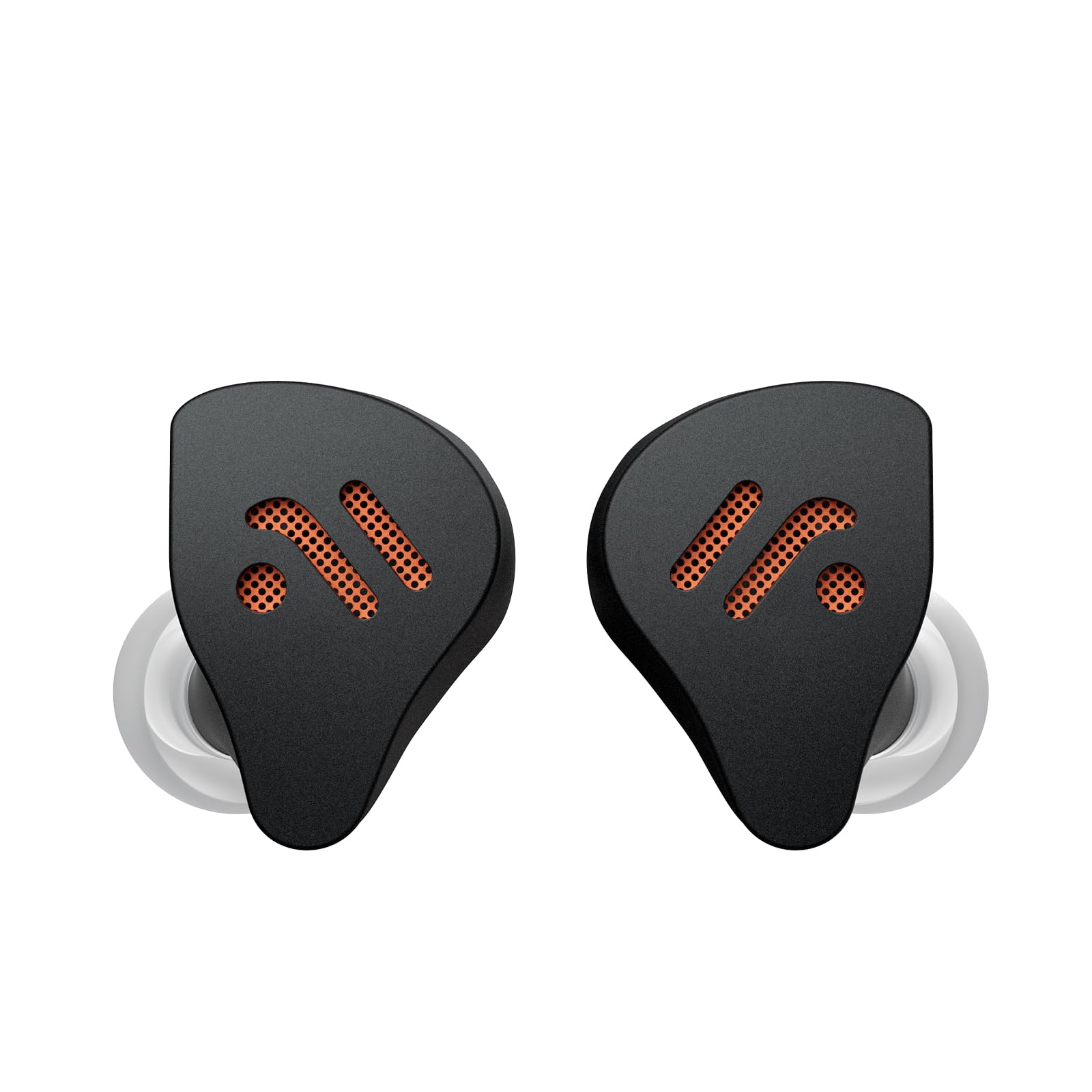
This is the pick for the listener who hates the plugged-ear feeling. The Fosi IM4 skips a Bluetooth radio entirely; it is a wired in-ear built around an open-back design, which means the shell has an open-mesh structure that lets air and sound move in and out of the ear. That single choice is what makes it feel so different from the sealed systems elsewhere on this list. You get a spacious, airy stage instead of a pressurized pocket, and long sessions stop being a chore. If you want to add wireless later, a detachable adapter like the Shure above can turn a wired pair like this into one.
Under the hood is a 10mm beryllium-coated diaphragm dynamic driver, which is the moving part that actually makes the sound. It runs on a dual-chamber structure and an N52 dual-magnet circuit for a natural, unforced tone across the range. Each bud weighs just 7g, so it sits barely-there and disappears on your ear. Impedance is 32 ohm, which most phones and laptops drive without a separate amp. The shell is full aluminum alloy with CNC machining, and it connects over a standard 3.5 mm jack.
You get three sets of ear tips (balanced, bass, deep-bass) and two nozzle types in brass and aluminum, so you can tune the sound to taste — brass for a touch more top-end, aluminum for a warmer balance. Owners love the range of tuning options and the clean, defined bass, and the fit gets credit for working on small ears during long sessions. Be aware this is an open-back design with no real isolation, so a busy room leaks in. Bass also stays clean and tight rather than deep and heavy. What buyers rave about most is the sound quality, and with a 4.5+ star rating across hundreds of owners, this is the value-focused wired option to beat.
Pick this if: you do long desktop or studio sessions and want fatigue-free, wide-open sound with swappable tuning on a wired connection.
Better to pass if: you need noise isolation for a live stage or a noisy commute.
4. Sennheiser Pro Audio IE 100 Pro Wireless In-Ear Monitor

One pair that goes wireless for the commute and wired for the studio.
Sennheiser takes a different route from the single-mode systems above. This is a 2-in-1 bundle: you get the IE 100 Pro in-ears plus a Bluetooth module with a built-in microphone for calls, and you also get a standard 3.5 mm jack-plug cable for a hardwired connection. Swapping between the two is quick, which makes this the most flexible option here if you want one set of earphones for both home listening and walking around. The battery is rated at 10 hours of continuous use, which is respectable next to the Xvive’s 5, though the Shure’s 32-hour total still leads the field.
The earphones themselves are built for comfort during long sessions. You get four earpiece adapters to dial in fit, and the earpiece shape combined with flexible silicone and foam tips gives solid shielding from outside noise. The setup is described as stage-safe from the connection all the way down the cable conduit, so it holds up when you move. The sound is meant to be natural and distortion-free, reducing the strain of long listening.
Two things are worth flagging before you buy. First, the wired cable has no microphone, so if you need hands-free calls you have to use the Bluetooth module. Second, the Bluetooth module only fits the IE 100, 400, and 500 Pro — it won’t work with other MMCX earphones, so this is a Sennheiser-tied ecosystem. Owners find the tuning and ergonomics strong for the money, and the app’s lack of EQ for this exact model means you will need third-party software if you want to shape the sound. Bass and loudness draw some mixed notes; if you crave thump, this isn’t the one. At 4.0+ stars, it’s the flexible generalist in this list.
The case for it
- Wired 3.5 mm cable and Bluetooth module in one bundle
- 10 hours of continuous wireless use per charge
- Four earpiece adapters for a dialed-in fit
- Built-in mic on the wireless module for calls
The catch to weigh
- The wired cable has no microphone
- Bluetooth module only fits IE 100, 400, and 500 Pro
- Some buyers find the bass flat rather than heavy
One line: the pick for someone who wants a single set of in-ears that works wirelessly on the move and wired at the desk.
5. Phenyx Pro Compact UHF Stereo Wireless in-Ear Monitor System PDP-M
Stage range that pushes far past what a 2.4GHz system can manage.
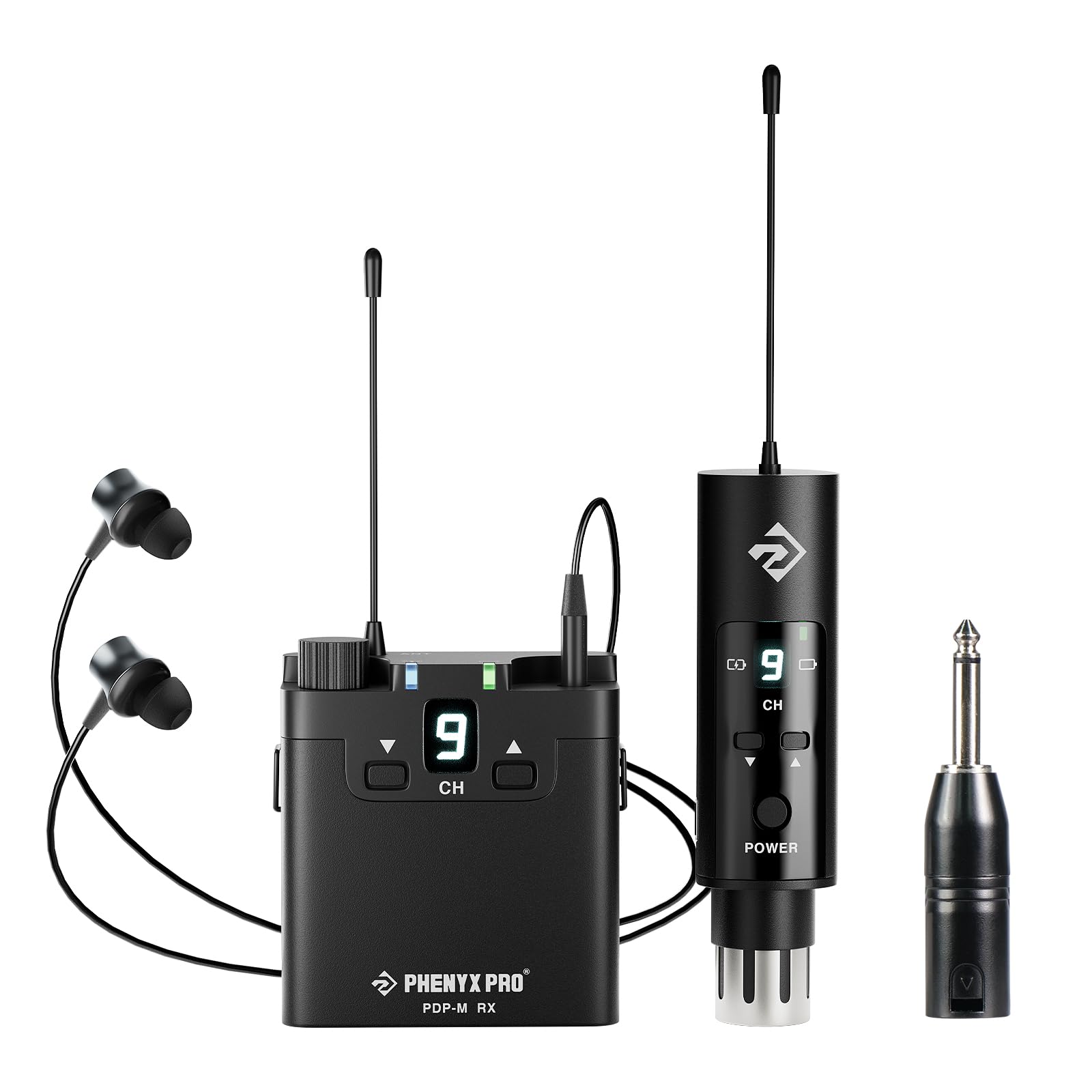
Where the Xvive U4 tops out around 90 feet, this Phenyx Pro runs on a UHF 900MHz frequency-hopping circuit and reaches 160-200 feet — a bigger footprint so you can wander the room, not just the stage. UHF is the band broadcast and stage gear have used for years, and the frequency-hopping part means it hops channels to dodge interference. A higher 30mW transmission power is what backs up that long reach and helps cut dropouts, mute issues, and dead spots.
The audio path is where it separates itself. A 24-bit/48kHz digital signal path is a clean, high-resolution digital chain, and it supports both mono and stereo. In mono mode, a single source stays focused and full; in stereo, vocals, instruments, and backing tracks spread across left and right. That matters because stereo positioning helps a singer know where they sit in the mix. There are 16 selectable UHF frequencies to hop to when a channel gets noisy, and one transmitter can send the same mix to multiple receivers. A Type-C dual charging cable charges the transmitter and receiver together, and runtime is up to 4 hours.
The kit arrives ready to use. Included 6.35 mm to XLR and 3.5 mm stereo to XLR adapters let the portable transmitter connect to common mixer outputs, and in-ear earphones plus a leather pouch are in the box. Owners describe solid build and clean sound, and call it a strong value for the money. It runs on rechargeable lithium batteries. The catch is that four hours is the shortest wireless runtime on this list, and recharging takes 2 hours, so a doubleheader day needs planning. It’s rated 4.0+ stars and is a smart middle-ground for a performer who wants stereo monitoring with real distance.
Choose it for: stereo monitor mixing and the longest stated range here, with 16 frequencies to dodge interference.
Look past it if: you need all-day runtime — 4 hours per charge is the tightest in this group.
6. Linsoul ZiiGaat x Hangout. Audio: Odyssey 2 in Ear Monitor
A four-driver hybrid built for people who want their bass deep and their mids clean.
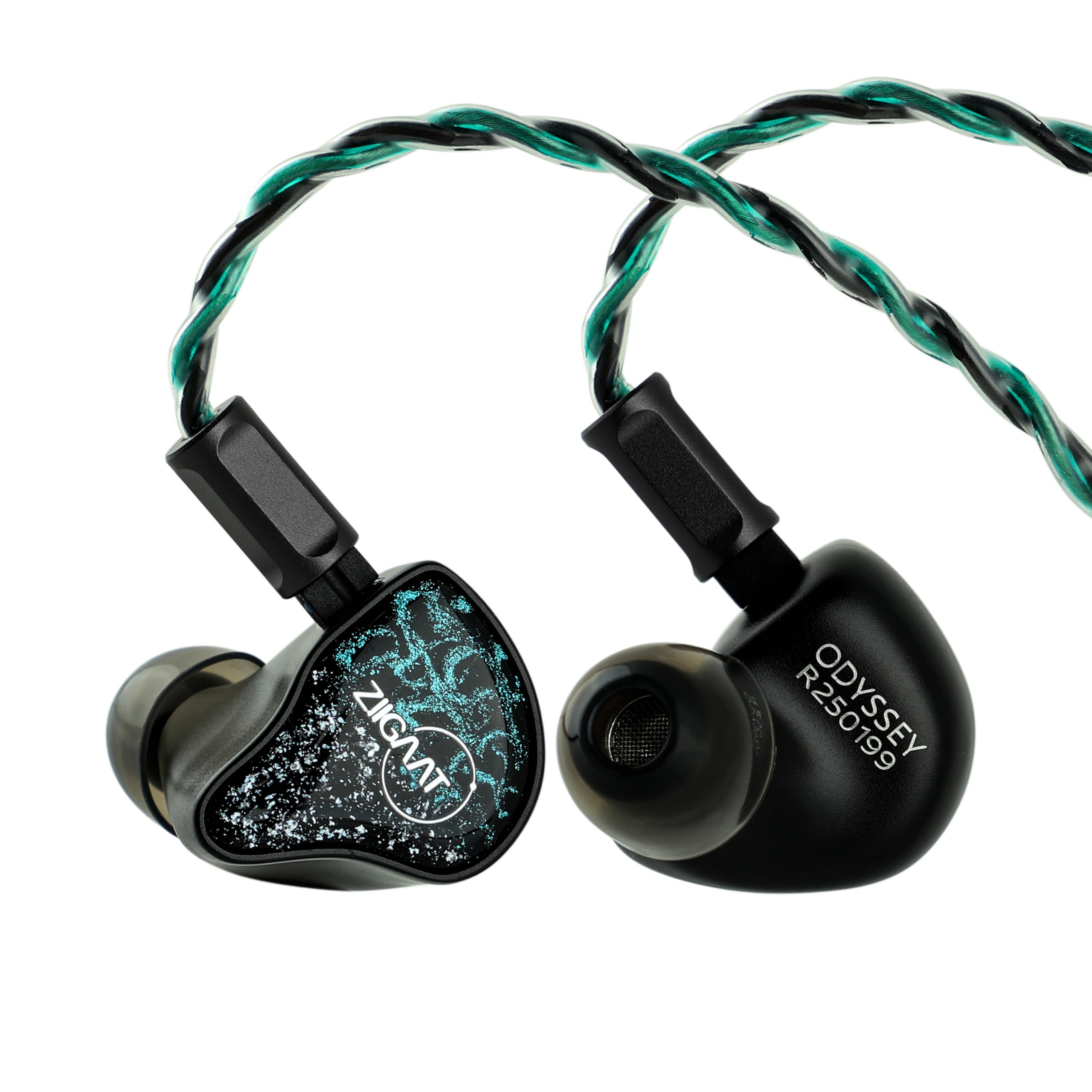
For the serious listener who cares about how a mix is put together rather than whether it’s wireless, this is where the money goes. The Odyssey 2 is a hybrid in-ear using four drivers in total — a 1DD + 3BA layout, which means one dynamic driver plus three balanced armatures sharing the work. That is a wired design, so plan to pair it with a Bluetooth adapter if you want to go cable-free. The bass end is a second-generation bio-cellulose composite diaphragm driver, which is the woofer responsible for the low-end punch, and the crossover network keeps those lows from bleeding into the mids.
The midrange and treble come from genuine Knowles balanced armature drivers. Two Knowles RAF 32873 drivers power the mids, and a single Knowles RAD 33518 tweeter handles the top end. Impedance is 20 ohm, an easy load to drive. The result is a tuning that reviewers describe as modern neutral with a tasteful sub-bass boost — strong sub-bass extension and rumble without mid-bass mud. Male and female vocals come through full and separated from the mix, and the treble has sparkle without turning harsh.
Build quality is a step up. Each unit is assembled by hand with an aluminum alloy shell and a hand-poured faceplate, and it ships with a 4-core oxygen-free copper plus silver litz cable on a 2-pin 0.78mm system, so you can swap cables. Comfort is a bright spot, with the shell easy to wear for hours. The one honest gripe is that the left and right modules are hard to tell apart, since the v-notch points outward. Value opinions split between “great for the price” and “a disappointment,” so this is a pick for buyers who prioritize sound above all. What owners rave about most is exactly that sound quality, and it holds 4.0+ stars.
Top of the tree: four drivers — one dynamic plus three Knowles balanced armatures — deliver a level of separation and sub-bass control the single-driver picks here can’t match.
Worth it if: you want wired audiophile tuning with deep sub-bass and hand-built shells, and don’t mind adding an adapter for wireless.
Think twice if: you need a built-in wireless connection or a value-first price.
7. Phenyx Pro 4-Channel UHF Mono Wireless in Ear Monitor System PTM-33-4B

Four mixes, four receivers, one rack — the whole band covered in a single box.
A four-piece band with four separate monitor mixes is exactly who this system is built for. The PTM-33-4B is a 4-channel wireless monitor station with 4 groups of left/right inputs and loop outputs, so four auxiliary jacks on one mixer cover the whole group. Each performer can run up to 4 standalone mixes, and there’s no delay in the sound, so each person hears their own blend. That is the practical solution to stage volume: nobody has to turn up to hear themselves, because everyone hears exactly what they need.
It’s a mono-only system, which is note up front. The upside is 4×25 UHF frequencies to dodge interference, and a stated range of 140-164 feet line of sight. The 42cm/16.5in studio monitor saves rack space, and the transmitter uses a widely compatible 1/4″ TS jack, with an antenna rackmount kit in the box for a tidy rack workflow. Channel linking is handled by IR sync, which snaps as many receivers as you want onto the same channel without fiddling.
The whole kit arrives complete: one wireless IEM transmitter, four UHF bodypack receivers, four in-ear earphones, a power adapter, two antennas, the rackmount kit, a manual, and eight AA batteries. Owners praise the packs and transmitter, the clear sound, and how easy the pack controls are to work. Quality is the standout, with solid, trustworthy components. The trade-offs: it’s mono, so no stereo spread; range depends on avoiding thick walls, glass, and metal; and the bodypacks run on AA batteries rather than rechargeable cells. At 4.0+ stars, this is the right call for a band that needs personal mixes for everyone.
What stands out
- Four bodypack receivers cover a full band from one transmitter
- 4×25 UHF frequencies to find a clean channel
- 140-164 feet of line-of-sight range
- IR sync links receivers fast; rackmount kit included
What to plan around
- Mono only, so no left/right stereo mix
- Bodypacks run on AA batteries, not rechargeable ones
- Range drops against thick walls, glass, or metal
Reach for this if: you run a four-piece band or worship team that needs separate monitor mixes for every player.
Look elsewhere if: you need stereo panning or rechargeable bodypacks.
Know the Specs
Latency In Milliseconds
Latency is the delay between the sound leaving the mixer and reaching your ear. A performer notices even a small delay, because it makes their own voice feel late against the beat. A figure under about 5 milliseconds is where live players want to land so the monitor feels immediate rather than out of step.
Battery Life And Charge Time
Battery life is the hours a system runs on a charge. A rating around 5 hours covers a typical show, and a longer figure stretches to a full rehearsal or worship set. Charge time matters too, since a system that needs a long recharge between sets may not be ready for a doubleheader day.
Bluetooth Range In Meters
Range is how far you can move from the transmitter before the signal breaks. A Bluetooth adapter typically trails well behind a dedicated stage system, and the numbers here show it — 10 meters of Bluetooth range against over 90 feet or 160-200 feet on the wireless stage systems.
Driver Type
Drivers are the components that actually turn signal into sound. A dynamic driver uses a moving diaphragm and tends to give punchy bass, while balanced armatures are tiny precision parts that often deliver cleaner mids and treble. Hybrids combine both, so one driver handles the low end and others cover the rest.
Common Questions
Can I use a Bluetooth adapter with wired in-ear monitors instead of a full wireless system?
What latency is acceptable for live performance monitoring?
How far can I walk from the transmitter before the signal drops?
Do I need a license to use a 2.4GHz or UHF wireless in-ear system?
How many hours of use should I expect from a wireless in-ear monitor per charge?
What is the difference between mono and stereo in-ear monitoring?
How many channels do I need if multiple band members share a system?
Can a wireless in-ear monitor system really reduce stage volume and feedback?
What should I check first if my wireless in-ear monitor has dropouts?
Does the Sennheiser IE 100 Pro Bluetooth module work with other MMCX earphones?
The Bottom Line
For most buyers, the bluetooth iem winner is the Xvive U4 Wireless in-Ear Monitor System Set because it bundles the transmitter, receiver, adapters, and bag into a single kit with under 5ms of latency and over 90 feet of range — a complete wireless monitoring rig for gigging musicians. If you already own detachable Shure earphones and want the longest runtime, grab the Shure RMCE-TW2 and its 32 hours of total battery. And for a full band that needs four separate monitor mixes from one rack unit, the Phenyx Pro PTM-33-4B is the one to reach for.
How we choose
We do not accept paid placement. Every pick is matched to a real buyer and a real use-case; we do not hands-on test units.
Sources
Specifications: manufacturer listings and product documentation. Review insights: verified customer reviews, as of October 2026. Pricing: not shown on this page (it changes often); check the current price via the retailer link.
As an Amazon Associate, Aappliancez earns from qualifying purchases. This does not affect which products we feature.