Disclosure: Some links in this post are affiliate links. As an Amazon Associate I earn from qualifying purchases, at no extra cost to you. Learn more
Specs are compiled from manufacturer listings and verified buyer reviews and can change over time — please confirm the key details on the product page before buying.
If you are tired of dragging heavy bins up a wobbly pull-down ladder, an attic lift system is the fix you have been looking for. These machines raise and lower your gear from the ground so you never have to carry a box one-handed up steep steps again. The picks below cover every budget and every ceiling type, from a drill-operated rack that holds 325 lbs to a motorized platform that stops itself when it touches an obstacle.
This guide is built by comparing the manufacturers’ published specifications and the patterns across verified customer reviews, so you get each pick’s real strengths and trade-offs instead of marketing spin.
If your garage floor is buried under bins and you want your attic to finally earn its keep, the right attic lift depends on three things: how much weight it lifts, how high it reaches, and if you want to crank a handle or push a button. This guide breaks down each option so you can match one to your ceiling height and save your back.
Top Picks


How To Choose The Best Attic Lift Systems
The single biggest mistake buyers make is picking a lift without measuring their ceiling first. A system rated for an 8-to-12-foot ceiling will not work in a low garage, and one built for a 7’8″ to 10’3″ opening will not fit a tall warehouse. Before anything else, grab a tape measure and check your ceiling height, the distance between your joists, and the swing room above your garage door.
Load capacity and what you actually store
Think about the heaviest single item you plan to lift, not the total pile. A platform rated for 200 lbs handles holiday decor and luggage, while a 325-pound rack can take a full set of toolboxes or a kayak. If you are lifting engines, furnaces, or roofing bundles, you need a hoist in the 400-pound to 2,200-pound class. Add up your heaviest item plus a safety margin, then match it to the rated capacity.
Drill-operated versus motorized versus manual winch
A drill-operated lift uses your own power drill to raise and lower the platform, so there is no motor to buy or maintain. A motorized platform runs on push-button controls and often stops automatically when it hits an obstruction. A manual winch or crank hoist uses a handle you turn by hand. Each has a trade-off: drill operation is simple and cost-effective, motorized is easiest on your body, and manual winches work without any power source at all.
Installation and ceiling structure
Some systems mount to horizontal or vertical beams and require no truss cutting. Others need a structural box built between headers, or a truss cut entirely. Several motorized models specifically warn that they will not fit engineered 2×4 trusses common in newer construction. Check your framing type before ordering, and plan for a helper — many of these installs take two people and several hours.
Side-by-Side Comparison
| Model | Best For | Load Capacity | Lift Type | Height Range | Amazon |
|---|---|---|---|---|---|
| Garage Ceiling Storage Racks – 4×8 FT (FERO)★ Best Overall | Drill-operated overhead garage storage | 325 lbs | Drill-operated lift | Ceilings 8 to 12 ft | Amazon |
| Aluminum Attic Ladder Pull Down (WTRAVEL)Best for Access | Attic access with climbing stairs | 375 lbs | Manual folding stairs | 7’8″ to 10’3″ ceilings | Amazon |
| Thule MultiLift Storage SystemMost Trusted Name | Rooftop boxes, kayaks, and surfboards | 220 lbs / 100 kg | Crank winch | Raises to 6″ from ceiling | Amazon |
| Overhead Garage Storage Rack – 4×8 FT (FERO) | Indoor overhead storage, low ceilings | 325 lbs | Drill-operated lift | Ceilings 8 to 12 ft | Amazon |
| VEVOR Electric Chain Hoist 2200 lbs | Heavy lifting in garages and shops | 2200 lbs | Electric chain hoist | 20 ft lift height | Amazon |
| SpaceLift SL 5228-S Motorized Attic Lift | Push-button attic storage elevator | 200 lbs | Motorized platform | 15 ft vertical range | Amazon |
| Genie Lift GL-8 | Industrial material lifting | 400 lbs | Manual telescoping lift | 10′ 0.5″ lift height | Amazon |
| TP250 – 250lb. 28ft. Ladder Hoist | Roofing and tall exterior lifts | 250 lbs | Gas-powered ladder hoist | 28 ft ladder reach | Amazon |
| TP400 – 400lb. 28ft. Ladder Hoist | Heavy roofing material lifting | 400 lbs | Gas-powered ladder hoist | 28 ft ladder reach | Amazon |
Detailed Reviews
1. Garage Ceiling Storage Racks 4×8 FT FERO
Our pick — 4.5+★ from 100+ verified ratings; the strongest balance of quality and price.
The drill-operated rack that turns dead ceiling space into 32 square feet of usable garage storage.
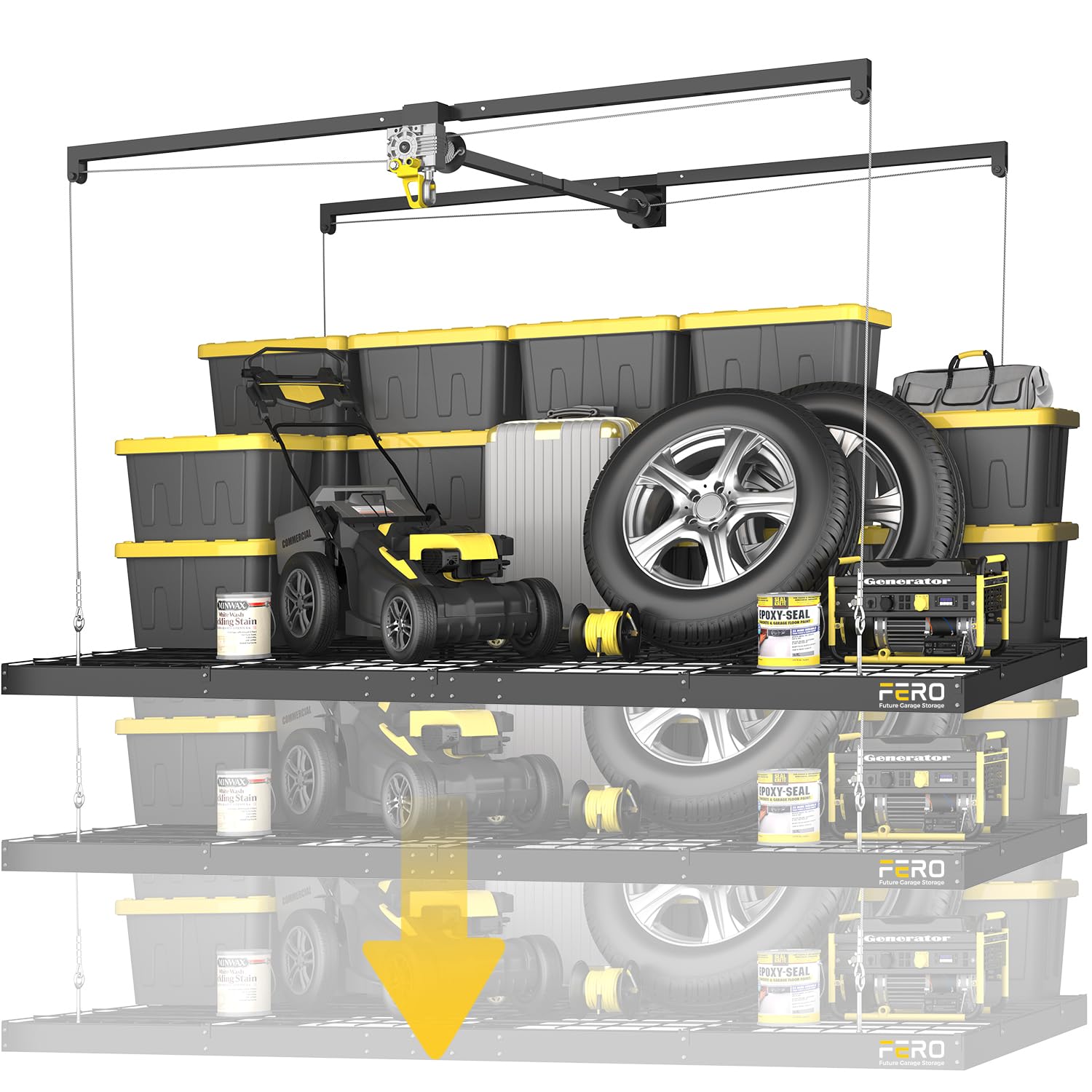
This is the one to buy if you want a serious overhead platform without paying for a motor. It gives you 32 square feet of storage space — enough for seasonal bins, toolboxes, or a kayak — and it mounts to ceilings from 8 to 12 feet high, with a platform that adjusts up to 9 feet. The lift runs off your own power drill, so there is no motor to burn out and nothing to maintain. You stand on the floor and work the drill while the rack rises or drops.
The structure is built from high-strength steel with an H-shaped frame that spreads the load more evenly than the four-point designs common in this category. It holds up to 325 lbs, and a manual safety lock keeps the platform secure while you load and unload. Installation works with both horizontal and vertical beams, so most garage ceilings can take it, whether you mount it above the garage door or in an unused ceiling zone. Be aware it weighs 92 pounds, so you will want backup lifting it into place.
What wins people over is how straightforward the assembly actually is. Owners describe getting the whole thing up in about two hours solo, with all parts and holes lining up and quality hardware in the box. The instructions are clear enough that most people finish without calling for help. A minor gripe that shows up now and then: one plastic insert can sit slightly off and need trimming to fit, and the manual drill method means raising and lowering takes a little patience on very high ceilings. Neither is a reason to walk away.
What earns it the top spot
- 325 lbs capacity with a manual safety lock for secure overhead storage
- Drill-operated lift means no motor to buy or maintain
- 32 sq ft platform fits ceilings from 8 to 12 ft
- H-shaped steel frame spreads load more evenly than four-point designs
What to plan around
- Weighs 92 pounds — definitely a two-person lift during install
- Manual drill operation takes some patience on higher ceilings
- One plastic insert occasionally needs trimming to align
Reach for this if: you want maximum overhead capacity with zero motor maintenance and a straightforward two-hour install.
Look elsewhere if: you need a fully motorized push-button lift or your ceiling falls outside the 8-to-12-foot range.
2. Aluminum Attic Ladder Pull Down Loft Stairs (WTRAVEL)
A folding aluminum ladder that gives you safe attic access without permanent floor space sacrificed.
Not every attic job calls for a powered lift — sometimes you just need reliable, safe access. This folding aluminum ladder is designed for ceiling heights from 7’8″ to 10’3″, with a 25-inch by 54-inch footprint. It folds down when you need it and tucks away small when you do not, so it does not eat into your garage or hallway. The maximum reach is 123 inches, and it is built from high-quality aluminum alloy for a light 44-pound carry.
The 375-pound load capacity is generous, and the heavy-duty hinges, non-slip footing, and widened steps work together to keep things steady underfoot. A handrail adds extra grip on the way up and down. Owners consistently describe it as well-built and sturdy — the kind of product that feels solid the moment you step on it. The thing everyone raves about is how straightforward the install is: clear, easy-to-follow directions, pull it down and put it away without fuss.
Here is the trade-off. Install takes real effort — cutting the ceiling hole and building the structural box that attaches to headers ran about four hours for one owner, and trim for the hatch is not included. The gas springs work well but could be a touch stronger. Shipping runs by truck and is not Prime-eligible, so factor in that logistics step before you order. It is worth the effort once it is up.
Where it stands out: 375 lbs capacity in a folding aluminum frame that weighs just 44 pounds, with non-slip footing and a handrail for secure climbing.
What to weigh first: it needs a ceiling between 7’8″ and 10’3″, and install involves cutting the ceiling and building a structural box — plan for a full afternoon and a helper.
Pick this: if you want dependable attic access with generous 375-pound footing and you are comfortable with a real carpentry install.
Think twice: if you want zero cutting or your ceiling falls outside the 7’8″ to 10’3″ range this ladder is built for.
3. Thule MultiLift Storage System
The crank-powered ceiling winch built for rooftop cargo boxes, kayaks, and surfboards.
If your storage problem is a rooftop cargo box or a pair of kayaks taking up half your garage, this is the system designed for exactly that load. It mounts directly to your ceiling and uses a built-in winch with a 4-foot crank handle to lift up to 220 lbs (100 kg). The rack lowers up to 78 inches so you can load at a comfortable height, then raises to within 6 inches of the ceiling when you are done. It ships preassembled with drill patterns for easier mounting.
The headline number is the weight: at 7.5 pounds, this unit is a feather next to a built-in steel rack that tips the scale at 92 pounds — that gap is real, and it means one person can handle the overhead positioning. Function and build quality are what keep owners happy. In the reviews, buyers report the smooth operation and that it works perfectly even on a 9-foot ceiling. The pulley design lets it tuck right above a closed garage door, which is a detail that matters in tight garages.
The honest catch is the mounting hardware. The metal plates do not fit 1.5-inch joists, and the universal brackets are not included — owners mention solving this with a 3/4-inch plywood plate or a wooden frame, and 14 fasteners are needed for install (not included). The included rope also arrives short for some setups. Most people work through it and end up happy, but go in knowing you may need a trip to the lumber yard.
Best for: rooftop boxes, kayaks, surfboards, and any load up to 220 lbs where you want a lightweight, crank-operated ceiling lift.
The catch: mounting hardware is not included, the plates do not fit 1.5-inch joists without a plywood adapter, and the included rope may need replacing — plan for a bit of custom fitting.
Choose it when: your main cargo is a rooftop box or board and you want smooth crank operation in a package light enough to lift alone.
Skip it when: you want everything in the box for a bolt-on install — this one expects you to supply fasteners and adapters.
4. Overhead Garage Storage Rack 4×8 FT FERO

The indoor-tuned sibling of our top pick, built for the same 325 lbs with a lower-profile fit.
This is essentially the same proven FERO platform as our number one pick, with one key difference: it is rated for indoor use only. That makes it the smarter call if your install is in a climate-controlled garage or a covered space where you never worry about weather exposure. It carries the same 325 lbs, adds the same 32 square feet of overhead storage, and adjusts to the same 9-foot platform height across 8-to-12-foot ceilings.
The H-shaped steel frame is the same load-spreading design, and the manual safety lock is there for secure ceiling-mounted use. Like the top pick, it runs off your power drill with no ladder required — you work from the floor and let the drill do the lifting. It weighs 92 pounds, so line up a helper for the overhead positioning. Owners keep coming back to how much floor room it frees up, and how sturdy and secure the platform feels once loaded.
Where this one differs from its sibling: the finish is white rather than black, and some owners note the gearbox ratio runs slow, which means raising and lowering on a 12-foot ceiling takes a bit of patience. It holds bulky ice fishing gear and keeps the mice out, and the simple directions get you through install quickly. For seasonal storage that goes up and comes down a few times a year, the speed is not much of a factor — but if you plan to raise and lower it daily, keep that in mind.
Why buyers keep it
- Same 325 lbs capacity and 32 sq ft as the top pick, rated for indoor use
- Clears low ceilings and vehicles, with easy drill operation from the floor
- Manual safety lock holds the platform secure while loading
- Sturdy enough for bulky, awkward gear like ice fishing equipment
Where it could improve
- Indoor rating only — not for exposed outdoor installs
- Gearbox ratio runs slow on 12-foot ceilings, so it takes patience
- 92 pounds means a two-person install
Best fit for: a covered or climate-controlled garage where you want proven 325-pound capacity and indoor-only durability.
Not ideal for: daily raise-and-lower use on a tall ceiling, or any install that sees rain and weather.
5. VEVOR Electric Chain Hoist 2200 lbs

A 2200-pound electric chain hoist that lifts engines, mowers, and boulders with a 328-foot remote.
When 325 lbs is not enough, this is where you go. The VEVOR chain hoist handles up to 2200 lbs with a 20-foot (6-meter) lifting height, driven by a copper motor with F-class insulation rated for temperatures up to 155°C. At 73.6 pounds and running on 120 volts, it is a genuine electric hoist built for shops, garages, and outdoor jobs — not a homeowner storage rack. The DT-grade carburized chain is made for the durability that heavy lifting demands.
what separates it from every other pick here is the control range. You get a 15-foot security cable for wired control and a 328-foot wireless range, so you can operate it from across the shop or from below a raised load. It also comes with an emergency stop and an electromagnetic brake for safe operation. Customers note it works well and is well-made, with the Bluetooth remote feature earning particular appreciation. It handles boats, engines, mowers, and heavy equipment across garages, shops, and homes.
The trade-off is durability over the long haul. The reviews include mixed feedback on build quality and value, and there is a report of gears stripping after six months of use. That is worth knowing if you plan to run it hard every day. For occasional or moderate use, the functionality and lifting power are solid. Mount it to your ceiling with metal or wood strips and it goes up without much fuss.
The standout spec: 2200 lbs capacity with a 20-foot lift and dual control — a 15-foot wired cable plus a 328-foot wireless range — backed by an emergency stop and electromagnetic brake.
Keep in mind: durability gets mixed reviews over time, with a report of gears stripping after six months of hard use, so this favors moderate or occasional lifting over constant daily duty.
Made for: garages, shops, and outdoor jobs that need serious 2200-pound pulling power with remote control freedom.
Rethink if: you plan to run it daily — heavy continuous duty is where the mixed durability reports show up.
6. SpaceLift SL 5228-S Motorized Attic Lift
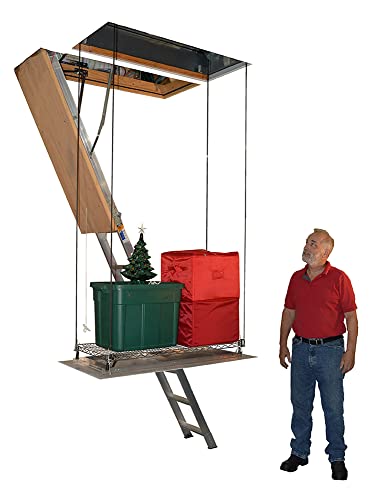
A push-button attic elevator that carries 200 pounds to your ceiling so you never haul a box up a ladder.
This is the pick for anyone whose attic access runs through a shaky pull-down ladder they would rather never climb again. The SL 5228-S is a motorized platform with a 24 by 41-inch low-profile deck that carries up to 200 pounds per trip, gliding between floor joists because it has no bulky outer frame. A wall-mounted control station lets you stand safely on the ground and press a button while the electric winch does the work. It offers a 15-foot vertical lifting range and stops automatically when the platform reaches full height or touches an obstruction.
Because it has no restrictive outer frame, you can stack tall or awkward items like an artificial Christmas tree as high as your attic ceiling permits. It is invented and built in the USA in a Monroe, CT workshop and carries a 2-year limited warranty. The quality of the materials is what buyers notice first, and the support team has a strong reputation — one owner described getting fast, thorough help during Thanksgiving week. The installation is considered good value, running considerably less than competing units.
The one thing to check before ordering is your framing. The maker states clearly that most contractors will not cut engineered 2×4 trusses common in newer Florida and Carolina construction — if your home has this framing, this larger model will not fit and you should look at the more compact SL 5222-S instead. Installation also typically involves cutting a truss, which is more complex work than the drill-operated racks above. The result is worth it: owners describe it as a genuine back saver, and one said it paid for itself the first time it was used.
The defining feature: a 24 by 41-inch low-profile platform that carries 200 pounds up to 15 feet, with obstacle detection and a wall-mounted push-button control.
Check before you buy: it will not fit engineered 2×4 trusses in newer Florida and Carolina builds, and install usually means cutting a truss — confirm your framing first.
Ideal for: anyone replacing a shaky pull-down ladder who wants 200-pound push-button lifting with automatic obstacle detection and US-built quality.
Rule it out if: your home uses engineered 2×4 trusses — the maker says this model will not fit and points to the more compact SL 5222-S.
7. Genie Lift GL-8

A telescoping aluminum workhorse that doubles as a hand truck, forklift, and dolly in one frame.
This is not a ceiling-mounted storage rack — it is a moveable industrial lift, and that changes who it is for. The Genie GL-8 uses a telescoping aluminum frame you roll into position, with standard steel forks and a 400-pound load capacity. It lifts loads to a maximum height of 10′ 0.5″ (3.06 m) and weighs 145 pounds, light enough to move around a shop or job site. Two casters and a single-door access design make it maneuverable in tight spaces.
Where this shines is versatility. One moment it is a hand truck, the next a forklift or dolly, all from the same telescoping frame. Owners describe it as stable and easy to operate, rolling easily on cement even with a load on board. The build quality earns consistent praise, and more than one buyer points to the brand’s reputation for reliability as the reason they chose it over the alternatives. For a tight spot or an open bay, it handles the load.
Two things to measure before you commit. The forks are 24 inches deep, so if you lift equipment wider than that — one buyer was moving 25-inch-wide furnaces — you will need to build extensions to set things safely. And while it is rated to 10′ 0.5″, one owner found theirs would only reach about 8 feet in practice. It also weighs 145 pounds, which is a lot of machine if you only need occasional overhead storage. For dedicated material lifting, it earns its place.
Strengths worth noting
- 400 lbs capacity across a 10′ 0.5″ lift height
- Works as a hand truck, forklift, or dolly from one frame
- Rolls easily on cement with a load, even into tight spots
- Aluminum build earns consistent quality praise
Measure before you buy
- 24-inch forks need extensions for wider loads
- One owner found the reach fell short of the rated 10 ft
- 145 pounds makes it a serious machine, not a casual pick
A strong choice if: you need one mobile machine that lifts, rolls, and doubles as a dolly for job-site material handling.
Look past it if: you only need ceiling-mounted storage — the 145-pound weight and 24-inch forks are built for daily industrial work.
8. TP250 – 250lb. 28ft. Ladder Hoist

A gas-powered ladder hoist built to send shingles and materials 28 feet up without the climb.
This is the tool for roofing crews and anyone moving material to a high elevation, not for garage storage. The TP250 lifts items weighing up to 250 lbs a full 28 feet off the ground, powered by a Lifan motor on a heavy-duty steel frame. It arrives as one 4-foot aluminum base track plus three 8-foot aluminum ladder sections, giving you a ladder reach of 28 feet. Each ladder section is 8 feet high and 17 inches wide.
What matters here is the control layout and the field-readiness. There is a wide-foot pedal control and a handle brake, non-slip deck, and tie-down slots for plywood or rolled goods so your load stays put on the way up. Assembly and disassembly are designed to be easy, and the collapsible plywood brackets pack down for transport. The whole rig assembles on site, which is exactly what a crew moving between jobs needs.
Buyers in the trades describe it as a time-saver that cuts labor and the back injuries that come with hauling shingles up a ladder by hand. That is the whole point. The honest caveats: the shipping process can run long and arrive inspected, and one buyer received an extension that came damaged with no response on a replacement. It carries a 90-day limited warranty, which is short for equipment in this class, so inspect everything on delivery. Treat it as a working tool that needs one careful check the day it lands.
Where it earns its keep: 250 lbs of lifting power reaching 28 feet via an aluminum base track plus three 8-foot ladder sections, with a wide-foot pedal and handle brake for controlled lifting.
Inspect on arrival: the shipping run can be long, one buyer received a damaged extension with no replacement response, and the warranty covers 90 days only.
Best for: roofing crews and trade pros who need to get materials to a 28-foot height fast, safely, and without a manual climb.
Not for: garage or attic storage — this is a field tool built for exterior material lifting, not your ceiling.
9. TP400 – 400lb. 28ft. Ladder Hoist

The heavier twin of the TP250, pushing 400 lbs to the same 28-foot reach for bigger material loads.
When the TP250’s 250 lbs is not enough, this is the step up. The TP400 lifts items up to 400 lbs a full 28 feet off the ground, on the same heavy-duty steel frame with a non-slip deck. It ships with one 4-foot aluminum base track and three 8-foot aluminum ladder sections, matching the same 28-foot ladder reach and 17-inch section width. It offers the same wide-foot pedal control and handle brake, plus collapsible plywood brackets and tie-down slots for plywood or rolled goods.
The meaningful difference is the capacity headroom. If your crew regularly sends up heavier bundles or a larger volume of material per trip, the higher limit on this unit means fewer runs up and down. It runs on a Lifan motor, same as its sibling, and the frame geometry that makes the TP250 steady under load carries over here. Assembly and disassembly design is carried across both models, so the field setup is familiar.
The honest caution is complete delivery. One buyer declined the shipment outright because it arrived missing parts, and the warranty runs 90 days limited — short for equipment at this level. Before you sign for it, confirm every section, bracket, and fastener is present and undamaged. Do that, and you have a heavier-reach hoist that handles material the lighter model would strain under.
What it brings to the job
- 400 lbs capacity at a 28-foot reach — more headroom than the TP250
- Ships with a 4-foot base track plus three 8-foot ladder sections
- Wide-foot pedal control and handle brake for controlled lifts
- Collapsible plywood brackets and tie-down slots for secure loads
Watch before you commit
- 90-day limited warranty is short for equipment in this class
- One shipment arrived missing parts and was declined
- Same 28-foot reach as the TP250 — the upgrade is capacity, not height
Settle on it if: your jobs send up heavier or bulkier material loads that the lighter 250-pound model cannot take in one trip.
Stick with the TP250 if: your typical loads stay under 250 lbs — you would be paying for capacity you never use.
Know the Specs
Load Capacity
This is the heaviest load a system is rated to lift, measured in pounds. A rack rated for 325 lbs handles toolboxes and kayaks; a hoist rated for 2200 lbs moves engines and boulders. Always size capacity to your heaviest single item, not the pile, and leave a margin. Going over the rated number is where failures happen, so match it to what you truly lift.
Lift Type
How the platform actually moves. Drill-operated lifts run on your own power drill — no motor to buy, but you work the trigger. Motorized platforms use push-button controls and often stop on obstruction. Manual crank winches turn a handle by hand, and gas-powered ladder hoists use an engine to raise material up the track. Each trades convenience against maintenance and cost.
Ceiling Height Range
Before you buy anything, measure your ceiling. Some racks fit ceilings from 8 to 12 feet; some ladders are built for 7’8″ to 10’3″; some motorized lifts offer a 15-foot vertical range. A system built for one range will not work outside it. Getting this wrong is the most common reason a lift gets returned unused.
Mounting and Framing
Where the system physically attaches to your structure. Some mount to horizontal or vertical beams with no truss cutting; others need a structural box built between headers. Several motorized models specifically will not fit engineered 2×4 trusses. Check your framing type first, and count your fasteners — some units need 14 of them, sold separately.
Common Questions
What load capacity do I need for a garage attic lift?
Will an attic lift fit my ceiling height?
Do I need to cut a truss to install a motorized attic lift?
What is the difference between a drill-operated lift and a motorized one?
How much weight can the Thule MultiLift hold and what can it store?
Are mounting fasteners included with attic lift systems?
Can one person install an attic lift system alone?
What is the difference between the TP250 and TP400 ladder hoists?
How long do these lift systems take to install?
Do attic lift systems come with a warranty?
The Bottom Line
For most garages, the best attic lift systems winner is the FERO Garage Ceiling Storage Rack because it balances 325 lbs of capacity, 32 square feet of platform, and a maintenance-free drill-operated lift that most people install in about two hours. If you want push-button convenience and never want to climb a ladder again, the SpaceLift SL 5228-S is the motorized pick worth stepping up for. And if your job is hauling material up to a roof, the TP250 Ladder Hoist is the one to reach for. Whichever you choose, measure your ceiling and verify your framing before you order — that single step prevents almost every return in this category.
How we choose
We do not accept paid placement. Every pick is matched to a real buyer and a real use-case; we do not hands-on test units.
Sources
Specifications: manufacturer listings and product documentation. Review insights: verified customer reviews, as of October 2026. Pricing: not shown on this page (it changes often); check the current price via the retailer link.
As an Amazon Associate, Aappliancez earns from qualifying purchases. This does not affect which products we feature.