Disclosure: Some links in this post are affiliate links. As an Amazon Associate I earn from qualifying purchases, at no extra cost to you. Learn more
Specs are compiled from manufacturer listings and verified buyer reviews and can change over time — please confirm the key details on the product page before buying.
If you need a phone that simply cannot take a photo, the hardware itself has to leave the camera out — no lens means no picture, no matter what app you install. That single physical fact is what makes a camera-free device different from a normal phone with its camera turned off. Some workplaces, secure facilities, and privacy-first buyers require exactly that, and a software toggle never satisfies them because the lens is still there. This guide walks through nine options that physically lack a working camera, and it separates the ones that also make good everyday phones from the ones that only make sense in narrow situations.
This guide is built by comparing the manufacturers’ published specifications and the patterns across verified customer reviews, so you get each pick’s real strengths and trade-offs instead of marketing spin.
Cutting a camera out of a phone is easy; keeping the battery, call quality, and build solid while you do it is the hard part. That is the trade-off running through every pick in this roundup of the android device without camera.
Top Picks

How To Choose The Best Android Device Without Camera
The first thing to understand is that “no camera” can mean two very different products. One is a phone whose lens has been removed entirely, so there is no way to capture an image at all. The other is a normal smartphone that happens to ship without a camera module in some configurations. Both can work, but only the first type is truly camera-free in the physical sense, so decide up front which one your situation demands.
Confirm the missing lens, not just a disabled app
A disabled camera app still leaves a working lens on the device, and anyone can re-enable it in settings. If your requirement comes from a workplace rule or a personal privacy goal, you want the hardware missing. Check the manufacturer’s own description for words like “no camera” rather than a software toggle.
Match the carrier to the phone before you buy
Many of these devices are GSM-only, which means they run on networks like T-Mobile, Metro, Mint, and Tello but will not work on CDMA carriers such as Verizon or AT&T at all. Confirm the network your SIM uses first, because a perfect phone on the wrong network is a paperweight. The band list in each spec sheet tells you which towers it can actually reach.
Settle on battery, size, and build for daily use
Once you know the camera and carrier answers, three practical specs decide the rest: battery capacity in mAh (milliamp-hours — the size of the fuel tank that sets how long you go between charges), screen size for comfort, and if you need a rugged housing for outdoor or job-site work.
Side-by-Side Comparison
| Model | Best For | Battery | Camera Status | Network | Amazon |
|---|---|---|---|---|---|
| Motorola Moto G15 4G LTE★ Best Overall | Everyday camera-free work phone | 5200 mAh | No camera in this configuration | GSM / T-Mobile towers | Amazon |
| NUU N30Best Value | Teen and parental-control use | 5000 mAh | No camera in this configuration | GSM / T-Mobile towers | Amazon |
| UMIDIGI G9TBig-Screen Pick | Big-screen budget daily driver | 5000 mAh | No camera in this configuration | GSM / open up | Amazon |
| Nokia C21 Plus | Simple calling, long standby | 4000 mAh | No camera in this configuration | GSM / T-Mobile towers | Amazon |
| Motorola Moto G Play 2024 | Cheap renewed backup phone | 5000 mAh | No camera in this configuration | GSM / CDMA capable | Amazon |
| Samsung Galaxy A14 5G | Seniors and first-time users | 5000 mAh | No camera in this configuration | GSM only | Amazon |
| FOSSIBOT F101P | Outdoor and job-site use | 10600 mAh | No camera in this configuration | 4G / dual SIM | Amazon |
| Punkt. MP02 | Minimalist distraction-free calling | 1280 mAh | No camera | 4G LTE / AT&T and T-Mobile | Amazon |
| Nothing Phone (3) | Premium performance daily driver | 5150 mAh | No camera in this configuration | 5G / AT&T and T-Mobile | Amazon |
Detailed Reviews
1. Motorola Moto G15 4G LTE (XT2521-2) 4+256GB Dual Sim
Our pick — 4.0+★ from 200+ verified ratings; the strongest balance of quality and price.
The full-size Android that runs two days on a charge — 256GB of storage, no camera compromise on the internals.
For a camera-free phone to be worth carrying, it still has to feel like a real phone, and this one does. The 6.72-inch IPS LCD screen runs at 1080 x 2400 pixels, which is sharp enough at 392 pixels per inch that text and maps look clean rather than fuzzy. Under the hood sits the MediaTek Helio G81 Extreme chip (a processor measured on a 12nm build), paired with Android 15 straight from the start. That combination handles calls, messaging, streaming, and browsing without fuss — it is not built for heavy gaming, and the specs make no claim that it is.
If you live on your phone all day, the 5200 mAh battery is the headline — a slightly bigger tank than the 5000 mAh in the NUU N30 below, so you get longer stretches between charges. You also get a 3.5mm headphone jack (the round socket for wired headphones), Bluetooth 5.0, and FM radio on board, plus dual SIM support so you can run a work number and a personal line side by side. Storage lands at 256GB, and the fingerprint reader on the side open up it with one touch.
One thing to know before you commit: this phone is GSM open up and will not work on CDMA carriers such as Verizon, Sprint, Boost, Cricket, Xfinity, or AT&T. It runs on T-Mobile, Metro PCS, Mint Mobile, and Tello — carriers that use T-Mobile towers. Buyers on those networks set it up quickly, moving a SIM card across without a call to support. The honest catch is performance: the reviews are mixed on speed, with some finding it on the slow side for multitasking, so it suits patient users over power users. What wins people over is the overall build and value — it feels like more phone than the name suggests.
What earns its keep
- 5200 mAh battery runs two days on a charge for light-to-medium use
- 256GB of storage holds years of photos, apps, and messages without a memory card
- 1080 x 2400 pixel screen at 392 PPI keeps text crisp for reading and navigating
- Dual SIM lets a work line and personal line share one handset
- 3.5mm jack, FM radio, and side fingerprint reader cover the basics most people actually use
Where it asks patience
- GSM only — no Verizon, AT&T, Boost, Cricket, or Xfinity coverage
- Performance is the weak spot; heavy gaming and app-switching feel slow
- Battery figure varies by use — a heavier radio load still taps it out in under a day
Reach for this if: you want a capable, big-screen camera-free phone on a T-Mobile-based network and you value battery and storage over raw speed.
Look elsewhere if: you need Verizon or AT&T coverage, or you plan to game on it heavily.
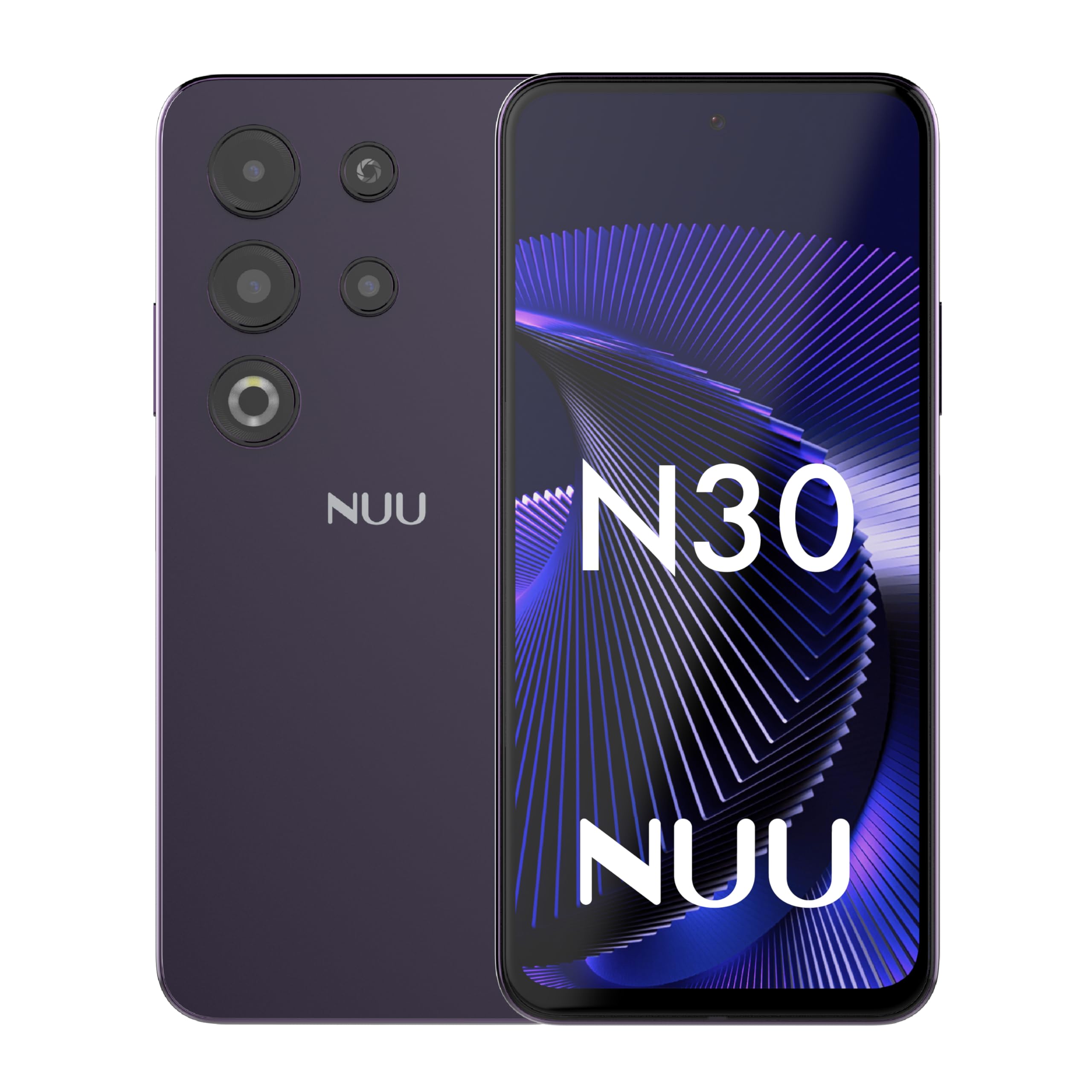
2. NUU N30 Cell Phone
The 6.7-inch cameraless handset built with parents in mind — stock Android, a case in the box, and a big display for a small price.
If you are handing a phone to a teenager and want it camera-free, this is the pick built for that exact job. NUU designed it to run any parental-control app — Google Family Link, Bark, Qustodio, Norton Family — so you can manage the device without a workaround. The screen measures 6.7 inches at 1600 x 720 resolution with a 90Hz refresh rate, which keeps scrolling smooth rather than stuttery. Inside runs Android 14 with no bloatware and no pre-installed ad apps, and the fingerprint reader adds a fast, private open up.
Power comes from an octa-core MediaTek Helio G81 running at 2.0GHz, paired with 6GB of RAM plus 6GB of virtual memory (a feature that borrows storage to act like extra RAM, for 12GB total max). Storage lands at 128GB and can expand by another 256GB with a microSD card. The 5000 mAh battery charges from 30% to 79% in 39 minutes on the included 18W brick. — and a clear TPU case ships in the box, so it is protected from day one.
The 5000 mAh cell here sits just under the 5200 mAh in the Motorola above, so expect slightly less headroom on a heavy day. On the network side, it supports T-Mobile, Mint Mobile, Metro, Boost (GSM), Q Link Wireless, and Google Fi — but not Verizon or AT&T. What most buyers notice is how functional and responsive it feels for the money, and the display and camera both get consistent praise despite the budget positioning. The recurring gripe is battery — some units drain faster than expected, especially with heavy use. The screen is HD+ rather than full high resolution, so text is soft up close, but for calls and casual use it is fine.
What holds up: The 90Hz refresh rate on a 6.7-inch panel is the standout for this price tier — motion feels smoother than the LCD competition, and the included case and 18W charger save you two separate purchases.
Built for: parents setting up a first phone with strong controls, and anyone on a T-Mobile-family network who wants a large screen without paying large-screen money.
skip it if: you need Verizon or AT&T service, or you need a camera for photos and video calls.
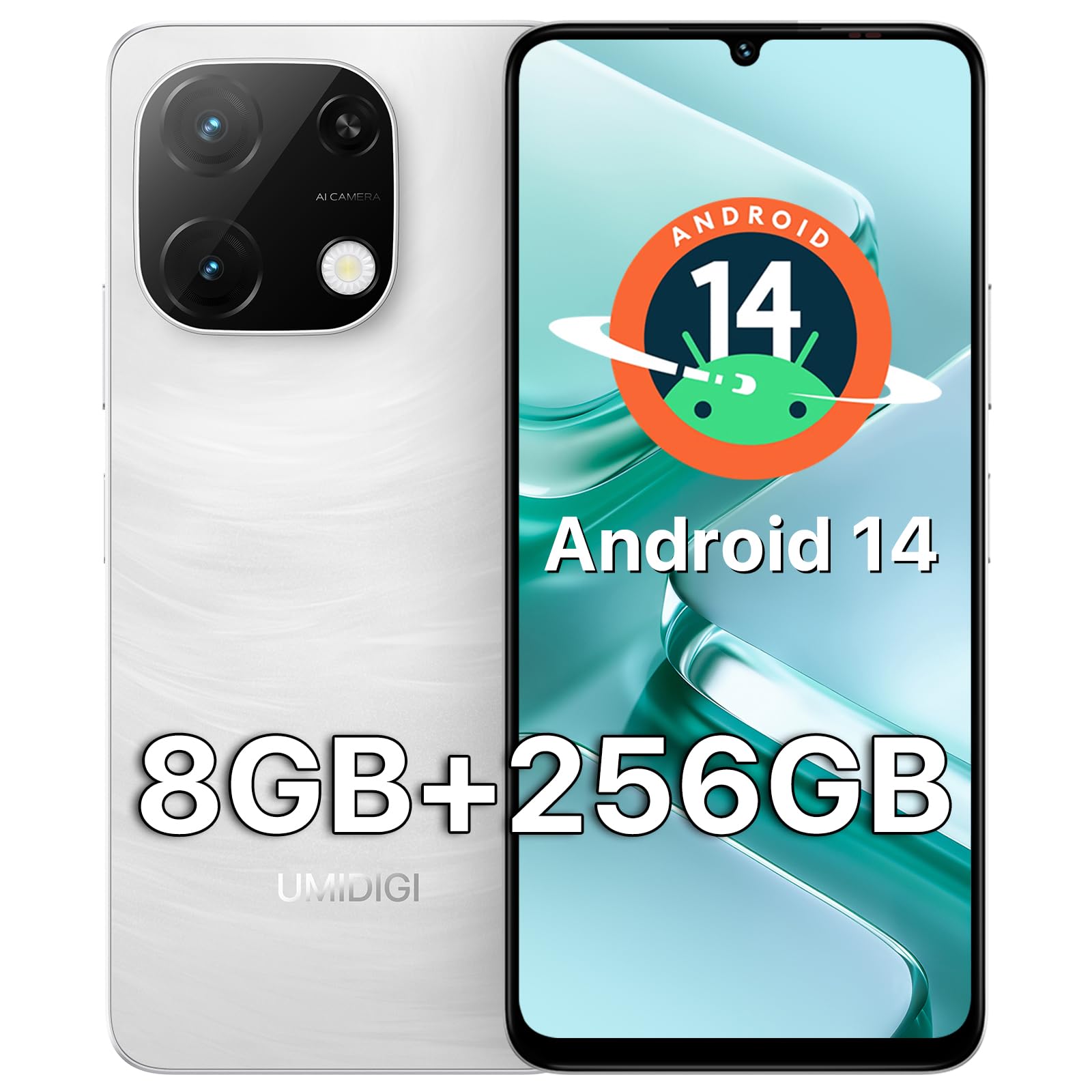
3. UMIDIGI G9T Android 14 Cell Phone, 8(4+4)+256GB
A 6.75-inch canvas with room for a 1TB card — storage flexibility is the whole pitch here.
Storage is the reason to look at this one. It ships with 256GB built in, then accepts a microSD card up to 1TB — far more than most phones in this tier, and enough to hold years of files, music, and downloads without touching the cloud. The screen runs 6.75 inches at 2340 x 1080 resolution with a 90Hz refresh rate, and the panel includes low blue-light technology aimed at reducing eye strain during long sessions.
Inside sits an octa-core UNISOC T606 chip on a 12nm process running up to 1.6GHz, paired with Android 14 and 8GB of RAM (4GB built-in plus 4GB virtual). The battery is 5000 mAh with 18W PD fast charging over USB-C. open up options are flexible — a side-mounted fingerprint sensor plus AI face open up — and the phone carries Bluetooth 4.2, FM radio, and a 3.5mm headphone jack. GPS works across four satellite systems (GPS, Glonass, Beidou, and Galileo), which keeps navigation accurate outdoors.
The contrast with the NUU above is instructive: that phone leans on parental controls and a 6.7-inch panel, while this one leans on raw expansion — 1TB versus 256GB of top-end storage. That said, the honest fit note here is that quality feedback on this model is mixed, and one recurring report flags the charging port failing after only a few weeks. That is a small share of buyers, but it is the kind of thing you should know before committing. When it works, owners describe good build quality and great value for the money. The big screen and 90Hz refresh are the types of upgrade you notice immediately.
What this gets right: You can add a 1TB card — no other phone in this roundup offers that ceiling — and paired with the 6.75-inch 90Hz screen (90 refreshes per second, so scrolling looks smoother), it makes the phone feel larger and more capable than its tier suggests.
Choose this for: media-heavy use where you want the biggest screen and the most expandable storage you can get without going premium.
Think again if: you need the reliability of a proven brand — the durability track record here is less consistent than the Motorola or Samsung options.
4. Nokia C21 Plus Smartphone

The phone that stays alive for two days and runs a clean, stripped-back Android built for the basics.
Nokia built this one around battery endurance, and it shows. The 4000 mAh cell is rated for 48 hours between charges. The screen measures 6.5 inches at HD+ resolution with an 8.5mm-thin body, which is designed to sit comfortably in one hand. Android 11 Go Edition (a lighter version of Android built for low-power hardware) keeps the interface clean and the storage footprint small, while the phone carries 2GB of RAM and 64GB of storage.
If you want reliable calling and texting with minimal fuss, the C21 Plus fits that job. open up works via a fingerprint sensor and AI face recognition, and the phone ships with dual SIM support and expandable storage. It also carries two years of quarterly security updates. Compatible networks include T-Mobile, Boost, Metro, Mint, H2O Wireless, and other carriers using T-Mobile’s network. It will not work with AT&T, Verizon, or their subsidiaries.
The trade-off here is that the reviews are mixed on quality, with some describing it as great and others as a bad product. The recurring note is that it can run hot during extended use, and the camera (while present in some configurations) is basic — owners describe the photo quality as early-90s. That said, when it works, the value-for-money praise is real. It is not a gaming phone, and the C21 Plus never pretends otherwise.
Designed for: someone who wants the longest standby possible in a small, lightweight body, and who only needs calls, texts, and light apps.
Pass on this if: you want fast performance, a good camera, or compatibility with AT&T or Verizon networks.
5. Motorola Moto G Play 2024

A renewed phone that arrives looking like new, runs the full carrier spread, and costs less than most of this list.
What sells this one is the fit between price and capability. It is a renewed device — professionally inspected and restored — and buyers consistently note it arrives in great condition and looks and feels like new, sapphire blue color and all. The screen is 6.5 inches at 1600 x 720 pixels with a 90Hz refresh rate (90 refreshes per second, so motion looks smoother), and the LCD panel hits up to 500 nits of brightness (a measure of how visible the screen stays in daylight), which is enough to read outdoors in most conditions.
The internals are more capable than the price suggests. The Snapdragon 680 4G mobile platform runs four 2.4GHz Gold cores and four 1.9GHz Silver cores, paired with an Adreno 610 GPU and a multi-core AI engine. That combination earns performance praise, and the 4GB RAM plus 64GB storage covers everyday use. The 5000 mAh battery lasts a full day under moderate use, with a side fingerprint reader and face open up. On networks, this phone is unusually flexible: it works on most GSM carriers like T-Mobile, AT&T, and Cricket, and also carries the bands for CDMA networks like Verizon and Sprint.
The one thing to watch: this phone is renewed, not new, and the open up status is not guaranteed in every unit. That is a small share of buyers, but the takeaway is to test carrier compatibility before committing — a fresh, factory-new alternative like the Moto G15 above sidesteps that risk entirely. Owners of working units describe it as reliable and stylish for the money, with gesture features like the shake-to-flashlight that owners especially enjoy. The downside is battery longevity — some report it does not hold a charge as long after heavy use.
Best for: a cheap secondary or backup line where you want a familiar Android feel on any of the major US networks.
pass on it if: you need guaranteed out-of-the-box carrier compatibility — a fresh device is the safer bet.
6. Samsung Galaxy A14 5G, 64GB + 4GB RAM, Black (Renewed)

The name-brand 5G handset that seniors and first-time users take to — familiar software, simple layout, reliable basics.
Samsung’s A14 is the phone to consider when the person using it wants a big, recognizable brand and a straightforward interface. The screen runs 6.6 inches at FHD+ resolution, which gives plenty of room for larger text, and the 393 pixels-per-inch density keeps it sharp. The octa-core processor with RAM Plus technology (a feature that extends memory for smoother multitasking) makes daily tasks feel fluid, and the 5000 mAh battery is specced to run from dawn to night on a single charge.
The design details are made for this audience: a large, easy-to-read screen, a clean interface, and physical buttons that make sense on first sight. Storage lands at 64GB with 4GB of RAM, expandable via a memory card. On the connectivity side, this is a GSM-open up device, so it works on GSM networks but not on CDMA carriers — worth checking if Verizon or a Verizon-based network is your carrier. It is a renewed unit with a battery-health guarantee of at least 80% of original capacity.
The tricky part with any renewed phone — this one included — is the open up claim. A recurring report from buyers describes receiving a device that carried a Tracfone boot logo despite being listed as open up, which blocked service on Visible Wireless. That is not the norm, but it is the main risk, and it is why testing carrier compatibility before committing matters. Owners who get a working unit describe it as a great fit for seniors and a strong value. If you want the safest path, a fresh device sidesteps the renewed question entirely.
Real-world angle: The 6.6-inch FHD+ display plus Samsung’s familiar Android build combine to make this the least intimidating pick on the list — the kind of phone a first-time smartphone user picks up without needing a tutorial.
Ideal for: a senior or first-time smartphone user who wants a well-known brand, a big screen, and a simple interface on a GSM network.
Consider another option if: you need a guaranteed-open up device from the start — some renewed units arrive network-locked.
7. FOSSIBOT F101P Android 13 Rugged Smartphone, 10600mAh
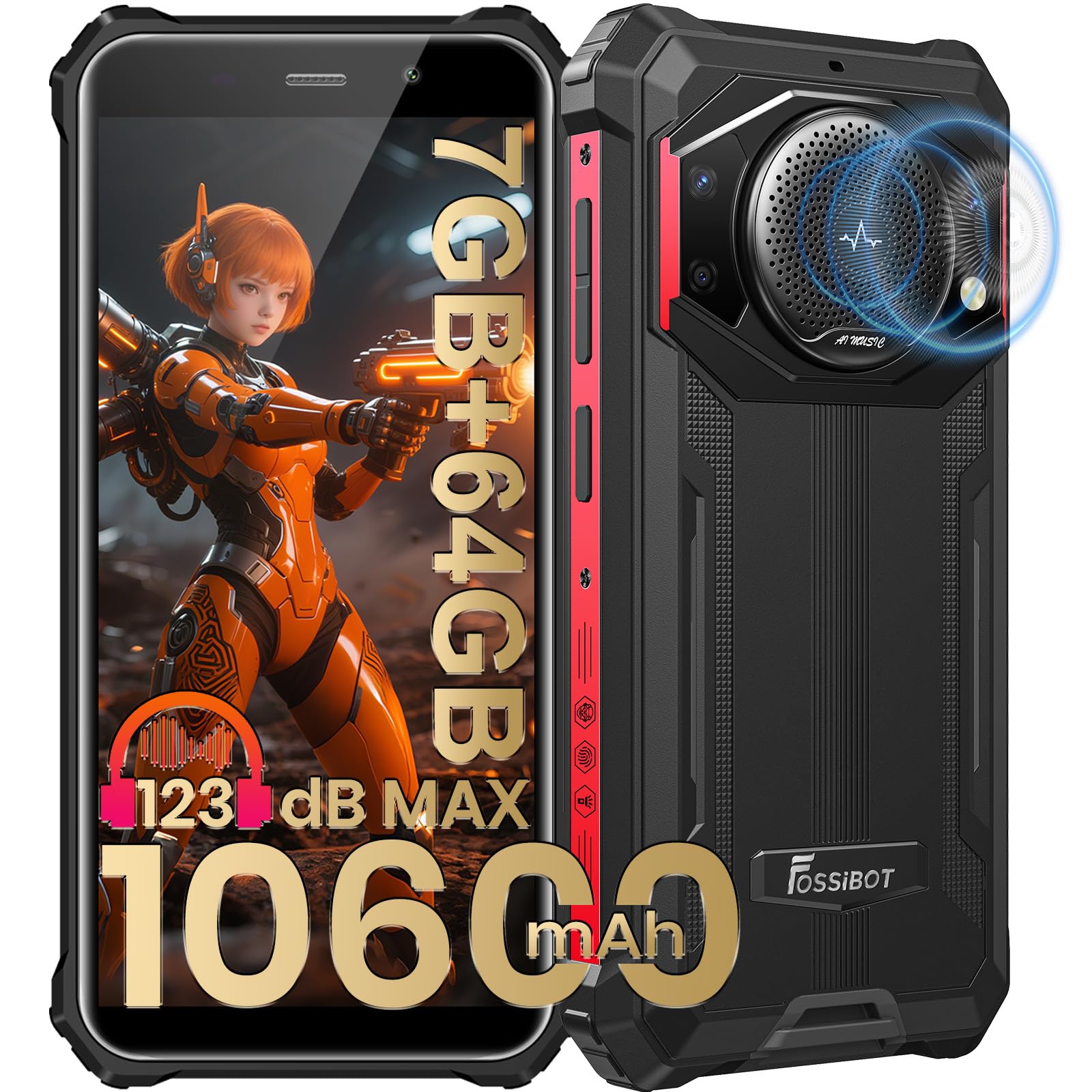
The tank of the group — a 10600 mAh battery, IP68 sealing, and a 123 dB speaker that sounds across a job site.
The number that matters here is 10600 mAh. That is more than twice the battery capacity of every other phone on this list, and it translates directly to less time tethered to a wall. FOSSIBOT rates it at 1050 hours standby, 94 hours of calls, and 11.5 hours of online video. — figures that let one charge stretch across days of moderate use. It also supports OTG reverse charging, which means the phone can act as a power bank for other devices in a pinch. 18W fast charging refills the tank when you do need to top it up.
This phone is built to survive conditions that would ruin a normal handset. It carries IP68 certification (an industry rating for water and dust resistance), meaning it is waterproof up to 1.5 meters for up to 30 minutes, 100% dustproof, and drop-resistant up to 1.5 meters. It also runs an eight-core CPU with 7GB of RAM (4GB built-in plus 3GB virtual) and 64GB of storage that can expand to 512GB by microSD. The 5.45-inch screen is small — deliberately so — and it is surprisingly compact for a rugged device.
What sells this phone to its audience is the combination of battery, sealing, and the 123 dB speaker — a 36mm waterproof sound chamber and speakers that stay audible outdoors or in a worksite. That is genuinely uncommon and confirms the durability angle. The honest catch is weight: this is a heavy phone, and buyers regularly describe it as bulky. Camera quality is mixed — one owner notes it is sharp, another calls it subpar — and the fingerprint reader is reported to miss more often than the premium alternatives. The trade-off here is that durability and battery carry the price of bulk and heft.
What makes it worth owning
- 10600 mAh battery runs multiple days on one charge
- IP68 waterproof and dustproof to 1.5 meters for 30 minutes
- Drop-resistant up to 1.5 meters — survives truck-like punishment
- 123 dB speaker is loud enough for a noisy job site or trailhead
- OTG reverse charging doubles as a power bank for other devices
Trade-offs to weigh
- Heavy and bulky — this phone’s mass is not disguised
- 5.45-inch screen is small for media and web browsing
- Fingerprint reader occasionally misses, requiring a second try
Built for: outdoor workers, hikers, and anyone who needs a phone that outlasts a work shift and endures drops, water, and dust.
Not the one if: you want a slim, pocketable phone for casual use — the weight and bulk are the price of the toughness.
8. Punkt. MP02 4G Dumb Phone — open up Minimalist Mobile Phone

A keypad phone with no camera, no apps, and no notifications — the pure simplification option.
This is the phone for someone who wants a device that makes calls and sends texts and does very little else. The Punkt. MP02 strips away the whole app ecosystem and offers calls and SMS-first texting without the always-on pull of a smartphone. There is no camera at all — so it is inherently camera-free by design rather than by camera removal. The physical keypad makes one-handed use easy, and the body is built from reinforced glass fiber for daily durability while staying lightweight enough to carry anywhere.
What the MP02 does offer is a mobile hotspot, so it can serve Wi-Fi to nearby devices. That is useful if you want a phone for calls and a laptop for everything else. On the network side, AT&T is supported with verified coverage and VoLTE (a voice-over-data standard that keeps calls clear on 4G networks). T-Mobile is supported but not with VoLTE, which means call quality may drop on that carrier. The MP02 also does not work on Verizon. The 1280 mAh battery is small in capacity but designed for the limited demands of a keypad phone.
The main trade-offs are baked into the concept. SMS-first messaging means MMS group chats do not work, and there is no way to see pictures or GIFs. That limitation is real and affects group messaging from the start. Signal app support is also reported to be unreliable. Nokia’s reception in weak-signal areas is another mixed point — indoor reception can be poor even where other phones function. Physical dimensions are smaller than expected, but that actually suits one-handed use. Buyers who accept these limits describe it as the phone they reach for when trying to step away from constant connectivity.
The honest angle: If you want a camera-free device for focus and privacy, the MP02 delivers that with zero ambiguity — but it also imposes real messaging and reception limitations that will frustrate anyone expecting a modern phone experience.
Right for you if: the entire point of owning the phone is fewer features, and you want the most camera-free device in this roundup.
Wrong choice if: you need group texting, picture messages, or reliable reception in weak-signal areas — those are real limitations here.
9. Nothing Phone (3) 5G

The premium end of the list — top-shelf chip, big AMOLED screen, and the fastest performance of the group.
If you want the best performance this roundup offers in a phone whose camera is not part of the deal, this is it. The Snapdragon 8s Gen 4 chip runs on 4nm technology with a 3.2GHz full-core CPU and an AI engine. Paired with 24GB of LPDDR5X memory (a faster-generation RAM standard) and UFS 4.0 flash storage, it makes everyday tasks feel easy and heavy apps run without lag. Storage lands at 256GB, and the 6.67-inch 1.5K AMOLED flex screen with 1.07 billion colors and a 120Hz adaptive refresh handles streaming and reading without strain.
What makes the Nothing unique is the software interface. The Glyph Matrix (the LED lights around the back) animates notifications and gives alerts a visual signature, and the Essential Key on the side is a physical button for screen-capture, voice recording, and quick access to Essential Space — an AI tool for organizing notes and captures. On the network side, it carries full support for VoLTE (voice calls over 4G), VoNR (voice calls over 5G), 3G, 4G, and 5G, with confirmed bands for both AT&T and T-Mobile. Verizon support is limited to a manual IMEI whitelist step and is not recommended. The 5150 mAh battery supports wireless charging and fast charging.
The honest shape of the deal here is that this phone is the most capable in the group but not always the easiest. Earpiece audio is reported as slightly thinner than some competitors, and the camera system needs fiddling to get the best shots. A few buyers have reported receiving a locked unit despite the listing saying open up, so confirm before committing. Where Nothing’s fans land is the fast performance, clean OS, and the satisfying AMOLED display. If brand-new is your priority, this is the only fresh-in-box option on the list that still hits the top tier.
What the flagship tier buys you
- Snapdragon 8s Gen 4 on 4nm with 3.2GHz full-core CPU — the fastest chip here
- 6.67-inch 1.5K AMOLED with 120Hz adaptive refresh and 460 PPI
- 24GB LPDDR5X RAM and UFS 4.0 storage for lag-free multitasking
- Glyph Matrix and Essential Key turn the interface into a tactile experience
- Wireless charging plus fast charging on a 5150 mAh battery
Where the complexity shows
- Verizon support is limited to a manual IMEI whitelist process
- Earpiece is reported to sound tinnier than some flagship competitors
- A few buyers have received a locked unit instead of an open up one
Premium pick for: a buyer who wants the strongest chip, the biggest and brightest display, and the most modern software on a cameraless device.
Second-guess this if: you prefer a simple setup or need Verizon without a manual whitelist step.
Know the Specs
Battery capacity in mAh
Milliamp-hours (mAh) measure how much energy the battery can store, and that number tells you roughly how long a phone runs between charges. A phone with 5000 mAh will typically last a full workday under normal use, while a device with 10600 mAh like the FOSSIBOT F101P can stretch into several days. A keypad phone like the Punkt. MP02 draws far less power, so its smaller 1280 mAh battery still gets through a workday. Real-world runtime is affected by screen brightness, signal strength, and app load, so treat these figures as a baseline rather than a promise.
Carrier compatibility (GSM vs CDMA)
GSM and CDMA are the two older network standards in the US, and most modern phones use VoLTE over 4G or 5G. Almost every phone on this list is GSM-only, which means it works on T-Mobile, Metro, Mint, Tello, and similar networks, but not on Verizon, AT&T, Boost, or Cricket. The exceptions are the Moto G Play 2024, which supports both GSM and CDMA networks, and the Nothing Phone (3), which supports AT&T and T-Mobile directly and Verizon only with a manual whitelist step. Confirm your carrier’s network before buying — a phone that will not make calls cannot be worked around.
IP rating and rugged build
An IP rating shows how well a device resists water and dust. IP68, which the FOSSIBOT F101P carries, means the phone survives being submerged in water to a specified depth for a set time — 1.5 meters for 30 minutes in this case — and is fully sealed against dust. A lower IP rating offers less protection. For outdoor work, a job site, or regular use in wet environments, this rating is the single most important spec a phone can carry — more important than chip speed or screen resolution.
Camera-removed vs camera-present
Most Android phones on the market now ship with a rear camera module, and removing it requires a different production build. The phones in this article are camera-free at the hardware level, which is materially different from disabling a camera app. A software-disabled camera can be re-enabled; a physically absent camera cannot. For workplace compliance, restricted-facility use, or personal privacy goals, that physical distinction is the entire point of the purchase.
Common Questions
Will a camera-free phone still work for video calls and video messaging?
How long does a 5000 mAh battery really last in these phones?
Can I use these camera-free phone on Verizon or AT&T?
Is a camera-free phone allowed in secure or restricted facilities?
Does the FOSSIBOT F101P actually survive being submerged in water?
Will the Nothing Phone (3) work on Verizon?
What happens to group texts on the Punkt. MP02?
Do these phones support mobile hotspot for tethering a laptop?
Should I buy renewed or new for a camera-free work phone?
Is a camera-free phone good enough as a primary device?
The Bottom Line
For most people, the android device without camera winner is the Motorola Moto G15 4G LTE because it pairs a 5200 mAh battery and 256GB of storage with a 6.72-inch 1080 x 2400 screen — a full-size everyday phone that happens to run on T-Mobile-based networks only. If you want the biggest screen and the most expandable storage without going premium, the UMIDIGI G9T accepts a 1TB card and gives you a 6.75-inch panel at 90Hz (90 refreshes per second, so motion looks smoother). And for outdoor work where a work shift ends and the phone does not, the FOSSIBOT F101P is the one to reach for — the 10600 mAh cell and IP68 sealing (dust-tight and protected against water immersion) carry the day.
If your priority is simply the most capable cameraless phone you can buy, the Nothing Phone (3) leads the group with its Snapdragon 8s Gen 4 chip and 6.67-inch 1.5K AMOLED display. And if you want a phone that does less on purpose, the Punkt. MP02 is the pure simplification route. Whichever you pick, check the network first — a camera-free phone that cannot connect to your carrier serves no one.
How we choose
We do not accept paid placement. Every pick is matched to a real buyer and a real use-case; we do not hands-on test units.
Sources
Specifications: manufacturer listings and product documentation. Review insights: verified customer reviews, as of October 2026. Pricing: not shown on this page (it changes often); check the current price via the retailer link.
As an Amazon Associate, Aappliancez earns from qualifying purchases. This does not affect which products we feature.